
DOWNLOAD THE APP


Customer Services
Copyright © 2025 Desertcart Holdings Limited
DOWNLOAD THE APP

🌡️ Master your temperature game with precision and power!
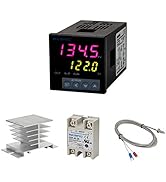
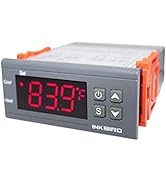
The INKBIRD PID Temperature Controller Kit is a professional-grade device designed for precise temperature regulation across 100-240VAC power supplies. Featuring dual LED displays for real-time and setpoint temperatures, it supports K-type thermocouples and 3-wire sensors, includes a 40A solid state relay for reliable switching, and offers an alarm output for safety alerts. Compact and easy to install, this kit is trusted by professionals seeking dependable, accurate thermal control.

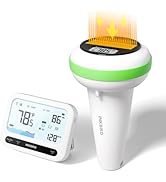


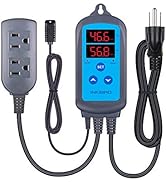

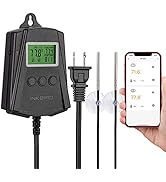










| ASIN | B08Y8GX1WT |
| Batteries required | No |
| Customer Reviews | 4.4 4.4 out of 5 stars (533) |
| Date First Available | 13 April 2023 |
| Display type | LCD or LED |
| Item weight | 0.4 Kilograms |
| Manufacturer | Inkbird |
| Manufacturer reference | PID40W |
| Product Dimensions | 8.89 x 4.78 x 4.78 cm; 399 g |
J**N
I have purchased several different brands of these controllers. Inkbirds are the most reliable and easiest to program.
A**R
debo probarlo para ver si al menos funcionalmente es bueno
J**H
I should have bought this before I wasted the money on my other tempature control efforts. The wiring and programming are relatively easy (once you find a step by step youtube tutorial). I've been using it for a 1600W heating element and haven't had any problems with it.
W**H
I used this to control a hot plate made from ¾ inch thick aluminum plate and cartridge heaters. I used the auto-tune feature to get started, then tweaked the Ctl and PID settings until I was able to achieve a variation of only plus or minus 0.5 degrees C from the set point, at a steady state temperature. With all the thermal mass in the plate, it was necessary to switch off power to the heater cartridges at least 20 degrees below the set point on initial heat-up, to avoid too much temperature overshoot. I would then switch the heaters back on as it eased up to the set point. I like that you can store an offset to calibrate the K type sensor. Be sure to use a good thermal paste designed for computer cpu’s when mounting the SSR to the heat sink.
S**N
final update: It's okay. The calibration seems to drift a little with outside temperature. I'm not sure if I need to insulate the back of the probe and the probe cable or what. It's honestly good enough for something low precision like a smoker, if I weren't so ocd. I made some pretty good barbecue. I expect to get decent use out of this even if I still have to micromanage it a little more than I'd like. The pid settings I ended up using are c:1, P:1, I:5, D:0, and it seems to keep a fairly tight cycling range. (within 15F degrees of set temp). For temperature calibration, using 225F as a reference (using an analog built in grill thermometer), a +25F to +35F correction was necessary, depending on outside temperature. Reference temp needs to be the same as desired temp since the temperature scaling over the total measurable range isn't flat. I used a different ssr than the one provided, btw. Not entirely necessary, but I wanted an inline neon indicator bulb (part of the modified original smoker controller now used as a connector cable) to not glow when the ssr output is off, and while the connector cable is unplugged from the smoker. I did also add a resistor in parallel to the bulb, but that didn't help with the original ssr, and I'm not sure if it's necessary with the replacement ssr, since I installed the resistor before getting the replacement ssr. (old): update 1: temperature readings are way off. Instructions on how to calibrate are nonexistent, in the vague af manual sent with the pid (which may not even be the correct manual, as the image on the amazon page was required as reference to wire the pid), and there's nothing here in the amazon page on how to calibrate it, either. I did find an option which /seems/ to be calibration, which I used yesterday to calibrate to read correctly at 98 degrees (using body temp as a reference; probe under tongue until probe temp stabilized at body temp), but accurate read doesn't hold as temp rises. It measures below actual temp. by around 10 degrees at room temp, but that margin grows as temperature rises. So the only option seems to be to calibrate it to read accurately at the specific temperature you want to measure at or near, and then re-calibrate if you ever need to use it at a different temp. Which is highly inconvenient. It will at least hold stable at a specific temp when calibrated using that specific temp as reference. I hope... (original review): Apparently it's normal for solid state relays to leak some small amount of power when off... I'll create a more complete review later, after some testing.
Trustpilot
2 months ago
2 days ago