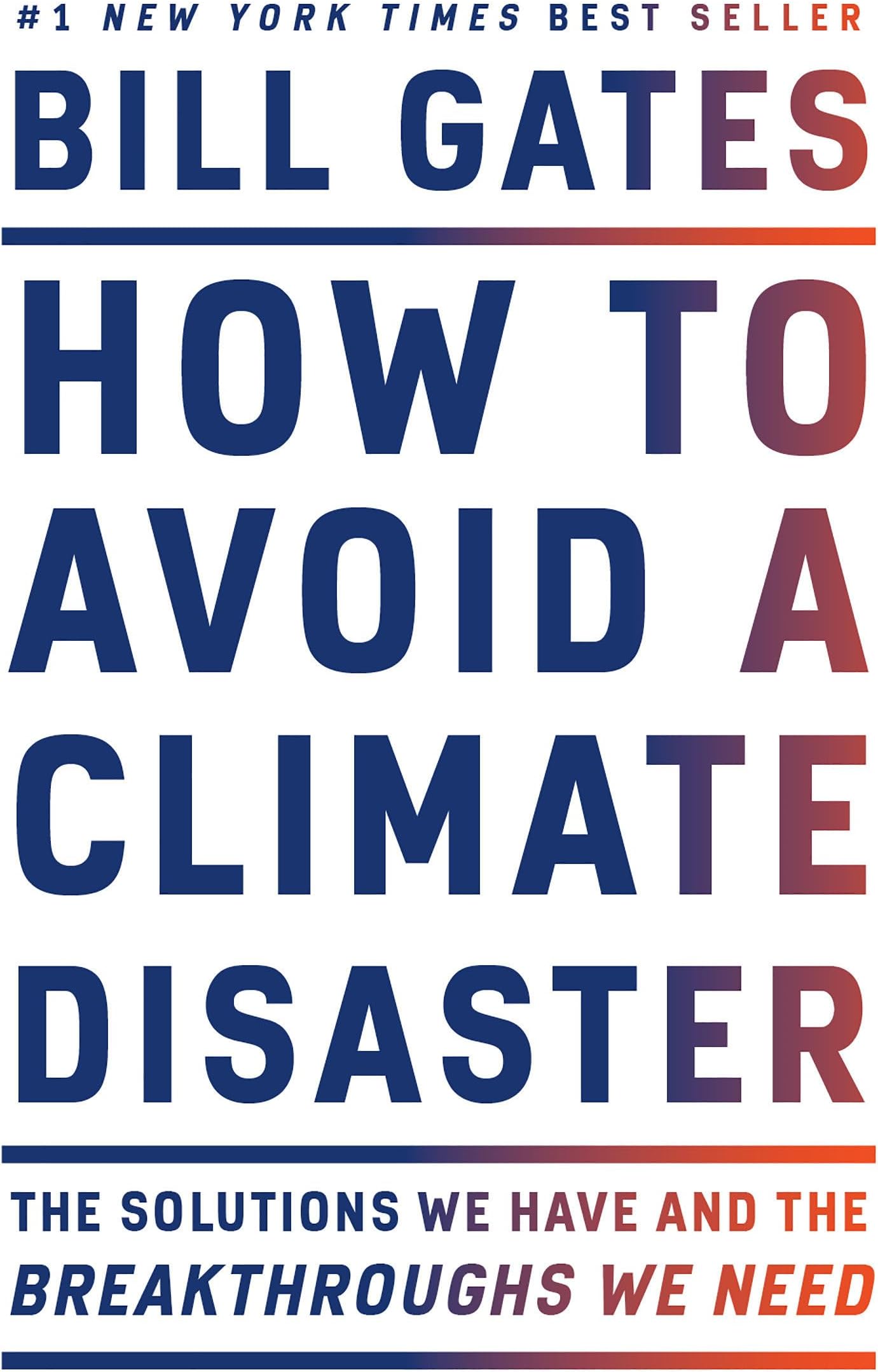
How to Avoid a Climate Disaster: The Solutions We Have and the Breakthroughs We Need
Product ID: 466998155
Desertcart purchases this item on your behalf and handles shipping, customs, and support to Spain.
#1 NEW YORK TIMES BEST SELLER • In this urgent, authoritative book, Bill Gates sets out a wide-ranging, practical—and accessible— plan for how the world can get to zero greenhouse gas emissions in time to avoid a climate catastrophe. Bill Gates has spent a decade investigating the causes and effects of climate change. With the help of experts in the fields of physics, chemistry, biology, engineering, political science, and finance, he has focused on what must be done in order to stop the planet's slide to certain environmental disaster. In this book, he not only explains why we need to work toward net-zero emissions of greenhouse gases, but also details what we need to do to achieve this profoundly important goal. He gives us a clear-eyed description of the challenges we face. Drawing on his understanding of innovation and what it takes to get new ideas into the market, he describes the areas in which technology is already helping to reduce emissions, where and how the current technology can be made to function more effectively, where breakthrough technologies are needed, and who is working on these essential innovations. Finally, he lays out a concrete, practical plan for achieving the goal of zero emissions—suggesting not only policies that governments should adopt, but what we as individuals can do to keep our government, our employers, and ourselves accountable in this crucial enterprise. As Bill Gates makes clear, achieving zero emissions will not be simple or easy to do, but if we follow the plan he sets out here, it is a goal firmly within our reach. Review: Climate problem should be solved from where we are, what we can do and with organizational agency. - Bill has gone to a great length to write a very good book on how to avoid a climate disaster. His book is jam-packed with information, (which I think is the best part), the relevant how-to knowledges, the plans to tackle the problems and the exceptional thus required wiggle-rooms around those plans. All of them have to do with how to avoid/cope with climate change and its impending total disaster. His direction is to create the 100% clean energy use and 0% of the carbon emissions. This is because the energy we now use mostly comes from coal, oil, and natural gas and its use creates greenhouse gases; the chief one, which is carbon dioxide. These greenhouse gases cause global warming. My point here is we should create the clean energy movement and not the revolution because the violence and the destruction will not be worth it as will be talked about the how-to in the end. Bill states that right now fifty-one billion tons of greenhouse gases such as Carbon Dioxide, Methane, Nitrous Oxide are added every year into the atmosphere. And as said before, greenhouse gases contribute to greenhouse effect and result in the warming of the earth incrementally. This could create increasing droughts and floods, and as I know, with no intervention, the earth will end up in total extinction of all living-beings or even worse as what Bill would call worst-case scenario. Bill writes in a personal, easy to read style, devoid of stuffiness in academic protocol. It makes his book more interesting to read. He's serious with his writing. He likes science a lot. His knowledges in all fields related are vast and deep. He's also brilliant for example in that he first orchestrates the things we do which are Making things, Plugging in, Growing things, Getting around, Keeping warm and cool and the climax of being smart is the problem of climate change comes from all these five activities and we need solutions in all of them. P.P. 54, 55 For the means to solve the climate change problem, Bill says we need to concentrate on markets, technology, and policy and in order for it to be effective, we need to tackle all of them at once and in the same direction. He also supports specifically nuclear energy which he says: "Nuclear is the only carbon-free energy source we can use almost anywhere, 24 hours a day, 7 days a week." P. 190 How humans now are approaching the problem, Bill states in his One Last Thought chapter: "Unfortunately, the conversation about climate change has become unnecessarily polarized, not to mention clouded by conflicting information and confusing stories." P. 224 The goal of his writing this book is to spark more fruitful and productive conversations. As a part of that goal, he himself presents the plans which should lead to effective change in meaningfulness and also human adaptation. In various places, Bill seems highly concerned about the underdogs or the poors. As he says: "To sum up: Rich and middle-income people are causing the vast majority of climate change. The poorest people are doing less than anyone else to cause the problem, but they stand to suffer the worst from it. They deserve the world's help, and they need more of it than what they're getting." P. 169 Finally, I have an additional opinion that we should have a directly organized entity that leads the global warming movement. We can use anything such as USA government, or UN, or a big departmental division somewhere or in either of them. It will be good for directly hitting the problem. Bill probably could help leading that organization. He also could be right that we have to start from where we are and what we can do. Conclusion: we should do both, having a direct-hit organization and move forth from where we are. Useful website from the book: breakthroughenergy.org Review: Useful Approach to Climate Change - How to Avoid a Climate Disaster: The Solutions We Have and the Breakthroughs We Need by Bill Gates “How to Avoid a Climate Disaster” is a practical approach to climate change. Bill Gates, yes that Bill Gates provides readers with a useful approach to the technical challenges we face in dealing with climate change. This beneficial 256-page book includes the following twelve chapters: 1. Why Zero?, 2. This will be hard, 3. Five Questions to Ask in Every Climate Conversation, 4. How We Plug In, 5. How We Make Things, 6. How We Grow Things, 7. How We Get Around, 8. How We Keep Cool and Stay Warm, 9. Adapting to a Warmer World, 10. Why Government Policies Matter, and 11. A Plan For Getting to Zero, and 12. What Each of Us Can Do. Positives: 1. Accessible, practical and succinct book. 2. The fascinating topic of climate change from an engineering solution approach. 3. An easy book to follow. Gates does a great job of simplifying terms and focusing on the world of the possible. The tone is hopeful and positive. “This book is about what it will take and why I think we can do it.” 4. A good use of charts and photos to complement the narrative. 5. Provides an early on summary of what it will take to avoid a climate disaster. “To avoid a climate disaster, we have to get to zero. We need to deploy the tools we already have, like solar and wind, faster and smarter. And we need to create and roll out breakthrough technologies that can take us the rest of the way.” 6. The book provides a way forward to avoiding a climate disaster. Gates breaks the book down in a logical manner, which makes it easier to reference at any given time. 7. Provides a brief explanation of why global temperatures are rising. “The reason we need to get to zero is simple. Greenhouse gases trap heat, causing the average surface temperature of the earth to go up. The more gases there are, the more the temperature rises.” 8. Provides a brief history of why energy transitions take a long time and the enormous challenges ahead of us. “To sum up: We need to accomplish something gigantic we have never done before, much faster than we have ever done anything similar. To do it, we need lots of breakthroughs in science and engineering. We need to build a consensus that doesn’t exist and create public policies to push a transition that would not happen otherwise. We need the energy system to stop doing all the things we don’t like and keep doing all the things we do like—in other words, to change completely and also stay the same.” 9. An excellent discussion on how much greenhouse gas is emitted by the things we do. 10. Explains what it will take to keep getting all the things we like from electricity and deliver it to even more people, but without the carbon emissions. “Nuclear fission. Here’s the one-sentence case for nuclear power: It’s the only carbon-free energy source that can reliably deliver power day and night, through every season, almost anywhere on earth, that has been proven to work on a large scale.” 11. Discusses storing electricity and other innovations. “Capturing carbon. We could keep making electricity as we do now, with natural gas and coal, but suck up the carbon dioxide before it hits the atmosphere. That’s called carbon capture and storage, and it involves installing special devices at fossil-fuel plants to absorb emissions.” 12. The biggest culprit of greenhouse gases. “We manufacture an enormous amount of materials, resulting in copious amounts of greenhouse gases, nearly a third of the 51 billion tons per year.” 13. The path to zero emissions in manufacturing. “Electrify every process possible. This is going to take a lot of innovation. Get that electricity from a power grid that’s been decarbonized. This also will take a lot of innovation. Use carbon capture to absorb the remaining emissions. And so will this. Use materials more efficiently.” 14. Borlaug’s impact to the globe. “As Borlaug’s semi-dwarf wheat spread around the world, and as other breeders did similar work on corn and rice, yields tripled in most areas. Starvation plummeted, and today Borlaug is widely credited with saving a billion lives. He won the Nobel Peace Prize in 1970, and we’re still feeling the impact of his work: Virtually all the wheat grown on earth is descended from the plants he bred.” 15. Hard challenges and facts to overcome. “Pound for pound, the best lithium-ion battery available today packs 35 times less energy than gasoline.” 16. The path to zero carbon for heating. “(1) Electrify what we can, getting rid of natural gas water heaters and furnaces, and (2) develop clean fuels to do everything else.” 17. The best way to lower the globe’s temperature without crippling the economy, find out. 18. The impact of government policies. Provides seven high-level goals. “In general, the government’s role is to invest in R&D when the private sector won’t because it can’t see how it will make a profit.” 19. Provides a plan for getting to zero. “When it comes to scaling up new technologies, the federal government plays the largest role of anyone.” 20. Steps on what each one of us can do. 21. Notes and links provided. Negatives: 1. The book is meant to be accessible for the masses so as a result it lacks depth. 2. If you are looking to know what causes climate change, there are far better books out there. This is a big picture look at what technical challenges we face. 3. No bibliography. In summary, I really like this book because the focus is on the big picture technical solutions for climate change. Many books of this ilk focus on trying to compel the reader that climate change is real while Gates that is a given and focuses on the possible and most likely technical solutions. As a recently retired engineer, I prefer this type of focus. The book is brief and gets to the main points but it comes at the price of depth. Overall, this is a very practical and useful book that will provide readers with hope. I recommend it. Further recommendations: “An Inconvenient Sequel” by Al Gore, “This Changes Everything: Capitalism vs. The Climate” by Naomi Klein, “Changing Planet, Changing Health” by Paul R. Epstein, MD, and Dan Feber, “The Crash Course” by Chris Marteson, “Storms of My Grandchildren” by James Hansen, “Warnings” by Mike Smith, “The Weather of the New Future” by Heidi Cullen, “The Hockey Stick and the Climate Wars” by Michael E. Mann, “Clean Break” by Osha Gray Davidson, “Fool Me Twice” by Lawrence Otto, “Lies, Damned Lies, and Science” by Sherry Seethaler, “Reality Check” by Donald R. Prothero, and “Merchants od Doubt” by Naomi Oreskes and Erik M. Conway.


| Best Sellers Rank | #444,960 in Books ( See Top 100 in Books ) #15 in Environmental Economics (Books) #19 in Climatology #99 in Environmental Science (Books) |
| Customer Reviews | 4.5 out of 5 stars 11,313 Reviews |
S**L
Climate problem should be solved from where we are, what we can do and with organizational agency.
Bill has gone to a great length to write a very good book on how to avoid a climate disaster. His book is jam-packed with information, (which I think is the best part), the relevant how-to knowledges, the plans to tackle the problems and the exceptional thus required wiggle-rooms around those plans. All of them have to do with how to avoid/cope with climate change and its impending total disaster. His direction is to create the 100% clean energy use and 0% of the carbon emissions. This is because the energy we now use mostly comes from coal, oil, and natural gas and its use creates greenhouse gases; the chief one, which is carbon dioxide. These greenhouse gases cause global warming. My point here is we should create the clean energy movement and not the revolution because the violence and the destruction will not be worth it as will be talked about the how-to in the end. Bill states that right now fifty-one billion tons of greenhouse gases such as Carbon Dioxide, Methane, Nitrous Oxide are added every year into the atmosphere. And as said before, greenhouse gases contribute to greenhouse effect and result in the warming of the earth incrementally. This could create increasing droughts and floods, and as I know, with no intervention, the earth will end up in total extinction of all living-beings or even worse as what Bill would call worst-case scenario. Bill writes in a personal, easy to read style, devoid of stuffiness in academic protocol. It makes his book more interesting to read. He's serious with his writing. He likes science a lot. His knowledges in all fields related are vast and deep. He's also brilliant for example in that he first orchestrates the things we do which are Making things, Plugging in, Growing things, Getting around, Keeping warm and cool and the climax of being smart is the problem of climate change comes from all these five activities and we need solutions in all of them. P.P. 54, 55 For the means to solve the climate change problem, Bill says we need to concentrate on markets, technology, and policy and in order for it to be effective, we need to tackle all of them at once and in the same direction. He also supports specifically nuclear energy which he says: "Nuclear is the only carbon-free energy source we can use almost anywhere, 24 hours a day, 7 days a week." P. 190 How humans now are approaching the problem, Bill states in his One Last Thought chapter: "Unfortunately, the conversation about climate change has become unnecessarily polarized, not to mention clouded by conflicting information and confusing stories." P. 224 The goal of his writing this book is to spark more fruitful and productive conversations. As a part of that goal, he himself presents the plans which should lead to effective change in meaningfulness and also human adaptation. In various places, Bill seems highly concerned about the underdogs or the poors. As he says: "To sum up: Rich and middle-income people are causing the vast majority of climate change. The poorest people are doing less than anyone else to cause the problem, but they stand to suffer the worst from it. They deserve the world's help, and they need more of it than what they're getting." P. 169 Finally, I have an additional opinion that we should have a directly organized entity that leads the global warming movement. We can use anything such as USA government, or UN, or a big departmental division somewhere or in either of them. It will be good for directly hitting the problem. Bill probably could help leading that organization. He also could be right that we have to start from where we are and what we can do. Conclusion: we should do both, having a direct-hit organization and move forth from where we are. Useful website from the book: breakthroughenergy.org
B**K
Useful Approach to Climate Change
How to Avoid a Climate Disaster: The Solutions We Have and the Breakthroughs We Need by Bill Gates “How to Avoid a Climate Disaster” is a practical approach to climate change. Bill Gates, yes that Bill Gates provides readers with a useful approach to the technical challenges we face in dealing with climate change. This beneficial 256-page book includes the following twelve chapters: 1. Why Zero?, 2. This will be hard, 3. Five Questions to Ask in Every Climate Conversation, 4. How We Plug In, 5. How We Make Things, 6. How We Grow Things, 7. How We Get Around, 8. How We Keep Cool and Stay Warm, 9. Adapting to a Warmer World, 10. Why Government Policies Matter, and 11. A Plan For Getting to Zero, and 12. What Each of Us Can Do. Positives: 1. Accessible, practical and succinct book. 2. The fascinating topic of climate change from an engineering solution approach. 3. An easy book to follow. Gates does a great job of simplifying terms and focusing on the world of the possible. The tone is hopeful and positive. “This book is about what it will take and why I think we can do it.” 4. A good use of charts and photos to complement the narrative. 5. Provides an early on summary of what it will take to avoid a climate disaster. “To avoid a climate disaster, we have to get to zero. We need to deploy the tools we already have, like solar and wind, faster and smarter. And we need to create and roll out breakthrough technologies that can take us the rest of the way.” 6. The book provides a way forward to avoiding a climate disaster. Gates breaks the book down in a logical manner, which makes it easier to reference at any given time. 7. Provides a brief explanation of why global temperatures are rising. “The reason we need to get to zero is simple. Greenhouse gases trap heat, causing the average surface temperature of the earth to go up. The more gases there are, the more the temperature rises.” 8. Provides a brief history of why energy transitions take a long time and the enormous challenges ahead of us. “To sum up: We need to accomplish something gigantic we have never done before, much faster than we have ever done anything similar. To do it, we need lots of breakthroughs in science and engineering. We need to build a consensus that doesn’t exist and create public policies to push a transition that would not happen otherwise. We need the energy system to stop doing all the things we don’t like and keep doing all the things we do like—in other words, to change completely and also stay the same.” 9. An excellent discussion on how much greenhouse gas is emitted by the things we do. 10. Explains what it will take to keep getting all the things we like from electricity and deliver it to even more people, but without the carbon emissions. “Nuclear fission. Here’s the one-sentence case for nuclear power: It’s the only carbon-free energy source that can reliably deliver power day and night, through every season, almost anywhere on earth, that has been proven to work on a large scale.” 11. Discusses storing electricity and other innovations. “Capturing carbon. We could keep making electricity as we do now, with natural gas and coal, but suck up the carbon dioxide before it hits the atmosphere. That’s called carbon capture and storage, and it involves installing special devices at fossil-fuel plants to absorb emissions.” 12. The biggest culprit of greenhouse gases. “We manufacture an enormous amount of materials, resulting in copious amounts of greenhouse gases, nearly a third of the 51 billion tons per year.” 13. The path to zero emissions in manufacturing. “Electrify every process possible. This is going to take a lot of innovation. Get that electricity from a power grid that’s been decarbonized. This also will take a lot of innovation. Use carbon capture to absorb the remaining emissions. And so will this. Use materials more efficiently.” 14. Borlaug’s impact to the globe. “As Borlaug’s semi-dwarf wheat spread around the world, and as other breeders did similar work on corn and rice, yields tripled in most areas. Starvation plummeted, and today Borlaug is widely credited with saving a billion lives. He won the Nobel Peace Prize in 1970, and we’re still feeling the impact of his work: Virtually all the wheat grown on earth is descended from the plants he bred.” 15. Hard challenges and facts to overcome. “Pound for pound, the best lithium-ion battery available today packs 35 times less energy than gasoline.” 16. The path to zero carbon for heating. “(1) Electrify what we can, getting rid of natural gas water heaters and furnaces, and (2) develop clean fuels to do everything else.” 17. The best way to lower the globe’s temperature without crippling the economy, find out. 18. The impact of government policies. Provides seven high-level goals. “In general, the government’s role is to invest in R&D when the private sector won’t because it can’t see how it will make a profit.” 19. Provides a plan for getting to zero. “When it comes to scaling up new technologies, the federal government plays the largest role of anyone.” 20. Steps on what each one of us can do. 21. Notes and links provided. Negatives: 1. The book is meant to be accessible for the masses so as a result it lacks depth. 2. If you are looking to know what causes climate change, there are far better books out there. This is a big picture look at what technical challenges we face. 3. No bibliography. In summary, I really like this book because the focus is on the big picture technical solutions for climate change. Many books of this ilk focus on trying to compel the reader that climate change is real while Gates that is a given and focuses on the possible and most likely technical solutions. As a recently retired engineer, I prefer this type of focus. The book is brief and gets to the main points but it comes at the price of depth. Overall, this is a very practical and useful book that will provide readers with hope. I recommend it. Further recommendations: “An Inconvenient Sequel” by Al Gore, “This Changes Everything: Capitalism vs. The Climate” by Naomi Klein, “Changing Planet, Changing Health” by Paul R. Epstein, MD, and Dan Feber, “The Crash Course” by Chris Marteson, “Storms of My Grandchildren” by James Hansen, “Warnings” by Mike Smith, “The Weather of the New Future” by Heidi Cullen, “The Hockey Stick and the Climate Wars” by Michael E. Mann, “Clean Break” by Osha Gray Davidson, “Fool Me Twice” by Lawrence Otto, “Lies, Damned Lies, and Science” by Sherry Seethaler, “Reality Check” by Donald R. Prothero, and “Merchants od Doubt” by Naomi Oreskes and Erik M. Conway.
N**R
A for Engineering and B- for Economics
Bill Gates is doing a lot to make the world a better place. He doesn't just write checks. Instead, he literally rolls up his sleeves to solve problems as a generalist. Part of his success is to change his thinking when one approach doesn't work and he finds a better approach. Traditional philanthropy becomes too entrenched to do this. This book reflects his exploration into climate change, what he has done so far, and what we can all do to address it. Let me preface the rest of this review by stating up front I read this book and the corresponding Bjorn Lomborg book back to back with an open mind. My general take is that Gates gets the economics only partly right compared to Lomborg. On the engineering/problem solving they actually share a lot of the same views (even both telling the same story about Nobel prize winner Norman Borlaug's innovations to increase crop yields and prove the modern day Malthusians wrong); however, Gates (the engineer) is more concrete (pun intended) on the engineering issues. Why do I believe that Gates has it somewhat wrong on the economics? On the plus side, he doesn't treat climate change as a religious system along the lines of those parodied so easily by people like Shellenberger. Gates acknowledges the importance of alleviating poverty and improving health outcomes (especially in developing countries). Given his other philanthropy he is obviously concerned about these issues quite a bit. He certainly isn't saying "Qu'ils mangent de la brioche" yet he fails to acknowledge that the tradeoffs between economic growth and climate change are as stark as Lomborg. Obviously, we need to assess this tradeoff as we go along (we will have better view of climate, economics, and engineering for the period 2040 to 2050 in 2030 than today) but Lomborg's assessment of the tradeoffs involved in achieving net zero 2050 seem much more compelling to me in arguing against net zero 2050 than Gates arguments in favor after reading both books. For those who haven't read Lomborg, he wants to address climate change but sees net zero as inhumane because of the delays in poverty relief necessary to achieve net zero as well as the potential for adaptation to alleviate some of the impacts. Gates also talks about the importance of adaptation but in a less optimistic manner. In addition, Lomborg talks about the positive effects of climate change that Gates largely omits (e.g., increased crop yields in certain geographies, decreased deaths from cold). These effects don't completely cancel out the negatives but need to be considered. On the engineering side, Gates does a great job explaining the types of decisions involved in addressing climate change sensibly. One could debate whether his view that moving from coal and oil to natural gas on a temporary basis is not a good way to minimize C02 but he explains it well in the context of net zero. Most importantly, he basically calls out as misguided people who only focus on solar, wind, and expensive electric cars made of freshly produced steel and powered by coal fired electricity as the whole solution. Some of the key messages worth heeding in this book are (1) addressing climate change will undoubtedly require cheap, safe nuclear power, (2) using a broader approach that catalogs the sources of CO2 and equivalents and addresses them all to varying degrees rather than a narrower approach only focused on a few sources will have a bigger impact, and (3) and encouraging lots of innovation from the private sector in developed countries can make it achievable and affordable. His chapter on government makes it clear that government can both help solve climate change problems and at the same time cause lots of problems. An example of the former is enabling carbon trading via cap and trade or otherwise and of the latter is locking in specific technologies and thwarting further innovation (as with heat pumps). He seems to be quite aware of the dangers of regulatory capture too. On balance this a good read for someone interested in the topic and he is to be commended for showing optimism for a way forward that will achieve some results.
G**R
The kind of clear, comprehensive, solution-oriented analysis Gates is famous for
In this relatively short and very readable book Gates provides a comprehensive overview of the who, what, why and where of global warming. (Not surprisingly, the issue is very much related to the Gates Foundation’s well-publicized interest in global health and the eradication of poverty.) This is a great primer covering what is causing the problem today and what can be done about it, clearly delineating the technology that currently exists and that which should be pursued through a joint effort of the citizenry, the government, and industry. He also provides a simple methodology, called Green Premiums, for understanding the relative costs of the current technology that can reduce greenhouse gases. This, in turn, provides a brilliant way to establish priorities and focus our effort and our investment. To his credit, Gates has gone out of his way to look beyond the emotional divisions often associated with the topic. It’s a book about building bridges toward a common goal and steers clear of ideology and politics. “I think more like an engineer than a political scientist, and I don’t have a solution to the politics of climate change.” He also stays clear of the technical-speak that often clouds the issue. This book is written for a mass audience and while there are statistics, he studiously avoids the complicated science that often just serves to cloud the issue and to put constructive discussion out of reach of the general public. My only personal disappointment in the book is that he goes just a little too far in avoiding any discussion of the need for behavioral change. “We aren’t going to solve the climate problem by telling people not to eat toast.” He advocates the use of heat pumps and electric cars and encourages consumers to step up to more energy efficient purchases but he stays clear of any suggestion that our cultural norms and priorities contribute to the problem in any way. I understand why. One of the most nonsensical criticisms we hear from those who refuse to acknowledge either the reality of climate change or that humankind is contributing to it is that “These people just want us all to be poor.” But there is a big difference between being poor and being just as happy and fulfilled as the richest billionaires are now but getting by with less – and thus contributing less to climate change (and other socio-economic ills that currently plague us). Think of it as cultural simplification. If you are in the top one-third of income earners do you really need half of the stuff you own to live a happy and fulfilling life? I think not. And in the end I believe cultural simplification will be necessary to solve the climate change crisis. Technology alone won’t be enough if we just keep building bigger homes and buying more exotic toys and experiences. Most of us could live in much smaller homes and lead simpler lives and still be just as happy. And I speak from experience. I have lived all along the continuum that is wealth and income and I can assure you that the size of my house or how many toys I owned but seldom used had no bearing on my sense of personal fulfillment. That, however, was not the objective of this book. Gates undoubtedly knew, however he personally feels about the topic, that all else would be lost once he set foot on that path. And, as a result, we have a wonderful primer on the state of the issue and a road map for where we go from here that I believe everyone should be able to buy in to. It’s simple, understandable, and chock full of common sense.
S**K
Not Just Another Billionaire With A Plan
Bill Gates readily concedes that the world isn’t short of “rich men with big ideas” in How To Avoid A Climate Disaster. He brings an intellectual honesty to the climate change debate that is absent from Democrat policy prescriptions, and often ignored by Republicans. Gates has done his homework, producing a book spilling over with facts and insights. The climate impact of each human activity (use of power, making things, moving around) is presented, along with its contribution to the 51 billion tons of Greenhouse Gases (GHGs) emitted annually. He presents the issues in an easily understood framework that many readers should find engaging and accessible. Although Bill Gates is surely a Democrat, it’s unlikely progressives will welcome his contribution. He dismisses Democrat orthodoxy by showing that the energy transition will be very expensive. He feels we should be motivated by the moral obligation to counter planetary warming because it will harm poorer countries the most. Rich countries can afford to manage rising sea levels (see Netherlands). Since the Gates Foundation is focused on disease and malnutrition in the developing world, his altruistic view isn’t surprising. And the moral argument is a respectable one. But it exposes the enormous political challenge in gaining popular support for higher domestic energy prices to stop, say, Bangladesh flooding. Last week Joe Biden rejected a French proposal to redirect 5% of our Covid vaccines to poorer countries until all Americans have been vaccinated. It was a minor acknowledgment of political reality. Few have the means or inclination to dedicate themselves to solving poor countries’ problems before their own. How To Avert A Climate Disaster reaches positive conclusions because it argues that current technology and innovation make solutions within reach. It provides policy prescriptions but deliberately avoids the politics. In many cases Gates calculates a “green premium”, reflecting the cost of converting transport, power generation, cement or steel production to be emission-free. Not surprisingly he favors a carbon tax to create price signals that fully reflect the externalities of burning fossil fuels. Renewables figure far less prominently than in the Green New Deal (see The Bovine Green Dream), a document Gates would likely view as fantasy if he didn’t studiously avoid such engagement. He illustrates the fundamental problem of solar and wind intermittency by considering the battery back-up a Tokyo 100% reliant on windmills would require to maintain power during a not-uncommon three-day typhoon. Even with optimistic assumptions about improved technology, the cost would be prohibitive. Gates concedes to have, “…lost more money on start-up battery companies than I ever imagined.” He knows a bit about the subject. Although efforts to curb emissions around the world generate enormous energy and press coverage, any actual improvements to date have come mostly from coal-to-gas switching for power generation (i.e. the U.S.) or last year’s drop in global economic activity due to Covid. U.S. energy costs haven’t risen noticeably, although California’s energy policies have managed to combine high costs with unreliability (see California Dreamin’ of Reliable Power). Gates believes poor countries should be allowed to increase emissions, since energy consumption is inextricably linked to improved economic well-being. “We can’t expect poor people to stay poor because too many rich countries emitted too many greenhouse gases” he argues from the lonely moral high ground. Reaching zero emissions by 2050 requires western democracies imposing substantial new regulation and costs on economic activity for decades. Meanwhile, the world’s building stock will grow mostly in poorer countries, requiring cement, steel and all the other emission-producing byproducts of human advancement. This construction will add the equivalent of another New York City every month for decades. Gates asserts that climate change will inevitably cost – inaction will lower GDP, and action will take lots of money. It’s well he doesn’t consider how governments will sell this to voters if an honest discussion ever occurs, because by comparison the technical challenges are more easily solved. Recognizing the political impracticality, Joe Biden instead disingenuously talks about “…tackling climate change and creating good union jobs here” (his emphasis). The technology already exists to capture the carbon dioxide emitted by burning fossil fuels, whether to generate electricity (27% of global GHGs) or produce steel (manufactures also including cement and plastics in total are 31% of GHGs). Gates estimates that emission-free power in the U.S., to include gas and coal with carbon capture, would raise prices by 15%. The green premium to make ethylene (plastic), steel and cement without CO2 emissions would raise prices by around 12%, 23% and 110% respectively. We could already start implementing such policies if the support was there. But political leaders avoid such talk, recognizing that voters’ concern about climate change doesn’t include much tolerance for higher prices. An energy investor today has to assess plausible outcomes, ignoring the shrill rhetoric of climate extremists unburdened by the costs, facts and technological challenges Gates lays out. Emerging economies will continue to grow, feeding all the increase in global energy demand as they seek OECD living standards. Their GHG emissions will rise. How tolerant will western democracies be of rising costs for virtually everything while we save the planet and allow poorer countries to catch up? Bill Gates is an unfailing optimist – invariably the most pleasant posture for living. But your blogger found the comprehensive list of what needs to be done dauntingly improbable. Mitigants of the results of global warming are probably a better investment than betting on decades of extended selflessness by 1.3 billion OECD citizens, the rich world whose collective actions Gates believes will save all 7.6 billion of us. There are already bold options available. We could phase out coal. We could require carbon capture on industrial use of fossil fuels. We could use more nuclear, whose safety record per unit of power generated is unmatched. Instead, more solar and wind is the climate extremists’ mantra in spite of intermittency and the NIMBY challenges of building transmission lines to move power from sparsely populated solar and wind farms to population centers (see Review Of Russell Gold’s Superpower for an example of how hard this is). Burning less coal, carbon capture and compensating for renewables’ unreliability all support growth in natural gas demand. Gates argues against a shift to natural gas for power generation. He fears the 30-year life of a typical combined cycle power plant would embed its CO2 emissions for too long. It would show progress to 2030, while putting zero by 2050 out of reach. But if tangible results within the timeframe of election cycles are needed, it’s hard to see a better way. If in a decade that’s how things have turned out, Gates the pragmatic optimist will hail it as success. We should too.
I**N
A Good Primer, Ignore 1 Star Reviews
Everyone is entitled to their opinion and nobody should feel they should agree with Bill Gates just because he's Bill Gates, but some of the 1 star reviews are obvious agenda-driven commentaries. Bill Gates didn't do his homework?? Bill doesn't understand political gridlock? Come on folks, get real. He is a very smart guy, voracious reader and has been studying this stuff and talking to all sorts of people on the international political stage about climate and its impacts on different groups for YEARS. Not saying his word is gospel but dismissing it all with complaints like the ones above are pretty much absurd. Bottom line you need to understand what this book is (and isn't). It's not intended to be a scientific treatise / proof of all the kinds of things he's promoting, just a summary of what's most important. This book is a primer, typical mile-wide inch-deep (maybe 2-3 inches deep, a garden variety "dry flood" in Miami?) but it's going to be a good read for many voting citizens looking to get "the big picture" without having to nerd out on 500 page books specific to individual topics like solar efficiencies, carbon in agriculture, etc. While those books are important especially to policy makers and their staffs the average reader won't have the time or dedication. One of the things that is GOOD about this book is that Gates leaves all the far-left, far-right talking points NONSENSE out of the fold and instead focuses on educating readers on a variety of issues that are pragmatic concerns, not regularly covered by our sometimes lousy media. (Not lousy because fake but because media bosses care more about profits than detailed reporting - ever notice how each half hour of news is actually about 15 minutes of ads, 8-10 minutes of weather, sports, and "human interest" and 5-7 minutes of actual reporting on important events?) Another great aspect is that Gates provides an overview on the technology and carbon costs of making extremely important staples like concrete and steel, and about how we need to stop dismissing different types of nuclear power by over-stating the dangers (another easy way to tell if a climate author is trying to convince using emotion vs logic). He explains why we need devise a much more green approach to electricity generation overall (and other solutions relating to transport, agriculture, etc), while not denying developing countries some ability to use coal or gas on a limited basis. He echos other thoughtful authors in pointing out that we won't reach our goals with a bunch of wind and solar farms everywhere, and if we tried anyway, the amount of additional land use and species disruption would be HUGE. Many people don't realize just how damaging a wind-solar-thermal-only approach would be to overall ecology. Some is good, especially in developed areas where it can reasonably replace coal or gas plants (usually areas with smaller power demands) with minimal disruption (most of these areas will be coastal for wind, American SW / desert areas for solar). --------------- One flaw with this book is that it's not annotated, which could be part of the reason some people will be paranoid / skeptical about it, BUT I don't see anything here inconsistent with other good climate books I've read, including "Apocalypse Never" which covers a lot of important ground in debunking the far-left fear-mongering stuff, while simultaneously covering important topics like deforestation, selective use of nuclear (including developing safer kinds that will eventually cost less - Gates owns up where he has a financial interest), and farming efficiencies, in detail. In fact several of the two books' most important points are in common; another reason I trust Gates' conclusions here for the most part. Another minor flaw is that he doesn't spend much time on the #1 barrier we will face: human nature (greed, ignorance, clueless politicians on both sides, short-sighted solutions that are OK now but won't help 50 years from now). That said he does mention incentives at several points, alluding to the business mantra that if you want someone to do something, make it financially appealing to them in the long run. In the end it probably will be money that decides our fate, so incentives are not unimportant. Approaching this problem in a philosophically puritanized way (see US talk show circuit and regular cast of characters / influences) will never get us to our goals, only more fighting and minimal progress. One thing he did cover that I would like to hear more people in the media mention is that a crazy drive right now to get everyone into an electric car. This ONLY makes sense in the parts of (one's) country served heavily by one of: nuclear, hydro, wind, solar. If your house or office does not get the majority of its power from one of these sources, there is literally no climate benefit to getting an electric car or to paying that premium.
L**E
Thorough, well-written and well-organized information
I’ve read several books on climate change which were heavy on the environmental impact of inaction and light on the solutions. I found the reverse in this book. Bill mentions how we have to get to zero emissions by 2050 (and I like how he doesn’t sugar coat it as “goal” but instead states it as a non-negotiable must-do), but the focus of this book is on solutions. For me, this book was a page turner because every page was filled with such good information that was clearly explained and organized. This book is very readable and definitely not a difficult/scholarly read (it’s written for us normal people). The impending climate disaster (if we don’t correct it in time) is depressing. Before reading this book, I thought that all of us humans would have to collectively reduce waste, buy electric cars, install solar panels on our houses, etc. to have a fighting chance. While this certainly would help, Bill is a realist who seems to understand this will never happen and so he focuses on the scientific and industrial changes that need to happen. This makes me feel more hopeful, in a sense, because this seems more realistic than getting the world’s population to change their behavior in a time where we can’t even get everyone to wear a mask. I feel like Bill read tons of research and met with many experts and compiled the information he gathered into a comprehensive guide and high-level action plan. I give him an A+ on this assignment. I hope change will happen now that the man who warned us about our unpreparedness for a pandemic is giving us the same warning about climate change. I love Bill’s no-BS analytical style of writing. I like how he compares every solution to the stated goal (reducing green premiums to a viable level in order to have a chance of meeting 2050 zero emissions). This helped clarify and prioritize some things for me. For example, just getting everyone into an electric car is not going to solve our problems, and also how with some additional innovations, plastics could become the hero (carbon sinks) vs. the enemy. He also explained something I never realized before – I knew that steel and concrete were major contributors to CO2 levels, but I thought this was the result of the energy needed to make these products (not the actual byproduct or making them). The only critique of this book is that I wished he had talked more about how climate solutions also need to prevent further deforestation and reduction of biodiversity (I think he dedicated maybe one or two sentences to this topic). I also think he could have touched more upon the forces of the disinformation campaign (championed by the Koch brothers network of oil and gas) that delayed (and continue to delay) action for so long – these forces aren’t going away (and Fox news still has millions of viewers), and so every solution is going to have to account for this (and how? I still don’t know the answer). I think he doesn’t address this because it’s not the focus of this book. The focus is what we need to do and how we can potentially do it (and the rest falls into the vague category of “political innovations” that he mentions are also needed).
C**J
Bill Gates And The Best Minds On Climate Change
Disregard the review that claims Bill Gates hasn't studied climate science. The reviewer is an oil industry pawn spewing agenda driven propaganda under the veil of science. This isn't part of the rational dialogue regarding Climate Change. It's simply unethical blather designed to maintain the status quo. Shame on those who muddy the water in this way on such an important subject. How To Avoid A Climate Disaster offers a way to tackle the mega challenge of Climate Change. Some of it is admittedly theoretical, and it acknowledges that there are lots of questions yet to be answered. However, that's the nature of innovation, which is required in a big way for creating supportive alternatives to curb our carbon emissions. Bill Gates is one of the most brilliant problem solvers of our time and this book is the best roadmap to potentially turn this dire situation around. His ideas come from his own analysis of data and cutting-edge computer models, as well as dialogue and cooperation with the best science minds on the subject. Of course, there is the reality of many people still denying climate change is real and caused by human activity. Political and industry agendas are often counter to sustainability of any kind. Then there is the fact that achieving the scale of global cooperation necessary for success is a very idealistic aspiration. However, the alternative is to give up, or justify the status quo until it's too late. Historically speaking, too late is nearly here. There is always hope and the human spirit though! This book comes from a man who is demonstrating his pure motive, humanitarian heart, and is among the greatest philanthropists the world has ever known. I bristle at the ones who take cheap shots accusing Bill of profit motives. He's working hard to give away one of the largest fortunes ever created, to help others. Enough said on that. Combine Bill's uncanny ability to solve complex problems with the desire to help in a genuine way, and you have what clearly seems to be our best hope to effectively deal with Climate Change. It's a great book, well written, and this information is presented in a way that's easy to take in. I do feel better for the educational value, and as they say, knowledge is power. Stopping the devastating effects of Climate Change is possible and our future is in our own hands. Time will tell what's going to happen. Meanwhile, enjoy your days because that's what this life is all about.
S**N
Fantastisk bok.
Köp och läs denna bok som är skriven av en otroligt kunnig person. Behandlar vad vi måste göra för att klara klimatet inom alla olika delar av vårt samhälle. En måste läsa bok!
K**.
Solide recherchiert, kurzweilig, appellierend! 1-Stern-Bewertungen ignorieren!
Das Buch fasst zusammen, wo der aktuelle wissenschaftliche und technische Stand zum Thema Klima steht. Es ist gegliedert in übersichtliche Kapitel, die jeweils ein zentrales Thema haben. Nicht zu viel, nicht zu wenig, klasse! Der Optimismus ist ansteckend und man wird begeistert, welche Innovationen es bereits gibt und hoffentlich demnächst geben wird. Dass das Buch mit einem konkreten Plan konkludiert ist richtig und wichtig, denn nur so weiß man, was man selber und letzten Endes wir alle zusammen tun können, um eine vielversprechende und nachhaltige Zukunft zu gestalten. Klimaschutz, Wirtschaftswachstum und ein besseres Leben für alle im Sinne des Humanismus agieren dabei symbiotisch und sich gegenseitig fördernd, nicht gegeneinander! Das eine schließt das andere nicht aus, ganz im Gegenteil! 1-Sterne-Bewertungen zu dem Buch wurden zu einem Zeitpunkt verfasst, an dem wohl kaum jemand das Buch überhaupt erhalten (!) geschweige denn gelesen hat. Ich habe vor etlichen Monaten vorbestellt und erhielt das Buch erst am 20.02.2021. Der grammatikalisch wie orthographisch unterirdische, beleidigende Inhalt der 1-Sterne-Bewertungen spricht für sich. Hier sind leider Verschwörungstheoretiker unterwegs, die hoffentlich baldig einen Weg aus dem Gefängnis der gedanklichen Paranoia finden.
B**D
Excellent summary of the climate challenge.
Excellent summary of the climate challenge in plain layman’s language.
G**C
Practical, optimistic, and very constructive...
We need more clarity and good mental models to address climate change. Bill Gates can provide both in his book. Not having an anti-growth approach is always more constructive and realistic, and that is what you get from Gates. The book is very clear for people that are not experts in most of the topics in need to address, like myself. I feel enlightened and motivated to do more, the most I can to do my part. People that don’t know how to help should read, but most of all business leaders and politicians should stop what they are doing and pick this book up.
A**O
Reasonable but not great
The book is easy to read.. probably too easy. Bill gates has covered quite some aspects in the book, however only in a shallow way.
Trustpilot
3 days ago
1 week ago