
DOWNLOAD THE APP


Customer Services
Copyright © 2025 Desertcart Holdings Limited
DOWNLOAD THE APP
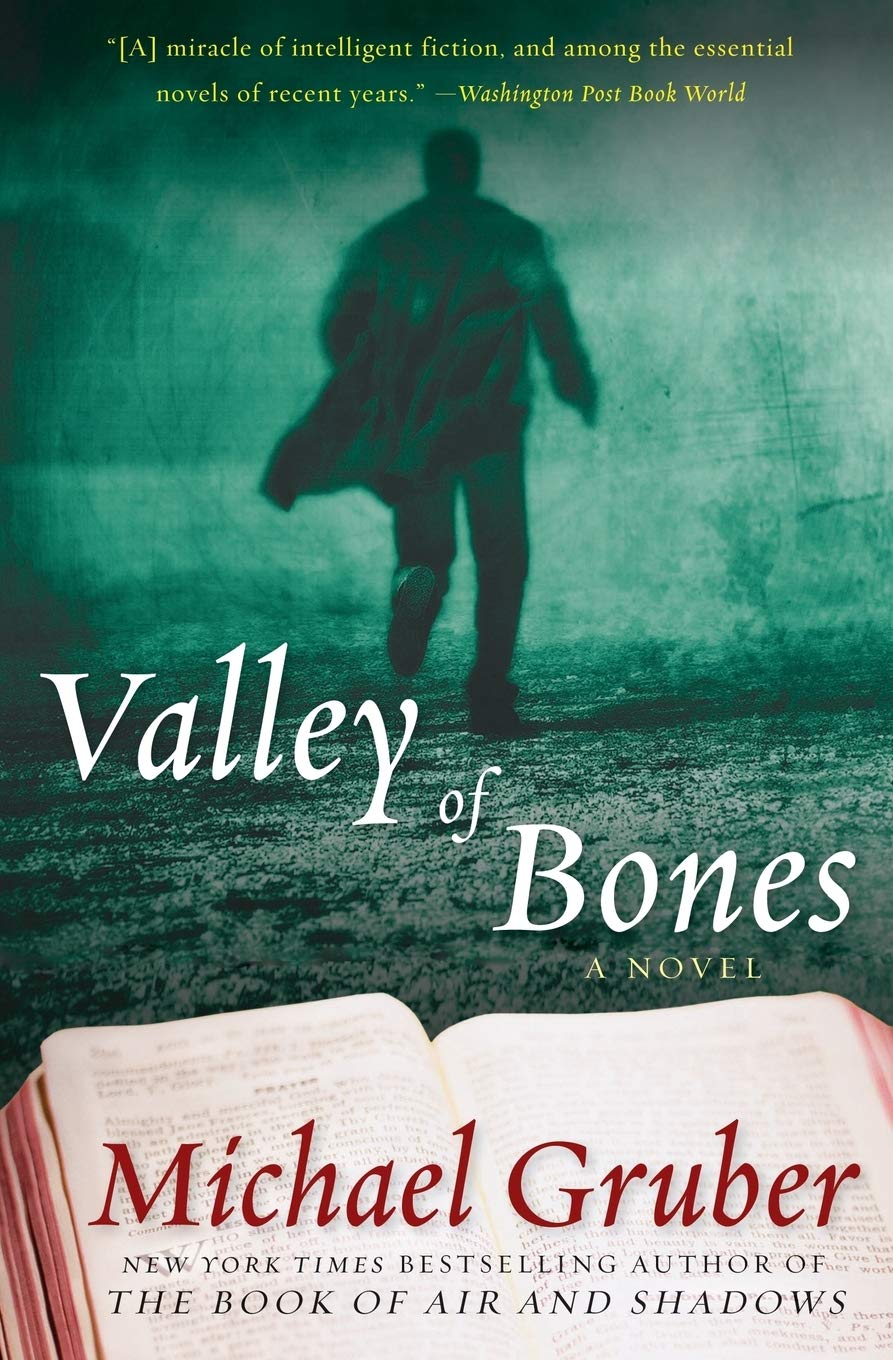
Buy Valley of Bones by Gruber, Michael online on desertcart.ae at best prices. ✓ Fast and free shipping ✓ free returns ✓ cash on delivery available on eligible purchase. Review: Fabulous, intelligent author. A great read. Review: Clever, entertaining, gripping. Jimmy Paz at his best. Only to be topped by Night of the Jaguar, his final case.
| Customer reviews | 4.4 4.4 out of 5 stars (29) |
| Dimensions | 13.49 x 2.57 x 20.32 cm |
| Edition | Reprint |
| ISBN-10 | 0061650749 |
| ISBN-13 | 978-0061650741 |
| Item weight | 363 g |
| Language | English |
| Print length | 448 pages |
| Publication date | 28 April 2009 |
| Publisher | William Morrow Paperbacks |
E**I
Fabulous, intelligent author. A great read.
J**S
Clever, entertaining, gripping. Jimmy Paz at his best. Only to be topped by Night of the Jaguar, his final case.
W**O
but a definitely superior product. [For me, five stars is a rarely attainable maximum, the one that only the "hundred you'd take to the desert island where you're marooned" get, so I'm somewhat restricted in my four-stars awards. If Amazon's rating system allowed it, I'd give "Valley of Bones" ("VoB") 3¾+ stars]. The plot is aptly summarized both in Amazon's ed rev, and in Gail Cooke's and Kay Day's excellent and more detailed ones (with which I agree), so I won't repeat it here. Obviously, Gruber has taken the trouble to read widely on the subject. He's also able to invent a very ingenious and very complicated, many-layered story (you'll savour it more if you read it twice, as on a first perusal it seems less plausible than when you know the ending, and the second time, page-turning urgency gone, you pay more attention to the details), full of twists wound around a theme told at two different levels, let's call them naturalistic and numinous to simplify. His most risky character, the nun, is well portrayed (I actually have a couple of female Catholic friends that, while quite lower on the "fundamentalist sanctity" scale, could conceivably hold the same beliefs and attitudes). The epiphany is very convincing and masterfully depicted: when she shouts "filthy filthy ... !", for example, you feel it could have been taken from a real experience, and is actually quite a respectable attempt to reconstruct and repeat -with a difference- a historical episode (I'm sorry to be so vague, but otherwise I'd be giving away too many details of a scene that merits to be read by "virgin" minds). This numinous level version is also more believable than that of ToN, perhaps because its main episodes are placed before the end, and so the denouement is much more rational and "whodunitic". The other two main characters are also tolerably well depicted, although less so than the nun's (Paz and his mother are, as in ToN, two clichéed Cubans, while Dr. Wise is, at least at the beginning, a bit of a Woody-Allenish caricature, not really suited to the mood of the book). Miami and Florida are described rather well, the city's and its police's corrupted atmosphere coming through more believably, and in a less annoying language, than, say, in Stone's "King of Swords". The African part is superb, sounding both matter-of-fact and exotic. I'm not qualified to judge whether the account of Garigeau's/Dideroff's infancy in Florida and teenhood in Blue Ridge with the white supremacist philosopher and drug dealer Orne (IMO one of the least plausible of the book's characters) is believable. For me, it was the least interesting part of the novel, and the most contrived (I mean, really, could there be people so crime-prone that don't get caught?). The writing is vivid, and there are four distinct narrations in different styles: I would say a virtuoso performance (I assume the first parts of the Order's history are written to parodize some Saints' bios). All in all, I would say that IMO, for somewhat intellectual tastes, this should the best thriller (if it can at all be confined to that genre, although I think it trascends it) around. Why then not four stars? For two main reasons: (1) The book is essentially the same as ToN (although of course with different personages except the here almost monogamous Paz, and Barlow, and their families; different type of numen involved -although there's some Santería as well, but it's secondary-; different African setting; much more "international" and ramified plot; slightly different and more believable story development, as already noted above); in particular, the modes of description of the epiphanies, although with different meanings and actors, are almost identical. (2) The resolution is implausible. CAUTION: PERHAPS LIGHT SPOILER AHEAD! For example, how did the perps know Emily would fall into a trance and so be conveniently around when Paz entered the suite? More basic, how did they know Morales and Paz would be the cops who first arrived? Different ones might have acted differently. LIGHT SPOILER ENDED. Or, is it believable that a Government psychiatrist could spirit away a patient interned by a judge in a Gov hospital, without neither consequences nor investigation into the disappearance? There are other examples of not very credible situations in the novel (a one-legged, or at least with only one foot, person parachuting? Etc.). (3) Also, although this is a minor quibble, the book must have been finished in a rush: there are some verb tense confusions (especially in Lorna's part, which is told in the present tense), and some negatives are missing from Emmylou's (or else some sentences would have no meaning). To conclude: VoB is a four-star book if you aren't acquainted with Gruber's ToN, a three-star one atherwise. Eminently worth reading in any case. I won't however buy the third Paz volume.
S**L
Very entertaining, intelligently written; I got it after I read "Tropic of Night." The type and amount of detail he provides shows either a tremendous amount of research into his subjects or else this author has lived an extremely interesting life; I suspect both are true. I felt like I'd been on a roller coaster that took me places I couldn't believe (WHAT? The author's taking her WHERE?), but it's all done so well that I keep going along until, at the end, I closed the book and said, "Sheesh!" I also learned a few new words....
W**R
Books like this are why it's called "genre writing." _Valley of Bones_ falls (not to say sinks) into the category of "beach reading" (provided it's a really nice beach and you're in an especially distracted mood) or what it's perhaps more accurate to call "potato chip reading": the pages go down like potato chips, but no individual chip requires your attention. There's only one reason to write like this: money. Before anyone gets his knickers in a wad, let's be clear: I'm very happy if writers make money. But I also think it's fair to say, if the most impassioned defense one can bring to bear on a book is that it makes money, that there's at least the possibility the writer doesn't love you nearly as much as his publicist would like you to believe he does. I certainly don't think it's an easy task to sustain invention, even at the dilute level of _Valley of Bones_, for 400+ pages, but books like this make me wonder one thing: Why not try to write better? _Valley of Bones_ contains a fine collection of sentences goony enough for the Bulwer-Lytton contest, not a few of which are simply incomprehensible. And if you can't write better, how come Harper doesn't give you a real editor? Could it be that your publisher, too, is more interested in rolling out a product than in writing as a (dare I say it?) profession? The problem here isn't--or isn't solely--the writer's devices (such as a long, intermittently interesting journal that may or may not contain information that may or may not explain the plot of the novel) or characterization; the problem is that the elements of the story are handled by someone who suggests he isn't all that interested (Gruber's technique for characterization, just to focus on that, is to provide his characters with a series of psychological tics and catch-phrases which they dutifully trot out whenever they appear; he doesn't actually believe in character development). I don't think I'll be spoiling much if I say the title of the book has absolutely nothing to do with the story or that, in the end, Gruber makes only a feint at resolving the book's central mystery. It's not amateurish; these days, sadly, it's entirely professional. What it is, is distracted, lowest-common-demoninator writing (and editing) that demonstrates a major preoccupation with buyers and only a minimal interest in readers.
Trustpilot
2 weeks ago
1 month ago