
DOWNLOAD THE APP


Customer Services
Copyright © 2025 Desertcart Holdings Limited
DOWNLOAD THE APP
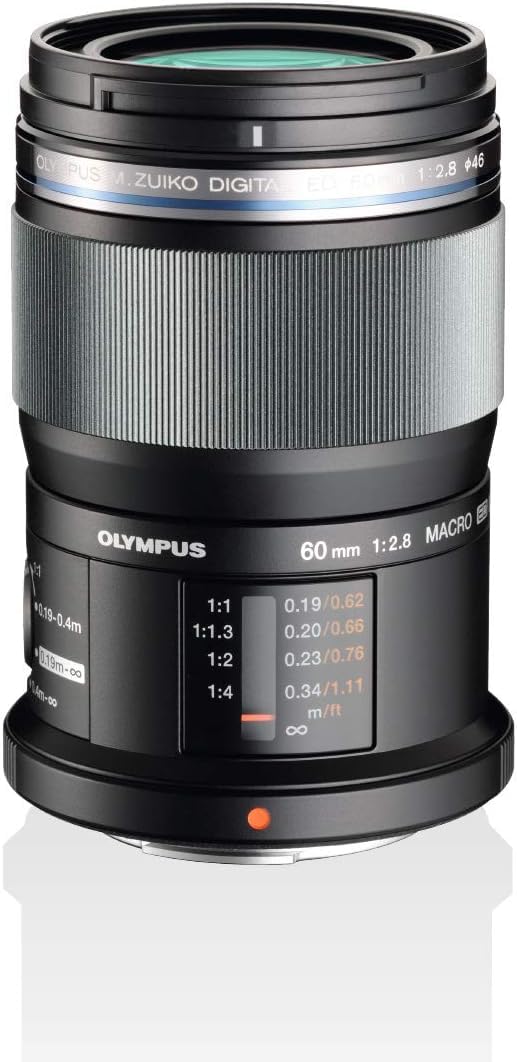
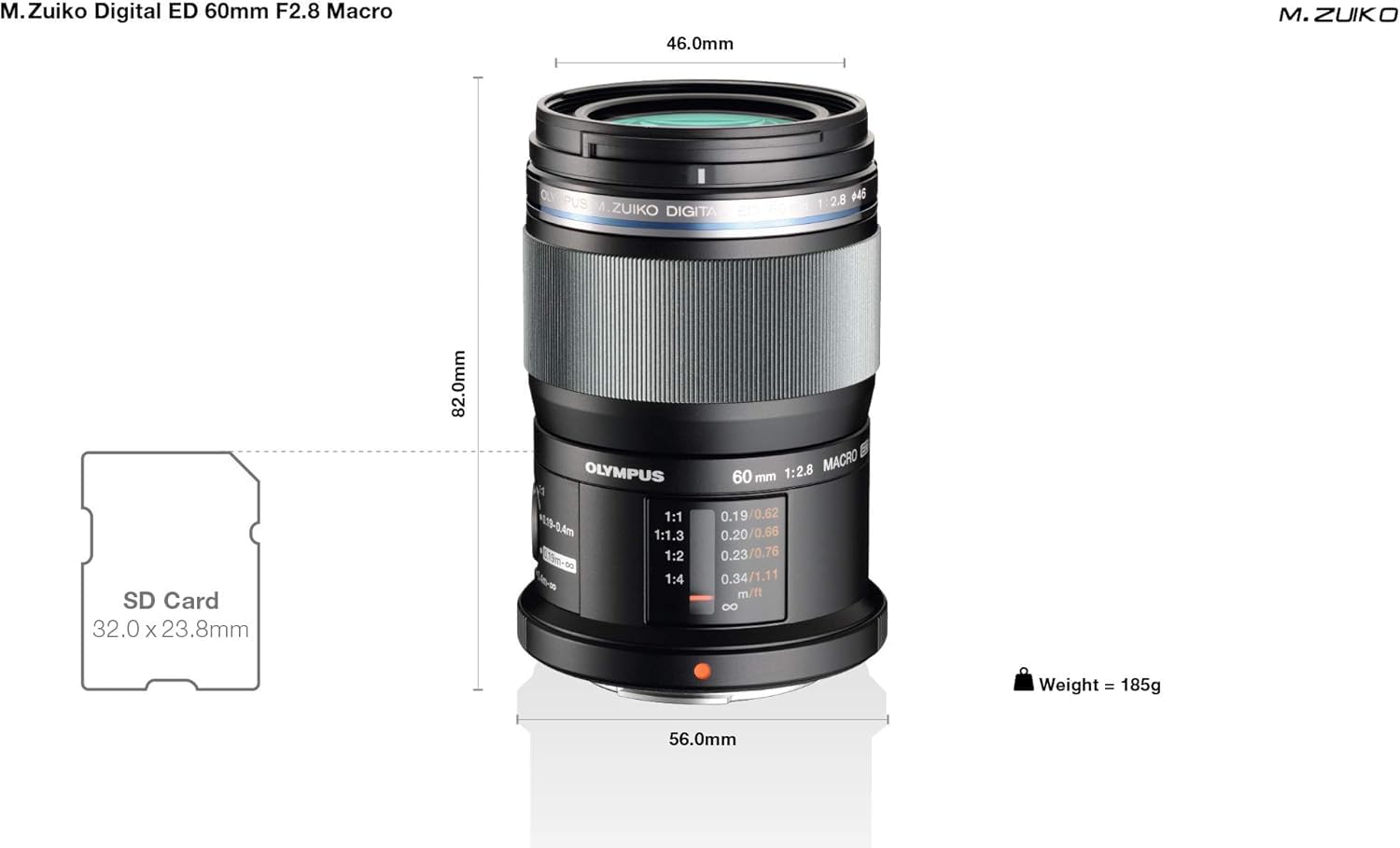
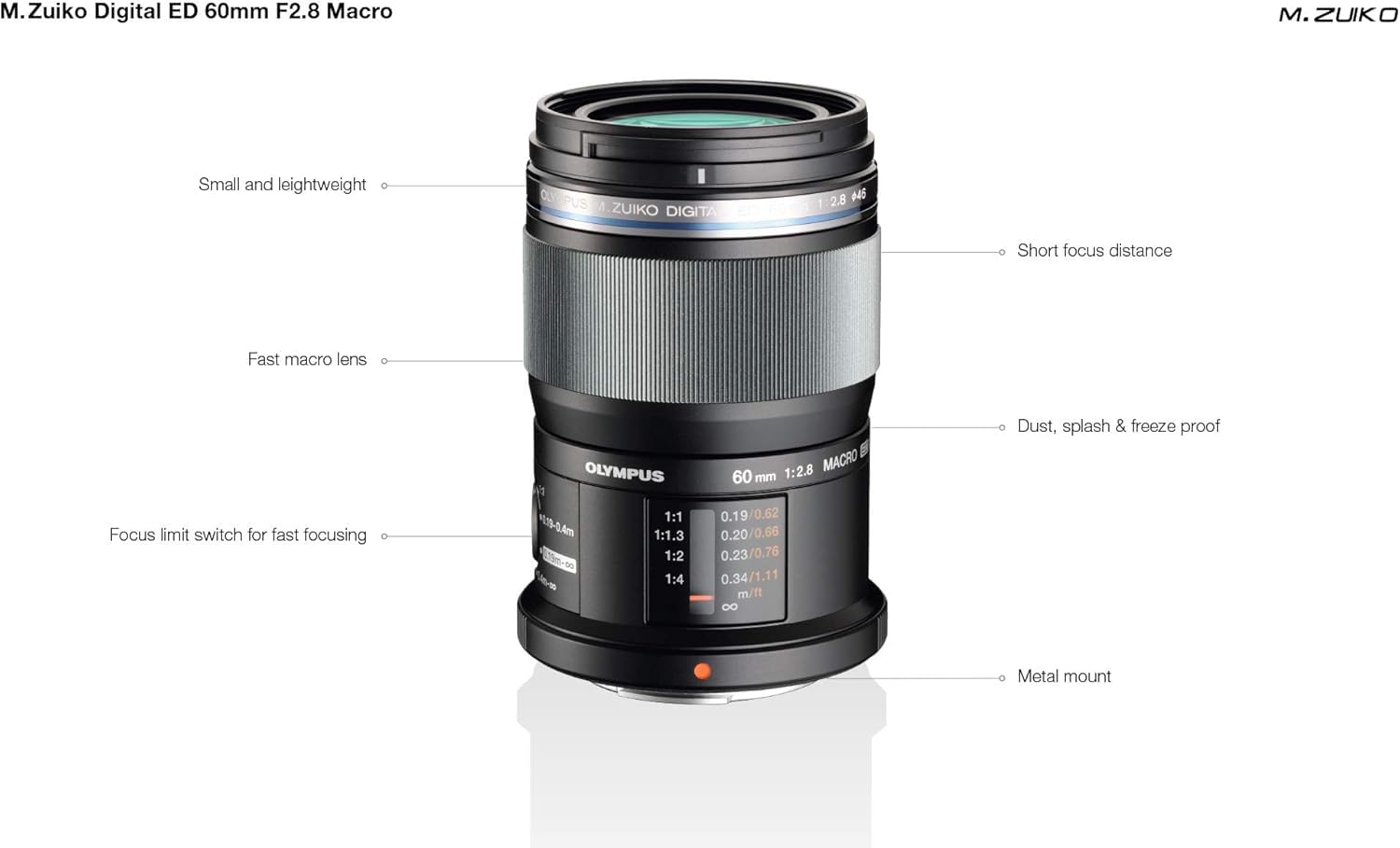
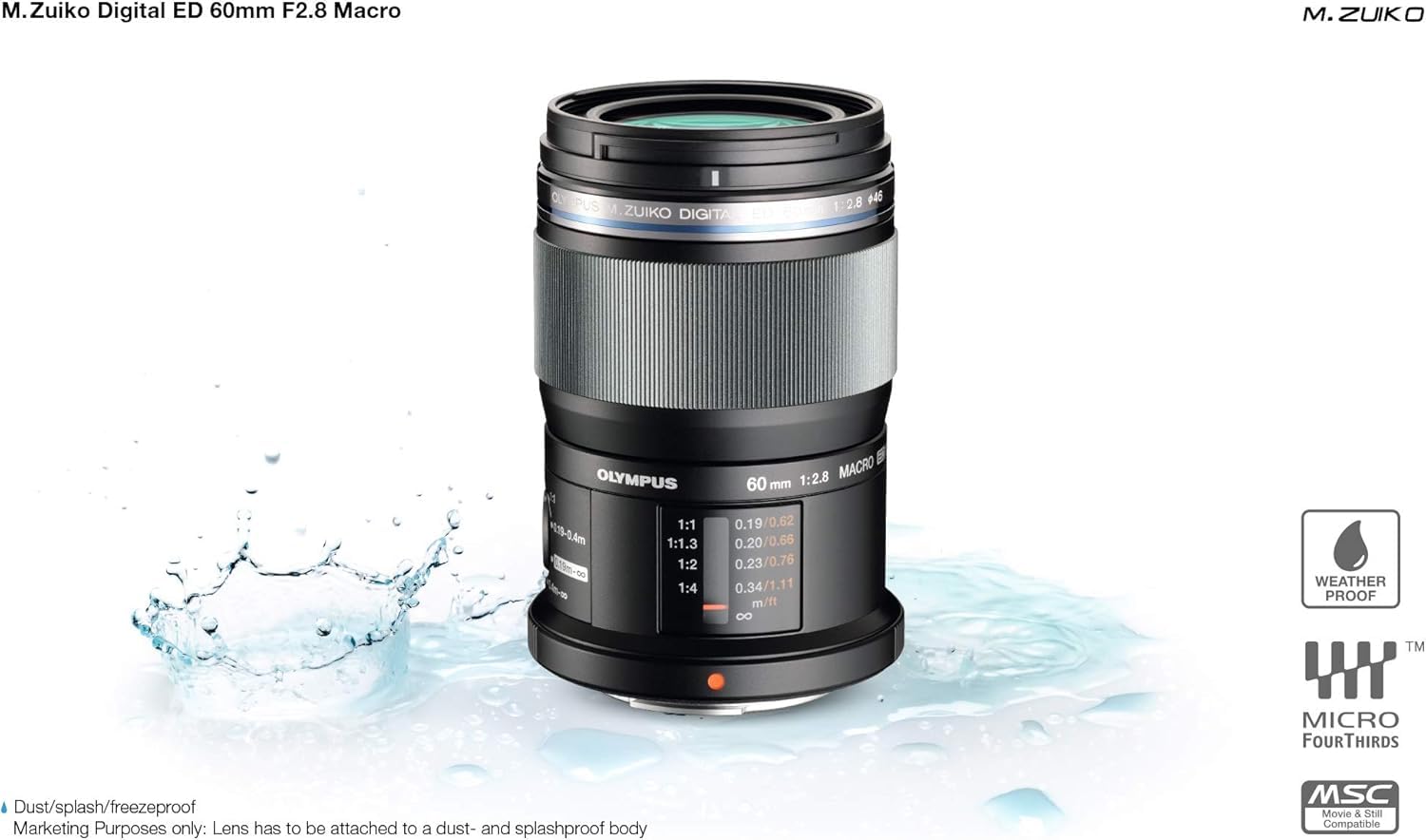
🔎 Elevate your close-up game with Olympus’ macro marvel — don’t just shoot, captivate!
The Olympus M.Zuiko ED 60mm f/2.8 Macro lens offers professional 1:1 life-size macro photography with exceptional edge-to-edge sharpness. Its dust and splash-proof metal construction ensures durability for outdoor use, while the compact 185g design keeps it travel-friendly. Featuring a focus limiter switch and smooth fly-by-wire focusing, it delivers precise control and fast operation. Ideal for macro, portrait, and nature photography, this lens combines versatility with Olympus’ renowned optical quality.
| ASIN | B009C742Y2 |
| Best Sellers Rank | #146,377 in Electronics ( See Top 100 in Electronics ) #1,066 in SLR Camera Lenses |
| Item model number | FBA_EM-M6028 |
| Manufacturer | Olympus |
| Product Dimensions | 8.2 x 5.6 x 5.6 cm; 185 g |
T**L
What can I say but that this is a wonderful lens. Tack sharp across its field even wide open. Great for macro or regular shooting. I find myself carrying this on my OM-1 a great deal of the time for on the go macro shots. The lens is a little slender but I have adopted a grip where I wrap my left hand around the barrel in a full overhand grip and move the focus with my pinky. Works great. I got an aftermarket lens hood for it off Amazon for 16 bucks which works perfectly. I stay away from the horribly expensive Olympus accessories.
Q**W
I just had to buy this. With Amazon discounting it and also offering a £70 voucher, it was too much of a bargain to turn down. I had to wait a few weeks for it to arrive but the immense saving of £160+ made that wait worthwhile. (Even used versions of this lens sell for more.) A 1:1 magnification ratio is the gold standard when it comes to macro lenses, which means that the image on the sensor is the same size as in reality. So, what’s it like to use? Attached to my EM5.2, in a word; brilliant. Weighing in at a mere 6.5oz (185g), the first thing you’ll notice is the three position ‘oh-so-handy’ focus limiter switch and distance scale. To save the lens from hunting it’s entire length, you set a specific range outside of which the lens won’t focus, but you can also jump from a close focus distance to a far one and back again in milliseconds. If you’re using the 0.19-0.4m setting, by moving to switch to the 1:1 position (it will spring back to its previous position) you go to the closest focusing distance then it’s easier to actually move the camera itself until you get the focus you want. Or use manual focus alongside the focus peaking option. Not only that, the large ribbed fly-by-wire focus ring is comfortable to use and precise, but to go from infinity to the closest distance does require a lot of turns, hence the limiter. Unusually, the distance scale is vertical instead of the usual horizontal type. Due to its internal focusing mechanism, unlike many other lenses, this one doesn’t extend, so you needn’t worry about scaring those creepy crawlies. That it doesn’t rotate either means you can carry on using that polariser (or any other filter) if and when needed. Having used this for a week or so, I’ve decided that though f11 and f16 are perfectly satisfactory, it’s at its best from f2.8 to f8 with spectacular centre sharpness. It’s both dust proof and splash proof and it doubles as an excellent portrait lens and medium telephoto one too. Now, some may bemoan the absence of an included lens hood, but Olympus (or should it be OMDS now?) doesn’t include them with their non PRO lenses anyway, so it’s not really a deal breaker. + Exceptionally sharp, even wide open at f2.8. No chromatic aberration (that I have seen). Weather sealing. Focus limiter. Renders nice bokeh. Small and light. Excellent as a slightly longer prime lens. - No lens hood.
V**X
Livré dans les temps, et en parfait état. Tropicalisé, léger, ça va être génial mais c’est un tout autre type de photo qui exigera apprentissage et persévérance. Complété par un filtre de 46mm indispensable à mes yeux afin de préserver l’objectif des branchages vu les plans très serrés. Le part soleil est un choix à l’appréciation de chacun sachant que la difficulté majeure de la macro va consister à suffisamment éclairer son sujet.
P**O
Voilà 2 ans et demi que je l'utilise monté sur un E-M1... que du bonheur... Léger, il délivre de magnifiques macros... et pas que... sous ce libellé «macro» il excelle aussi en portrait, que ce soit humains ou animaux. À grande ouverture, les bokehs sont doux et séduisants même si le système 4/3 limite un peu le rendu par rapport aux systèmes classiques. Si on devait dire un peu du mal, mais je ne lui enlève pas d'étoile, (vu la qualité des images)c'est que, effectivement comme l'a remarqué un autre utilisateur averti, la molette en mode 1:1 n'est pas pratique et on doit la tenir pour déclencher en conservant ce mode. Et ne pas proposer de pare-soleil sur un tel objectif est un peu pingre de la part du fabricant, il faut l'avouer...
D**D
Das Olympus 60mm f/2.8 ist das zweite Makroobjektiv für das micro four thirds (MFT) System (das andere ist das Panasonic H-ES045E Makro-Objektiv Leica DG Lumix G F2,8/ 45 mm (90 mm KB, bildstabilisiert, 46 mm Filtergewinde) schwarz ). Mit seiner längeren Brennweite verspricht das Olympus einen größeren Arbeitsabstand, welcher für Makroaufnahmen wichtig ist, damit ausreichend Licht das Objekt erreicht. Dieser ist dennoch deutlich kürzer als bei Spiegelreflexobjektiven mit entsprechender Brennweite, was echte Makroaufnahmen etwas schwieriger macht: Die Nahfokusgrenze liegt bei 19cm, was einen Arbeitsabstand (vom Objektiv bis zum Objekt) von ca. 9cm bedeutet. Das Olympus 60mm ist ein relativ leichtes, aus Plastik gebautes Objektiv, das jedoch für MFT Maßstäbe vergleichsweise groß ist. Es ist spritzwassergeschützt und hat kameraseitig einen Gummiring, der Eindringen von Spritzwasser in die Kamera verhindern soll. Gemeinsam mit einer spritzwassergeschützten Kamera (z.B. Olympus OM-D) kann man sich damit auch in moderaten Regen trauen. Am Objektiv gibt es einen Drehknopf mit dem man den Fokusbereich einschränken kann, also auf 0.19-0.4m (für Makros), 0.4m-unendlich oder den gesamten Fokusbereich. In einer vierten Position kann man das Objektiv auf 0.19m fokussieren lassen (entsprechend einem Abbildungsmaßstab von 1:1). Dort rastet der Knopf jedoch nicht ein, man muss ihn gedreht halten. Diese Funktion wird man vornehmlich bei manuellem Fokus verwenden, da man hier sonst viel am Fokusring schrauben müsste, um von undendlich auf 1:1 zu kommen. Das Fokussieren funktioniert, wie bei vielen anderen MFT Objektiven, indirekt: Beim Drehen des Fokussierringes steuert die Kamera den eingebauten Fokusmotor an. Das manuelle Fokussieren geht sehr präzise, dafür eben auf Kosten der Geschwindigkeit. Der Autofokus funktioniert für nicht-Makro Entfernungen mit ähnlicher Geschwindigkeit und Präzision wie bei den anderen meiner Fixfokusobjektive. Für Makroaufnahmen sollte man (wie auch bei Spiegelreflexkameras) manuell fokussieren und ein Stativ verwenden. Die Schärfe ist selbst bei offener Blende sehr gut. Für Portrait- oder andere nicht-Makro Aufnahmen zeigt des Objektiv ein gutes, wenn auch nicht umwerfendes, Bokeh. Aufgrund der kleinen Sensorgröße von MFT Kameras wird man dieses aber eher bei Nahaufnahmen zu sehen bekommen. Longitudinale chromatische Aberration (Farbsäume an hellen Objekten, welche nicht um Fokus sind) konnte ich keine merkbare feststellen. Die Streulichtblende ist wie für Olympus üblich, NICHT im Lieferumfang enthalten. Diese wird als Abzocke von Olympus für einen überhöhten Preis als Zubehör angeboten. Da Olympus Kameras eine eingebaute Stabilisierung am Sensor besitzen, hat dieses Objektiv keine weitere Bildstabilisierung. Das Panasonic 45mm Makro hat im Gegensatz eine, die jedoch von Olympus Kameras nicht benötigt oder unterstützt wird. Für echte Makroaufnahmen spielt diese eine eher untergeordnete Rolle, da sie bei so großen Vergrößerungen nur sehr kleine Abweichungen kompensieren kann. Ausserdem hat das Objektiv eine sehr gute Lichtstärke. Für Tele-/Portraitaufnahmen kann eine Bildstabilisierung dennoch in gewissen Situationen hilfreich sein. Es folgt eine Zusammenfassung der Eigenschaften, die für mich ausschlaggebend für die Bewertung waren: + Lichtstark (f/2.8) + Super scharf + Leicht + Präziser manueller Fokus, guter Autofokus +/- Relativ groß +/- Gutes (aber nicht herausragendes) Bokeh - Kurzer Arbeitsabstand - Keine Streulichtblende - Keine Bildstabilisierung für Panasonic Kameras In Summe also ein fantastisches Makroobjektiv für MFT. Eine klare Kaufempfehlung für Olympus Kameras. Panasonic Besitzer müssen sich überlegen, ob sie für den Bildstabilisator die längere Brennweite und den besseren Preis aufgeben wollen.
Trustpilot
1 month ago
5 days ago