

🧲 Magnetize your projects with precision and power!
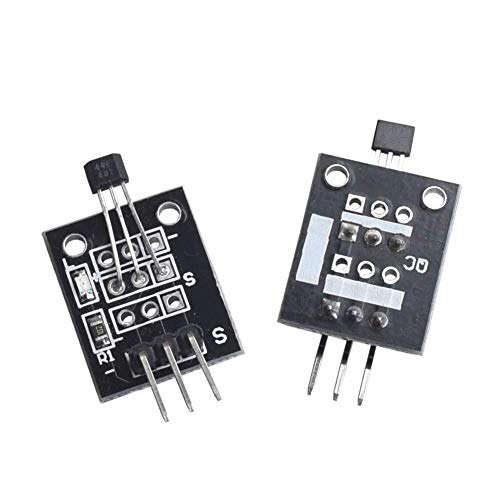
The HiLetgo 5pcs Hall Effect Magnetic Sensor Module features a 5V DC powered integrated Hall effect IC that converts magnetic induction into a reliable digital voltage signal. Designed for seamless use with popular microcontrollers like Arduino and Raspberry Pi, it offers non-contact, temperature-compensated magnetic sensing ideal for RPM measurement and smart car applications. This 5-pack delivers professional-grade performance in a compact, easy-to-mount form factor.
| ASIN | B01NBE2XIR |
| Batteries Included | No |
| Batteries Required | No |
| Brand | HiLetgo |
| Colour | Black |
| Connector Type | Screw |
| Country of Origin | USA |
| Customer Reviews | 4.5 4.5 out of 5 stars (114) |
| Date First Available | 26 August 2019 |
| Item Weight | 45 g |
| Item model number | 3-01-1193 |
| Manufacturer | HiLetgo |
| Material | Copper |
| Model | 3-01-1193 |
| Mounting Type | DIN Rail Mount |
| Number Of Contacts | 5 |
| Number Of Poles | 5 |
| Package Dimensions | 13.21 x 10.41 x 1.52 cm; 45 g |
| Voltage | 5 Volts |
C**S
When I received the sensors they were all mangled because it was badly packaged
A**R
I needed a simple RPM tester so I put together some simple Python code. Connected the Hall effect board to my PI. The board has '-' clearly marked for GND at the connector. I connected that to pin 6 on my PI. '+' is not marked on the board but is the middle pin, so I connected that to pin 2, 5V, on my PI. Then the status line, marked with an 'S' to GPIO18 which is physical pin 12 on the PI. Note the boards status line is open collector, meaning it is either open or GND. It does NOT swing up 5V. In the Python code I did set the GPIO18 pin to be pulled up by the PI, not sure if I needed that since that may be the default. I tested my simple code on all 5 of the boards I received and they all worked as expected. I could easily detect an RPM from 30 to 400 RPM. Sorry that is NOT the limit of the circuit, just my hand tool. This little board is very inexpensive and works perfectly.
L**L
Funcionaron bien
A**.
This worked well for me. Note however that the sensor is sensitive to the polarity of the magnet. Make sure to test it and orient the magnet and which side of the sensor works with it.
R**T
Wired this circuit board with a built in LED, to a 3 to 5 Volt power supply and monitored the output signal with both a digital multimeter and Oscilloscope. Moving a magnet at different speeds across the Hall Effect Transistor, enables me to view a varying square wave shaped pulse width modulated signal. My main focus was to use this as a learning tool, and I was not disappointed. The price is right as well.
Trustpilot
3 weeks ago
2 months ago