🔗 Connect with confidence — control your power like a pro!
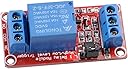
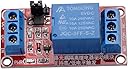
The CHENBO 5V 2 Channel Relay Module WJ-00010 delivers reliable switching with genuine quality relays supporting up to 250V AC/10A and 30V DC/10A loads. Featuring SMD optocoupler isolation for stable performance and a jumper-configurable high/low trigger, it’s designed for seamless integration with Arduino and other microcontrollers. Compact, user-friendly, and equipped with clear LED indicators, this module is perfect for smart home automation, DIY electronics, and professional projects demanding precise power control.
| ASIN | B079FJSYGY |
| Item model number | WJ-00010 |
| Manufacturer | CHENBO |
| Package Dimensions | 12.45 x 6.6 x 2.79 cm; 68 g |
M**.
My use is to power up a USB power supply using a USB port on computer as trigger. I have some lighting that I want to always come on when the computer is powered on or comes out of standby. The PCI-E USB card I'm using powers down in standby so I'm running a cable from that to trigger this relay which will close the AC circuit on a USB power supply. I could've potentially powered them from the USB card on the computer but I'd rather subcontract this power demand to a lesser device. Using my inline USB voltage and current meter, (so-so quality, readings always seem appropriate and correlate with the load put on it but I haven't checked it against a VOM), standby current was too low to read and with relay engaged it showed 80mA. Resolution on this USB meter is only 2 decimal places so something under 10mA for unclamped state. I could've just used a 5V relay for this task but I haven't seen any with 1/4" spade terminals and it's convenient having a board to solder the 120V wires to. For the price I went ahead and got a 5 pack for future projects. I was able to use only USB power by connecting red(+ from USB cable) to DC+ and IN terminals, and black (- from USB cable) to DC- terminal. This initial use is just for "bling" but I can imagine many applications where having switch control conditional to a computer being on or off would be handy.
J**N
Ils font partie d'un système de domotique
M**L
These are actually quite simple to use after a little digging. The datasheet is terrible but the manufacturer has placed these relays on a breakout board that allows you to use a HIGH or LOW signal to activate the relay. I'm using mine for a class project involving a temperature controller that turns on a fan or heating element depending on the temp. They are rated for up to 250V AC and use an infrared optocoupler to separate the digital control circuit (low voltage) from the analog output (higher voltage). Very happy with my purchase as many Amazon electronic components are very inconsistent in quality and reliability coming when they come from foreign manufacturers. Would recommend.
A**G
I'm using this with two Raspberry Pi boards (one a 3B+, the other a 2B) connecting both the 5V to power the solenoid board and using the PI 3.3V GPIO to turn on/off. One of the 4 units was defective out of the box but the others are working. For the money, they are a good choice. Note that there is a severe limit on the current available for GPIO switching from the Pi, so the single-channel model would be the only viable choice. I am able to use this to power a 3D printer on/off by switching the AC power using the OctoPrint PSU control add-in, which simply raises a configurable GPIO pin.
A**K
need to add a jumper wire if you want to have both channels controlled by 1 input, but they work well and a bargain for the price - terminals are hard if you don't know to place wire to one side as the screw is in the middle.
Trustpilot
2 weeks ago
4 days ago