
DOWNLOAD THE APP


Customer Services
Copyright © 2025 Desertcart Holdings Limited
DOWNLOAD THE APP
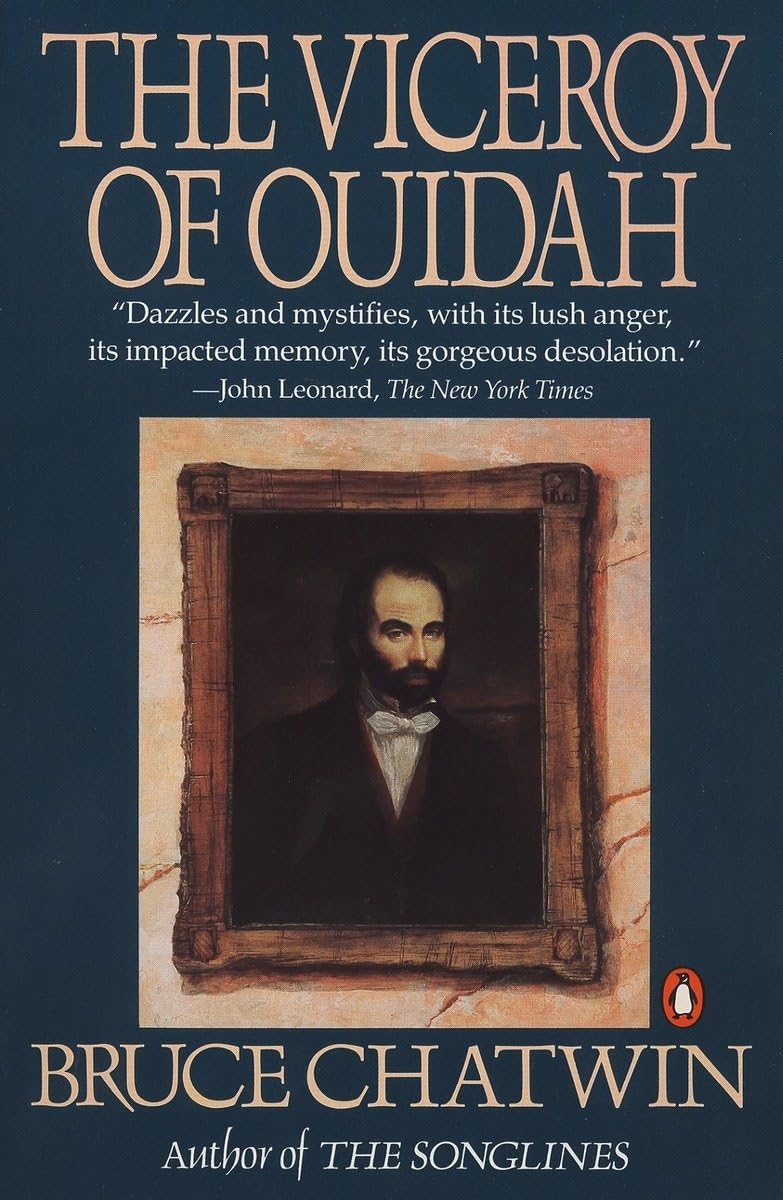
desertcart.com: The Viceroy of Ouidah: 9780140112900: Chatwin, Bruce: Books Review: Five Stars - lovely Chatwin novel Review: Destroyed by the night - I came to Chatwin's The Viceroy of Ouidah by way of Werner Herzog's (very loose) film adaptation of it, "Cobra Verde." Herzog's film doesn't quite work. At the end of the day, it's rather fragmented. Chatwin's novel does work. The storyline is simple, and ultimately, I think, not as important as the mood the novel creates. Francisco Manoel da Silva is an early 19th century Brazilian sharecropper who sails to the west African kingdom of Dahomey, makes a fortune in the slave trade, but is eventually brought low and dies penniless and mad. His descendants, wanting desperately to think of themselves as white and Brazilian, fetishizing their ancestor's memory, and nostalgically harkening back to the day when the da Silva name meant something in Dahomey, congregate annually to commemorate him. At the annual gathering that opens the novel, Eugenia, the only suriving child of Francisco, is dying. She's well over 100 years old. None of this is remarkable. What's so powerful about The Viceroy of Ouidah (not an especially good title, by the way) is the mood it creates. Even better than Joseph Conrad, Chatwin draws a portrait of the dark and unfathomable forces of nature--both human and nonhuman--that we "civilized" folks who confront them can't even begin to imagine. We may think for a while, as Francisco does, that we're their master. But in the long run, to cite an unsettling scene in the novel, the night will slay us. The night will destroy us. Paralleling the wild, insane, destructive forces of nature in the novel is the equally destructive slave trade that Francisco engages in. One reviewer has remarked that we gain no insight into Francisco's psychology, and I think this is an accurate statement. He remains opague to the reader. But this may be intentional on Chatwin's part: in his own way, Francisco is part of the very darkness that destroys him, and that darkness is too inky, too swamp-like, for clarity. An extraordinary allegory. Not as rich as the author's later Utz, but well worth reading.
| Best Sellers Rank | #2,238,993 in Books ( See Top 100 in Books ) #1,709 in Classic Action & Adventure (Books) #11,408 in Mystery Action & Adventure #38,071 in Literary Fiction (Books) |
| Customer Reviews | 3.6 3.6 out of 5 stars (108) |
| Dimensions | 5.06 x 0.4 x 7.75 inches |
| Edition | Reissue |
| ISBN-10 | 0140112901 |
| ISBN-13 | 978-0140112900 |
| Item Weight | 4.8 ounces |
| Language | English |
| Print length | 160 pages |
| Publication date | June 7, 1988 |
| Publisher | Penguin Publishing Group |
M**E
Five Stars
lovely Chatwin novel
K**S
Destroyed by the night
I came to Chatwin's The Viceroy of Ouidah by way of Werner Herzog's (very loose) film adaptation of it, "Cobra Verde." Herzog's film doesn't quite work. At the end of the day, it's rather fragmented. Chatwin's novel does work. The storyline is simple, and ultimately, I think, not as important as the mood the novel creates. Francisco Manoel da Silva is an early 19th century Brazilian sharecropper who sails to the west African kingdom of Dahomey, makes a fortune in the slave trade, but is eventually brought low and dies penniless and mad. His descendants, wanting desperately to think of themselves as white and Brazilian, fetishizing their ancestor's memory, and nostalgically harkening back to the day when the da Silva name meant something in Dahomey, congregate annually to commemorate him. At the annual gathering that opens the novel, Eugenia, the only suriving child of Francisco, is dying. She's well over 100 years old. None of this is remarkable. What's so powerful about The Viceroy of Ouidah (not an especially good title, by the way) is the mood it creates. Even better than Joseph Conrad, Chatwin draws a portrait of the dark and unfathomable forces of nature--both human and nonhuman--that we "civilized" folks who confront them can't even begin to imagine. We may think for a while, as Francisco does, that we're their master. But in the long run, to cite an unsettling scene in the novel, the night will slay us. The night will destroy us. Paralleling the wild, insane, destructive forces of nature in the novel is the equally destructive slave trade that Francisco engages in. One reviewer has remarked that we gain no insight into Francisco's psychology, and I think this is an accurate statement. He remains opague to the reader. But this may be intentional on Chatwin's part: in his own way, Francisco is part of the very darkness that destroys him, and that darkness is too inky, too swamp-like, for clarity. An extraordinary allegory. Not as rich as the author's later Utz, but well worth reading.
A**R
A Complicated Picture
For anyone interested in either West Africa or the origins of the slave trade, this book presents an interesting take on the intricacies that evolved between the Europeans and the West Africans in a somewhat novelized format. While occasionally complicated to follow, it presents a look into a murky time in history.
J**R
One Star
Difficult read. Couldn't finish it.
A**K
Small masterpiece
In just 101 pages, Bruce Chatwin (BC) evokes the life and times of Francisco Manoel da Silva (FMdS), a Brazilian slave trader in the African kingdom of Dahomey from 1812 until his death in 1857. This brilliant novella starts with a powerful description of the annual celebration of his passing away in Benin by his many rather impoverished descendents, who today form branches of a true diaspora. They hope, and some are convinced, that somewhere the tremendous riches accumulated by the founder of the dynasty, is hidden, buried somewhere. BC's novella is a dazzling piece of reading and in today's terms politically incorrect: each character is simply an extension of the era's principal protagonists' world views about the need for human sacrifice, for warfare, and for profit from dealing in human bodies. E.g. the Dahomey king argues that tradition rules there shall be war in every dry season. ‘What to do with captives? Behead them to reassure the elders, the Dead Kings that I have not gone soft in the head, or sell them in one piece to FMdS to live on in Brazil?’ There is a lot of madness in this book. BC's previous job at Sotheby's guarantees total authenticity of the novella's visual impact by effortlessly naming the artefacts en vogue at the time, the imported brands, fabrics, household items, luxuries, tools, pieces of dress, etc. BC naturally did exhaustive archival and field research in Britain, Brazil and Benin, as Dahomey is called today. In fact, during his research in Benin, BC was mistaken for a mercenary after a failed coup and almost executed. In his posthumously published collection of journalistic writing called "What Am I Doing Here", he admits the incident did delay the writing of this quaint novella. In 1988 Werner Herzog turned the novella into a movie called "Cobra Verde", with Klaus Kinski playing FMdS. Director and star made four previous films and this (final) cooperation was not rated their best. Which proves that the book is always better than the film.
S**N
Shining, but ultimately unsatisfactory
I am not a great fan of this novel. For me, this is Chatwin at his most show offy. This book followed hot on the heels of his thumpingly successful debut 'In Patagonia' and Chatwin was clearly garnering a reputation for describing far flung places in an original and inventive way. This he does in the Viceroy of Ouidah, a short biographical novel about the Brazillian Manoel de Silva who rose from poverty and obscurity to become the head of slave trading in Dahomey, now Benin in West Africa. A potentially brilliant framework for Chatwin's prose style to let rip you might think, but I think he goes overboard on the lush descriptions of the geography, climate and people of the regions he illuminates and loses sight of how to really engage the reader in the novel. This novel was not all that well received when it first came out. His next work 'On the Black Hill' reveived the 1982 Whitbread Literary Award for Best First Novel, overlooking the fact that Chatwin had alreay published Viceroy previously and I think this is telling. I found the novel lacking in the gripping substance, intangible though that may be that really makes a great novel. Like one of the many works of art Chatwin catalogued when he was working at Sotheby's, it is a glistening gem, but beneath the surface, there is little that stirs the soul and lodges in the memory as passages of great fiction do. Still worth reading though, as Chatwin at his worst is better than many writers at their best.
P**A
I love how everything is detailed and absorbs you in, but it takes a lot of time and concentration. The book delivered was not as good as one expects from amazon. Guess was kind of an old copy of the book
A**K
In only 101 pages, Bruce Chatwin (BC) evokes the life and times of Francisco Manoel da Silva (FMdS), who was a Brazilian slave trader in the African kingdom of Dahomey from 1812 until his death in 1857. His brilliant novella starts with a powerful description of the annual celebration of his passing away in Benin by his many present-day rather impoverished descendents, who today form branches of a true Diaspora. They hope, some are convinced, that the supposed tremendous richness accumulated by the founder of the dynasty, is hidden, buried somewhere. BC's novella is a dazzling piece of reading and in today's terms politically incorrect, as it should be: each character is simply an extension of the era's principal protagonists' world views about the need for human sacrifice, for warfare, for profit from dealing in human bodies. E.g., the Dahomey king argues: tradition rules there shall be war every dry season. What to do with captives? Behead them to reassure the elders, the Dead Kings that I have not gone soft in the head, or sell them in one piece to FMdS to live on in Brazil? There is a lot of reason and madness in this book. BC's previous job at Sotheby's guarantees total authenticity for the novella's visual impact by effortlessly naming the artefacts en vogue at the time, the imported brands, fabrics, household items, luxuries, tools, pieces of dress, etc. Similarly, BC has done exhaustive archival and field research in Britain, Brazil and Benin, as Dahomey is called today. In fact, during his early research there, he was mistaken for a mercenary after a failed coup and almost executed. In his posthumously published collection of journalistic writing called "What Am I Doing Here", he admits the incident delayed the writing of this truly fabulous novella. In 1988, Werner Herzog turned the novella into a movie called "Cobra Verde", with Klaus Kinski playing FMdS. Director and star made four previous films and this (final) cooperation was not rated their best. Which proves that the book is always better than the film.
D**H
Vivid, dramatic, economic: what's not to like?
T**H
Not a bad little book. Easy to read, Story quite interesting..
S**K
Excellent read
Trustpilot
4 days ago
2 days ago