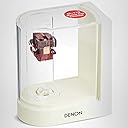
![Denon DL-110 High Output Moving Coil Cartridge [Electronics]](https://m.media-amazon.com/images/I/210seThAixL.jpg)


🎧 Elevate Your Sound Game!
The Denon DL-110 High Output Moving Coil Cartridge is designed for audiophiles seeking high-quality sound with easy installation. Featuring advanced Litz wire technology and a high output design, it ensures exceptional audio fidelity and compatibility with various turntables.
| ASIN | B0007DA226 |
| Best Sellers Rank | #15,828 in Musical Instruments ( See Top 100 in Musical Instruments ) #64 in DJ Turntable Cartridges |
| Brand | Denon |
| Color | Red |
| Compatible Devices | Phono Preamp, Turntable with MM Phono Input |
| Connector Type | RCA |
| Customer Reviews | 4.6 out of 5 stars 231 Reviews |
| Item Dimensions | 3.31 x 3.15 x 1.81 inches |
| Item Height | 1.81 inches |
| Item Weight | 2.88 ounces |
| Item dimensions L x W x H | 3.31 x 3.15 x 1.81 inches |
| Manufacturer | Denon |
| Model Number | DL-110 |
| Number of Items | 1 |
| Number of Ports | 1 |
| Package Quantity | 1 |
| Power Plug Type | No Plug |
| Unit Count | 1 Count |
G**T
Fantastic price to performance Cartridge
I own quite a few cartridges. From mid range to high end moving magnet as well as moving coil cartridges. This cartridge is my only high output moving coil cartridge and it's a zinger. Honestly, I don't think you can find a better cartridge in this price range and it beats out many higher end carts. Was a bit boomy at first but within just a couple hours of break in, it smoothed out and the bass response became much tighter. It's on the lower end of a high output moving coil cartridge (1.6mV), so a decent phono pre-amp is a must. I am currently using an iFi Zen Phono 3 with the 48 dB gain setting and it's a beautiful match. Great detail, clean highs with no sibilance and a deep and tight low end with excellent mid range. The Zen is another Zinger that won't break the bank. You could get this cartridge and the Zen and spend the same as a different cartridge alone and get better performance. Cartridges like this sometimes make me wonder why I've spent $1k on other carts (sometimes...)
N**T
An excellent sounding cartridge for a reasonable price!
Once you buy one of these you will never go back! I have owned a Denon DL-110 since 2008. The stylus finally wore down to the point where I am getting more surface noise. I am so happy to see that they still make this, in 2025, it is one of Denon's Best Products. I love it so much I bought another. The frequency response is well above 50Khz using a computer spectrum analyzer. The stereo separation is excellent at all frequencies. But the best thing about it is its TRACKING CAPABILITY. Unlike many others, this cartridge can accurately track bongos, kick drums, and most importantly, percussion and "s" sounds. It doesn't have that hollowed out "expanded stereo" sound that some the audiophile cartridges do. Its ability to track at between 1.2 and 1.7 grams makes it ideal for transcribing records and first play of sealed records. It handles harsh vocals smoothly and doesn't produce that stylus sound that you typically get on ordinary cartridges. The stylus is also small enough that it plays the bottom of the groove rather than the upper edges. This reduces surface noise, but it improves one major thing. I have found that using a Denon DL-110 to play records that were beat up buy a jukebox or a record-eater ceramic cartridge console stereo, allows you to hear the portion of the groove that didn't wear out due to the heavy fat stylus. I have gotten excellent quality from records that have grooves that turned white from being worn by a 5 gram ceramic record eater. Yes, I had to vacuum the fine dust out of the record. but small rod-shaped diamond shaft allows you to play the bottom of the groove that wasn't destroyed. Denon tracks better than a Shure, blows away most Audio Technica, maintains excellent stereo separation and excellent frequency response and is an overall excellent value. I use a Yamaha A-500 or C-4 preamp, which has a moving coil function and an excellent signal to noise ratio, however, this has enough output to work on a standard phono preamp and you don't need an MC preamp, you may need to turn up the volume a little. My first DL-110 was mounted on a Yamaha P-500 direct drive straight arm table, later moved to an Pioneer PL-L800 linear tracker. This current purchase is for a Yamaha PX-3 linear tracker. These also sound great on a Denon DP-35 table which uses magnetic anti-skate and magnetic tracking force. However I have not been able to get that table to function. If you have kids, pets or are clumsy, the DL-110 is NOT for you as the stylus is not removable. They can be re tipped, but it will cost you almost as much as a new one. To prevent stylus damage, keep your record player at eye level. This helps prevent accidental damage. I have had mine since 2008 and have avoided damage. Proper use of lift arm and or automatic features also reduces the chance of damage. Most people that purchase these are experienced users of records. If this is your first time using a record player, start out with an inexpensive basic magnetic cartridge, and get used to the format before going to a moving coil cartridge.
J**Y
Denon DL 110 Continues to Perform
I own moving coil cartridges 3 and 4 times more expensive, but I seem to come back to this old favorite. One thing I've learned through trial and error is, it's very finicky when it comes to tonearm height adjustment. If your arm is up too high, it becomes very bright. Adjusted low or even level it can be too bassy. The sweet spot is just a touch above level. Meaning, if I level out the tonearm, and add about a millimeter of height, it dials in perfectly. I go with the recommended 1.8g of tracking force, 47db, and adjusted anti-skate. This cart is very energetic and lively. It pairs well with classic, prog, and heavy metal rock. It also works well with acoustic, Americana and folk music. Pop and electronic music also sound great. It definitely has a unique sound signature, that produces solid punchy bass, clean mids, and sparkling clear highs. Unless you are strictly listening to jazz, there's not much this cart can't do. It's probably the best value in HOMC carts still on the market today.
C**E
This cartridge does everything well!
Wow, I'm totally blown away by the sound of this cartridge and it's not even broken-in yet! The trebble is excellent, not over-exagerated like the Ortifon's and Audio Technica's that I was using. The midrange is just right voices sound so life-like and natural. If you like bass, you're in luck with this cartridge. The bass is forcefull, deep and punchy without being boomy. All three segments of the music spectrum, (Trebble, Midrange and Bass), are joined together beautifully! The blend is perfect! I installed the DL-110 HOMC on my (newly purchased from Amazon), Denon DP-3000ne Direct Drive turntable. It works perfectly on the tonearm, and was so easy to align and set up. Now I want to buy a second DL-110 HOMC from Amazon for my VPI Prime 21 turntable. If all this wasn't good enough, Amazon sells this cartridge as a direct Japan import at almost half the price you would have to pay if you bought the USA version from Denon USA. You just can't beat the deal. I'm very picky, and I am so happy with this purchase. Like I said, I'm thinking about buying a second DL-110 HOMC for my VPI Prime 21 turntable. Excellent cartridge. I highly it!
L**O
Great Product, Annoying Installation...
Frequency range is phenomenal. Sound stage is the best I have ever heard. Bass is solid without obscuring the vocals. Properly set up (not too much vertical force—1.8 grams recommended), this cartridge is a revelation. Despite what others have said, this works perfectly with standard (Sch. Mani level) MM settings. Maybe just a tad more amp volume required than CDs. On the negative side, the instructions for this Japanese direct import version are exclusively in Japanese, though the English version is available from their website. (Hint: Don't try to find it on the website; do a search engine search using the terms "Denon DL-110 manual." It's the second one to come up in DuckDuckGo.) The worst problem is mounting the darned thing in the head shell. What a nightmare! Through trial and error, I came up with the following procedure: 1) Insert one screw through one of the holes in the head shell and affix a nut to it. THEN, 2) Slide the cartridge up against the already inserted screw (make sure the stylus guard is in place) and while holding it in place, tighten down the cartridge to within about one millimeter of the head shell. 3) Slide the (annoyingly) slippery metal spacer between the cartridge and the head shell and place the second screw through the other hole in the head shell. This should keep everything reasonably secure while you add a nut to the second screw and tighten down both screws, leaving just enough play to adjust the overhang and angle of the cartridge relative to the platen. Overhang (distance beyond center of spindle to stylus is 15 millimeters (.59 inches=~19/32 inches). You don't need to use the silly plastic "gauge" supplied. A finely marked ruler will work just fine. You also don't need a fancy gauge to set the alignment of the cartridge to the platen. Most rubber mats have either square indentations or circular stripes at the beginning, middle, and end positions of the record. The DL-110 is square, so it's just a matter of aligning the cartridge with the indents or stripes. Rule of thumb is to set the anti-skate adjustment the same as the stylus pressure (1.8). GOOD LUCK!
A**D
Washed out
Wasn’t so great!!!! I played verses the ortofon blue no comparison the blue was much better the highs were washed out
F**E
Yes and No. But, mostly yes.
This is a good cartridge. And I've put about 100 hours on it now and can finally give some feedback on this. I have a vintage setup using a 1965 HH Scott LK-60 transistor amplifier and a 1962 Empire 298 Turntable with 980 Tonearm. Previously, I was using a Stanton 500.V3 for almost a decade and I was pretty satisfied with it's performance, but it always seemed to get some sibilance on newer titles, especially with the inner grooves. New stylus did not correct the problem and there were a few that adjusting the VTA/tonearm height did help with the issue, but either way I was finally at a point in my life where I can start experimenting with more expensive cartridges. I'm not a fan of Audio Technica cartridges. I can't speak for their $100 and up range of cartridges, but 70s and 80s AT carts that were complimented with the turntables of the era always had a very flat and boring sound. They're very neutral, almost muffled sounding. I have heard some of their newer budget range carts and they have the same sound character. I debated Grado carts for a while, but was unwilling to guinea pig it because of their hum potential. The Shure M97XE "audiophile" cart sounded like a potential winner, but I was interested in something a little more exotic. So after much debate I decided to try out a DL-110. Getting this cart was sort of a gamble as it's not exactly matched to my arm. I get about 8hz resonance with test records, but I don't have problems with warbly bass or annoying sweep sounds on slightly warped records. So, if you have an older Empire turntable and are curious if this will work with it, the answer is yes but recognize that it's not the ideal match. The cart was very bright for the first 10-20 hours or so. It was also very good at masking moderate surface noise (think newer or well cared for vinyls), it did nothing for beat up records regarding surface noise. The bass response was a bit lower than what I was expecting but I am unsure if this is because of the tonearm match or because this is a sacrifice of the high-output with moving coils. Nevertheless, during this time I also noticed the cart was very unforgiving with anti-skate and azimuth. I assumed that this was because I was upgrading from spherical stylus to an elliptical. Something I've never done before. So, I got a test record, got it dialed in and was pretty satisfied beyond the brightness. The stereo imaging was a bit exaggerated during this time too and I found myself tweaking the balance dial quite often. It wasn't so bad with loudspeakers, but headphones would make it obvious and difficult to listen to. This all may sound like bad things, but at some point I'd say anywhere around 20-40 hours (I can't give a specific number, sorry) I noticed that I didn't need to defeat the treble as much. Somewhere around this time I also ran the test record again, readjusted the antiskate and checked the tracking torture tests to make sure tracking weight good. Around the same time, a cold solder joint on a diode popped a fuse on my amp and also took out the one channel so I decided now was a good time to test it with my ~1965 (specific year unknown) Trio/Kenwood W45 Tube amp. The DL-110 did not match very well at all with the tube amp. Bass response was so low that even almost maxed out sometimes it would feel that it wasn't enough and really annoyed me. The tube amp wasn't as loud as the scott transistor amp either so I couldn't really crank it up. Fast forward a week later, got my transistors, got my fuse, wired it all back and much better! The sound has mellowed out that I can have the treble tone controls at the 12 oclock position and enjoy it. I did some recordings with the Stanton 500 and the DL-110 and even compared them to the CD version of the songs. The DL-110 is actually much more accurate in recreating the sound, but the Stanton 500 does colour things a bit to be a little brighter and to have a bit more boom on the bass. The DL-110 still is slightly weak in the bass, but I only have to bump it up slightly on the tone controls to get at a level I am comfortable with. Again, I can't say if this is from the DL-110 itself or the tonearm match. But, I do suspect it may be a little bit of both. It doesn't mask the surface noise as well as it did in the beginning, but it still does a better job than the Stanton did. But, it really does excel at eliminating sibilance. I haven't heard shrilly "sssss" sounds from vocals or cymbal crashes since I've owned this cart and my wife heard this versus a low end AT cart and the Stanton and she likes how this has a wider sound to it. She thought the AT sounded flat and compressed sounding. But she also did notice that the bass response isn't as intense. So overall, some of this may sound negative. But I am impressed. I became more impressed with it when I was able to see that the rips I did compared to the CD versions the Denon was very accurate in recreating that stuff. So, it's not going to artificially impress like the Stanton does, but sometimes I do enjoy that type of sound for some rock records so I will keep both but I've been exclusively using the Denon DL-110 ever since. I also noticed that after the break-in period it's not as picky about azimuth or anti-skating being compromises and this was something I was able to verify with a test record. It's also never been very picky about VTA/arm height. I tried experimenting with stacking an extra slipmat or two on the platter to see if the sound quality changed and I couldn't tell a difference. The Stanton was very picky about that with some newer heavy weight records; otherwise with the Stanton the sibilance was terrible. If only the bass response was just a little higher then I couldn't complain so much. I did build a DIY SUT and experimenting with different capacitors and resistor loading values and couldn't get the bass dialed in where I wanted it with that.
A**N
Perfect Sound, Silent Background, Superb Tracking
Absolutely loving the Denon DL-110 on my SL-1300G with the stock headshell. It tracks perfectly with no IGD, great channel separation, and a clean frequency response. Mids and highs are nicely forward without any fatigue, and the bass has a solid punch. What really stands out is how quiet it is. Low surface noise and no background hum, unlike the 540ML which picked up a lot of interference in my apartment. To me, it sounds better than the 540ML and is well worth it.
Trustpilot
3 weeks ago
2 weeks ago