
DOWNLOAD THE APP


Customer Services
Copyright © 2025 Desertcart Holdings Limited
DOWNLOAD THE APP
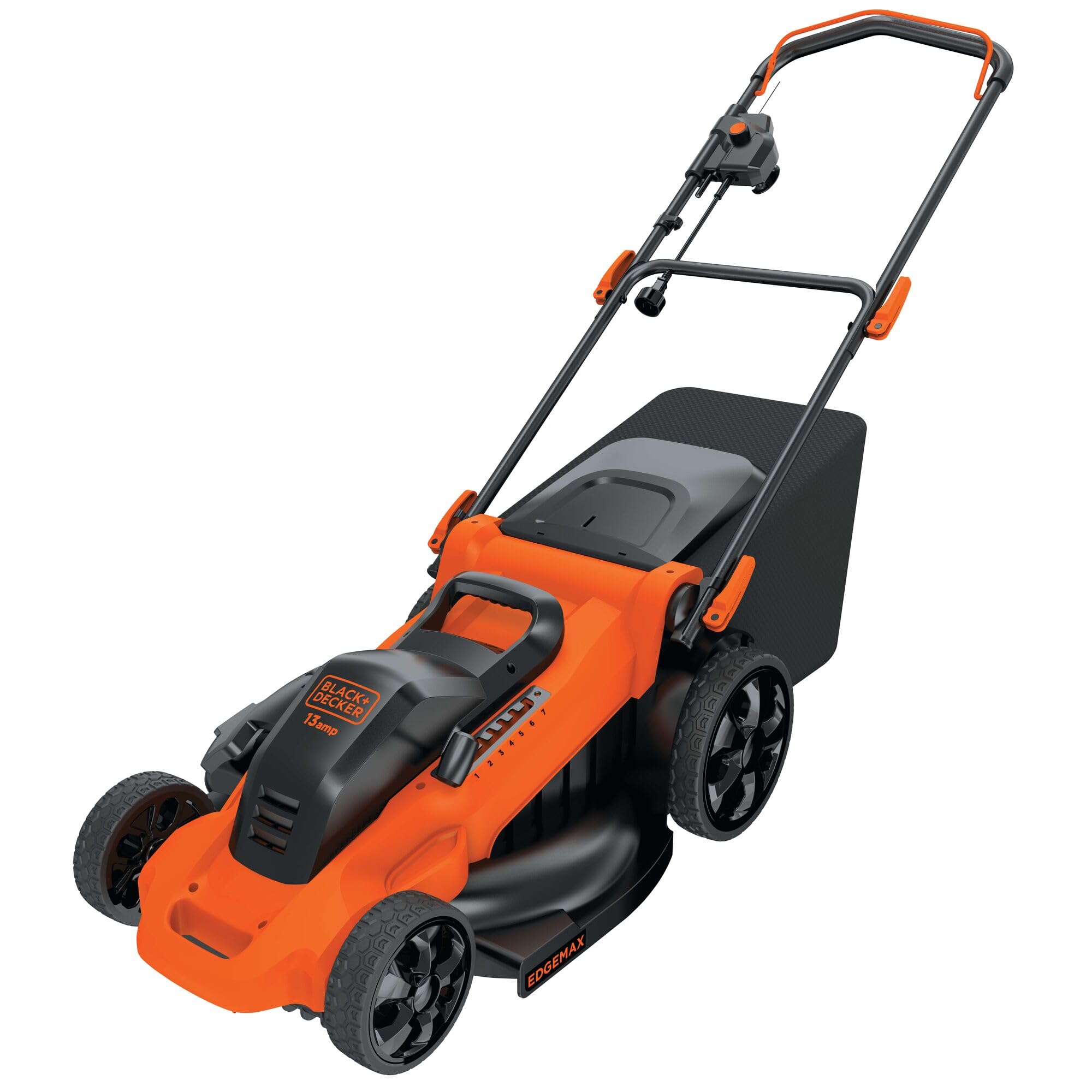
🌿 Cut smarter, not harder — the electric mower that means business!
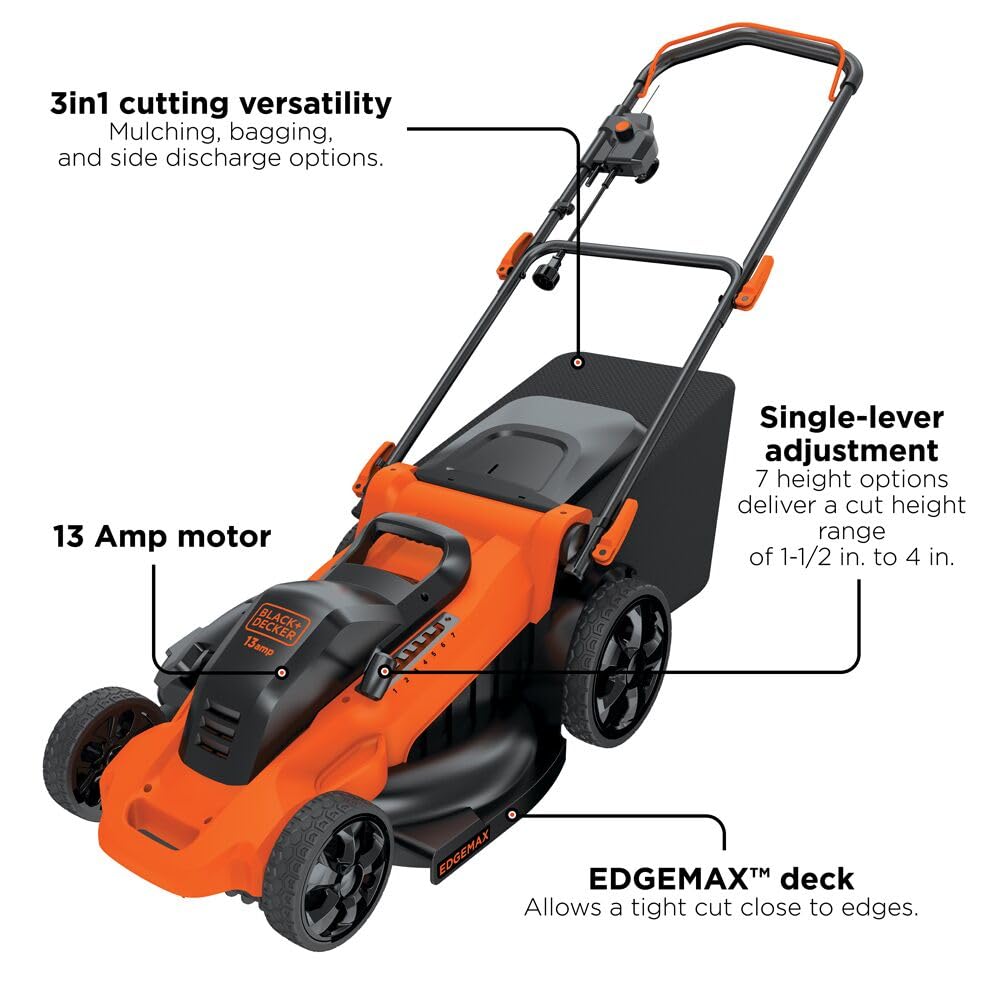
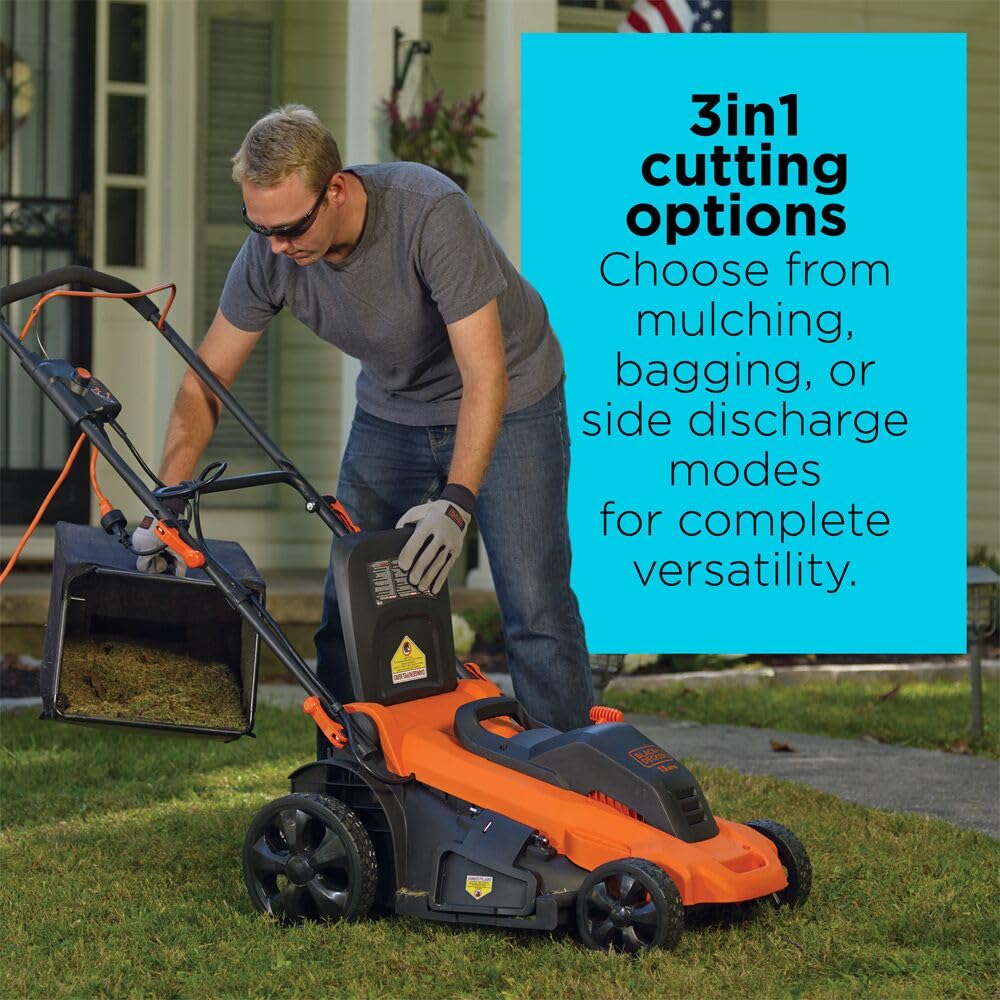
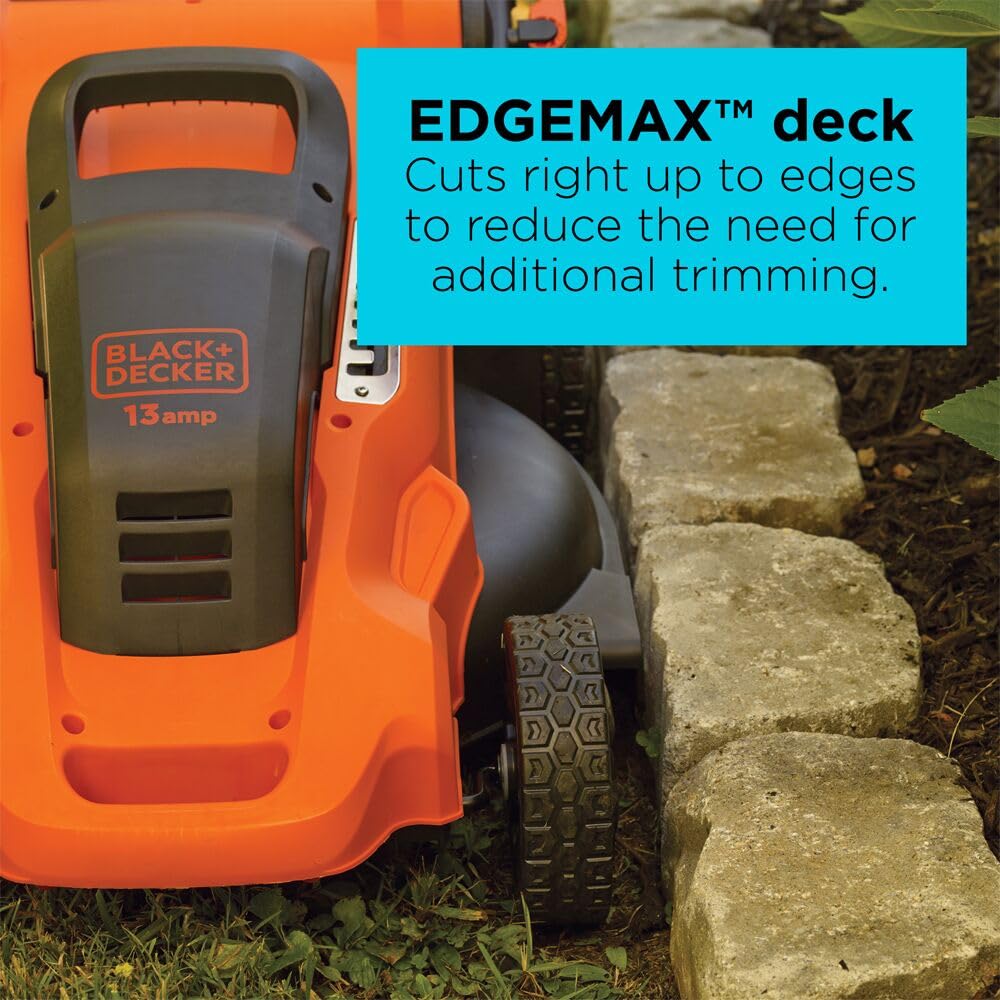
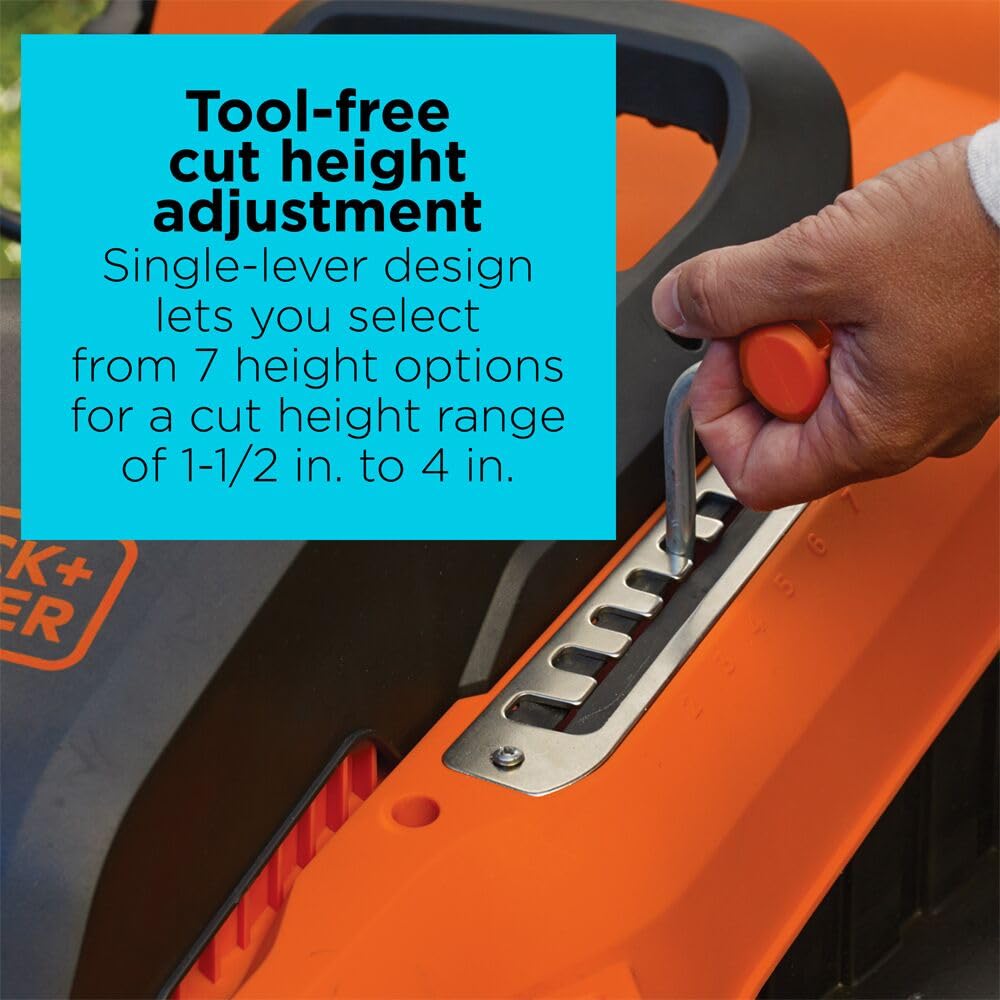
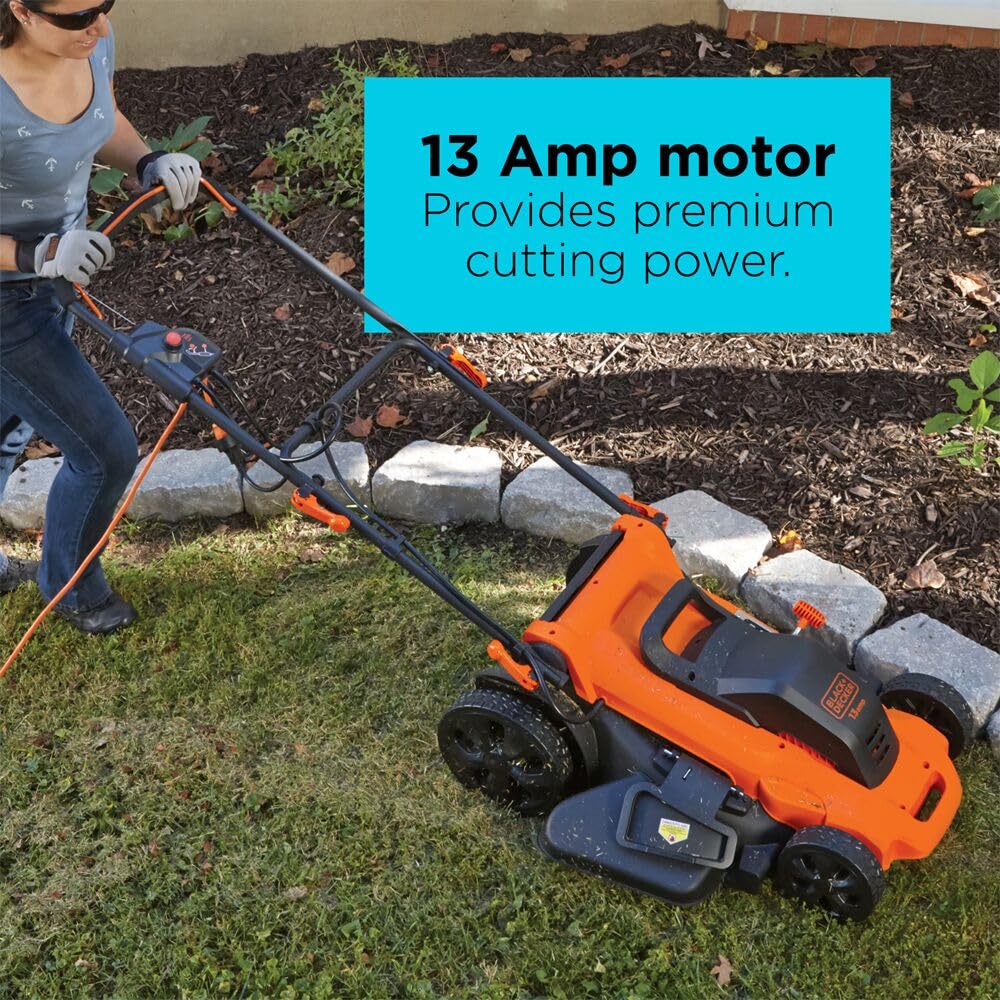
The BLACK+DECKER 20-Inch Corded Electric Lawn Mower (MM2000) combines a powerful 13 Amp motor with versatile 3-in-1 cutting modes and a precision EdgeMax deck for close-to-edge trimming. Its lightweight design and 7-setting tool-free height adjustment make lawn care effortless and customizable. With a large 13-gallon fabric grass bag and a 2-year warranty, this mower offers reliable, eco-friendly performance without the hassle of batteries or gas.


| Best Sellers Rank | #95,161 in Patio, Lawn & Garden ( See Top 100 in Patio, Lawn & Garden ) #122 in Walk-Behind Lawn Mowers |
| Brand | BLACK+DECKER |
| Color | Orange, Black |
| Customer Reviews | 4.0 out of 5 stars 1,449 Reviews |
| Item Weight | 46.85 Pounds |
| Material | Alloy Steel |
| Power Source | Corded Electric |
| Style | Classic |
D**M
Best mower ever! Get one!
Highly recommend. Great mover. Powerful. Will do almost any job. The mower is super light and easy to use and dependable. My only regret is I used a gas mower all these years. Having a cord is not a problem, no different than using a vacuum for a living room. I don't have to worry about buying an expensive battery or the battery failing over time. This mower can handle 90% of American lawns.
B**E
PERFECT MOWER, SAFER THAN BATTERY UNITS, GREEN, LOW COST, BUY BEFORE THEY ARE GONE!
The MM2000 Black and Decker Mower is the IDEAL mower for this time. Imagine, cutting your lawn, no matter the size, WITHOUT THE "CHARGE THE BATTERIES FOREPLAY!" Make no mistake, this IS the Electric Age. We abandoned Kerosene flashlights decades ago, and Lithium Batteries are appropriate for Phones, Computers, Weed Trimmers, Power Drills, AND Plug-In-Hybrid Automobiles, but not so for Lawnmowers (and Snowblowers.) WHY NOT? The power supply is "Not THERE YET". We need to get the job done, one shot, right? I estimate 3,500 Watt-Hours of power to trim my suburban lawn. An EGO 56V 5Amp battery would provide 280 Watt-Hours. Again these are estimates, but rounding, I would need 12.5 such batteries at 100% efficiency. The MM2000 uses a power source that is 100% compatible with what I already own-12or14 Gauge extension cords. This is clean power. Quoting the US Secretary of Energy, "the power comes from the wall." (No oil, gas, coal, nuclear.) :+} :=) It took less than 5 minutes to get the MM2000 out of the box and assembled, just attaching the handle with nice thumbscrew/levers, no tools needed. The MM2000 has a full range of height settings, a mulching adapter, is nimble&lightweight (no batteries or gasoline weight to smash the grass down), and a great built-in fan above the blade that provides suction and picks up & mulches (compacts) leaves-NO RAKING. The left side "EDGEMAX" almost makes weed trimmers un-necessary in many landscaping scenarios. The collection bag is easily unhooked, & the opening fits perfectly into standard yard waste paper bags. All very neat. The two stage switch is very well thought out. I cannot imagine the unit running "accidentally" but PLEASE, UNPLUG THE UNIT WHEN DOING ANY CLEANING OR INSPECTION. NOT HAVING AN EVER-PRESENT BATTERY MAKES THIS A V-E-R-Y S-A-F-E Lawnmower. THERE IS NO WAY THE MOTOR CAN TURN WHEN IT IS UNPLUGGED, RIGHT??? Now comes the classic objection-"what about the cord?" THIS IS AN INANE OBJECTION! Who cuts their lawn without 1 checking for children, 2 a mowing pattern, 3 checking for pets and wildlife, 4 checking for garden hoses and 5 checking for debris(potential projectiles)-CONTINUOUSLY? So if an Environ-mentally Friendly extension cord is a problem, perhaps consider a Professional Lawn Care Service? Buy a B&D MM2000 while you can and at a TERRIFIC PRICE ON AMAZON!
M**T
Great for mowing but durability an issue. Dead for 2nd time in 3 years.
Original review: I’ve had this mower for a bit over 2 years. It replaced a similar Black and Decker electric mower that I used for over 6 years previously. The original motors on both mowers failed after their first year of use. I replaced the motors under warranty at a Black & Decker service outlet, as well as some miscellaneous parts such as handle grips, the rear rubber flap, and misc handle hardware that fell off and was lost in use. Had to wait several months for the parts to come in and the repairs to be made on this new one, but luckily that was over the winter months when I didn’t really need it. In the year since then it has worked great and have had no further issues. Overall, the functionality is great, it’s easy and convenient to use, and it does a good job. I’ve had electric mowers for over 40 years and much prefer them to gasoline-powered mowers. May 17, 2020 Update: About 15 minutes into mowing my lawn today the motor shut down in the middle of cutting an average swath of reasonably short grass. I thought maybe I knocked the plug out, but found power was going to the mower just fine. Not sure if motor just failed again or whether it is just a switch or something else more minor. Mower is now 2-1/2 years old and out of warranty so doubtful that it will be cost effective to have repaired. It appears that Black & Decker corded electric lawn mowers have degenerated to the point of being disposable products that last about a year or two at best now. Looks like I will need to shop for a different brand. Do not recommend them any longer.
G**7
Cuts grass well
This mower managed to cut my overly tall lawn as easily (if not slightly more so) than the 6.5hp Craftsman gas mower I retired. It even does a better job of mulching. It is light enough to be picked up with one hand (using the handle on top of the motor) and maneuvers well. The light weight does make it bounce around a bit on rough surfaces, but that's just a matter of getting used to it. The plastic housing is tougher than expected as proven by the rocks my son's dog so thoughtfully scattered in the backyard. It's also quiet enough that you can actually hear the music coming from your headphones without damaging your hearing. I only have two gripes -- 1) The blade is absolute crap. The metal it's made of is too soft and the edge is not terribly sharp. It may be worth looking for an alternate blade. Sharpening it is a definite priority in any case. This is the reason I only gave it four stars. 2) While it does cut closer to the sides than many gas mowers, the front handle sticks out too far and makes it hard to get close when trying to cut under bushes and such. Overall, it's a great mower -- especially for only $200.
T**U
Has plenty of power for slightly wet grass to not clump.
I'll be honest, I'm surprised in a positive way. My grandfather has been using black and decker as long as I can remember. His old black and white one was still working from the 90s the last time I used it. That being said, these new ones are trash, at least the ones I've bought prior to this one. This one gets the job done!!! To me, it feels lighter, is easier to push and pull, has no problem cutting down 6" high grass that's slightly wet from on and off rain days for a week, and the mulcher side sprayer makes cutting a lot faster if you're not bagging. I was able to cut my entire yard in 1/3 the time of a BND model a few years older. I hope to come back to this next year with a continued positive review.
K**K
cuts grass blades easily and effectively
Warning: Long, opinionated, sanctimonious, but 100% truthful review to follow, by a reluctant, foot-dragging self-styled expert in mowing with an electric mower. If you are easily POed, you have been warned. 5 stars is based, not on this mower being the ultimate of all products I have ever used, but on perceived future worthiness and proper present operation. (As of July 17, 2015 I have been using this for 3 months.) I explain that because I realized people have radically different ideas about ratings after I saw a review of some cheap, perfectly functioning item which said 5 stars could only apply to sublime items, should you ever encounter one in your lifetime, which is how he rated novels less worthy than William Shakespeare, and that was how he was going to rate products. IMO, good sense tells us that mundane, engineered products all have inherent inadequacies in our losing struggle with the real world, so rating products as if they were art is foolishness. I will mention some faults with this product, but as a total evaluation, they should be taken as incidental. In other words, this mower cuts grass blades as well as any rotating mower can. It has the power, in effect, of gas powered mowers that might cost a few hundred dollars more, and is fabulously more convenient to use. You can stop here if all you want is an opinion without details. I weighed the mower without the bag (which I don't use because bagging is pointless) and it was 43 pounds. The Amazon specs say 53, which may be because of the bag. The height adjustment lever, which is convenient by being on top, and easy to move by having a long handle for good leverage, therefore also gets easily knocked out of its locked #7 position when it is hardly brushed against by low branches of my many shrubs, dropping to #4 position, scalping the lawn. For the first few cuttings this happened a lot, but now that I have learned to watch it doesn't. The top hand-operated skewers, something like quick releases on bicycles, that let the handle be folded quickly for storage, could not be made tight even with the adjustment knob all the way in. Some washers I added were enough. Since other reviews do not mention this, either something was left out in my case, or B&D has changed something. The levers on the quick-releases sometimes hook onto branches. In fact all kinds of things on the MM2000 get hooked, whereas the older models had smooth housings. I could make false, bragging claims about my wisdom when I decided on an electric mower around the year 1970. Like: It was better for the environment! (which it is.) Or: it is more economical to operate! (which it is.) Or: it is much lighter! (which it is.) Actually, I had a job in which my primary work during the growing season of Michigan was pushing a very nice and expensive gas lawn mower all day to get what the big tractor mowers couldn't get at, or near, or under. At home, I had a classy push reel-mower, which was murder in the blasted humidity and heat of summer, but I declined to replace it with a gas mower, because it was too much for me to endure the sound of a gas-mower for one more second than I had to. While again wistfully contemplating the gas mowers at S--rs, I noticed an obscured, wimpy little thing off to the side: an electric mower, audaciously claimed to be quiet-er. Whether you can claim something loud is quiet-er is a question for philosophers, but it did not sound at all like a gas mower. And it cut as well as the gas mowers, but much easier. It may not have survived the 4 foot weed stalks my on-the-job mower could manage, after I acquired the technique, but that was not even slightly relevant. That light, little, aluminum-housed, mower with a novel pair of side-by-side 8 inch blades, lasted, with some repairs, for 27 years, I suppose because my lawn was so small, and electric motors do not require elaborate engineering to be durable. (The repairs were: a switch, one set of brushes, and the two belts.) The old thing which I thought would last forever gave out in 2 years when I moved to where the lawn took 3 and 1/2 hours to cut. 27 years without smelling or keeping gas, without once having trouble starting, without any new spark plugs or tuneups, with less than half the effort of pushing and maneuvering a gas version, without hearing the nasty popping noise. That mower was followed by a B&D MM850, an ancestor of this current (but totally re-engineered) model, which could only handle a mere 17 year pounding, again with some repairs. (The replacements were a set of brushes, one new blade, a top bearing, and the clips that hold the wheels on. I replaced the rusted out, flimsy clips with endcaps.) I will mention that I have a 4 year technical degree in electronics, which does not qualify me to design electric motors, but it is some credentials, in case somebody wonders. The electric motor of this model supposedly is rated at 13 amps. It does not use 13 amps. A rating means different things when applied to different equipment. So, for instance, you have circuit breakers in your breaker box rated at 15 amps. That means you could use 15 amps, not that you are using 15. Electric mowers by their nature pull more amps if you load them down. 13 amps in the case of this mower's motor probably means that past 13 amps the motor will progressively get hot enough to burn the insulation on the windings. (And the rating is probably done in free air, not inside a stifling enclosure such as the mowers housing.) That means you risk failure if you operate your mower at 13 amps for prolonged periods. I rigged something to measure the amps while cutting grass 3 inches taller than the mower's maximum height adjustment, at which the mower was pulling 3.7 amps, not 13. At as fast as I could walk, and you could then hear the motor bog some, it was 4.2 amps. So when the manual advises a 14 or even 12 gauge cord, this is because of lawyers, not either safety or the requirements of the mower under normal operation. Naturally, I did not think of this when I bought my cords. I have a 100 foot, 14 gauge, 2 wire cord, to which I add a 50 foot, 12 gauge, monster 3-wire cord to get to the furthest part of the lawn. It is of no use to run a 3 wire cord to a device that has two prongs, as this mower, and practically all electrical lawn equipment does. So why are two wire cords very hard to find? This mower, as well as its ancestors like my MM850, has a DC motor with a bridge rectifier to convert the house AC to pulsating DC. AC motors are everywhere and not expensive, and refrigerators and furnace blowers use them. It makes sense to use AC motors with AC, does it not? And AC motors don't necessarily have brushes, which wear out and cause problems, nor bridge rectifiers, which drop the voltage a couple volts and waste a bit of power. The rectifier drops voltage (2 volts), in the same range as 150 foot cords some people seem worried about. And there ARE mowers that use AC motors. For what reason is B & D going with DC? It is my understanding that DC motors do not overheat when they are slowed down significantly, or when operated at lower voltages, as some AC motors do. That's good. (DC motors turn slower, and use less power, at lower voltage.) But brushes do cause problems. Probably most people who think their lawn mower "has conked out" (and it isn't just the switch) have worn out the brushes. (Brushes are what they call the replaceable contacts that supply the rotating motor with electricity.) It is not a difficult replacement if you are handy with a screwdriver. But I have also had my old mower suddenly refuse to run, or run very slowly. After getting off the cover, blowing out the astounding amount of very fine crud inside, and working the brush springs, to get out particles blocking the brushes from good contact, the mower is revived. Lifting and banging the mower down on the sidewalk a few times often works, but don't get carried away. Although the manual instructs you not to get inside (as demanded by lawyers), that means debris will accumulate inside until it ultimately strangles the motor to death. People accustomed to replacing their cheap-crap gas mowers frequently may not realize they can get another long period of good operation out of their electric mower by getting inside. The motor cannot be totally sealed, because air must circulate to cool the motor. (There indeed is a fan inside the blade housing which draws air through a couple of small holes (prone to clogging), which draws cooling air into miscellaneous openings on top). But dust and mostly tiny particles of grass which the mower kicks up gets drawn inside, and can get in the motor and lodge in the brushes. The first time I opened up the forbidden motor compartment of the MM850, after a couple years, I was baffled why they would line the inside with a greenish foam rubber mat molded exactly to the interior of the cover. They didn't! The new MM2000 makes it just as difficult to get inside, by having screws set in deep holes that fill up with fine grass clippings you have to blow out. The reason electric motors last a long time, compared to gas motors, is that the only wearing parts are the two bearings that hold opposite ends of the shaft that turns, and those don't cost much. Gas mowers have that and a lot more, and the parts take a tremendous pounding from the brief but strong explosions of the gas. Yes they can make cheap gas engines, but they can't make gas engines that last cheap. Battery mowers are a mistake. You may feel a cord is too much hassle, but lugging and charging expensive batteries, which are only able to last a couple of years, because the high energy cycling wears them fast, is a hassle. Isn't electricity expensive compared to gas? Yes, but the conversion to useful work is much better for an electric motor than a gas engine. 90% efficient is not a big deal for an electric motor. 30% efficient in practice would be a miracle for a gas engine. IAC, here is the calculated cost for me. Around here, the total maximum charge for 1000 watts for 1 hour is $0.17. While in operation, the mower uses under 500 watts. If it took less than an hour to cut the lawn, it would cost under $0.09 for the electricity. For 3 1/2 hours, it would be under 30 cents. (0.17 x .5 x 3.5) At $200 for the mower, assuming it lasts 15 years, that comes to $13.33 per year. In my case, that comes out to 44 cents per cutting. So, not counting my labor, total out-of-pocket cost is 74 cents per cutting. I mentioned that bagging clippings is pointless. Here is how I came to think that: In the later 70's the ecology movement erupted. One idea was that to reduce creating ever-more eco-destructive landfills, we should not put biodegradable material in them. Manufacturers and eco-fanatics then proclaimed that specially designed mulching mowers, which chopped the cuttings short enough to fall unobtrusively between the grass blades (provided the lawn was left long enough to hide them) were eco-correct. Frankly, I 'd prefer to avoid bagging the clippings, not because of eco concerns, but that bagging is three times the work of not bagging. So I, after seeing articles claiming that they had found some ordinary mowers that did just as well as the mulchers, tried my suddenly out-dated mower (set to maximum height) and found it worked too. I monitored for the potential lawn disease that might result, which never happened. On the contrary, the lawn stayed greener between fertilizer applications, and after a few years of this, I seldom put fertilizer on the lawn. (True, the grass is not that deep blue-green you get after fertilizer anymore, except in spring, but it is a pretty green.) To be clear, if you cut more than an inch off the grass blades, or have the height lower than 3 1/2 inches, you risk seeing grass clippings laying on the lawn. I have not bagged the clippings since around 1975. The mower is working fine as of July 7, 2016. (To be continued when I have time. )
A**E
Cuts grass well.
I've used this about 20 times so far to cut my grass and not had an issue at all. Even on fairly tall grass. Sometimes I like to let the grass grow 5 or 6 inches to reseed itself before cutting it and this mower has no issues cutting it. My lawn is in the desert and is Bermuda grass. I usually cut the grass when it is dry but on occasion the sprinklers kick on right before I cut and this mower still does very well on wet grass, which is a lot harder to cut. I don't use the grass catching basket since they never seem to work well on any mower, so I can't say how well the one on this mower works. Instead I installed the included side port thing that lets the grass fly out the side. I rarely rake up my grass as I like to leave it and let it feed the grass so I don't have to fertilize often. I only have to rake if the grass is really tall when I mow it. Anyway, yeah the cord is a little but of a pain in the butt sometimes, but I rather have a corded electric mower than a cordless. I like the power I this mower delivers. Having always had gas mowers in the past this electric is much easier to use and maintain and it is much quieter which is a big bonus too. I very much like this mower and I am happy I bought it and it does a very good job on my lawn.
D**L
Black & Decker MM2000 Is A Great Machine, With Some Modifications
The Black & Decker MM2000 Type 2 is a great machine, with modifications. This is my 3rd B&D corded electric mower since 1982. This mower is the Type 2 which has the belt drive reduction and Not the standard direct drive motor. This mower has more initial torque than my 18 season MM600 mower and the easy switching between cutting discharge methods is a time saver. The larger diameter wheels make it push much easier. The mower has some small issues that required modifications. 1. The rock shield jams on a backward pull, so it had to go. 2. The side discharge attachment has a closed end that blocks grass, so I cut the end open. 3. The handle hits me above the waist, so I cut the lower handle hoop shorter and drilled new holes and reassembled. It hits below my waist so I don't cut the grass like Frankenstein's Monster. 4. The bail wire end hooks in loose and can jam and snap off, so I put it in its correct position and wrapped it with a band of electric tape. It doesn't move now and shouldn't fail. 5. The push button to engage the bail had to go, so I modified the Torsion Spring so I just pull the bail and it's running. I am still thinking about that front carry handle that sticks out in the way. Make no mistake, this is a GREAT mower, but I know what I need to cut my grass. People seem to be calling this a Push Button Start, it IS a Push Button Safety Interlock. Push button and pull bail back to start. WARNING: The modifications require a skill level and make the mower Less Safe to operate. I am looking forward to spring for season 19 on the MM600 and full season 2 on the MM2000. Thanks B&D for the quality mowers, I love them. Thanks.
Trustpilot
2 months ago
1 month ago