🚀 Capture Every Moment Like a Pro — Don’t Just Shoot, Create!
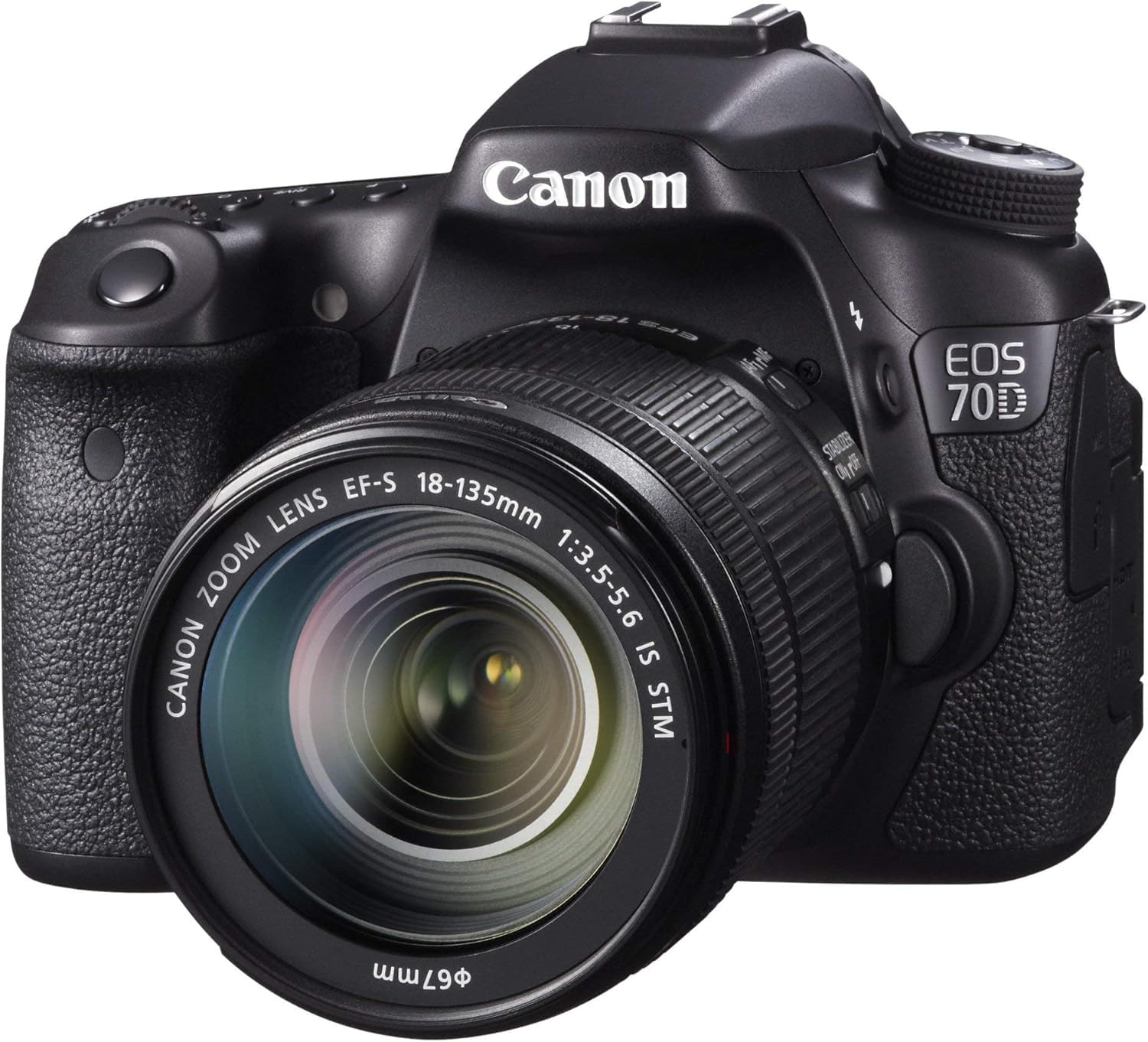
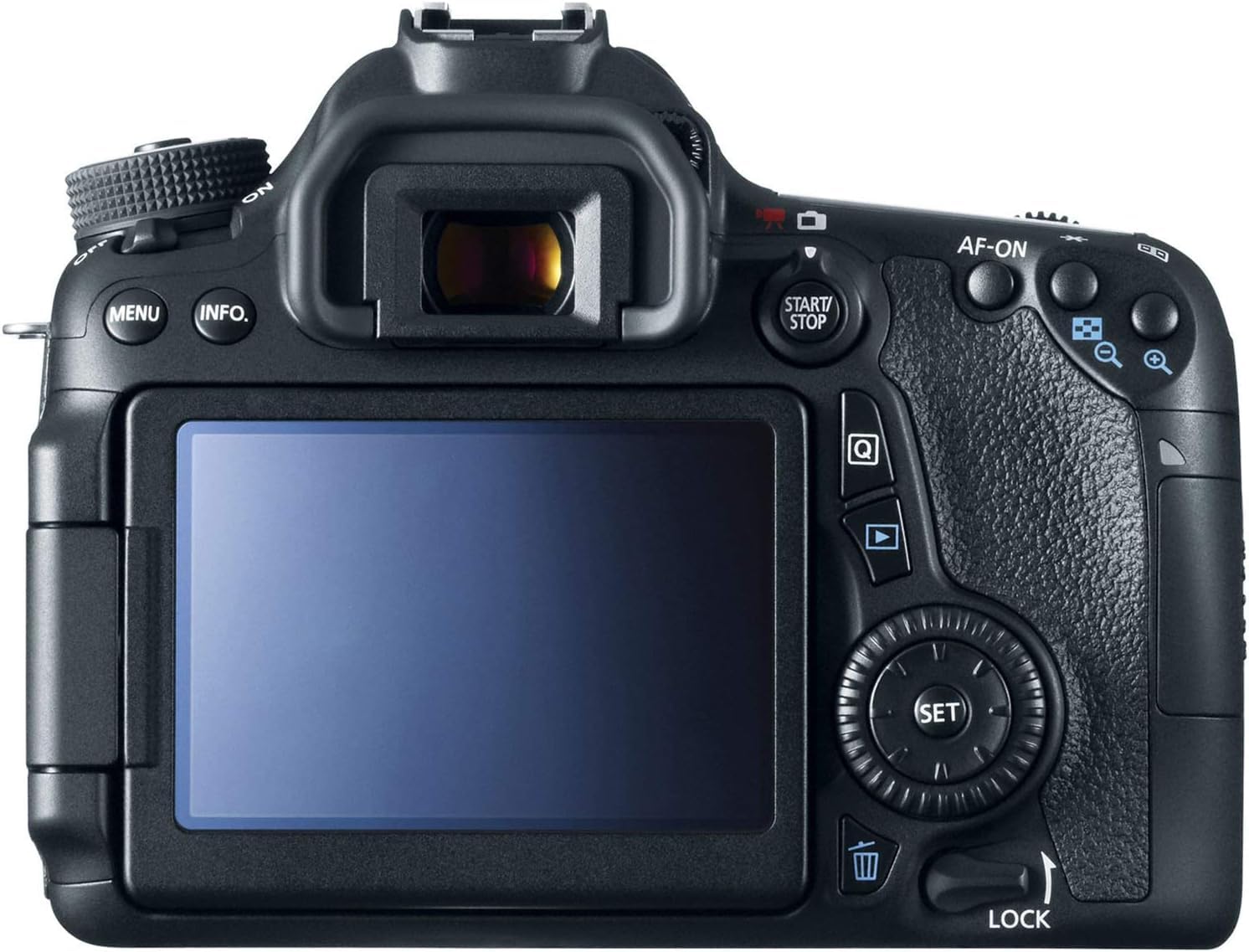
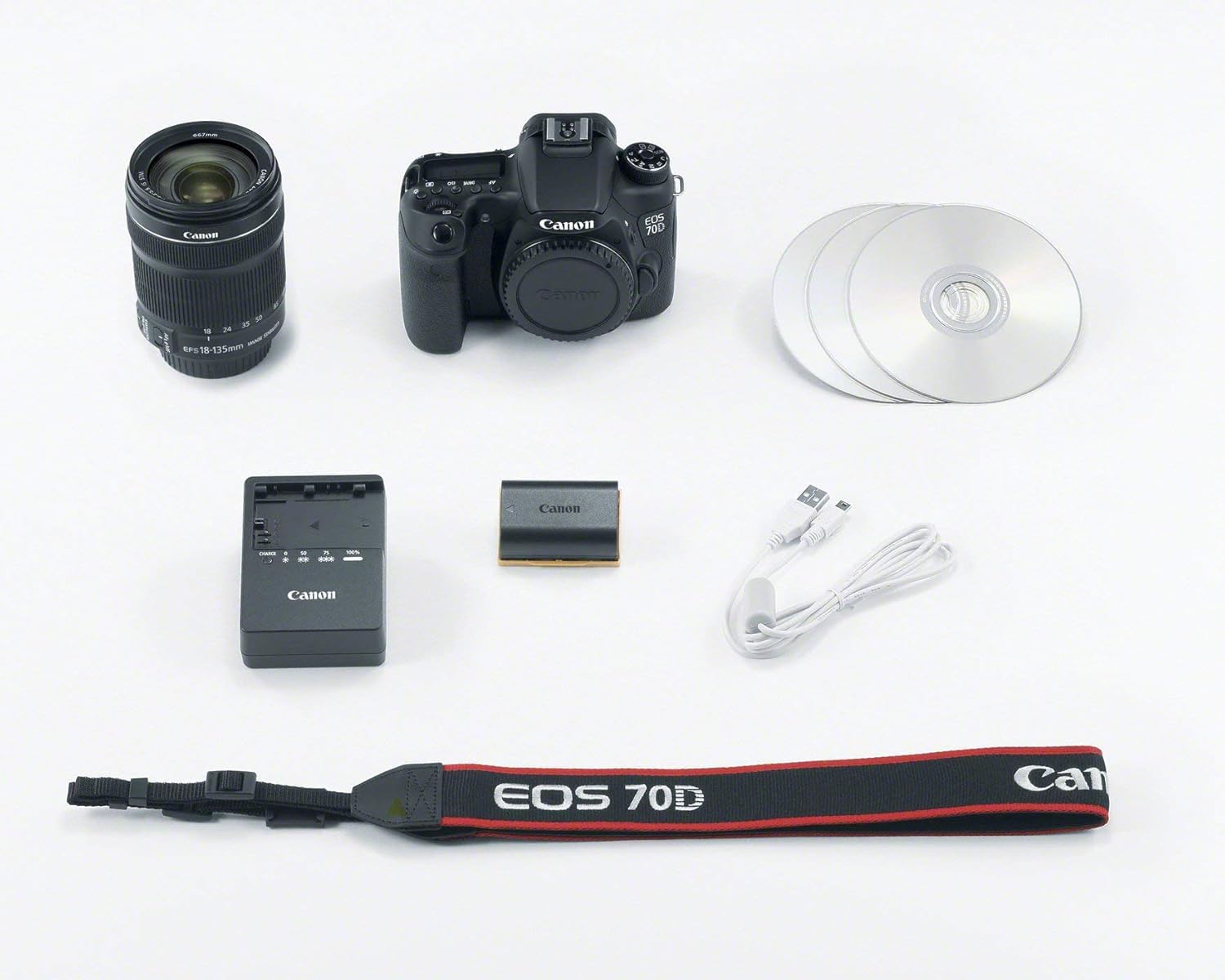
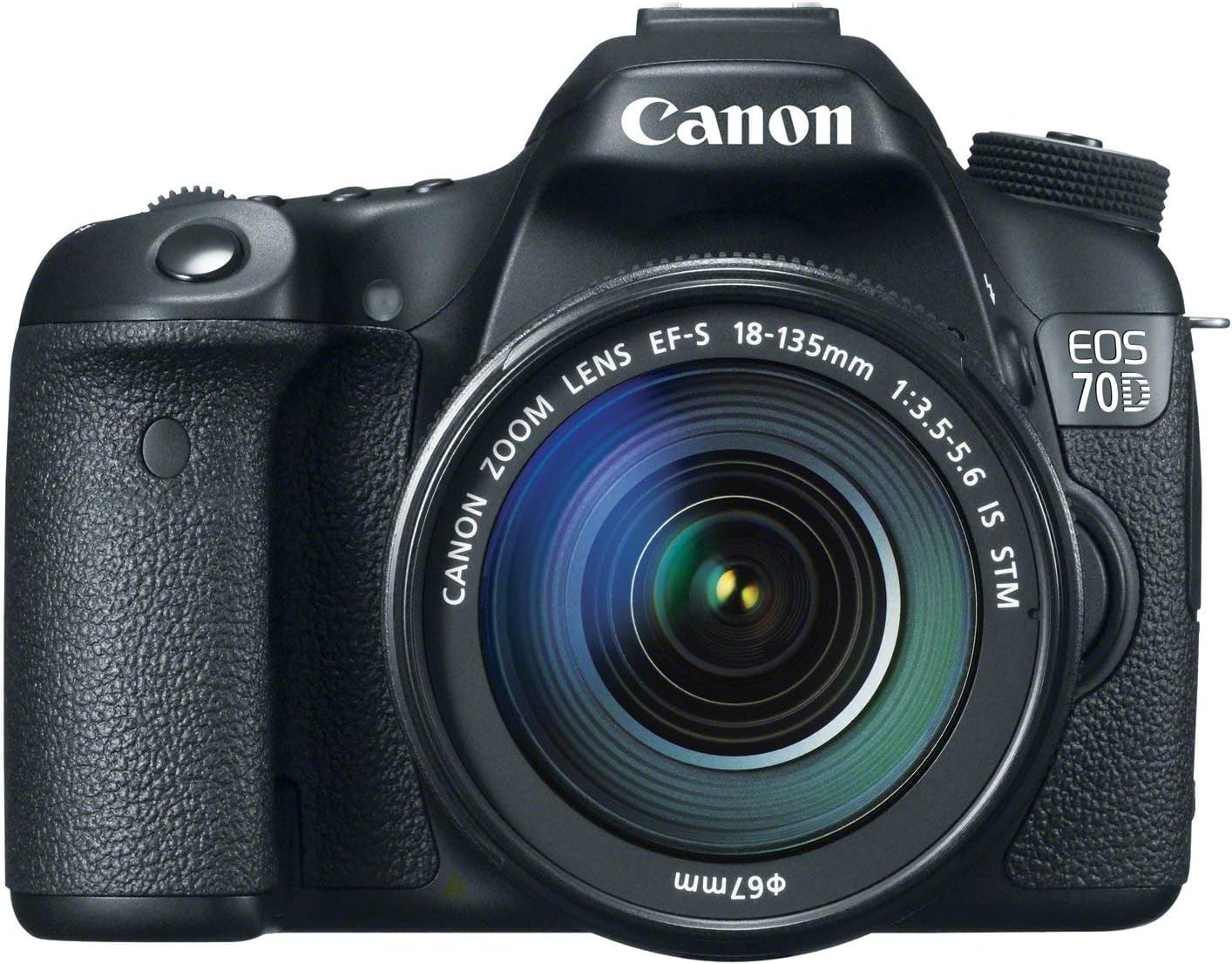
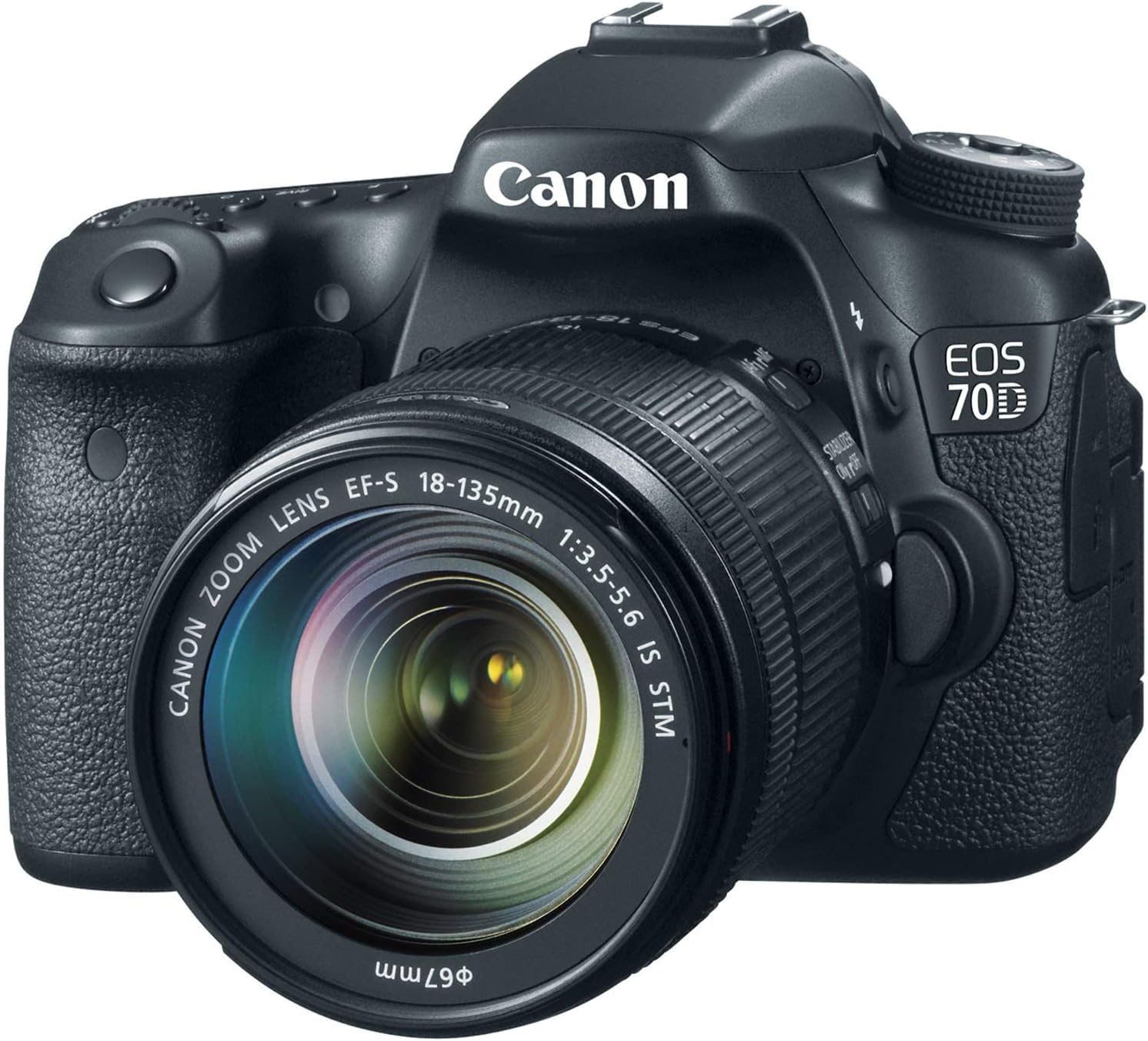
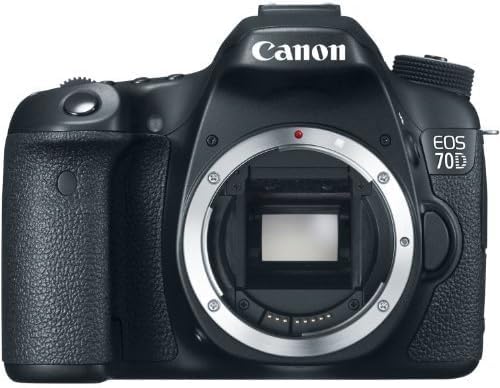
The Canon EOS 70D with 18-135mm STM lens is a powerhouse DSLR designed for millennial pros seeking high-quality stills and cinematic video. Featuring a 20.2MP APS-C CMOS sensor paired with Canon’s innovative Dual Pixel CMOS AF, it delivers fast, accurate autofocus in Live View and video modes. With up to 7 fps continuous shooting, a 19-point cross-type AF system, and a versatile stabilized zoom lens, it excels in dynamic shooting scenarios. The 3-inch vari-angle touchscreen with built-in Wi-Fi enables intuitive control and instant sharing, making it ideal for content creators who demand speed, precision, and connectivity in one sleek package.
| ASIN | B00DMS0LCO |
| Age Range Description | Kid |
| Are Batteries Included | Yes |
| Aspect Ratio | 16:9 |
| Auto Focus Technology | Center, Continuous, Contrast Detection, Face Detection, Live View, Multi-area, Phase Detection, Selective single-point, Single, Touch, Tracking |
| Autofocus | Yes |
| Autofocus Points | 19 |
| Best Sellers Rank | #81,415 in Electronics ( See Top 100 in Electronics ) #88 in DSLR Cameras |
| Bit Depth | 8 Bit |
| Brand | Canon |
| Built-In Media | Camera And Standard Items |
| Camera Flash | Built-In |
| Camera Lens | 18-135mm f/3.5-5.6 IS STM lens |
| Color | Black |
| Compatible Devices | Canon EF, Canon EF-S mount compatible cameras |
| Compatible Mountings | Canon EF |
| Connectivity Technology | USB |
| Continuous Shooting | 7 |
| Crop Mode | 16:9 |
| Customer Reviews | 4.5 out of 5 stars 1,197 Reviews |
| Digital Zoom | 3 x |
| Digital-Still | Yes |
| Display Fixture Type | Articulating |
| Display Resolution Maximum | 720 X 480 Pixels |
| Display Type | LCD |
| Dots Per Screen | 1040000 |
| Effective Still Resolution | 20.2 MP |
| Expanded ISO Minimum | 100 |
| Exposure Control | Manual |
| External-Memory Size | 32 GB |
| File Format | JPEG |
| Flash Memory Bus Interface Type | SD, UHS-I |
| Flash Memory Installed Size | 32 GB |
| Flash Memory Speed Class | 10 |
| Flash Memory Supported Size Maximum | 32 GB |
| Flash Memory Type | SD/SDHC/SDXC |
| Flash Memory UHS Speed Class | Class 1 |
| Flash Modes | Auto, Manual |
| Focus Features | TTL-CT-SIR, 19 focus points (cross-type), f/2.8 at centre |
| Focus Mode | Continuous-Servo AF (AF-C), Single-Servo AF (AF-S) |
| Focus Type | Auto Focus |
| Form Factor | Mid-size SLR |
| HDMI Type | Type C Mini HDMI |
| Hardware Interface | HDMI, PictBridge, SDHC, USB |
| Has Color Screen | Yes |
| Has Self-Timer | Yes |
| ISO Range | Auto, 100, 200, 400, 800, 1600, 3200, 6400, 12800 (25600 with boost) |
| Image Capture Type | Stills & Video |
| Image stabilization | Optical |
| Item Weight | 0.75 Kilograms |
| JPEG Quality Level | Basic, Fine, Normal |
| Lens Construction | Wide Angle |
| Lens Type | Wide Angle |
| Light Sensitivity | ISO 100-25600 |
| Manufacturer | Canon |
| Maximum Aperture | 7.5 f |
| Maximum Focal Length | 216 Millimeters |
| Maximum Shutter Speed | 1/8000 Seconds |
| Memory Slots Available | 1 |
| Metering Methods | Multi, Center-weighted, Spot, Partial |
| Minimum Focal Length | 19 Millimeters |
| Minimum Shutter Speed | 30 seconds |
| Model Name | 8469B016 |
| Model Number | 8469B016 |
| Model Series | EOS |
| Movie Mode | Yes |
| Night vision | No |
| Number of Diaphragm Blades | 8 |
| Optical Zoom | 3 x |
| Photo Sensor Resolution | 20.2 MP |
| Photo Sensor Size | APS-C |
| Real Angle Of View | 13.84 Degrees |
| Remote Included | No |
| Screen Size | 3 Inches |
| Sensor Type | CMOS |
| Series Number | 70 |
| Shooting Modes | Automatic, Manual, Program, Aperture Priority, Shutter Priority |
| Skill Level | Novice |
| Special Feature | Wireless |
| Specific Uses For Product | Photography |
| Supported Media Type | ProductImage, EnhancedContent |
| Total Still Resolution | 20.2 MP |
| Total USB 2.0 Ports | 1 |
| Total USB Ports | 1 |
| Touch Screen Type | Yes |
| UPC | 013803221633 |
| Video Output | HDMI |
| Video Resolution | FHD 1080p |
| Viewfinder | Electronic |
| Warranty Description | 1 year coverage for labor, 1 year coverage for parts |
| White Balance Settings | Auto |
| Wireless Technology | Wi-Fi |
| Write Speed | Up to 95 MB/s or more |
| Zoom | Optical |
S**T
Amazing Vlogging Camera
The bottom line is this is a fantastic vlogging camera, which is the specific reason I bought it. If you're not interested in 4k, if you're a 1 man band, or just someone that wants to shoot a lot of great material and get it out to the world fast, this might be the camera for you. Already being the owner of a Canon 5D mark iii and mark iv, I am very familiar with the Canon brand. I do both still photography and videography, equally. I endeavored to help my wife start up a lifestyle vlog, and did a lot of research on cameras before picking this one. It made a lot of sense to me because I already own a lot of high-end Canon glass. However, owning full frame cameras, I don't have too many super wide angle lenses, that are better for this APC-S sized sensor. Please see below for a detailed analysis. VIDEOGRAPHY: Pros: -I love the articulating touch screen. To me, this is the main reason this camera beats the pants off of my 5D's for shooting video. You can place this camera high or low, left or right, face it at you or behind you, and turn the screen to see it. You can tap on the screen to focus or adjust properties easily. -Facial auto focus works really great! I know there is an upgraded camera (80D) that makes this better. But honestly, if you are looking to save some money, just get this camera. You're gonna be happy with the autofocus. It's fine. -Compared to my bigger cameras, this guy is really light weight -The menus are easy to navigate -the footage looks amazing -Shoots 24p -Sound is straightforward. You need an off camera mic, and you preferably want a powered mic so you can use the mic gain and not the camera's gain to get less hiss. -Can use any EF or EF-S lens.So you you are a canon shooter, you've got a head start -Takes pretty nice photos too! Since I didn't buy this for photos, admittedly I haven't delved in. I would, truthfully, use my 5D Mark IV for a photo shoot. But for me, when I am out there shooting video, if I want to snap a few stills, this guy works great. Cons: -Not 4k (this is not a con for me, but if you want 4k, look elsewhere) -Not a high quality/high bit-depth format. (Again, this is not a huge deal for me. I'm about story and speed over noodling with quality. I also own a BMPCC, and yes, shooting raw 10 or 12 bit is amazing... but you have to CC everything, do online/offline workflows, etc. so this is really more of a preference than a con. You have to know what you want to do. I think this camera wins for vlogging -Not as great with low light as other cameras. This camera caps off at ISO 6400. But realistically you wanna be at 800, 1600 max if you are good with seeing some noise. On my Mark IV I can shoot at 6400 and see no visible noise. But I mean, the Mark IV is like thousands of dollars more, so it's not a great comparison. -Its not full frame. Not a huge problem, neither was the Alexa I've shot TV shows on for years. But, if you want full frame, this ain't it. So you need wider aperture lenses or to shoot really long lens if you want to get shallow depth of field. LENSES: On lenses, I did pick it up with the 18-55mm kit lens, then also bought the little 2.8 24mm pancake lens. They're both great lenses, actually... for the cost. The 18-55 has stabilization, so is better for hand held stuff, but needs more light. The 24mm makes the camera super light to carry, and also looks nice at 2.8. Both of these lenses autofocus great with the camera. So I disagree with some reviews out there that say don't get the kit lens. These days canon makes them pretty good and they are cheap in comparison to other lenses. So unless you have all the glass you need - get the kit lens. I usually get the short zoom kit lens because they are sharper and faster. Having used this camera for a few weeks, I really want to get something wider like the canon 10-22 or the sigma equivalent. I think there are times when being at a 10 to 14mm, especially out doors, would be helpful. I have not used either of these two lenses, my widest lens that is not a fisheye is the canon 15mm zoom. CONCLUSION: This camera may be on the older side right now, but I have to tell you I like it better for videography than my Mark IV. it's just so much faster and easier to use, and doesn't make you're wrist feel like it is going to break off. And because it is older, you can get it cheaper. Don't let all the posts and videos about technical quality hold you back from just going out there and creating. At the end of the day, it's about your talent and your stories. Tell them. I've seen big TV shows with Alexa's suck. I've seem people do amazing things with iPhones. It's not the cameras, its you and how you use them. So if you're gonna go tell stories, and you have about $1200 bucks to do so, get this camera, the kit lens, and an on camera mic. That's all you need. I promise you.
C**S
Best Canon at this price point yet!
I have had this camera for a little over a month now and am only working with the kit lens and body right out of the box. I am not using any hot shoe flashes, extra lenses, filters etc., which is the best thing about this camera - it is superb right out of the box as a stock set up. And, I do mean superb. I have owned Canons for about the past 20 years and have to say this is the best I have owned yet for the price point. The stock lens: Excellent lens for a kit lens and truly responsive in terms of focus vs. stabilization and lighting. This, of course, also works in conjunction with the sensor and chip. But, this is a nice, solid lens at a good cost. Video: The primary selling point on this is the focus when using video. I have to try pretty hard to trick the camera in order to see any focus problems when recording video. It's easier to trick the camera in low light, but I think this is the best video I have ever shot with a camera. The audio seems to be on par or above with most cameras in this price range. But, a nice shotgun mike would probably make a nice addition for the serious videographer. I've never considered myself a serious videographer, but this camera could change that. Battery Life: Battery life seems very good and I am still working off the same charge from when I pulled the camera out of the box about a month ago. However, to me this has never been an issue since I ALWAYS carry a spare battery. I may consider a battery grip for this camera and have owned a couple of Canon battery grips with previous Canons. As a result, battery life has never been much of a concern for me. Speed: The speed of the camera is excellent and I have worked in situations where I fired a number of bursts with great success. Form Factor: I think this is a nicely sized camera and the controls are very well placed for my hands. Everyone has different hands and mine tend to be a little smaller. But, I do like the size and feel of this Canon. It is significantly larger than the Rebels and I think that is what I like about it since I always felt the Rebel was a bit small. On-camera Flash: The last thing I'll mention is the on-camera flash. It's the best I have used yet. Hands down. I am not a big flash user because I shoot a lot of naturally lit subjects. But, I have used this one with a lot of success and am pleasantly surprised at how well it works. Overall, I can't say anything bad about this camera. I wish I could offer up something constructive. But it appears as though Canon got everything right in this one. Even the interface...though I am sure there will be plenty of nit-pickers out there, the interface is pretty intuitive with minimal use. This is truly the best Canon I have ever owned.
M**.
I've been more than happy with this camera
I've been more than happy with this camera. It's seen lots of use (and some light abuse) for 3 years and still works great. Even today it's still a worthy camera. Sitting in basically the middle of the Canon lineup (when it was release), it offered a build quality and features above the Rebel line and just below the semi and pro cameras. For anyone that wants a nice camera and feels they may outgrow a Rebel camera or wants more configuration options/control, but can't afford a 6D/7D or higher, this is a great choice. It has proven to be very reliable for me. I've taken it on many hikes (with it bouncing around), used it the cold (snow) and light rain (covering it the best I could) and it's never let me down. I don't do a lot of video, but what I have done turned out nice. It may not have the video features some other cameras, but the DPAF and touch screen are really nice. I find the 1080p video to be fine. You're not going to make feature films with it, but that's not what it's really designed for. I've used almost all the STM lenses on it and they all focus smoothly and quietly, but I still recommend using an external mic. With still photos I don't really have any complaints. It's focused well with all the lenses I've put on it except for the 50mm 1.8 II, but that's more the lens than the camera. Noise at high ISOs is tolerable, especially if you're not making huge prints. Overall I highly recommend this camera. If it has the features you want/need and is in your price range, you can't go wrong with it.
C**R
Excellent upgrade for Canon owners
Over time I have migrated up the line of Canon DSLR cameras from the early Rebel series through to the 60d (the 70d predecessor). As such I am heavily invested in Canon compatible lenses so any thought of switching to another brand of camera body such as Nikon or Pentax is really out of the question. So for anyone comparing the 70d to any cameras from competing camera manufacturers this is not the review that you will find most helpful. But for those who may be considering moving up the Canon line or hopping in for the first time hopefully I can help. From the first use the 70d is an impressive camera. It looks, feels, and can operate much like the 60d that I owned previously so I could use it right out of the box. But as I become more familiar with the 70d I am finding the upgrades from the previous generation are significant and useful in actual use. The touchscreen is much more than a gimmick, it is my go to method of set up when I turn the camera on. I can immediately see my settings and make alterations with a touch of a finger. I find autofocus to be faster and more accurate with all my lenses than had been the case with the 60d. I appreciate the ability to fine tune the autofocus plus or minus if any lens combination were to yield consistent front or back focusing issues. I really like the revision to the autofocus point selection options in the viewfinder. Gone are the red dots that the 60d had replaced by what I find to be more useful squares with increased options for point selection including a zone focusing mode that the 60d lacks. Net result is that I have more "keeper" shots than before. I tend to default to the viewfinder for my composition but the Live View option on the 70d is so good that I am using it as well. Simply compose a shot, touch the specific point on the Live View screen and the 70d can be set up to quickly focus on that spot and shoot. The sensitivity of the autofocus points in Live View is also excellent, arguably more accurate than what can be achieved through the viewfinder. Finally a word about Video performance. Spectacular! Again the upgrade from previous models is significant with better focus tracking and wonderful HD performance. One caution, some third party lenses may not work well in Video mode or may have other compatibility issues with this camera that did not show up on the 60d. My Tamron 28-70 VC and 18-270 PZD for example failed to record video with this camera body. In my case Tamron service was aware of the issue and under warranty upgraded my lenses firmware and now everything works perfectly. But I suggest checking first if you intend to use third party glass on this body
C**L
Unbelievable camera, the best I've ever owned!
There's so much to love about this camera that deciding where to start is a challenge. My absolute favorite feature on this camera is that you can easily attach your smart phone to it. Via wifi one can control the shutter or transfer pictures wirelessly. You can see exactly what the camera sees from your phone's screen! This is a great feature because you don't have to buy a dedicated shutter release. Canon was super smart about how they implemented this wireless connectivity. The camera itself creates an access point that your device can attach to. Once you've connected your phone to the camera's hotspot you just launch the Canon app. You can even change the shutter speed and aperture on the camera from your phone. The screen on this camera is AWESOME! It can pivot and turn allowing you to take pictures without being forced to look through the eye hole. The screen is vivid and colorful. Oh, and by the way, the screen is touch controlled. At first I kind of laughed at this feature, like "ha, who would ever use that?" I can't tell you how awesome the touch screen is, it's sensitive and accurate and a complete pleasure to work with. What's better is that almost every control you might ever need to adjust while shooting is accessible through the screen, meaning you don't have to fumble around with buttons, knobs or navigate menus to adjust your shot settings. The 70D has a reasonable HDR shooting mode, which is a function I always want on my cameras. Some of the Sony cameras have pretty awesome HDR, taking up to 7 pictures to combine together. The 70D can take 3 pictures at different exposures and combine them together, which in many cases is adequate. Of course the picture quality is astounding on Canon's 70D. Right out of the box I took 3 pictures of friends in my house that just blew me away. I knew after 10 minutes of shooting with this device that I made the right purchase. I've owned the Canon 20D and 50D in the past. One thing that always drove me crazy was that the battery meter. The meter previously had four indications, Full, Medium, Low and flashing (very low). On my previous cameras the battery meter would show full, then be at low, skipping the midrange all together. The Canon 70D's battery meter is far more accurate, meaning you aren't surprised by a dead battery all of a sudden. While we're at it, the battery life is superb on the 70D. I never really cared much about shooting video with my cameras before. The 70Ds video shooting is SO incredibly good that I am now looking for opportunities to record things! Last night I recorded my friend's harp recital. I was standing in the doorway across the room and just using the built in microphone. The sound was good (though one can purchase a wireless microphone for better sound), and the video quality was out of this world. The only real complaint I have with this camera is that it seems challenged by scenes with highly differing contrasts. The first evening after receiving the 70D I went for walk a little bit before sunset. I was taking pictures of brick buildings with the sky above them. The brick looked overly dark and lacked detail. I had several other similar experiences shooting with bright skies. The pictures were so concerning I called Canon tech support (which was excellent by the way). They looked at my raw images and said the camera was fine. After using the 70D for some time now I've learned to compensate by setting the ISO to auto or adjusting the metering mode. Most DSLRs I've owned have had their own "personality." Learning the nuances of these cameras takes a little time. All in all, this is by far the best camera I've ever owned. I can't recommend it enough!
R**7
Review mostly for still image photography and compared to 6D and T2i (550D)
Second Update (3/15): I tried another sample and phase detection autofocus works a lot better on this one. Maybe not as good as I would expect, but the keeper rate is considerably higher. If this would have been my first copy, I probably would have never noticed (as I would not have looked at it that critically). The noise is surprisingly a little worse than on my first copy and matches that of my T2i exactly. So I bumped it up a star, but not back to the original 4 stars, given the existence of QC problems and lack of improvement in sensor performance. =========================================================================================================================== Update: While I was able to get some nice shots in earlier sessions (primarily with the 400mm lens), I did encounter the autofocus problem now that others have noticed with faster lenses. It seems to be limited to the center autofocus point, but in certain shooting situations, it missed focus in about 30-50% of my shots. In comparison, my old T2i, while not perfect, missed only 3% with the same shots and lens and the 6D was perfect. I wanted to like it and gave it a few more tries and chances, but the results were consistent (in a bad way). Not acceptable in my book. =========================================================================================================================== I understand that the "game changing" capabilities of this camera are on the video side, but I don't shoot a lot of video and there are plenty reviews out there on that topic. Just briefly, I did try it out and it is a tremendous step up. I was able to take well focused and shake-free footage with both the 18-135mm STM kit lens as well as my 24-105mm L lens, without really trying much... My main review though is for the still image use and comparing it to my aging T2i (which this will replace) and my Canon 6D. I have not had the camera for long, so I'm not covering close to all features, but focus on the primary ones (80/20 rule). It was between the T5i, 60D and the 70D for me, prior to picking the 70D. Pros: - While just a bit smaller, the body is almost identical to the 6D, with similar layout and pretty much the same feel (which I love). For some, who want more ruggedness, such as found in the 7D or 5D's, this might be a negative. However, if I look at my trusty Rebel T2i, which has been used in rain, on the beach, thrown in the backpack on many bike rides and abused in hours and hours of astrophotography sessions (usually covered in frozen dew), it still looks and behaves almost like new. So I think the 70D will do just fine. - Touch flip screen. I like my buttons and I am slow to adjust to what the touch screen offers, but I am catching on. Especially selecting the focus point by touch is a nice feature. Responsiveness is just as good as on my iPod Touch. - Auto-focus. I have not explored it in detail, but out of the box it works great. I often take photos of birds in flight and I got a lot more keepers compared to my other bodies. The camera was tracking nicely when shooting a low flying eagle against the background of trees and fields. - 7 fps. Works like a charm (after I got used to the somewhat tinny sound of the shutter). - Good kit lens. Comes surprisingly close to the 24-105mm L lens, but with a wider range and a lot lower price. I posted a separate review under the individual lens item on Amazon. In summary, well worth it the extra money. - Wireless. Same as the 6D. Using your smart phone or iPad/iPod as a remote, without much complications, is something that I got hooked on with the 6D. - Long exposure behavior (I use it for astro pictures at 2-5 minute exposure) is really no difference to the already great T2i. Some stated concerns that the new sensor design (with the split photodiodes per pixel) might have a negative impact here. But based on first tests, it does not. Cons: - Image quality is pretty much the same as with the T2i. Now, the T2i has great image quality (especially based on the year when it came out), but noise and dynamic range are practically the same. In fact, I can't tell the difference between unprocessed results from both sensors, even at 100%, for ISO 800 and below. Only for higher ISO and longer exposures one can see a little improvement (but not much more than you can expect in variances from the same sensor model). The only significant difference is that DPP takes a lot longer to generate the high definition view... Now, in a way, that still justifies having a full frame camera (and I prefer the smaller APS-C sensor for astrophotography and wild life), the 6D is just an order of magnitude better when it comes to image quality, but one could have hoped for some improvements over the last 4-5 years here. Others have done it. Note: Some report significant low light performance improvements over the older 18 MP sensor, but you might want to check the noise reduction settings in DPP. For the same camera settings, the 70D produces much more aggressive image settings than my T2i, which makes the 70D performance look much better at first glance. Setting noise reduction to 0 (or the same value) for both, will make such differences mostly go away... Overall, the additional features (such as wireless, better auto-focus, better body, LCD display) make it worth the higher price compared to the T5i and 60D (at least the first two here) to me, but ultimately, you can probably take the same quality still pictures with all three (at least if the subject is not moving too fast...).
S**D
Wonderful camera which suits my needs ... only minor firmware issues
Before I review some of the features of this magnificent camera here is my background. I am an intermediate level family photographer with advanced knowledge of computer software and tech gadgets. Canon 70D is my first DSLR which I got about a week ago. Previously I had film SLR, several advanced digital cameras and camcorders. I needed a DSLR which can capture videos and take photos in low light. I have to say this is a wonderful camera which suits my needs. Every good thing you read regarding this camera's focusing ability, video capabilities, LiveView (LV) shooting is mostly true. There are a few shortcomings, most of which I think can be corrected with future firmware updates (if Canon wishes). 1. The Wi-Fi feature is great for sending photo to your phone or tablet or email or sharing on social media sites but it needs to be disabled manually for movie shooting and USB connection which is very annoying. Wi-Fi should automatically get disabled when switching to Movie mode or when USB cable is connected (with a pop-up message). 2. I miss the AF assist light. Good thing is the strobe flash AF assist has a good range and works with most lens but the strobe flash AF assist has some limitations as mentioned below (apart from startling your photographed subject). 3. LiveView (LV) focusing is absolutely brilliant with the touch to focus capability. But in low light AF assist strobe fires only in ViewFinder (VF) mode and not in LV mode. Hence in low light, in LV mode the camera will not focus at all! After communicating with Canon support, I tried the P mode and found in P-mode only if AF quick mode is selected, AF assist works. However in AF quick mode you cannot select a region to focus (tap to focus)! 4. The horizontal level indicator is a neat feature but in LV mode there is no way to show the level while shooting (as an overlay). 5. Also I didn't find a way to enable/disable flash using the "Quick Control" button in advanced modes such as P. It is however present in basic modes such as A+! 6. While capturing video if you want to take a still photo, there is quite a few frame drops (about 1 sec as mentioned in the manual) even when using SD card with 95mb/s speed. My old Canon camcorder has "Dual Shot" without any frame-drop. I wish Canon could implement "dual shot" in this camera as well. 7. In LV mode, when you are switching between still photo shooting modes using mode dial, LV switches off which is somewhat annoying. 8. The 19 cross-type AF points is more than what I need but there is no way to select the AF points in Basic modes (A+, No Flash, CA) when using VF. I think including this option (at least in the creative auto (CA) mode) would have been a good thing for novice users. 9. Lastly, I think it would be really convenient, if in VF mode, when you are switching shooting modes using mode dial, the LV panel could automatically show the information about that shooting mode. This will be really helpful if you are using SCN mode as there is no way to know what scene you have previously selected in the top LCD. In summary this is great camera for taking excellent quality photo and video in most situations (including low light). As Canon has incorporated so many features in this camera for the LiveView (LV) shooting, I think they need to include all the features of ViewFinder (VF) shooting in LV mode and tweak the firmware a little bit. Also I have to say, I am extremely glad I made this purchase. UPDATE (9/24/2013): Regarding electronic horizontal level indicator. It is possible to show it as overlay in Live View (LV) mode but only when you are not using "face detection + tracking"!!! Also when you are using continuous shooting in LV mode the screen becomes blank! The canon customer service said it is not possible to capture image and show the live view at the same time. This means continuous shoot is not useable in LV mode!
M**O
Solid buy for a new shooter looking to learn
This is a great camera and the packaged kit lens is quite good if you get the 18-135mm. The price is a little high at $1500 but chances are you can snag it for $1200-1300 sometime. I thought strongly about buying this or the Nikon D7100. In terms of dynamic range and overall still quality/sharpness the 7100 is a little better. If pictures are really your only concern than you may be better off with that model. In terms of an overall package though - the 70D is hard to beat at this level. I give the final edge to the 70D based on the complete package you get. IQ - the 7100 is a touch ahead. The 70D is better in many areas though - namely usability. The 70D is so easy to use and change settings with, thanks to the capacitive touch screen which is just like the touch screen on a nice smartphone. The 70D has great high ISO performance with usable shots up to about 6400 ISO or maybe even a touch higher (personal use of course). The 70D is one of the best cameras when it comes to video as well. This is one area where the 70D beats the D7100 quite badly. Pair this camera with an STM lens and you've got camcorder like video on a DSLR. The 18-135mm kit lens gives you a great range as a walk around lens. For casual photographers this lens + a fast prime (50mm 1.8) will probably be all you'll ever need. If you're into other types of photography such as landscape photography then you'll want a 10-22, 11-16, or a long telephoto for wildlife like a 55-250 (budget option), etc. There's a good bit of distortion on the wide end, but if you're a casual photographer it doesn't matter much, and you can always fix it easily in lightroom or photoshop. The lens is relatively sharp, especially for a kit lens. Overall, if you think you might ever want to shoot video then I'd definitely take this over Nikon, Sony, or any other manufacturer's current offerings in the price range. If IQ in still photos is your only concern then you may be better off with an offering from Sony (such as the A77) or the D7100 from Nikon.
Trustpilot
5 days ago
1 day ago