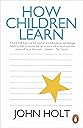
How Children Learn
Product ID: 98577195
Desertcart purchases this item on your behalf and handles shipping, customs, and support to Spain.
A book where John Holt uses anecdotal observations that question assumptions about how children acquire knowledge and learning skills. Review: nice - nice Review: Five Stars - nice
| Best Sellers Rank | #246,353 in Books ( See Top 100 in Books ) #6,540 in Education (Books) #16,304 in Personal Transformation |
| Customer Reviews | 4.4 out of 5 stars 98 Reviews |
K**A
nice
nice
S**S
Five Stars
nice
S**.
Enlightening... wish I read it sooner...
My daughter has just turned 3 yesterday. I bought this book about 2 weeks ago and once I started reading it, I just could not put it down. It was a very entertaining experience reading about the behaviour of children, I was so struck by the truth and familiarity of what the author described that I laughed till I cried. It made me start looking at how I had been raising my daughter so far, and made me look back at my childhood years (of which I have very strong memories of), thinking why in the world I had sometimes been doing to my child the way I'd use to hate as a kid when my parents did the same to me. Sometimes people just end up acting like their parents, I think because that was the only living example of parenting they had experienced in their lives, and since their lives had not turned out disastrous, they assumed it was probably an acceptable, if not, one of the many correct ways of "parenting" which will not hurt their children. Its surprising (and somewhat daunting) to realise just how many people (including my own parents) have been misguided so deeply in thinking that sending their own children to school is the best way for children to grow up learning and becoming smarter, useful people in the society. What's worse is that some parents think that school is *the* only proper way of educating kids, and they would never entertain any thoughts of educating their own kids themselves - with care and attention. They just leave it to the school teachers in school (who by the way, are often too overburdened with work to provide enough individualised attention to pupils. In a school system, it is often impossible for any teacher to teach each child according to their own learning pace - so children who are quicker to learn can get bored if the teacher's going too slowly, and children who are slower to learn try desperately (in many cases, in vain!) to catch up. Bottom line is : if parents leave all or most of the responsibility of education to the school system, their kids will miss out on a lot more knowledge they could possibly benefit from, if their parents had played a more active and supportive role in taking up the educational responsibility for their kids. This is not to say that by taking an active role, parents should adopt a "school-teacher"-like approach to their kids by reprimanding them, setting up too many limits at home, constantly correcting their children, etc. In my opinion, one of the best points John Holt has made in this book about educating children is that kids learn better if the learning experience itself has been pleasant and free, rather than having the parent constantly hovering over the child correcting the child constantly. Children must be allowed to explore the world by themselves. Yes, rules are sometimes absolutely necessary. Rules like "Do not go near the hot stove", for example, are necessary for health and safety. Otherwise, children should be left free to explore the workings of the things around them and make their own mistakes. The best way of learning (for children and adults alike) is always to keep an open mind and play by trial and error and not be afraid of making mistakes. Mistakes only help us grow. I just wish I had read this book sooner. I know that at times, I can act towards my daughter just like the way my parents did to me, and it didn't really produce any good at all. Just a nagging feeling of guilt all the time for trivial things really. Looking back, I wish I could just take back all those instances and replace them with positive ones for my daughter. Now I hope its not too late to reverse some of the damage I might have done! This book's educational value is unsurpassed. If you're already checking out the book's reviews on Amazon now, I suggest you just get a copy of the book and see for yourself what every reviewer here has been raving on about. It's a small book - short and sweet, yet laden with so many ideas and tips on parenting, and to top it all off, it makes for a very entertaining to read. The language is informal, almost diary-like, and what's more, all the ideas presented are well-researched, tried-and-true methods. The book also makes for a rather nostalgic read for me, as I found myself identifying traits of my own behaviour when I was a child and wondering "what if" things were done differently back then. I wouldn't dare say this book is the authoritative guide on parenting, but it has the definite potential to surprise and enlighten many people - albeit people whose parents shoved them to school since they were young and never knew any better. It can and will possibly contradict many preconceived notions you may have about what makes for proper, good parenting.
1**Y
A classic for a reason - just as fresh and inspirational now!
Many books on psychology or learning become dated very quickly with new advances in knowledge; this book is not one of them. From what I picked up in this book and in "How Children Fail", the author John Holt was a teacher who took a year to observe children and how they learn, from close observation at home and in school. The key premises. What he found is that the way children learn is wildly different from how we (as adults in charge of their learning) believe it works. He found that children start out keen for knowledge and learning, and learn by constantly sifting through the chaos for threads, and then they test different theories about how things work. They learn through tactile experience, through patient experimentation, they want to know and to understand, and often show far more advanced capabilities than they are given credit for. However, the way schools are set up does not align with how they learn, and often stifles the wonder and joy for learning, in favor of shame, anxiety, pleasing people in authority, and learning how to cheat (on purpose or through interpreting nonverbal clues given by teachers/parents) and game the system. This book focuses much more on the wonder and joy of learning (How Children Fail focuses more on the school part), and is really inspirational, and the reader can gain some really good practical tips about how to deal with children. The book is set up as almost a journal - at first Holt records his observations, without all that much interpretation, and then he starts analyzing. It's a really natural way for us as readers in turn to learn, and his conclusions then have the impact of "yes this is it!" because we walked the path along with him, and "saw" these children and how they act. I have been surprised by how much I have thought about this book since finishing it, and how often his observations float to the surface of my brain, especially when dealing with children, but also when dealing with adults and when observing myself. Note that there are some dated references (like to a typewriter) and some of the adult-child interactions pluck at current sensibilities oddly (like the game that one little child invented and played with him where they "spanked" him and he play-cried). But that was another era with different rules, and the book continues to be powerful and feel relevant today.
T**9
da leggere
Anche se il libro è stato scritto molti anni fa, è veramente interessante notare come le idee di Holt siano all'avanguardia pure oggi. Lo consiglio a genitori e insegnanti!
C**É
Fantastic
Anybody who is ever going to spend more than 5 minutes around kids should pick up this book and take its lessons to heart.
K**E
Not a crammer! Child-led learning unveiled
Think the one-star review showed a classic lack of understanding, in that parents sometimes pick up these kind of books expecting something to help their child have an edge in school. In fact, it's not that kind of book at all. Having read a few of his books, John Holt has the central idea that children can, and do, learn a great deal more than we realise without being "taught" at all. If that idea surprises you, then get this book and find out more. You may finish it agreeing with him to a greater or lesser extent, but there is no doubt that the case studies he gives show us the processes children go through when they learn, and how our efforts to "teach" them can in fact out them off whatever it is we are trying to teach them. Of course, this goes counter to a lot of my accumulated beliefs: as a parent, I feel it's my job, even my duty, to guide and teach my daughter. But as we have just decided to homeschool her, I have started to read up on educating children outside the schoolroom, and this book was my starting point. Whatever you may think of Mr Holt's central tenets, there is no doubt he comes across a wonderful man who genuinely listened to children and attempted to see the world as they did. It's a humane and loving work which I think should be on the bookshelf of every parent...not that I would try to force that view on you of course. That would be far too much like teaching!
Trustpilot
2 weeks ago
1 month ago