
Buy anything from 5,000+ international stores. One checkout price. No surprise fees. Join 2M+ shoppers on Desertcart.
Desertcart purchases this item on your behalf and handles shipping, customs, and support to Spain.
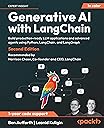
Go beyond foundational LangChain documentation with detailed coverage of LangGraph interfaces, design patterns for building AI agents, and scalable architectures used in production—ideal for Python developers building GenAI applications Key Features Bridge the gap between prototype and production with robust LangGraph agent architectures Apply enterprise-grade practices for testing, observability, and monitoring Build specialized agents for software development and data analysis Purchase of the print or Kindle book includes a free PDF eBook Book Description This second edition tackles the biggest challenge facing companies in AI today: moving from prototypes to production. Fully updated to reflect the latest developments in the LangChain ecosystem, it captures how modern AI systems are developed, deployed, and scaled in enterprise environments. This edition places a strong focus on multi-agent architectures, robust LangGraph workflows, and advanced retrieval-augmented generation (RAG) pipelines. You'll explore design patterns for building agentic systems, with practical implementations of multi-agent setups for complex tasks. The book guides you through reasoning techniques such as Tree-of -Thoughts, structured generation, and agent handoffs—complete with error handling examples. Expanded chapters on testing, evaluation, and deployment address the demands of modern LLM applications, showing you how to design secure, compliant AI systems with built-in safeguards and responsible development principles. This edition also expands RAG coverage with guidance on hybrid search, re-ranking, and fact-checking pipelines to enhance output accuracy. Whether you're extending existing workflows or architecting multi-agent systems from scratch, this book provides the technical depth and practical instruction needed to design LLM applications ready for success in production environments. What you will learn Design and implement multi-agent systems using LangGraph Implement testing strategies that identify issues before deployment Deploy observability and monitoring solutions for production environments Build agentic RAG systems with re-ranking capabilities Architect scalable, production-ready AI agents using LangGraph and MCP Work with the latest LLMs and providers like Google Gemini, Anthropic, Mistral, DeepSeek, and OpenAI's o3-mini Design secure, compliant AI systems aligned with modern ethical practices Who this book is for This book is for developers, researchers, and anyone looking to learn more about LangChain and LangGraph. With a strong emphasis on enterprise deployment patterns, it’s especially valuable for teams implementing LLM solutions at scale. While the first edition focused on individual developers, this updated edition expands its reach to support engineering teams and decision-makers working on enterprise-scale LLM strategies. A basic understanding of Python is required, and familiarity with machine learning will help you get the most out of this book. Table of Contents The Rise of Generative AI: From Language Models to Agents First Steps with LangChain Building Workflows with LangGraph Building Intelligent RAG Systems with LangChain Building Intelligent Agents Advanced Applications and Multi-Agent Systems Software Development and Data Analysis Agents Evaluation and Testing Observability and Production Deployment The Future of LLM Applications Review: An excellent book. - This book provides a systematic introduction to how to develop agents, covering various aspects of the field. It is truly outstanding. Review: Amazing - This is a great read. I enjoyed everything about this book - the content, the writing. There are a few typos, but apart from this, it is great for anyone working with LangChain.


| Best Sellers Rank | #113,313 in Books ( See Top 100 in Books ) #21 in Artificial Intelligence (Books) #39 in Natural Language Processing (Books) #198 in Artificial Intelligence & Semantics |
| Customer Reviews | 4.5 out of 5 stars 60 Reviews |
S**U
An excellent book.
This book provides a systematic introduction to how to develop agents, covering various aspects of the field. It is truly outstanding.
J**T
Amazing
This is a great read. I enjoyed everything about this book - the content, the writing. There are a few typos, but apart from this, it is great for anyone working with LangChain.
M**T
A good introduction to agenticAI
Worth reading with the Github code on the screen
S**I
Modern LLM Practical Guide
Generative AI with LangChain is a comprehensive, technically rich, and highly practical guide for developers and architects building LLM applications. it elaborates LangGraph—a powerful orchestration framework built on top of LangChain—and teaches how to use it to build structured, multi-agent workflows capable of reasoning, coordination, and error recovery. One of its greatest strengths lies in demystifying the journey from prototype to production by introducing scalable design patterns that incorporate advanced techniques like retrieval-augmented generation (RAG), hybrid search, re-ranking, and fact-checking. Readers are guided through intelligent agent construction using LangGraph’s node and edge abstractions, bringing determinism and modularity to systems that are otherwise probabilistic and fragile. A major focus of the book is showing how to architect robust workflows that go beyond one-shot queries or simple chatbots. It includes examples of specialized agents for tasks such as data analysis and software development—use cases that are increasingly being adopted across industries. Moreover, the book doesn’t shy away from difficult topics like observability, monitoring, and testing in dynamic LLM environments. Concepts such as latency tracing, model output evaluation, and prompt governance are treated as essential, not optional. For teams concerned with responsible AI practices, there’s also guidance on embedding security, compliance, and ethical development into the system design from the outset. While it assumes basic Python skills, it remains friendly to intermediate readers, and the advanced topics will be particularly valuable for experienced teams working on critical production systems. Overall, this second edition serves as a field guide for anyone serious about building intelligent, scalable, and trustworthy generative AI applications. It is an essential resource for moving from lab experiments to reliable deployments, offering practical blueprints for architecting AI agents that can reason, interact, and perform in real-world enterprise environments. Whether you're working solo or as part of a cross-functional platform team, The inclusion of multi-agent coordination patterns—where multiple agents can specialize, delegate, and hand off tasks—offers a glimpse into what the future of enterprise AI may look like. this book will give you the patterns, tools, and confidence to deliver LLM-powered solutions that are not only smart, but stable and secure.
A**A
Great Resource for those working for Lang Chain
I'm working on building some AI products for work. This has been a great resource to learn how to properly leverage LangChain and LangGraph when building AI products using GenAI.
B**N
Practical, Updated Guide for Agent Development with LangChain
I read the first edition and liked the foundational overview, but the second edition really shines when it comes to building with agents. It goes beyond concepts and dives into actual agent development, how to integrate tools, enable multi-step reasoning, and build workflows that do more than just respond to prompts. The real-world examples, especially around question answering and task automation, helped connect the dots for me. If you’re serious about using LangChain to build functional, dynamic LLM apps, this edition is a must-read.
T**I
Just getting started with this book... and already building things!
I’ve just started reading this book and diving into the hands-on labs, but I’m really impressed! As I’m not a Python expert or a professional AI engineer, I find this book easy to follow. The explanations are clear and practical, and the labs make it easy to start building things right away. All needed is explained in a way that makes sense without being overwhelming (at least that's my view). As I'm progressing through this book, I'm learning not just what the tools do, but how and when to use them in real-world examples. Highly recommended this well-written resource to anyone curious about building stuff with LangChain.
A**S
Felt a bit deceived!
Says “In color” but it has no color! The structure of the book is not very clear. It feels it is trying to cover all topics but there is no flow in the book or examples.
C**N
Great book, I recommend it
The best book for learning langchain and langgraph
S**E
Practical Read
Only a fraction of the way through this book but it has been very helpful for understanding how to use this very powerful framework to accomplish things. Langgraph has been especially mind blowing after writing scrappy python code to organize everything. The book is even better when you consider how daunting and unstructured langchain’s documentation can be. Would recommend for developers looking to understand practical design patterns for AI applications.
A**A
What You Need
Very understandable and easy to follow.
B**L
I recommend it
I have read some books about agentic Ai. This one belongs to the group I recommend. It is focused on Lang chain, but also contains plenty of base knowledge to start with. Where it could improve is to show more knowledge about agentic Ai patterns.
A**N
Pretty good for beginners and intermediate
It’s really nice book I like it and I like the fact that you get an online version of it unfortunately the examples are not that advanced so it’s good for intermediate or beginners but if you’re looking for like building a huge product this is not gonna help you it just explains the basics and the Intermediate techniques like it opens the doors for you but it doesn’t provide advanced techniques for complex use cases this is my honest review. Please note that I didn’t complete the book. I wrote this review only after reading the first three chapters, so you have to judge that for yourself
Trustpilot
5 days ago
2 weeks ago