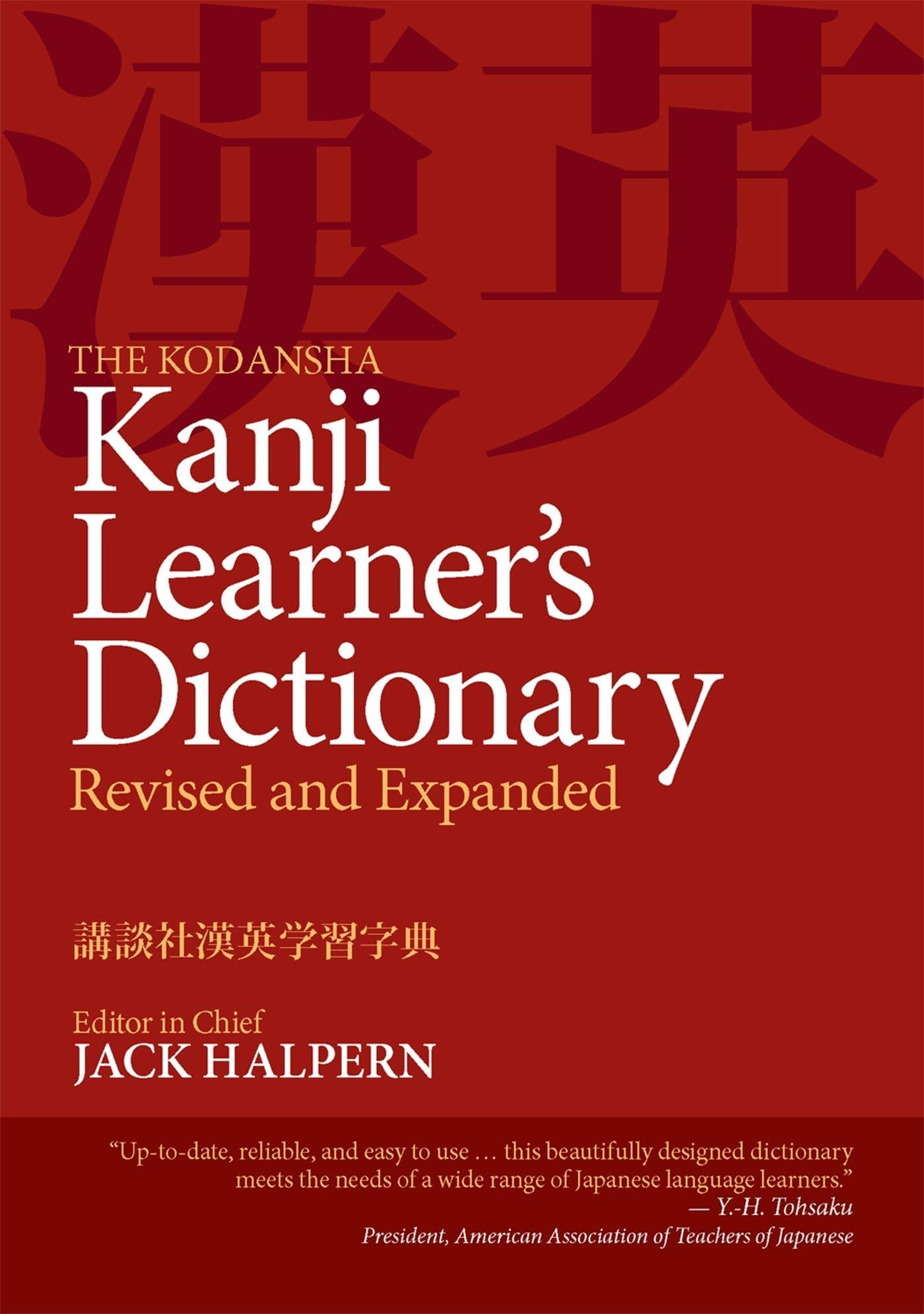
The Kodansha Kanji Learner's Dictionary: Revised and Expanded
Product ID: 6909490
Buy anything from 5,000+ international stores. One checkout price. No surprise fees. Join 2M+ shoppers on Desertcart.
Desertcart purchases this item on your behalf and handles shipping, customs, and support to Spain.
With The Kodansha Kanji Learner's Dictionary: Revised and Expanded , learners finally have at their fingertips accurate and in-depth information on all the kanji prescribed by the Japanese government. In all, 3,002 characters-772 more than in the first edition-fill its pages, making it the most comprehensive and up-to-date dictionary of its kind. The main goal of the dictionary is to give the learner instant access to a wealth of useful information on kanji, including their meanings, readings, stroke order, and usage in compounds. Compounds pose a special problem for learners. Normally one must memorize them as unrelated units. A unique feature of this dictionary that overcomes this difficulty is the core meaning, a concise keyword that defines the dominant sense of each kanji, followed by character meanings, or specific senses the kanji can have when used in the living language. Together these features help learners understand the logic behind compound formation. Another unique feature is the System of Kanji Indexing by Patterns (SKIP), a revolutionary indexing system that has gained widespread popularity because it enables the user to locate characters as quickly and as accurately as in alphabetical dictionaries. With SKIP, all one needs to do to find a kanji is identify the geometrical pattern to which it belongs, then count the strokes in each part of that pattern-a much speedier process than searching by traditional methods. These features, and many more, make this dictionary the most powerful kanji-learning tool ever devised. Review: Great dictionary in every way - The Kodansha Kanji Learner's Dictionary Revised and Expanded, is all you could hope for and more, much more. With the brilliant and easy SKIP method of kanji lookup, plus 4 other methods, the kanji you want can be found in less than a 1/2 minute, (unless you stop to browse, which is very tempting). The 5 methods of lookup are clearly and simply laid out on the inside of the front and back covers with more descriptive material on the methods in the appendixes. Easy to understand. Extremely valuable are the Core meanings with the pertinent Kanji in red. If you know a core meaning, you can understand or sense what an unknown compound means. Handy as well are the stroke order diagrams to help you learn to write the characters better and to count strokes correctly. There are also tips for correct counting of strokes in Appendix 2. I have used the SKIP method with the first edition's electronic version as well as in the App so I was a bit concerned the paper version would slow me down. Not at all! I now prefer the paperback for the beauty of it and for browsing. Gone is the romaji of the first edition making this a highly more usable dictionary, more professional and more in line with current teaching. There are 3002 kanji, 772 more than the first edition and thousands of compounds which appear to be well chosen. The meanings are precise, well written and also well chosen. The front and back material is very interesting and Jack Halpern and the others who worked on this dictionary should be highly applauded and greatly thanked! . The paper is perfect with some see through but not in anyway disturbing, the text remains quite clear.The type used for the hiragana and katakana is beautifully clear and so easy to read, with no inky muddiness, no lines running together. It is very well designed, the cover is sturdy. The center margin is wide enough for readability when opened. At 1 3/4 inch thick, it is full value for the money. I don't feel you have to be only a learner to get full value from this dictionary. It is going to be by my side for many years. Thank you Jack Halpern! Review: Kanji improvement - This is useful in advancing kanji learning
| Best Sellers Rank | #2,241,135 in Books ( See Top 100 in Books ) #3,519 in Foreign Dictionaries & Thesauruses |
| Customer Reviews | 4.8 out of 5 stars 349 Reviews |
L**N
Great dictionary in every way
The Kodansha Kanji Learner's Dictionary Revised and Expanded, is all you could hope for and more, much more. With the brilliant and easy SKIP method of kanji lookup, plus 4 other methods, the kanji you want can be found in less than a 1/2 minute, (unless you stop to browse, which is very tempting). The 5 methods of lookup are clearly and simply laid out on the inside of the front and back covers with more descriptive material on the methods in the appendixes. Easy to understand. Extremely valuable are the Core meanings with the pertinent Kanji in red. If you know a core meaning, you can understand or sense what an unknown compound means. Handy as well are the stroke order diagrams to help you learn to write the characters better and to count strokes correctly. There are also tips for correct counting of strokes in Appendix 2. I have used the SKIP method with the first edition's electronic version as well as in the App so I was a bit concerned the paper version would slow me down. Not at all! I now prefer the paperback for the beauty of it and for browsing. Gone is the romaji of the first edition making this a highly more usable dictionary, more professional and more in line with current teaching. There are 3002 kanji, 772 more than the first edition and thousands of compounds which appear to be well chosen. The meanings are precise, well written and also well chosen. The front and back material is very interesting and Jack Halpern and the others who worked on this dictionary should be highly applauded and greatly thanked! . The paper is perfect with some see through but not in anyway disturbing, the text remains quite clear.The type used for the hiragana and katakana is beautifully clear and so easy to read, with no inky muddiness, no lines running together. It is very well designed, the cover is sturdy. The center margin is wide enough for readability when opened. At 1 3/4 inch thick, it is full value for the money. I don't feel you have to be only a learner to get full value from this dictionary. It is going to be by my side for many years. Thank you Jack Halpern!
P**U
Kanji improvement
This is useful in advancing kanji learning
J**S
The best update kanji dictionary you can get!!
I just got my copy of this book today and I'm really happy it was worth the price, I have the previous edition too but I must say this is by far the best (compact) and update kanji dictionary I own by now. It has the official kanji list 2,136 of 2009 reform and much more kanji; the most outstanding feature of this edition is that every kanji is given its readings (ON/kun) using KANA instead of roumaji which was the previous book, every entry has many compounds showing the use and frecuency of that character plus its proper stroke order (except the kanji for names or Jinmeiyou Kanji have no stroke order shown) which help you to memorize them properly...at the end it explain the sounds of Japanese language using the IPA (International Phonetic Alphabet) for improving your pronunciation if you want to know nowdays kanji this is the DICTIONARY for you!!
S**Y
Very Satisfying
Similar looking kanji have always been nightmare for me. Therefore, I needed a printed dictionary where the kanji are categorized according to their similarity, and the radicals. I think this is what called "jibiki" in Japanese. I also recommend "Dictionary of Japanese Grammar" book for beginners. They go along together for a good self study pack. I do not like subject-oriented books like Genki or Minna no Nihongo, I would like to study the way the most people would say "boring". It is also time saver. Don't get me wrong, the dictionary is pretty much fun to use. You just have to get used to categorizing systems-there are four- to find whatever you are looking for quickly. I presumably fall in somewhere between the beginner and the intermediate level, I can recognize and read up to 600 kanji, and hundreds of words made of kanji, but I have yet to notice any mistakes. For more advanced vocabulary, it would be better if there were more words of the given kanji, but it is not essential for the beginner or lower intermediate. It's very tiny, pocket-sized but a little bit thick. The most used kanji are in red, others in black. The design, page color, fonts, etc. are adjusted so it won't be tiring for your eyes. There is one thing I wanted to be different. Cover is too thin, so I fear that I will damage it if I don't carry very carefully. It comes with a case, but I wish there was a hard cover version.
B**R
Must have
If you are learning Japanese I consider this a must have. It is well laid out for a student who is learning the language. There is more than one index in the back so, if like me, you can't find it in one index you will likely find it in another. Each entry shows the stroke order, the number of strokes, quite a few compounds (or words that include the kanji in question). The amount of information packed into this book is bountiful to say the least. *** If you are a new student to Japanese it will likely take you sometime to discover all the wonderful things this dictionary has to offer. When I first started using it I would sometimes resort to "paging through" the dictionary looking for a Kanji. But in doing so i learned the layout and discovered many ways to find a Kanji. Perseverance will win in the end and you will learn more than you thought possible.
A**S
Very handy dictionary!!
I got this to supplement the ancient Nelson kanji dictionary that is often frustrating to use. Although I didn't read this dictionary's intro closely, I am still able to use it easily. I can locate a character in minutes if not seconds where the Nelson's traditional look-up method drove me nuts. What I like is that the examples provided for each character include words in which that character is NOT the first one in the word. This enables me to find many words faster. In the Nelson, only the words BEGINNING with that character are given as examples. The larger type is also easier to read and there is a step-by-step stroke diagram if you care to learn the proper order.
G**A
4 stars for the book; 5 for a different incarnation
This new edition expands on the old one for the ShinJoyo and also for the hundreds of name kanji introduced in 2003. Frankly, it has nearly all the kanji you could meet in reading without furigana annotation. I looked for kanau, tsuji, i (Italy, Ito) and others and they were all there. It is about the size of the old full 1st edition kanji book in listings. You may not need the more expensive larger one but that does seem to have some additional info in the entries from what I saw on Amazon in the preview. Some of the definitions in the book I always found a bit off. Kin (number 2000) (fungus, germ) has the meaning listed as bacteria but really if this kanji means anything in Japanese it means fungus. (Check out the Kanjigen and Kenkyusha ShinWaEiDaiJiten listings and see for yourself). Bacteria is more directly saikin (detailed germ). Essential Kanji has "fungus, germ" as meanings and is dead on. Fungus doesn't even appear anywhere in the entire full entry. There are a number of entries like this. Also, having a listing of 14 entries for kakeru (number 449) don't seem to make sense. These have to do with lexical niceties inherent with shoehorning in a yamato word (kun reading only) with a Chinese character. They are better handled in a regular dictionary. All the kan-ei dictionaries do this however. It still bugs me. Nevertheless, there is one saving grace. They have an IOS app for $24.95 (cheaper than the book) which is outstanding and looks just like the book entries color-wise. 1 - You can switch between kana or romaji for the readings. Choice is good. 2 - The SKIP search uses cylinders which you can spin for the entries. If you count the stroke number wrong it has these entries greyed out. If you click one it will show you the correct entry. One more click and you are there! Remember before you had to start over with the "correct SKIP number"? Finally, finally, just send me to what I want. 3 - You can browse the entries by Toppan frequency or by grade level. This is powerful because it gives you the equivalent of flash cards. You could even use it as a substitute for the Kanji Learners Course if you already know the bushu meanings and can make up your own stories - sometimes more preferable. Plus you are not forced to learn wacky low frequency characters early on just because they are Joyo. They might have chosen the aggregate collection on strict Toppan frequency but did not, but now you can. Great for review. 4 - Most importantly, if you tap on a compound entry, you get a new page with the kanji as components. Tap these and you are instantly sent to the meanings of the components. Sweet. This is a very powerful vocabulary learning tool much like what they have always had in the "New Dictionary of Kanji Usage". Now you have it too. denwa - electric voice (telephone), denchi - electric pond (battery). This is a royally painful process to do using the book. In short, the app is five stars. I would suggest that you just buy the app if you have an IOS device especially if you have one with a retina display. I also have Daijirin (updated for free with 800 more entries in May, 2013 - see the advantage? Also it costs 2/5 the print version + postage from Nihon; and that edition is stuck at 2006). If you already have purchased the book, it is probably worth just breaking down and getting the app in addition. My book went into a drawer and then finally storage. The app is really well done.
J**.
Great for repeated translation of basic terms
First use of this dictionary is rather unusual due to its layout. For the main portion, the dictionary is divided first into structure (such as left/right - 郡, top/bottom - 奈, enclosure - 国, or whole - 大), then into stroke for the first radical (left, top, enclosure) then stroke count for the remaining portion. For example, 町 would be 5 strokes (田), followed by 2 strokes (丁), or LR section 5-2. Once you go to a section, there is a guide on the edges of the page that show the first radical used for that section. If you don't know the stroke count, and want to look by the kanji, flip to the very back of the book. There, the kanji are sorted into an index by the same method, which makes it easy to find which one you are looking for and tells the exact page to flip to. Overall, I recommend this book if you are planning to translate the most common kanji over and over again for practice. If you only need it for once-in-a-while use, I recommend using an online lookup tool or the app version of this book.
W**E
Fastest most efficient Japanese dictionary for a student.
As a dictionary it's easily the best I've come across. Pretty comprehensive - even with a special interest subject - I have yet to catch it out, and it has as much as needed - the kana (with each Kanji and their sounds in an reference section), radicals reference, table of frequently miscounted strokes - and how to use their "pattern" classification system. It gives On and Kun readings and lists of useful compound words/Kanjis. Plus it gives progressive diagrams of stroke order for those learning. Well, it gives more information than I could put in a review. It's based on the idea that Kanjis follow 4 basic patterns. Once you recognise the pattern you count the strokes of the key part of the pattern, then count the remaining strokes....then look it up. Down the margin of each page the possible "key shapes/pattern keys" are listed so you can flip though to find the one you want - then look at the entries for the (remaining) stroke count. So, for instance, for pattern 1, you might have 4-7 - the key by which you identify the pattern has 4 strokes while the remaining strokes add up to 7. (There's a slight variation with the last of the patterns but it's easy to work out). So, under that pattern (top corner of page so easy to find) you look up 4- then flip through to the right shape for your 4, finally go to the -7 (i.e. 4.7) and find the Kanji. The secret is counting the strokes correctly. If you practice drawing a few Kanji with a pencil or whatever you soon get the hang of it.
C**I
Per imparare i kanji usati oggi!!!
Conoscevo già la prima edizione di questo dizionario, oltre a possedere già il classico Nelson! E allora perchè comprarlo? Semplicemente perché è perfetto!!! Ottimo lay-out, ottima organizzazione e validità dei contenuti. Personalmente lo utilizzo come manuale di kanji, più che come dizionario, perché la scelta dei composti è equilibratissima, aggiornata e basata sulla frequenza e l'effettiva utilità per leggere giornali, libri, blog e siti attualmente pubblicati! I diversi significati sono poi chiaramente distinti e la comprensione dell'uso di ogni singolo kanji è sicura tanto che si diventa capaci di capire anche composti mai visti! Utile il rimando agli omofoni e ai kanji facilmente confondibili! I più frequenti poi, sono distinti dal colore rosso, così si può decidere la priorità nello studio. C'è lo schema per la scrittura di tutti i kanji tranne quelli dei nomi. La nuova edizione aggiunge due elementi notevoli, l'aggiornamento alla riforma del 2010 (compresi tutti quelli dei nomi, per cui si arriva a 3000) e l'uso dei kana al posto del romaji per le letture on e kun. Trovate il 99% dei kanji usati oggi! Se volete andare sullo specialistico, buttatevi pure sul Nelson (con il relativo peso) o meglio su dizionari on line! Questo vi farà compagnia per un bel po'. Consigliatissimo a chi sa l'inglese. Il dizionario Vallardi della Marina Speziali è aggiornato nel numero dei kanji (ma senza i kanji per i nomi), ma è insufficiente nell'analisi e negli esempi. Insomma, visto che i prezzi dei due si avvicinano, se solo sapete anche poco inglese, decisamente vi consiglio di scegliere questo! Se invece conoscete solo la lingua madre, vi perdete un gioiello!:)
D**)
You fall in love with Japanese language and in general linguistics and the ...
A monumental work to ease learning Kanji. After practicing with this book you become expert in guessing the meaning of each Kanji based on the radicals within each. You fall in love with Japanese language and in general linguistics and the question of "why there are so many different languages in teh world?"., different flowers of a garden good Job Profesor Halpern!
C**N
Un regalo caído del cielo
Este diccionario es para mí imprescindible a la hora de estudiar japonés. Es pequeño, muy manejable, y completo. El sistema de localización de kanjis es un milagro, lo que buscas, lo encuentras.
C**N
indispensable dicitionnaire de japonais
j'ai commencé à apprendre le japonais il y a quelques mois, je trouve avec ce dictionnaire un complément très intéressant pour approfondir mes apprentissages indépendamment des cours.
Trustpilot
5 days ago
3 weeks ago