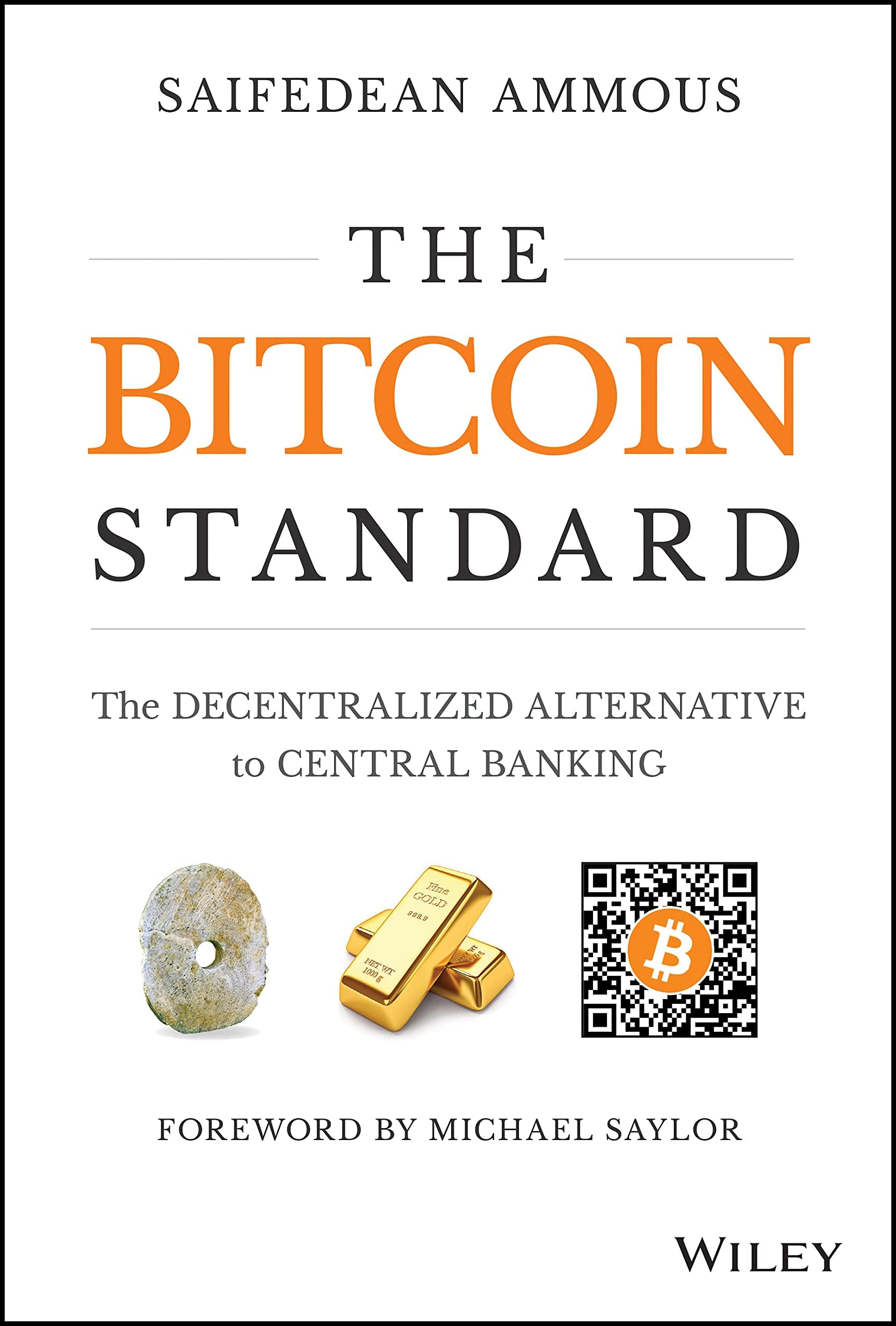
The Bitcoin Standard: The Decentralized Alternative to Central Banking
Product ID: 62037385
Buy anything from 5,000+ international stores. One checkout price. No surprise fees. Join 2M+ shoppers on Desertcart.
Desertcart purchases this item on your behalf and handles shipping, customs, and support to Spain.
A comprehensive and authoritative exploration of Bitcoin and its place in monetary history When a pseudonymous programmer introduced “a new electronic cash system that’s fully peer-to-peer, with no trusted third party” to a small online mailing list in 2008, very few people paid attention. Ten years later, and against all odds, this upstart autonomous decentralized software offers an unstoppable and globally accessible hard money alternative to modern central banks. The Bitcoin Standard analyzes the historical context to the rise of Bitcoin, the economic properties that have allowed it to grow quickly, and its likely economic, political, and social implications. While Bitcoin is an invention of the digital age, the problem it purports to solve is as old as human society itself: transferring value across time and space. Author Saifedean Ammous takes the reader on an engaging journey through the history of technologies performing the functions of money, from primitive systems of trading limestones and seashells, to metals, coins, the gold standard, and modern government debt. Exploring what gave these technologies their monetary role, and how most lost it, provides the reader with a good idea of what makes for sound money, and sets the stage for an economic discussion of its consequences for individual and societal future-orientation, capital accumulation, trade, peace, culture, and art. Compellingly, Ammous shows that it is no coincidence that the loftiest achievements of humanity have come in societies enjoying the benefits of sound monetary regimes, nor is it coincidental that monetary collapse has usually accompanied civilizational collapse. With this background in place, the book moves on to explain the operation of Bitcoin in a functional and intuitive way. Bitcoin is a decentralized, distributed piece of software that converts electricity and processing power into indisputably accurate records, thus allowing its users to utilize the Internet to perform the traditional functions of money without having to rely on, or trust, any authorities or infrastructure in the physical world. Bitcoin is thus best understood as the first successfully implemented form of digital cash and digital hard money. With an automated and perfectly predictable monetary policy, and the ability to perform final settlement of large sums across the world in a matter of minutes, Bitcoin’s real competitive edge might just be as a store of value and network for the final settlement of large payments―a digital form of gold with a built-in settlement infrastructure. Ammous’ firm grasp of the technological possibilities as well as the historical realities of monetary evolution provides for a fascinating exploration of the ramifications of voluntary free market money. As it challenges the most sacred of government monopolies, Bitcoin shifts the pendulum of sovereignty away from governments in favor of individuals, offering us the tantalizing possibility of a world where money is fully extricated from politics and unrestrained by borders. The final chapter of the book explores some of the most common questions surrounding Bitcoin: Is Bitcoin mining a waste of energy? Is Bitcoin for criminals? Who controls Bitcoin, and can they change it if they please? How can Bitcoin be killed? And what to make of all the thousands of Bitcoin knockoffs, and the many supposed applications of Bitcoin’s ‘block chain technology’? The Bitcoin Standard is the essential resource for a clear understanding of the rise of the Internet’s decentralized, apolitical, free-market alternative to national central banks. Review: “The Bitcoin Standard” by Saifedean Ammous - Three months ago, I embarked on a journey to unravel the complexities of financial technology, and “The Bitcoin Standard” by Saifedean Ammous was the first book I chose. What an extraordinary starting point it turned out to be! This book, now a cornerstone in my collection of over twenty titles on the subject, easily secures a spot in my top three for its clarity, depth, and transformative insights. As I sit down to write this review today, I am struck by how profoundly it shaped my understanding of money, economics, and the revolutionary potential of Bitcoin. Ammous masterfully combines historical analysis, economic theory, and forward thinking vision to craft a compelling case for Bitcoin as a decentralized, sound money system. The book begins with a captivating exploration of money’s evolution from primitive barter systems to gold, backed currencies laying a foundation that makes the concept of Bitcoin accessible even to newcomers like I was at the time. Ammous doesn’t just explain what Bitcoin is; he illuminates why it matters, dissecting the flaws of fiat currencies with surgical precision. His discussion of inflation, central banking, and the erosion of purchasing power was an eye opener, making me question assumptions I would never thought to challenge. What sets “The Bitcoin Standard” apart is its ability to weave technical detail with broader philosophical and economic implications. Ammous dives into Bitcoin’s mechanics its fixed supply, proof of work, and decentralized ledger without overwhelming the reader. His writing is clear and engaging, balancing academic rigor with a passionate advocacy for financial sovereignty. I was particularly struck by his concept of “time preference,” which illustrates how sound money like Bitcoin incentivizes long term thinking and savings over reckless consumption. This idea alone reshaped how I view personal finance and societal priorities. The book’s historical parallels, from the gold standard to the rise and fall of empires, added a rich context that made Bitcoin feel not just innovative but inevitable. Ammous argues persuasively that Bitcoin’s design as a deflationary asset could restore economic stability and individual freedom in a world plagued by monetary mismanagement. I found its laser focus on Bitcoin’s unique properties refreshing. It’s not a broad fintech primer but a deep dive into why Bitcoin stands alone. Reading “The Bitcoin Standard” was like being handed a map to navigate the chaotic world of modern finance. It’s rare for a book to be both a page turner and a profound education, but Ammous delivers exactly that. For anyone curious about financial technology, economics, or the future of money, this book is a must read. It didn’t just teach me about Bitcoin it gave me a new lens to see the world. Three months and twenty books later, its lessons remain as powerful and relevant as ever. Highly recommended! Review: Brain Upgraded to the 'Satoshi Standard' - Before reading The Bitcoin Standard, my understanding of money was pretty basic: you earn it, you spend it, and sometimes the number in your bank account goes up or down seemingly at random. Bitcoin? That was just that confusing internet money thing people argued about online. Saifedean Ammous didn't just explain Bitcoin; he took me on a journey through the history of money itself, from primitive seashells to gold standards to the current fiat system. And let me tell you, that journey is eye-opening. He makes a compelling case for why Bitcoin isn't just another digital fad, but a potential paradigm shift in how we think about value, scarcity, and freedom from centralized control. This book is incredibly well-researched and argued. Ammous has a knack for explaining complex economic concepts in a way that's both rigorous and surprisingly readable. It's not just for the crypto-bros; it's for anyone who's ever wondered why prices keep going up, or what gives money its value in the first place. Reading this book felt like getting a fundamental upgrade to my understanding of the world's financial plumbing. It challenged my assumptions and gave me a completely new perspective on economics and technology. If you want to move beyond the headlines and understand the fundamental principles behind Bitcoin and why it matters, The Bitcoin Standard is an essential read. It's insightful, thought-provoking, and might just change the way you view money forever. Highly, highly recommended!


| Best Sellers Rank | #10,513 in Books ( See Top 100 in Books ) #2 in E-Commerce (Books) #3 in Bitcoin & Cryptocurrencies #6 in Money & Monetary Policy (Books) |
| Customer Reviews | 4.7 out of 5 stars 8,555 Reviews |
D**K
“The Bitcoin Standard” by Saifedean Ammous
Three months ago, I embarked on a journey to unravel the complexities of financial technology, and “The Bitcoin Standard” by Saifedean Ammous was the first book I chose. What an extraordinary starting point it turned out to be! This book, now a cornerstone in my collection of over twenty titles on the subject, easily secures a spot in my top three for its clarity, depth, and transformative insights. As I sit down to write this review today, I am struck by how profoundly it shaped my understanding of money, economics, and the revolutionary potential of Bitcoin. Ammous masterfully combines historical analysis, economic theory, and forward thinking vision to craft a compelling case for Bitcoin as a decentralized, sound money system. The book begins with a captivating exploration of money’s evolution from primitive barter systems to gold, backed currencies laying a foundation that makes the concept of Bitcoin accessible even to newcomers like I was at the time. Ammous doesn’t just explain what Bitcoin is; he illuminates why it matters, dissecting the flaws of fiat currencies with surgical precision. His discussion of inflation, central banking, and the erosion of purchasing power was an eye opener, making me question assumptions I would never thought to challenge. What sets “The Bitcoin Standard” apart is its ability to weave technical detail with broader philosophical and economic implications. Ammous dives into Bitcoin’s mechanics its fixed supply, proof of work, and decentralized ledger without overwhelming the reader. His writing is clear and engaging, balancing academic rigor with a passionate advocacy for financial sovereignty. I was particularly struck by his concept of “time preference,” which illustrates how sound money like Bitcoin incentivizes long term thinking and savings over reckless consumption. This idea alone reshaped how I view personal finance and societal priorities. The book’s historical parallels, from the gold standard to the rise and fall of empires, added a rich context that made Bitcoin feel not just innovative but inevitable. Ammous argues persuasively that Bitcoin’s design as a deflationary asset could restore economic stability and individual freedom in a world plagued by monetary mismanagement. I found its laser focus on Bitcoin’s unique properties refreshing. It’s not a broad fintech primer but a deep dive into why Bitcoin stands alone. Reading “The Bitcoin Standard” was like being handed a map to navigate the chaotic world of modern finance. It’s rare for a book to be both a page turner and a profound education, but Ammous delivers exactly that. For anyone curious about financial technology, economics, or the future of money, this book is a must read. It didn’t just teach me about Bitcoin it gave me a new lens to see the world. Three months and twenty books later, its lessons remain as powerful and relevant as ever. Highly recommended!
M**S
Brain Upgraded to the 'Satoshi Standard'
Before reading The Bitcoin Standard, my understanding of money was pretty basic: you earn it, you spend it, and sometimes the number in your bank account goes up or down seemingly at random. Bitcoin? That was just that confusing internet money thing people argued about online. Saifedean Ammous didn't just explain Bitcoin; he took me on a journey through the history of money itself, from primitive seashells to gold standards to the current fiat system. And let me tell you, that journey is eye-opening. He makes a compelling case for why Bitcoin isn't just another digital fad, but a potential paradigm shift in how we think about value, scarcity, and freedom from centralized control. This book is incredibly well-researched and argued. Ammous has a knack for explaining complex economic concepts in a way that's both rigorous and surprisingly readable. It's not just for the crypto-bros; it's for anyone who's ever wondered why prices keep going up, or what gives money its value in the first place. Reading this book felt like getting a fundamental upgrade to my understanding of the world's financial plumbing. It challenged my assumptions and gave me a completely new perspective on economics and technology. If you want to move beyond the headlines and understand the fundamental principles behind Bitcoin and why it matters, The Bitcoin Standard is an essential read. It's insightful, thought-provoking, and might just change the way you view money forever. Highly, highly recommended!
A**S
Probably the most important book of my generation
This book was very helpful to me and I highly recommend. Bitcoin is admittedly an extremely obscure and abstract concept, but once understood, is almost unfathomably enlightening. When one looks at the world around them and sees all the ills and craziness, it's often possible to trace the underlying issue back to a bad incentives created by bad money. This bad money regime is enabled by an ever-present, yet often unseen, handful of individuals who single-handedly possess the ability to take from some to give to others (often in the form of taking from those on the margin and giving to those whose needs are already met). This book is in laymen's terms and is suitable for most everyone, regardless of prior experience with finance, money or business. The book answers a question most have never thought to ponder, "What is money, exactly?". The book provides a great overview of the history of money, lays out the characteristics that make for both good and bad money and finishes with an overview of how Bitcoin was created as a potential solution to some of the negative aspects present in today's fiat money system. Lastly, the book concludes with a balanced pros/cons discussion and highlights potential scenarios that would lead to both Bitcoin working and not working. Though it sounds hyperbole, this book completely changed the way I view money, finance, business, free markets and the world as a whole. Bitcoin provides a plausible avenue to a better world. As the quip from the famous Charlie Munger ironically goes, "show me the incentive, I'll show you the outcome". Bitcoin represents a paradigm shift and realignment in the underlying incentive structure driving outcomes in the world we live in. Cheers and I hope you enjoy the book as much as I did.
E**A
The author is great when he sticks to his topic; sadly, he can’t bring himself to do that.
I learned a lot from this book – enough to earn it 5 stars. I learned not just about bitcoin, but money in general. Despite its flaws, I recommend this book even to those who don’t care about bit coin. It’s a good overview of the history of money and how it works. However, there are two flaws the reader has to look past to get the most from this book. One is repetition, especially towards the end. Sadly, this is commonplace these days. Authors have 70-80 pages of material but seem to feel like it’s not a real book unless they can turn it into 250-300 pages. I’ll pay for a short, concise book if it has something valuable to say. The second flaw is more unique to this book. The author strays far from his subject matter to poop all over all kinds of things. He clearly despises John Maynard Keynes. That’s fine. But Keynes’ personal life has nothing to do with the subject of this book. And usually when an author resorts to attacking a person rather than that person’s ideas, that means the author’s ideas can’t stand up to the ideas it is criticizing, and thus has to attack the person behind the ideas to distract the reader. This is an unfortunate “self-own” / own-goal by Ammous, because his ideas clearly have merit. He should have let them stand on their own. The second half of Chapter 5 and parts of Chapter 7 can be skipped by anyone interested solely in the topic the book purports to cover. He also poops all over modern society and sees the era of the gold standard as a utopia that would return if we simply used bitcoin. For example, “Any industry in which people complain about their [jerk] boss is likely part of the [problem of loose money] because bosses can only really afford to be [jerks] in [this] economic fake reality….” In his hard-money utopia, “bosses who mistreat their workers will either lose the workers to competitors or destroy their business quickly.” Does he not remember that in the era of hard money he longs for many bosses literally owned and beat their workers? Hard money doesn't guarantee a society free of jerk bosses. And can one really consider the rocket engine and transistor simply iterations on or somehow less significant inventions than the internal-combusting engine and lightbulb? Based on Ammous commentary you’d have to believe that. He resorts to evidence-free assertions that the arts, culture, and society of yesteryear are better than today’s. None of this is empirically verifiable, and more importantly, none of it is relevant to his arguments about. “It was hard money that financed Bach’s Brandenburg Concertos while easy money financed Miley Cyrus’s twerks.” Please. There was plenty of the equivalent of twerking happening in Bach’s day, and there is art produced the last few decades that will last for centuries. The anguish he cites of Michelangelo over his art reminds me of Leonard Cohen’s over some of his, despite Leonard Cohen being part of our debauched soft-money era. And the poem he cites from Michelangelo is no more void of ego than some of the modern pop artists the author disdains. The author cherry-picks once-in-a-century artists of the past and compares them to some of the basest performers of today, a false comparison, and one he doesn’t even pretend to back up with any evidence or argument. “[O]nly long pretentious diatribes shaming others for not understanding the work give it value.” This is his criticism of modern artists. The lack of irony with which he writes this, given it describes the exact chapter it appears in, shows a sad lack of self-awareness. He should have kept these off-topic opinions to himself rather than letting it soil what is otherwise the really solid case he is making. All of this is a sad and distracting (as evidenced by how much I’m writing about these digressions compared to the book as a whole) digression from the point of his thesis. It really deserves reducing my rating by 2-stars. But because I still recommend this book despite those flaws, I’m only deducting 1 star and giving it a 4-star rating.
A**D
I Wish I Had Read This Sooner
If only I had read this sooner, I might be enjoying my early retirement a whole lot more. I thought I understood Bitcoin well enough but realised after completing this book that I only had a cursory understanding of it. Bitcoin is truly a remarkable milestone in the long history of money. This book explains this history, the problems and the various solutions which have brought humanity to trust-less digital cash which is Bitcoin. I may not agree entirely with the author about the pointlessness of 'altcoins' (similar alternatives to Bitcoin) but he does make a good case for his side. I hope the book keeps getting updated because a lot is still happening in the crypto space. A recommended read for anyone interested in economics and the history (and future) of money.
M**G
“The Bitcoin Standard” or “The Bitcoin Bible”?
About mid-way through reading this book I realized there was a problem with the book. The title doesn’t quite do it justice. Though it would be a bit hubristic to title your own book “The Bitcoin Bible” it won’t stop me from doing so on Ammous’ behalf. That’s right. This book is the missing treatise on “Why Bitcoin?”. It is not technical from a coder’s point of view; however, it is technical on its treatment of economics. Don’t let that scare you away. If you ever considered “getting into Bitcoin”. If you never heard of Bitcoin. If you are a long-time holder of Bitcoin. This book is for you. The book fills a gap on three fronts. First it helps those of us who became enamored with Bitcoin through individual and economic freedom explain our viewpoint in a succinct manner. Second, it serves as a philosophical on-ramp to the multitudes of speculators who flooded into Bitcoin in the past 6 months or so. It provides them a concrete reason to transform their time-preference (a key economic theme in the book) from trader to HODLer. Lastly, it is for people who have never heard of Bitcoin or have heard of it but don’t know or understand much about it. It provides these folks with the very best reason for converting at least some of their government-backed fiat money into the sound/hard money of Bitcoin. Another overriding theme in the book is security. Without it there is no such thing as financial freedom. Near the beginning of the book Ammous explains: “Should you come out of reading this book thinking that the bitcoin currency is something worth owning, your first investment should not be in buying bitcoins, but in time spent understanding how to buy, store, and own bitcoins securely.” This is without a doubt the best advice one could possibly give regarding Bitcoin. In reading the book you may find yourself wondering when he’s going to start getting to the Bitcoin part. The first seven chapters barely mention Bitcoin. Instead there is a gradual discussion of money and economics, including the various popular schools of economics. Ultimately, the conclusion is that Austrian Economics provides the fundamental basis of “Why Bitcoin?” In fact, those of us already schooled in Austrian Economics should celebrate the existence of this book. It can potentially spread the common-sense Austrian view to multitudes of people who otherwise would never learn of it. If you know someone who bought bitcoins for speculation or to make some quick money buy this book for them and force them to read it. You may even have to go all “Clockwork Orange” on them, strapping them to a chair and pinning their eyes open. They may scoff at first, but they’ll thank you later (yet another benefit of having a low time-preference). “The Bitcoin Bible”… er.. I mean “The Bitcoin Standard” is essential to read and understand for anyone even remotely interested in Bitcoin. Read it. Then read it again. Then pass it around to everyone you know and if they are reluctant, figure out non-violent ways to get them to read it. So, you probably shouldn’t resort to the “Clockwork Orange” method mentioned above. Just find a way. If Roger Ver can be “Bitcoin Jesus” (or more accurately “Bitcoin Judas” at this point) then Saifedean Ammous is a “Bitcoin God”. Read his bible with the highest time preference so you can learn to have a low time preference when it comes to Bitcoin itself. BTFD and HODL!
R**Y
BOOK IS BASED!!!!
I was expecting a book about Bitcoin but instead got a book about the history of money and what makes for the best form of money. I also got the first explanation for the Great Depression that I actually think is true and correct (and it’s different from the narrative I got from my college professor). This book is intelligent, common sense, and simple to follow (just the way any economic lesson should be in my opinion). Truly, before reading this book I thought I had an understanding of the case for Bitcoin but this book made me realize I didn’t even know the beginning. Thanks to this book I now have a comprehensive understanding of the case for Bitcoin and why normal economic forces will make it mainstream (as I write this the current price of Bitcoin is $117k). As you read this book you know you’re being told the truth. Truly a must read for anyone even remotely interested in the subject of Bitcoin.
A**N
Excellent book! Light on Bitcoin, but great on it's fundamentals.
Excellent book! A must-read even if you don't care about Bitcoin. The author discusses the foundations of what makes 'sound' money and describes how, over history, we've departed from these foundations, leading to a recurring set of consequences that inevitably end with the downfall of the currency and sometimes of the civilization/country. In particular, I found the history of the Roman currency interesting and telling. Later, the book discusses why gold has historically been a great store of value, and shows hard numbers that prove that it fits the conditions previously described as ideal for sound money. This part of the book feels airtight in its logic. As the author moves on to the era of fiat money, the book helped me understand the significance of Bretton Woods, the Nixon shock, as well as understand how the Keynesian, Monetarist and Austrian school of political economy understand the cycles of capitalism. I had not previously realized that despite the fact that centralized economies are no longer considered sound economic policies, the way that our Central Banks control the interest rate and currency emission is a residue of that kind of thinking. And, in the context of Democratic governments vying for the public's support, this gives Governments a tool that offers immediate short-term relief in exchange for fuzzy long-term pain which most likely will be felt by the next administration. Many of the vices of populist governments are fundamentally exploiting this loophole. The book became less insightful to me in the last 20% as it discusses Bitcoin. The discussion is centered around the properties that make it a suitable sound currency for the future, relating them to the previously established framework. While the conclusions are generally correct, Bitcoin is discussed entirely on an economic level and you won't find many technical details or explanations relating the technical design to its emerging properties.
E**O
Another Extremist Bitcoin Propaganda book
The author has very extreme opinions. He claimed that abandoning the gold standard was the root cause of all problems including the number of death of the 1st and 2nd world war. He portraits Keynes as an ignorant wannabe economist with questionable moral values and sexual preferences. And he does not save Milton Friedman too. He calls Mark Rothko's work "trash" because it takes few hours to paint his works but they are valued millions on the market. So be ready to frown an eyebrow every couple of pages. Other than that the book is thought-provoking so it worth the reading. Even if it could have been at least 50% shorter since he repeats the same concept for 9 chapters out of 10.
A**V
Easy read
Such an easy read. Makes money simple for commoners. Once you read this, you can’t go back to trusting fiat
C**J
Read this now.
An absolute must read for people interested in free markets and monetary policy. Even for people with no prior interest, this book will open your eyes to how governments impoverish their citizens (while increasing the wealth of a few) by continuously printing money, and actually have little idea what they are doing. The difference between hard and soft money, time preference etc. and how these have affected the prosperity of civilizations in the past is amazing. Now we live in a world obsessed with consumption and continuous growth. People have stopped saving. But it is saving which creates capital and prosperity. This book explains beautifully how Bitcoin fixes this. 日本語版は、まだ出版されていませんが、来年に出るようです。日本の友達などにあげるのを楽しみにしています。
S**S
Mycket lärorikt att läsa!
En bibel för alla som är intresserade av ekonomi och finans!
D**S
A must read
Excellent book about understanding what money is and the BTC origin and application. A few weeks ago , We got the 50th anniversary of the Dollar pattern and FIAT money experiment which has failed and giving privilege only to a few people near the political circles. The BTC has the power to give a more equalitarian access to a wealth and preserving on time. The BTC has the power to change the World. It already started to do it.!
Trustpilot
2 months ago
1 day ago