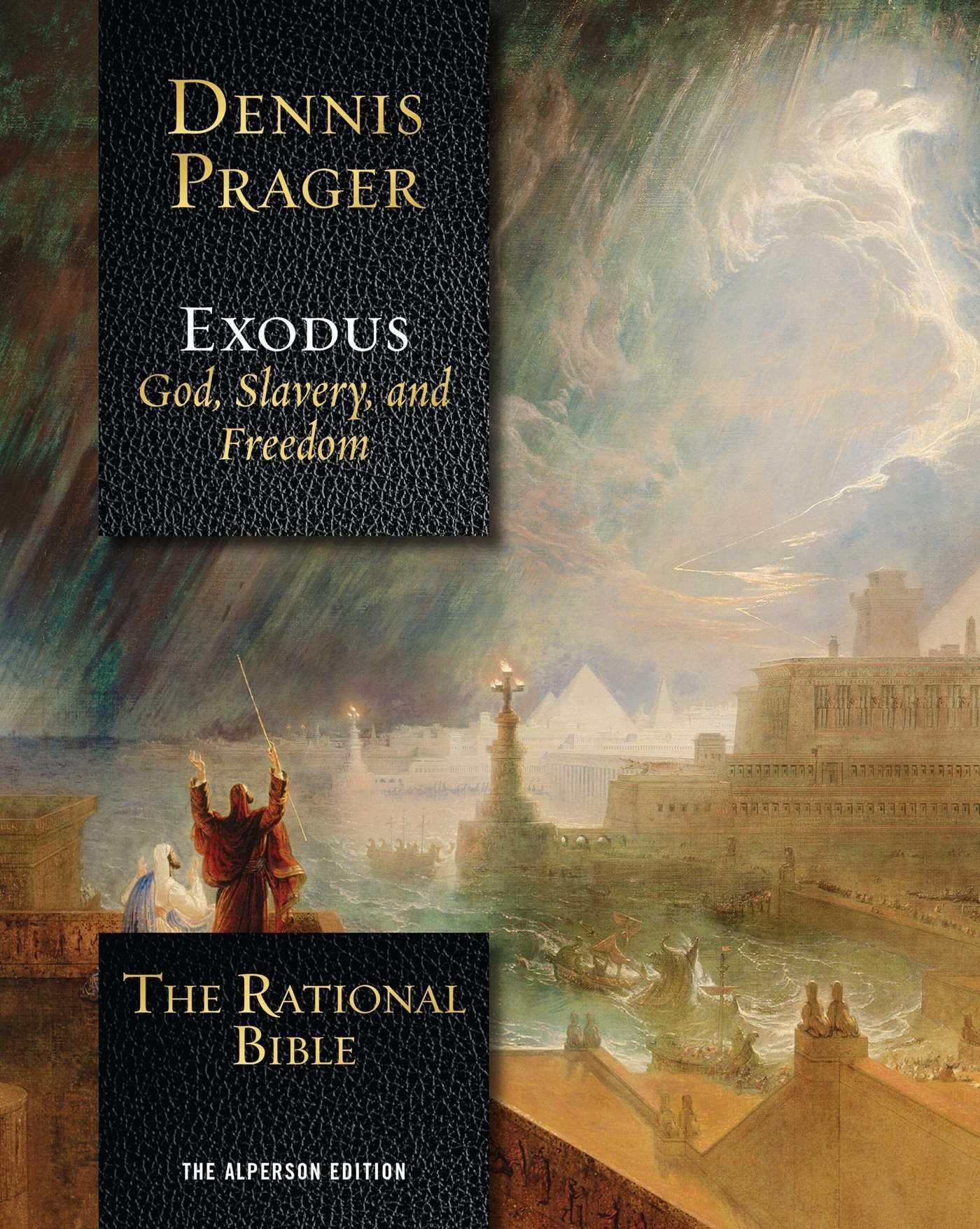
- The Rational Bible: Exodus
Product ID: 60956199
Buy anything from 5,000+ international stores. One checkout price. No surprise fees. Join 2M+ shoppers on Desertcart.
Desertcart purchases this item on your behalf and handles shipping, customs, and support to Spain.
The Rational Bible: Exodus [Prager, Dennis] on desertcart.com. *FREE* shipping on qualifying offers. The Rational Bible: Exodus Review: An insightful and approachable commentary - The Exodus is probably the most important story in Judaism, and certainly among the most important stories in Christianity as well. But while Prager writes for audiences of all faiths, his perspective is certainly the Jewish one. Prager’s argument (or at least one of his arguments) is that though the Torah (or the Bible at large) was written for specific people at a specific point in history, its relevance has not faded in modernity. Therefore, much of his commentary is aimed at translating certain verses in such a way as to render them comprehensible to modern ears or to applying the teachings of Exodus to modern situations. In those goals he succeeds admirably. Obviously, readers will come at this book from a variety of perspectives. There are certain passages atheists will struggle to understand even despite Prager’s best attempts to explain (atheists might argue explain away) some of the difficult passages. Christians will notice a lack of commentary pointing toward what they believe are foreshadowings of the New Testament. And though Prager’s Jewish commentary will feel most comfortable to the Jewish people, different movements within Judaism might agree or disagree on a variety of points. But where the book really shines, despite not quite succeeding in being all things to all people, is in rendering the text more approachable to modern readers. I’ve read Exodus before. I’ve read the entire Bible, of course. But even though the story is quite familiar to me, Prager nevertheless provided countless new insights that helped me to understand both much of the wisdom contained in the ancient text and why it is considered such a central element in Jewish culture. Long essays explain the Ten Commandments in great detail, and I think are a real highlight of this volume. Going back to the original Hebrew as necessary, Prager explains why he thinks those ten laws are so foundational to morality, as well as how many people—including many religious people—have misunderstood their meaning and misapplied their guidance. One might criticize the book for repetitiveness, but that’s not entirely Prager’s fault. Biblical texts themselves are often repetitive. Even still, Prager himself does repeat some of the same points multiple times. A few of these can be forgiven as repetition for emphasis, but in some cases, I think he added the same commentary to multiple verses simply because he had similar thoughts about each verse. If one wants to read this commentary as a reference book, that’s good; that way, the commentary is present at each verse whenever one might look it up. But if one wants to read it straight through, as I did, some of the repeated passages just felt extraneous. Nevertheless, I found this quite a useful book, and I’ll be first in line to get Prager’s commentary on Leviticus whenever it is released. Review: Maybe you thought the Torah lacked relevance to contemporary life - I am familiar with some of Rabbi Dennis Prager’s writing before coming to this book. Readers like me will find Exodus, like earlier works by this author, written in a style notable for its clarity and complete lack of pretension. It is a highly scholarly work that does not read like scholarship. One reason it does not read like an academic text is that it is also a highly personal work. Any reader encountering this book will see that it arises from a lifetime of one particular man’s contemplation of the Torah—its challenges, its rewards, its ever-expanding meaningfulness over the course of that lifetime. The book offers all of that to us as a gift to enrich our own lives. (As I read over the last two sentences written, I almost changed the word “arises” to the past tense, ”arose”—but I felt promptly that would be inappropriate. This book feels alive and exists in the present tense. One finishes each chapter with the feeling that the last word has not been said in the commentary one has just read. Let us all live a little longer, read the passage again, and Rabbi Prager would have more commentary to offer. This is just one of his accomplishments here—his book itself communicates the sense of the Torah as intensely alive and intensely relevant to us at all phases of our lives. The dialogue each reader has with the Torah may start at one specific place, but the conversation never ends. I will finish reading this book, set it aside and return to it in a few months… or years. When I do, I think I will find the book still arises….) More specifically: Rabbi Prager reads Exodus line by line, verse by verse and offers his commentary immediately as he does so. Commentary may not accompany every single line but often does; no group of verses lacks comment. Interspersed among the linear remarks are short (about 1-2 pages in length) passages the author identifies as Essays he uses to emphasize points, or to set the background for an upcoming passage, or to frame an argument. The commentary is frequently annotated with specific references to other works and authors. The text acknowledges and quotes directly from many previous Torah scholars. Why, any reader may reasonably ask, do we need another commentary on the Torah, on Exodus or any other of the five books of Moses? Our literature abounds with superb commentaries already. How could there be anything remaining to say about any line of the Torah? The facile answer is that there can never be too many commentaries on the Torah, that its plenty is inexhaustible. That may be true, but that is not the answer I want to offer on reading this book. What Rabbi Prager has done for me is to make Exodus relevant to contemporary life. His commentary is at various times refracted through ancient history and scholarship, through medieval times, through modern European history, up to the 20th century and the Holocaust, and through to the present day. He excels at drawing parallels between our times and the past as described in the Torah, and displays an uncanny ability to render our current moral and cultural dilemmas in Old Testament terms. This is why I feel the need specifically for this book at this time. I eagerly await his commentary on the rest of the Torah. One last point: In my opinion this book is readily understandable by younger readers. A high school student could benefit greatly from reading it. There is nothing ponderous here; there is no obstacle to understanding. Nothing in the prose commentary is stuffy or old fashioned. It appears that every effort has been made to allow the book to be accessible to the widest audience. George B. Goodman
| Best Sellers Rank | #25,298 in Books ( See Top 100 in Books ) #6 in Torah #42 in Old Testament Bible Study (Books) #98 in Christian Church History (Books) |
| Customer Reviews | 4.8 4.8 out of 5 stars (3,120) |
| Dimensions | 7.2 x 2 x 9 inches |
| ISBN-10 | 1621577724 |
| ISBN-13 | 978-1621577720 |
| Item Weight | 2.24 pounds |
| Language | English |
| Part of series | Rational Bible |
| Print length | 560 pages |
| Publication date | April 2, 2018 |
| Publisher | Regnery Faith |
B**S
An insightful and approachable commentary
The Exodus is probably the most important story in Judaism, and certainly among the most important stories in Christianity as well. But while Prager writes for audiences of all faiths, his perspective is certainly the Jewish one. Prager’s argument (or at least one of his arguments) is that though the Torah (or the Bible at large) was written for specific people at a specific point in history, its relevance has not faded in modernity. Therefore, much of his commentary is aimed at translating certain verses in such a way as to render them comprehensible to modern ears or to applying the teachings of Exodus to modern situations. In those goals he succeeds admirably. Obviously, readers will come at this book from a variety of perspectives. There are certain passages atheists will struggle to understand even despite Prager’s best attempts to explain (atheists might argue explain away) some of the difficult passages. Christians will notice a lack of commentary pointing toward what they believe are foreshadowings of the New Testament. And though Prager’s Jewish commentary will feel most comfortable to the Jewish people, different movements within Judaism might agree or disagree on a variety of points. But where the book really shines, despite not quite succeeding in being all things to all people, is in rendering the text more approachable to modern readers. I’ve read Exodus before. I’ve read the entire Bible, of course. But even though the story is quite familiar to me, Prager nevertheless provided countless new insights that helped me to understand both much of the wisdom contained in the ancient text and why it is considered such a central element in Jewish culture. Long essays explain the Ten Commandments in great detail, and I think are a real highlight of this volume. Going back to the original Hebrew as necessary, Prager explains why he thinks those ten laws are so foundational to morality, as well as how many people—including many religious people—have misunderstood their meaning and misapplied their guidance. One might criticize the book for repetitiveness, but that’s not entirely Prager’s fault. Biblical texts themselves are often repetitive. Even still, Prager himself does repeat some of the same points multiple times. A few of these can be forgiven as repetition for emphasis, but in some cases, I think he added the same commentary to multiple verses simply because he had similar thoughts about each verse. If one wants to read this commentary as a reference book, that’s good; that way, the commentary is present at each verse whenever one might look it up. But if one wants to read it straight through, as I did, some of the repeated passages just felt extraneous. Nevertheless, I found this quite a useful book, and I’ll be first in line to get Prager’s commentary on Leviticus whenever it is released.
G**N
Maybe you thought the Torah lacked relevance to contemporary life
I am familiar with some of Rabbi Dennis Prager’s writing before coming to this book. Readers like me will find Exodus, like earlier works by this author, written in a style notable for its clarity and complete lack of pretension. It is a highly scholarly work that does not read like scholarship. One reason it does not read like an academic text is that it is also a highly personal work. Any reader encountering this book will see that it arises from a lifetime of one particular man’s contemplation of the Torah—its challenges, its rewards, its ever-expanding meaningfulness over the course of that lifetime. The book offers all of that to us as a gift to enrich our own lives. (As I read over the last two sentences written, I almost changed the word “arises” to the past tense, ”arose”—but I felt promptly that would be inappropriate. This book feels alive and exists in the present tense. One finishes each chapter with the feeling that the last word has not been said in the commentary one has just read. Let us all live a little longer, read the passage again, and Rabbi Prager would have more commentary to offer. This is just one of his accomplishments here—his book itself communicates the sense of the Torah as intensely alive and intensely relevant to us at all phases of our lives. The dialogue each reader has with the Torah may start at one specific place, but the conversation never ends. I will finish reading this book, set it aside and return to it in a few months… or years. When I do, I think I will find the book still arises….) More specifically: Rabbi Prager reads Exodus line by line, verse by verse and offers his commentary immediately as he does so. Commentary may not accompany every single line but often does; no group of verses lacks comment. Interspersed among the linear remarks are short (about 1-2 pages in length) passages the author identifies as Essays he uses to emphasize points, or to set the background for an upcoming passage, or to frame an argument. The commentary is frequently annotated with specific references to other works and authors. The text acknowledges and quotes directly from many previous Torah scholars. Why, any reader may reasonably ask, do we need another commentary on the Torah, on Exodus or any other of the five books of Moses? Our literature abounds with superb commentaries already. How could there be anything remaining to say about any line of the Torah? The facile answer is that there can never be too many commentaries on the Torah, that its plenty is inexhaustible. That may be true, but that is not the answer I want to offer on reading this book. What Rabbi Prager has done for me is to make Exodus relevant to contemporary life. His commentary is at various times refracted through ancient history and scholarship, through medieval times, through modern European history, up to the 20th century and the Holocaust, and through to the present day. He excels at drawing parallels between our times and the past as described in the Torah, and displays an uncanny ability to render our current moral and cultural dilemmas in Old Testament terms. This is why I feel the need specifically for this book at this time. I eagerly await his commentary on the rest of the Torah. One last point: In my opinion this book is readily understandable by younger readers. A high school student could benefit greatly from reading it. There is nothing ponderous here; there is no obstacle to understanding. Nothing in the prose commentary is stuffy or old fashioned. It appears that every effort has been made to allow the book to be accessible to the widest audience. George B. Goodman
J**A
Não terminei de ler ainda pois é longo e após cada nova “revelação” apresentada é necessário parar de ler para refletir sobre aquilo. Muita informação nova, mesmo para alguém que já estuda a Bíblia a muitos anos. Recomendo muito!
L**C
This book provides a brilliant contextual and ethical commentary on the Book of Exodus. It brings the Torah closer to the earth and the reader closer to the Sinaï!
J**M
The rational bible is great for readinf the bible the first time, but also if you already read the bible it gives you new insights! Must read!
W**Y
If you have never read the Bible in your life but want to understand its importance, this book is the perfect way to start. Dennis Prager is a master communicator, and as such is able to impart the great wisdom of the Bible in a simple and engrossing manner. Not only will you learn of the Bible's historical significance but also how it remains as relevant today as it did when it was written. Our ancestors, the people who built the freest, most prosperous and fundamentally decent society in history, which we enjoy in the West today, were all steeped in the Bible from an early age. Perhaps we should be humble enough to acknowledge that the Bible has as much to teach us as it did them. If not, we are doomed to forget the great wisdom of the past and in doing so forget who we are and what we stand for. It is Mr. Prager's belief that the Bible is key to creating a better world, and after reading this you will find it hard to disagree with him.
R**R
This book has concise and strong commentary which you will most certainly learn a lot from. It has consistency and depth. On top of that, it looks great as well, from the cover to the page design.
Trustpilot
1 week ago
2 weeks ago