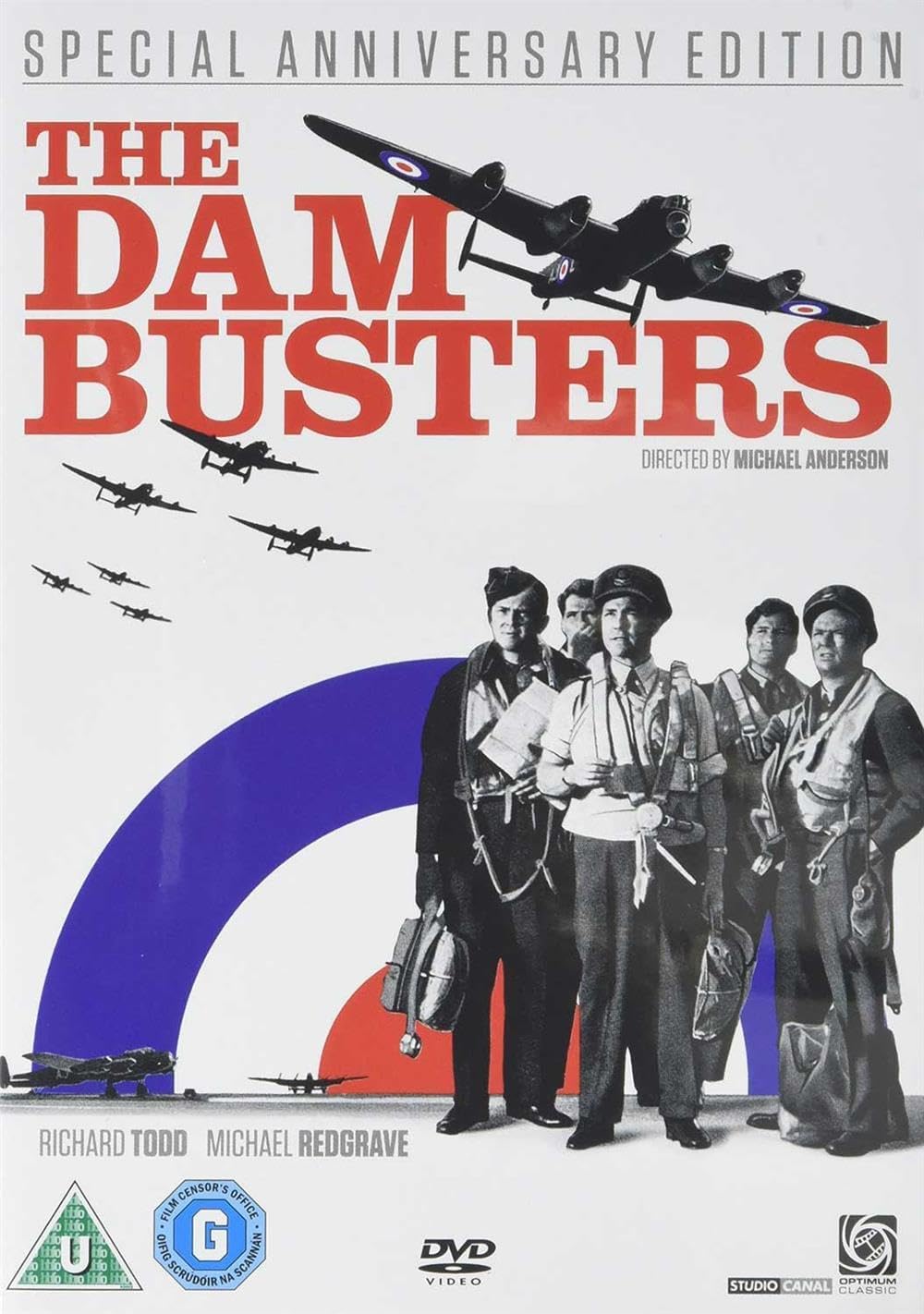
The Dam Busters - Special Edition
Product ID: 51819868
Details
- FormatAnamorphic &
- GenreDrama
- LanguageEnglish
- Runtime2 hours and 3
Buy anything from 5,000+ international stores. One checkout price. No surprise fees. Join 2M+ shoppers on Desertcart.
Desertcart purchases this item on your behalf and handles shipping, customs, and support to Spain.
Classic wartime drama directed by Michael Anderson. The film tells the story of Dr Barnes Wallis (Michael Redgrave), whose invention of the 'Bouncing Bomb' is greeted with scepticism in World War II. However, RAF Wing Commander Guy Gibson (Richard Todd) proves the bomb's worth in a daring mission to destroy the German Ruhr dams. The cast also includes Basil Sydney and Ursula Jeans. Review: A major classic, aged but still wearing that crown, towering over the competition! Also a lesson in how war films should be made - This war film based on actual events is an already immortal classic, still as powerful in Year of Grace 2014 as it was when first released in 1955. Below, more of my impressions, with some SPOILERS. 1. Operation "Chastise" and real "Dam Busters" Operation "Chastise" (very appropriately named, possibly for the first time in military history) was an attack on three German dams carried out on 16-17 May 1943 by Royal Air Force No. 617 Squadron flying specially modified Lancaster bombers and using a new weapon: "bouncing bomb" invented and developed by renown engineer Barnes Wallis (amongst his earlier realisations was the design of Vickers Wellington bomber). This mission was unusually dangerous because to succeed British bombers had to attack at low speed and very low attitude, risking at any moment crashing in the ground, when in the same time being exceptionally vulnerable to the Flak, including the numerous 20 mm guns, which usually were not a concern to four engine bombers operating at high attitude... As the result of the attack, the Möhne and Edersee Dams were breached, causing catastrophic flooding of the Ruhr valley and of villages in the Eder valley - the third target, Sorpe dam, sustained only minor damage. Two hydroelectric power plants were destroyed and several more were damaged. Numerous factories and mines were also damaged to diverse degree due to flooding and an estimated 1,600 people drowned. Even if the damage was repaired by Germans, production in affected areas didn't return to normal before September 1943. The cost to the attackers was high, as out of 20 Lancasters which took off for the attack 8 were lost and 53 crew members were killed with 3 more being taken prisoners. What made this incredibly daring and very successful operation even more remarkable, was that, although it was not made on purpose, the 617th squadron was a very multinational and diverse outfit, with crews hailing from all over the Commonwealth: United Kingdom, Canada, Australia, New Zealand and amongst the pilots there was even one American volunteer serving with RAF, Lieutenant Joe McCarthy. Following the Dams Raid 617 Squadron was kept together as a specialist unit and participated in numerous bombing operations, frequently using other types of specialised ordnance developed by Barnes Wallis, including giant Grand Slam and Tallboy bombs. It was with those latter munitions that the 617th Squadron attacked and destroyed in 1944 German super-battleship "Tirpitz" in her base in Norway. The squadron is still active today. Very sadly, Wing Commander Guy Gibson, the officer in command of the whole mission, didn't survive the war - he was killed in action (probably shot down by a German fighter) on 19 September 1944, when flying a target marking Mosquito over Netherlands. He was only 26 years old. Five of men who flew on the same bomber with him in operation "Chastise" were killed even earlier, during another bombing mission over Germany on 16 September 1943. 2. The film The film was made in 1955, when Barnes Wallis and many "Dam Busters" were still alive, therefore it was possible to consult with them extensively and as result this film sticks quite closely to the reality of things. This real deal feeling was also helped by RAF contributing three real Lancaster bombers taken out of reserve and refit for service for the needs of this film. The narration is strictly chronological, from the moment when Barnes Wallis got the idea of "bouncing bombs", through the phase of conception of those new munitions, experimentation and modifications until finally the introduction in service. Then begins the phase of selection of crews for the mission, training and other preparations and finally the extremely dramatic mission itself. For the needs of the film some changes were of course introduced, the most important of which is the whole struggle Barnes Wallis has to wage with war time bureaucracy (both civilian and military) to even be able to launch the whole project of "bouncing bombs". In reality no such thing took place, to the contrary, Wallis, who was already very well known in this time, received lots of support and was efficiently backed up by both civilian and military hierarchy, which explains how this project advanced so fast. Another interesting thing is that in 1955 the whole "bouncing bomb" technology was still a military secret, therefore in the film the bombs have the shape of spheres, when in the reality they were shaped as barrels... Finally, another major change was made to make the action even more dramatic - in the film one of the bombers crashes into a mountain as it is not able to pull up fast enough from the bomb run (I am NOT saying which bomber it is...). In reality no such thing happened during the bomb run but some planes damaged by Flak crash landed after the attack itself was over. The music written for this film is of course already a legend - the "Dambusters March" achieved already immortality and will certainly continue to be performed, listened to and adored for centuries. 3. My impressions about the film The first time I saw this film was ages ago, in communist Poland, when I was still a boy - and it was an "eyes wide open, nail biting, jaw dropping" experience! And now, after re-watching it recently, I was very pleased to see that with time it didn't lose any of its fire power! The success of the film is certainly not due to special effects which in 1955 were nothing like those available today. This film is also in black and white and action scenes happen at night, which should logically diminish their impact - but it is NOT the case! No, the real reason why "Dambusters" is so good is the strength of scenario and a perfectly structured narration of the story, an art frequently forgotten (or simply discarded) in today's films. The tension is build up from the beginning, with initially just a hint that something REALLY big is going to happen and then the stakes are raised slowly but regularly, until the moment when Gibson and his men see this first dam... At that moment the viewers couldn't care less about special effects as we are already so immersed in the story that no escape is possible, even if the Flak started to shoot spaghetti instead of tracers... To conclude on the action scenes - their age notwithstanding they still pack such power that together with the great finale from "633 Squadron" (a lesser war film describing a fictitious raid) they very strongly inspired George Lucas when he was creating the archi-famous sequence of rebel fighters attacking Death Star in "Star Wars". The way in which the heroism of those incredible men is described is another treasure. The whole story is narrated in a matter of fact way, as if it was just another day at the office - it just so happens that the office for those men is deep inside the enemy territory. There is no pathos, there is no drama, there is no soul searching, there is no PrTSD (Pre-Traumatic Stress Disorder, something that figures in most modern war movies), no politically correct pseudo-psychological babble (are we the good guys? Are we REALLY the good guys? Are we REALLY, REALLY, REALLY the good guys?), which all affect so badly so many modern war films. Here things are told simply and calmly and the viewers are trusted to be adult enough to understand by themselves how terribly dangerous that mission was and how it took real balls to fly at the lowest possible level into this Valley of the Shadows of Death, with Flak in the front, on both sides and even above(!) on the hills, carrying an enormous bomb exposed to enemy fire and still go at the target - MORE THAN ONCE if the first approach was unsuccessful! I heard many rumours that a remake of "Dambusters" is being prepared in USA, but until now nothing concrete was ever announced. Honestly, I am of two minds about it - on one hand I would be tempted to see this raid again, with the state of the art XXI century special effects but on another, when I think of all the abominations, horrors and other indignities visited lately upon war stories by Hollywood (just think of "Pearl Harbour", "U-571" or "Wind Talkers") I would as much prefer that at least this masterpiece remains unspoiled... There were many book written abouth this famous raid, but if I was to recommend just one I think I would go with "Dambusters. Operation Chastise 1943" by Doug Dildy, published by Osprey in its "Raid" series in October 2010. It is a small book, only 80 pages long, but quite comprehensive and it may be a good idea to read it before watching (re-watching) this film. CONCLUSION: this is a GREAT film, a GREAT classic, still as powerful today as in 1955. To buy, watch, keep and re-watch. Enjoy! Review: The definate War Movie - There can be few people who have never seen this superb war film recounting the design of the Bouncing bomb which was designed specifically for one purpose to burst the dams of the Rhur valley in Germany and thus cripple the industrial manufacturing base of the country. Wing Commander Guy Gibson awarded the VC for his command of 617 squadron played really well by Richard Todd. Recently on reading Guy Gibsons early 60s paperback autobiography about Bomber Command entitled "Enemy Coast Ahead" and now thankfully back in print after many years, the enactment of scenes in the film are very true to life having been given no embelishments to improve the story. Every single scene in the film is relevant to the story even down to Gibson and fellow officer watching the West end production in London, coming up with the ingenious idea of using searchlight beams to accurately assertain the correct height of his aircraft whilst in flight The tension,huge loss of life with eight Lancasters with the eight crew failing to return and the now famous Dambusters March. Possibly the special effects now well over 50 years old may appear dated but nothing detracts from making the Dambusters one of the most convincing and accurate depictions of true wartime events. You might be interested to know that behind the visitor centre just outside Rhayader in Mid Wales Elan Valley is the actual remains of Barnes Wallaces coffer dam used to test the neccessary explosive charge needed to breach the Rhur dams. After seeing an article about it in my daily newspaper i desided to go and see it for myself. Incredibly i have been to the Elan Valley many times to take part in the annual 20 mile road race without realising the remains of Wallaces dam were so close. The walk along Caban Coch reservoirs shoreline is not suitable for the infirm or elderly which is a shame but the sense of anticipation of going to see such a significant and famous wartime relic so cleverly concealed was something i will never forget. The dam must be atleast 20ft tall and 5ft thick and over 300ft wide but Mr wallace certainly made a mess of it. There is so much original debris lying around that those who know it's there can easily grab a piece without any threat of depleting the supply. When standing ontop which again is easily done the memories of this famous film come flooding back and you soon realise the importance and reasoning for sighting the dam in such a remote area of Mid Wales. Even the original buildings are there in a kind of time warp. The depiction of Barnes destroying the small dam at the begining of the film is quite strange after you realise how huge the original structure was. Even today without any knowledge of it's existence which must be the case for the countless thousands who visit this picturesque area it is of no surprise that the Germans never located it's presence. Derwent Water in the Peak District was the main test area for the Lancasters.The squadron was the only one officially allowed to fly under a hundred feet whilst in testing.Throughout the war nobody knew why the Lancasters flew so low,even other squadrons not connected to 617 were left in the dark. Guy Gibson did own a black labrador that he called "Nigger" and yes he was unfortunately killed just outside the airbase, so the film remains as close to the real events of the war that we are likely to get. It is only on purchasing the BluRay addition to this film that i was made aware of Gibsons lost companion "Nigger" appearing in the final credits of the film. Just watch as Barnes Wallace full of remorse at having sent so many young men to die on this important mission for war moral talks to Gibson. Just in the distant background above Gibsons right shoulder we see a ghost like black creature in slow motion, is this Nigger ?. Nothing in the film has been added to improve the story unlike vertually every other war film to date. The film keeps to the known facts and uses them to its brilliant advantage and on watching it again recently the acting and storyline still carry significant weight to make the film one of the true greats in British cinematic history. The film may be approaching it's sixtieth birthday remarkably quickly but it's popularity will never cease. Everything right down to the genuine archive film along Chesill beach on the south coast is factually accurate which goes to make it possibly the greatest war film to come out of a British studio.
| ASIN | B0039LAQ7Y |
| Actors | Basil Sydney, Derek Farr, Michael Redgrave, Richard Todd, Ursula Jeans |
| Aspect Ratio | 4:3 - 1.33:1 |
| Customer reviews | 4.7 4.7 out of 5 stars (1,627) |
| Director | Michael Anderson |
| Is discontinued by manufacturer | No |
| Item model number | 5055201811189 |
| Language | English (Dolby Digital 2.0) |
| Media Format | Anamorphic, Black & White, PAL, Widescreen |
| Number of discs | 1 |
| Producers | Robert Clark, W. A. Whittaker |
| Product Dimensions | 13.5 x 1.5 x 19 cm; 80 g |
| Release date | 14 Jun. 2010 |
| Run time | 2 hours and 3 minutes |
| Studio | Studiocanal |
| Writers | Guy Gibson, Paul Brickhill, R.C. Sherriff |
D**K
A major classic, aged but still wearing that crown, towering over the competition! Also a lesson in how war films should be made
This war film based on actual events is an already immortal classic, still as powerful in Year of Grace 2014 as it was when first released in 1955. Below, more of my impressions, with some SPOILERS. 1. Operation "Chastise" and real "Dam Busters" Operation "Chastise" (very appropriately named, possibly for the first time in military history) was an attack on three German dams carried out on 16-17 May 1943 by Royal Air Force No. 617 Squadron flying specially modified Lancaster bombers and using a new weapon: "bouncing bomb" invented and developed by renown engineer Barnes Wallis (amongst his earlier realisations was the design of Vickers Wellington bomber). This mission was unusually dangerous because to succeed British bombers had to attack at low speed and very low attitude, risking at any moment crashing in the ground, when in the same time being exceptionally vulnerable to the Flak, including the numerous 20 mm guns, which usually were not a concern to four engine bombers operating at high attitude... As the result of the attack, the Möhne and Edersee Dams were breached, causing catastrophic flooding of the Ruhr valley and of villages in the Eder valley - the third target, Sorpe dam, sustained only minor damage. Two hydroelectric power plants were destroyed and several more were damaged. Numerous factories and mines were also damaged to diverse degree due to flooding and an estimated 1,600 people drowned. Even if the damage was repaired by Germans, production in affected areas didn't return to normal before September 1943. The cost to the attackers was high, as out of 20 Lancasters which took off for the attack 8 were lost and 53 crew members were killed with 3 more being taken prisoners. What made this incredibly daring and very successful operation even more remarkable, was that, although it was not made on purpose, the 617th squadron was a very multinational and diverse outfit, with crews hailing from all over the Commonwealth: United Kingdom, Canada, Australia, New Zealand and amongst the pilots there was even one American volunteer serving with RAF, Lieutenant Joe McCarthy. Following the Dams Raid 617 Squadron was kept together as a specialist unit and participated in numerous bombing operations, frequently using other types of specialised ordnance developed by Barnes Wallis, including giant Grand Slam and Tallboy bombs. It was with those latter munitions that the 617th Squadron attacked and destroyed in 1944 German super-battleship "Tirpitz" in her base in Norway. The squadron is still active today. Very sadly, Wing Commander Guy Gibson, the officer in command of the whole mission, didn't survive the war - he was killed in action (probably shot down by a German fighter) on 19 September 1944, when flying a target marking Mosquito over Netherlands. He was only 26 years old. Five of men who flew on the same bomber with him in operation "Chastise" were killed even earlier, during another bombing mission over Germany on 16 September 1943. 2. The film The film was made in 1955, when Barnes Wallis and many "Dam Busters" were still alive, therefore it was possible to consult with them extensively and as result this film sticks quite closely to the reality of things. This real deal feeling was also helped by RAF contributing three real Lancaster bombers taken out of reserve and refit for service for the needs of this film. The narration is strictly chronological, from the moment when Barnes Wallis got the idea of "bouncing bombs", through the phase of conception of those new munitions, experimentation and modifications until finally the introduction in service. Then begins the phase of selection of crews for the mission, training and other preparations and finally the extremely dramatic mission itself. For the needs of the film some changes were of course introduced, the most important of which is the whole struggle Barnes Wallis has to wage with war time bureaucracy (both civilian and military) to even be able to launch the whole project of "bouncing bombs". In reality no such thing took place, to the contrary, Wallis, who was already very well known in this time, received lots of support and was efficiently backed up by both civilian and military hierarchy, which explains how this project advanced so fast. Another interesting thing is that in 1955 the whole "bouncing bomb" technology was still a military secret, therefore in the film the bombs have the shape of spheres, when in the reality they were shaped as barrels... Finally, another major change was made to make the action even more dramatic - in the film one of the bombers crashes into a mountain as it is not able to pull up fast enough from the bomb run (I am NOT saying which bomber it is...). In reality no such thing happened during the bomb run but some planes damaged by Flak crash landed after the attack itself was over. The music written for this film is of course already a legend - the "Dambusters March" achieved already immortality and will certainly continue to be performed, listened to and adored for centuries. 3. My impressions about the film The first time I saw this film was ages ago, in communist Poland, when I was still a boy - and it was an "eyes wide open, nail biting, jaw dropping" experience! And now, after re-watching it recently, I was very pleased to see that with time it didn't lose any of its fire power! The success of the film is certainly not due to special effects which in 1955 were nothing like those available today. This film is also in black and white and action scenes happen at night, which should logically diminish their impact - but it is NOT the case! No, the real reason why "Dambusters" is so good is the strength of scenario and a perfectly structured narration of the story, an art frequently forgotten (or simply discarded) in today's films. The tension is build up from the beginning, with initially just a hint that something REALLY big is going to happen and then the stakes are raised slowly but regularly, until the moment when Gibson and his men see this first dam... At that moment the viewers couldn't care less about special effects as we are already so immersed in the story that no escape is possible, even if the Flak started to shoot spaghetti instead of tracers... To conclude on the action scenes - their age notwithstanding they still pack such power that together with the great finale from "633 Squadron" (a lesser war film describing a fictitious raid) they very strongly inspired George Lucas when he was creating the archi-famous sequence of rebel fighters attacking Death Star in "Star Wars". The way in which the heroism of those incredible men is described is another treasure. The whole story is narrated in a matter of fact way, as if it was just another day at the office - it just so happens that the office for those men is deep inside the enemy territory. There is no pathos, there is no drama, there is no soul searching, there is no PrTSD (Pre-Traumatic Stress Disorder, something that figures in most modern war movies), no politically correct pseudo-psychological babble (are we the good guys? Are we REALLY the good guys? Are we REALLY, REALLY, REALLY the good guys?), which all affect so badly so many modern war films. Here things are told simply and calmly and the viewers are trusted to be adult enough to understand by themselves how terribly dangerous that mission was and how it took real balls to fly at the lowest possible level into this Valley of the Shadows of Death, with Flak in the front, on both sides and even above(!) on the hills, carrying an enormous bomb exposed to enemy fire and still go at the target - MORE THAN ONCE if the first approach was unsuccessful! I heard many rumours that a remake of "Dambusters" is being prepared in USA, but until now nothing concrete was ever announced. Honestly, I am of two minds about it - on one hand I would be tempted to see this raid again, with the state of the art XXI century special effects but on another, when I think of all the abominations, horrors and other indignities visited lately upon war stories by Hollywood (just think of "Pearl Harbour", "U-571" or "Wind Talkers") I would as much prefer that at least this masterpiece remains unspoiled... There were many book written abouth this famous raid, but if I was to recommend just one I think I would go with "Dambusters. Operation Chastise 1943" by Doug Dildy, published by Osprey in its "Raid" series in October 2010. It is a small book, only 80 pages long, but quite comprehensive and it may be a good idea to read it before watching (re-watching) this film. CONCLUSION: this is a GREAT film, a GREAT classic, still as powerful today as in 1955. To buy, watch, keep and re-watch. Enjoy!
M**S
The definate War Movie
There can be few people who have never seen this superb war film recounting the design of the Bouncing bomb which was designed specifically for one purpose to burst the dams of the Rhur valley in Germany and thus cripple the industrial manufacturing base of the country. Wing Commander Guy Gibson awarded the VC for his command of 617 squadron played really well by Richard Todd. Recently on reading Guy Gibsons early 60s paperback autobiography about Bomber Command entitled "Enemy Coast Ahead" and now thankfully back in print after many years, the enactment of scenes in the film are very true to life having been given no embelishments to improve the story. Every single scene in the film is relevant to the story even down to Gibson and fellow officer watching the West end production in London, coming up with the ingenious idea of using searchlight beams to accurately assertain the correct height of his aircraft whilst in flight The tension,huge loss of life with eight Lancasters with the eight crew failing to return and the now famous Dambusters March. Possibly the special effects now well over 50 years old may appear dated but nothing detracts from making the Dambusters one of the most convincing and accurate depictions of true wartime events. You might be interested to know that behind the visitor centre just outside Rhayader in Mid Wales Elan Valley is the actual remains of Barnes Wallaces coffer dam used to test the neccessary explosive charge needed to breach the Rhur dams. After seeing an article about it in my daily newspaper i desided to go and see it for myself. Incredibly i have been to the Elan Valley many times to take part in the annual 20 mile road race without realising the remains of Wallaces dam were so close. The walk along Caban Coch reservoirs shoreline is not suitable for the infirm or elderly which is a shame but the sense of anticipation of going to see such a significant and famous wartime relic so cleverly concealed was something i will never forget. The dam must be atleast 20ft tall and 5ft thick and over 300ft wide but Mr wallace certainly made a mess of it. There is so much original debris lying around that those who know it's there can easily grab a piece without any threat of depleting the supply. When standing ontop which again is easily done the memories of this famous film come flooding back and you soon realise the importance and reasoning for sighting the dam in such a remote area of Mid Wales. Even the original buildings are there in a kind of time warp. The depiction of Barnes destroying the small dam at the begining of the film is quite strange after you realise how huge the original structure was. Even today without any knowledge of it's existence which must be the case for the countless thousands who visit this picturesque area it is of no surprise that the Germans never located it's presence. Derwent Water in the Peak District was the main test area for the Lancasters.The squadron was the only one officially allowed to fly under a hundred feet whilst in testing.Throughout the war nobody knew why the Lancasters flew so low,even other squadrons not connected to 617 were left in the dark. Guy Gibson did own a black labrador that he called "Nigger" and yes he was unfortunately killed just outside the airbase, so the film remains as close to the real events of the war that we are likely to get. It is only on purchasing the BluRay addition to this film that i was made aware of Gibsons lost companion "Nigger" appearing in the final credits of the film. Just watch as Barnes Wallace full of remorse at having sent so many young men to die on this important mission for war moral talks to Gibson. Just in the distant background above Gibsons right shoulder we see a ghost like black creature in slow motion, is this Nigger ?. Nothing in the film has been added to improve the story unlike vertually every other war film to date. The film keeps to the known facts and uses them to its brilliant advantage and on watching it again recently the acting and storyline still carry significant weight to make the film one of the true greats in British cinematic history. The film may be approaching it's sixtieth birthday remarkably quickly but it's popularity will never cease. Everything right down to the genuine archive film along Chesill beach on the south coast is factually accurate which goes to make it possibly the greatest war film to come out of a British studio.
N**L
This is a 1954 B&W movie based on a 1951 book by Paul Brickhill. Both the book and the movie are excellent. This film is packed with action, and the tension is maintained throughout. There is not a dull moment. There is a great deal of atmosphere in every major scene. The actors are good and the production is quite realistic. Some of the special effects are not very well executed though. I am sure they could have done better, even with the technological limitations of the early fifties. Speaking of technology, the first part of this movie deals with the challenge of destroying a dam that is 120 feet thick at the base. We spend a long time witnessing the development of an audacious idea concocted by a scientist who has to go through various trials and tribulations before his concept is vindicated. So the first half of the movie would qualify as a documentary in that regard. But there is just as much action and tension here as there are in the bombing scenes that follow. For the whole story is threaded with the same fabric. So the second half of the movie deals with the actual bombing of three German dams in the Rhur Valley. That is what we had been waiting for and it is delivered like an apotheoses. Indeed it is the climax of the movie, but the tension is only released after numerous attempts. There is a "feel good" part here, but the triumph is somewhat mitigated by the heavy casualties. That is what makes it a great war movie.
T**Y
Picture is crisp and clean, a wonderful improvement over the currently broadcast version. Plays well on a Region free Blueray player (also available from Amazon)
J**O
El producto llegó en perfecta condiciones y se ajustaba a la descripción de la página web. Grandes profesionales.
N**D
One of the great elements of this superb old film, made just after WW2, is that it covers the tremendous problems and travails that Professor Barnes Wallis, the designer of the Wellington bomber and incredible "the bouncing bomb", experienced in delivering the successful weapon against Government and Military skepticism. Sir Michael Redgrave puts in a superb performance as Barnes Wallis. Richard Todd is the quintessential Squadron Leader Guy Gibson. The supporting cast are also superb. Also, the film benefits from having a complete squadron of Lancaster bombers. The build up to the raid including the training and finding the correct height, speed and distance from the dams to drop the bomb supports Barnes Wallis' engineering problems and battle to convince the Bomber Command in 1942 - 1943 Britain. This buildup to the actual raid greatly adds to the unique character of this outstanding film. It's a magnificent piece of wartime history told by those who lived it and were not separated by a long period of time.
F**D
Rezension zu: "The Dam Busters" (GB 1955) Zum historischen Hintergrund: Während des Zweiten Weltkrieges entwickelte der britische Flugzeug-Ingenieur Barnes Wallis (1887-1979) eine spezielle Bombe für die Zerstörung von Talsperren. Die "Operation Chastise" (engl.: "Züchtigung"): In der Nacht vom 16. auf den 17. Mai 1943 flog die 617. Staffel der Royal Air Force unter dem Kommando von Wing Commander Guy Gibson (1918-1944) mit 19 umgebauten Lancaster-Bombern einen Einsatz mit dem Ziel, die Staumauern mehrerer Talsperren im heutigen Nordrhein-Westfalen und Hessen zu zerstören. Zum Einsatz kamen die von Wallis speziell entwickelten Rollbomben, welche die Mauern der Eder- und der Möhnetalsperre zerstörten. Zwischen 1300 und mehr als 2400 Menschen kamen durch die sich entwickelten Flutwellen ums Leben. 1955 entstand dieser spannende und handwerklich sehr gut gemachte britische Kriegsfilm (dt. Titel: "Mai 1943 – Die Zerstörung der Talsperren"), der sich an die historischen Fakten hält. Die Rolle von Barnes Wallis verkörpert Sir Michael Redgrave (1908-1985), die Rolle von Guy Gibson spielt Richard Todd (1919-2009). In diesem Film hatte außerdem Robert Shaw (1927-1978) seine erste größere Kinorolle. Die Bild- und Tonqualität [schwarz-weiß; Filmlänge ca. 122 min] dieses Spielfilms ist -gemessen am Alter dieses Film- gut. Dieser Film ist auch heute noch absolut sehens- und empfehlenswert. ACHTUNG: Diese DVD verfügt nur über die englische Sprach-Version!
Trustpilot
2 days ago
1 month ago