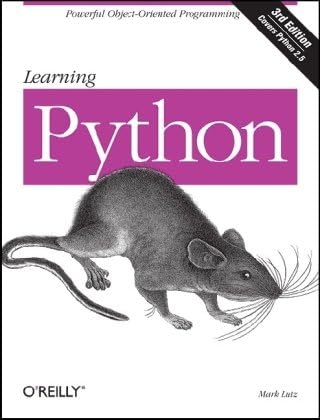
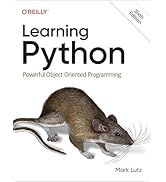
Learning Python, 3rd Edition
Product ID: 46658839
📚30 concise chapters
🚀Covers beginner to advanced
🧠Expert teaching clarity
Buy anything from 5,000+ international stores. One checkout price. No surprise fees. Join 2M+ shoppers on Desertcart.
Desertcart purchases this item on your behalf and handles shipping, customs, and support to Spain.
🐍 Unlock Python mastery with the ultimate learning companion!
Learning Python, 3rd Edition by Mark Lutz is a comprehensive guide featuring 30 well-structured chapters that teach Python from beginner to advanced levels. Praised for its clear explanations and practical examples, this book is perfect for professionals seeking to deepen their Python skills and gain a thorough understanding of the language. A must-have for any serious Python programmer’s library.


| Best Sellers Rank | #1,846,772 in Books ( See Top 100 in Books ) #237 in Macintosh Operating System #516 in Object-Oriented Design #1,582 in Python Programming |
| Customer Reviews | 4.1 4.1 out of 5 stars (58) |
| Dimensions | 7 x 1.5 x 9.25 inches |
| Edition | 3rd |
| ISBN-10 | 0596513984 |
| ISBN-13 | 978-0596513986 |
| Item Weight | 2.34 pounds |
| Language | English |
| Print length | 700 pages |
| Publication date | January 1, 2007 |
| Publisher | O'Reilly Media, Inc. |
A**N
Great book, even for the experienced python programmer
Learning Python 3rd edition. I bought this book in 2009 because I had been using python at work and still do, every day. I have two different versions of another python book, "Python, Essential Reference", and frequently turn to them when I forget, for example, how one of the string functions work, or when I want to know the details of a method in the os or os.path module. Those books are perfect for that purpose, but you could use a web resource just as well. This book is different, as it teaches about the python language, and it absolutely excels in that task. I would recommend it for any level: beginner, intermediate, or advanced. Oh how I wish that I dove into this book earlier, when I first bought it. I consider myself an expert in the language, and so thought I did not really need it. What I found out when I spent some time with it, is that the author is not only an expert in python, but also an expert in teaching it. I ended up understanding some things much better and more thoroughly that I had before, and learned lots of new things along the way. The author explains an aspect of the language and then gives examples that are easy to understand and solidifies the concept. That pattern repeats throughout the book. The book is structured in a way that lets you jump around if you wish. But after I did this for a while, I went back and took the time to read it from the beginning. I did not regret spending the extra time doing this. I ended up marking some places in the book with post-it markers for later reference. This book has to rank near the top of my technical book collection. I highly recommend it.
M**R
Good book for starting python
This book has about 30 short chapters that focus on introducing a small piece. The author does not assume much experience, and tries to provide a clear explanation of each topic. The book is divided to 7 parts that cover a certain aspect, such as classes or modules. The examples are mostly small, and very often for the interactive shell rather than as stand alone programs. The author states that this book was written as a learning tool, rather than as a guide to producing real life programs. For that, he guides readers to his follow up book, programming python (which I have not read). One shortfall was the confinement of exercises to the end of parts (which often have 5 or so chapters) rather than at the end of each chapter. This approach might be alright considering the level of material covered, but I think it would be helpful to have more exercises. In general, I think this is a good starting point to python, but probably needs to be followed by other books for actual production.
K**R
Wordy
This book should be called "Learning Python for people who have never programmed before". The author states in the preface that no assumptions have been made about the reader's programming background. I think that this is why this book is so wordy. Amazon's opening statement: "The authors of Learning Python show you enough essentials of the Python scripting language to enable you to begin solving problems right away..." Well, not right away. You have to read half the book first. The book delves into the details of data object types before even talking about basic programming features such as for/while loops (pg. 248). This book is an obvious outcropping of the author's classes on Python. I would think that the author's approach would be fine in a classroom setting, but this hand-holding approach in print is laborious. The book also has altogether too many references to later chapters. I got tired of reading "X will be covered later in chapter Y". If you aren't going to talk about it now, don't waste the reader's time talking about how you are not going to talk about it now. That said, I found the information in the book to be useful. I just received "Programming in Python 3" by Mark Summerfield. This book takes the approach I wish that "Learning Python" had.
A**R
The Longest Short-way to Python
If you are a top-down learner this book is not for you. You can safely pick "Dive into Python". However, if you are the bottom-up type, you will not regret. While the Python slogan promises "one way to do it", Mark Lutz will show you four, and explore every detail, like complex list comprehensions, closures and the diamond inheritance pattern. This is why you will wait 200 pages (exploring data types) until the introduction of the first Python statement, and 200 pages more for the first script. But if you cross the details, you will get excellent understandings of the core Python logic, which will save you countless debugging hours in the future. The OO part alone worth the entire book. It's going from the very basics of OO programming up to elementary design patterns and some advanced OO implementation issues in Python. One last caution: although 600 pages, this book should be really read cover to cover. It's a true tutorial, which gradually develops the major concepts (sequences, assignments, references, objects, namespaces etc) from the ground up, with (midterm?) exercises. Give yourself a few hours to really learn, exercise your brain (and fully grasp 100 ways to silently override your variables with namespace mistakes). It's a great book.
A**0
This is an excellent reference to understand all aspects of Python programming from the very basics to the more in-depth. It deals with Classes and OOP (Obect Oriented Programming) very well with many examples. Anyone with a sequential programming background who finds OOP difficult will delight in this book. I thoroughly recommend it.
C**Z
For those python programming lovers, students or fans, this is a must have book. I like how deep into the language this goes.
Trustpilot
1 week ago
1 month ago