Desertcart purchases this item on your behalf and handles shipping, customs, and support to Spain.
โก Unlock the secret language of your USB power like a true tech whisperer!
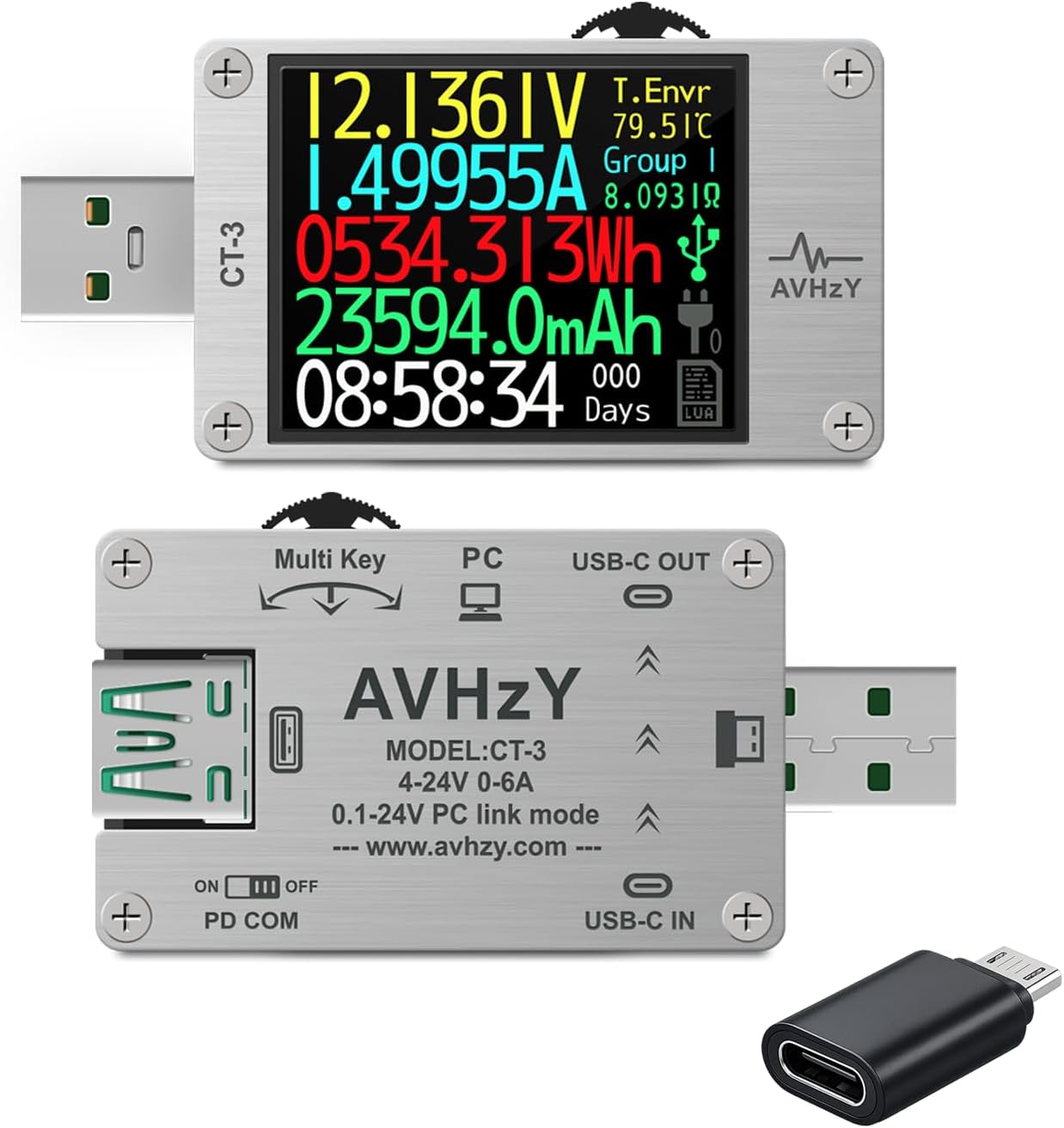
The AVHzY USB Power Meter CT-3 is a compact, professional-grade USB 3.1 multimeter and power delivery tester. It measures voltage up to 26V and current up to 6A with 4.5-digit precision and minimal error. Featuring a crisp 1.77โ TFT display, it supports a wide range of fast-charging protocols including PD, QC, Huawei SCP, Samsung AFC, and VOOC. Its integrated Lua interpreter and powerful PC software enable advanced scripting, real-time data logging, and detailed device diagnostics, making it an essential tool for engineers, tech enthusiasts, and professionals who demand precise USB power insights.


| ASIN | B073R7YRM9 |
| Best Sellers Rank | #149,554 in Industrial & Scientific ( See Top 100 in Industrial & Scientific ) #17 in Component Testers #323 in Multi Testers |
| Brand | AVHzY |
| Brand Name | AVHzY |
| Color | grey |
| Customer Reviews | 4.3 out of 5 stars 252 Reviews |
| Included Components | USB |
| Item Dimensions | 3.03 x 1.38 x 0.47 inches |
| Item Weight | 27.22 g |
| Item dimensions L x W x H | 3.03 x 1.38 x 0.47 inches |
| Manufacturer | AVHzY |
| Maximum Operating Voltage | 26 Volts |
| Measurement Type | Multimeter |
| Model | CT |
| Part Number | CT-3 |
| Power Source | Battery Powered |
| Specification Met | Ul 61010-1, Iec 61010-2-030, Ce Marked |
| Style | CT-3 |
| Style Name | CT-3 |
| UPC | 761330312552 |
R**A
Accurate, Detailed, and Perfect for Power Testing
Excellent tool for monitoring USB power delivery in real time. The display is clear and easy to read, and it provides detailed data including voltage, current, wattage, accumulated mAh, and Wh. Iโve used it to test chargers, cables, and device draw under load, and the readings have been consistent and reliable. The PD/QC trigger functionality is a big plus for stress testing and verifying fast-charge negotiation. Build quality feels solid and it handles higher wattage without issue. Great for anyone who likes understanding exactly what their devices are pulling.
R**I
WOW, Discover the secrets of your USB power sources
This little device (I have the all USB-C version) does much more than my previous USB power monitor. In addition to Power Delivery, Apple, and Qualcomm Quick Charge QC 2.0/3.0/4+, it can probe a battery/charger for more obscure protocols such as DASH (OnePlus), Adaptive Fast Charging (Samsung), FCP/SCP/SSCP (Huawei), and 4 kinds of VOOC. The user interface takes a bit of learning, but the left/right/enter switch makes things a breeze, especially when compared to my previous USB power monitor that had just one button to do everything. The C3 comes with two Type-A to Type-C adapters which provides it the ability to connect in a wide variety of situations. I used the this device to discover why my Anker 545 Portable Power Station was not delivering 12V on the USB C ports. it turns out that the 545 won't do 12V via PD Trigger, but the same Type C port will do 12V via QC3.0. Go figure. This deficiency seems to be common to a lot of Anker products. When using USB PD, they leave out the 12V profile. Why Anker, why? It is unfortunate that the PC software for this device does not support Linux. I could see people wanting to connect this to a Raspberry Pi or something. Lastly, it is possible to update the firmware even without the PC software. If you hold down the multi-key while connecting it to a PC, the device will go into its bootloader and preset as a USB drive to the PC. You can copy the firmware to the USB drive and tell the C3 to use the file for a firmware update. Sweet! I am very happy with this device. The software seems top-notch and the all Type-C design allows it to be very small. It even came with a tempered-glass screen protector. Nice.
W**H
Lots of capability, needs better instructions...
This is an impressively capable USB A and USB C tester. It'll let you put any power supply through its paces (especially with the optional electronic load), tell you more than you probably ever wanted to know about power and charging protcols, and it'll even let you do some truly unwise things. You can even connect it to your computer and log data for immediate or later perusal. All that capability begs for far better documentation. Surely someone at AVHzY could find or hire a native speaker for every language the instructions are provided in. This applies to the device as well. One of the messages in particular is quite odd, referring to the device under test as a "guy". As things are now, I haven't worked out every function this tester is capable of, mainly because the instructions are so dire.
S**N
Review of the CT-3: Great USB Meter
The AVHzY is a smart and useful USB meter. It is the very versatile and has the most features of all the meters I own. Supports USB C, USB A, and a Micro USB port for only connecting to the PC or providing power. One of the few testers that can read the e-maker chip of USB-C cables. I find this meter the easiest to use use of all my USB meters. It has a multi button that lets you press and rotate left/right, you'll still need to read the manual as this one button controls everything. Screen is nice and clear. It even came with a free tempered glass screen protector. The fit and finish is good but the stainless steel is edge can be a bit sharp. I only have two things I wish this meter did better: 1) wish it had bluetooth so I could monitor things via a smartphone app or wirelessly. 2) The female USB port is "upside down" (i.e. opposite orientation) of the male USB plug, which is strange to me. Make it so my USB load has to be put upside down when I connect it to the meter. Of my 4 meters, the generic UP-LCDV03, RD UM25C, RD TC66C, and AVHzY CT-3. The AVHzYCT-3 is my fav because it has the most features followed by the very compact RD TC66C because it is pure USB C.
E**C
A powerful combination of most of the current usb meters/triggers
This USB meter is very powerful. Build quality looks good. The large TFT screen helps to read easily. It has some common features like monitoring voltage, current, energy, power, capacity, and time with high accuracy. It also has wide operating range of 3.7-25V, 0-5A but a low quiescent current of 1mA@5V. Moreover, it has built-in clock and temperature sensor while most of the other usb meters donโt. Like some other usb meters, it supports dual-way detection thus donโt have to plug the input cable into the IN port, but the OUT port works as well. Furthermore, it has 5 different views of the home screen including everything on one page, D+ D- voltages & current direction & possible + current charging protocols, time and energy consumption, simple look with large fonts, and black screen. And It will automatically enter power saving screen when idle. The electronic load is fairly easy to use. Turn the knob clockwise/counterclockwise to increase/decrease the current. The fan will automatically turn on when the temperature is higher than 40โ to keep it cool. Good for performing stress test on a power adapter or measuring the capacity of a power bank. Next is the advanced part Iโd like to comment in detail. [Operations] All operations are carried out with the scroller. >Short press - switches/enters/confirms >Long press - enters the main menu >Double press - enters the charting mode/exits to the home screen >Short turn forward/backward - enters a mode/scrolls through menu options/triggers an action/increases or decreases a value >Long turn (turn and hold) forward/backward - enters a mode/scrolls through menu options/triggers an action/increases or decreases a value [Groups] Short turn forward to clean the current group. Can switch between 5 groups for different tests. [Charting] Double press to enter, short press to switch between V-A and Vd+/Vd-. Draws a V-A or Vd+/Vd- chart with real-time data at a selected sample rate [FastCharge Trigger] UNPLUG any device before doing this as it may DAMAGE your device! Short turn backward to enter. Short turn forward/backward again after the red warning message flashes three times. Short turn backward once more to release if triggered. Triggers different voltages that a power supply can deliver. >QC2.0 - triggers 5/9/12/20V if supported. >QC3.0 - triggers 5-20V, increases/decreases 200mV per time, if supported >Auto Detect - automatically detects the charging technologies the power supply supported and shows them in green. Helps to pick a power supply with high compatibility. >Apple 2.4A - makes a regular charger to charge like an apple 2.4A charger. Lets a regular charger charges an apple device faster. >Apple MFI Test - checks if a lightning cable is MFi certified. Helps to pick a good lightning cable. (Needs a QC3.0 charger) >Power Delivery - checks the PDOs the PD charger offered and triggers the voltages (Needs to turn on the PD trigger switch first) >HUAWEI FCP - triggers HUAWEI FCP voltages 5/9V. >Samsung AFC - triggers Samsung AFC voltages 5/9V. [Cable Resistance Test] Long turn backward to enter. Needs to use with the electronic load together to adjust the output current to 500mA or greater. Tests the ESR of a usb cable. Usually a better cable has a lower ESR. In addition, a lot of settings can be found in the main menu. Itโs awesome that a firmware update will bring more new features. Itโs really a combination of all my current usb meters/triggers with even more features. Powerful and useful. I wish bluetooth connection and PC/Smartphone apps would be found in a later version of this product. (I did everything pretty quick in the video to save your time.) ------------- UPDATE 12/27/2017 ------------- CT-2 Part [Independently/Externally Powered] Powered via the Micro USB port. Can measure DC 0.1-26V with this. Useful to check Ni-MH rechargeable batteries. [Offline Curve Recording] Short turn forward to enter. Records the voltage and current points. Will generate a curve diagram when finished recording. A charge curve helps determine if a charger is good. Also, the curve records can be accessed in the PC app. [PC App] Shows the curve diagram directly. Can save/export the curve diagram to a file and open the diagram recorded on the meter or computer. Tracks the communication between a charger (source) and a device (sink) with PD Listen. Will let you know how a PD charger charges a device. Needs the PD Tester switch to be turned on. Boot logo and theme can be easily customized here. Can perform firmware update here as well. I also updated the video. I am looking forward to the next version!
D**L
Useful tool for USB power debugging
I've used this on multiple occasions to test / debug a slow charging USB port. It is easy to use for the most basic tasks, and fairly easy to figure out the more advanced functionality with a bit of messing around, but has a user guide if needed. It's bright enough to read, easy to carry around, connects and displays data quickly, and not too expensive for the peace of mind of knowing where the issue is. Definitely worth taking with you if you suspect you'll need to test a USB port.
N**3
Does NOT support Power Delivery (PD) protocol for Raspberry Pi 5 (5.1V and 5A)
This worked great with the Raspberry Pi 4B which had broken support of the USB protocols. However, Raspberry Pi 5 does support USB protocols correctly and uses Power Delivery (PD) protocol (I believe, PD 3.0) with 5.1V and 5A. This AVHzY USB Power Meter does not provide 5A power to the Raspberry Pi 5 which reports insufficient power for full support of USB connected devices. This is a major disappointment. The software is excellent, although it does crash occasionally when run under VMware Fusion Pro on a Mac. There is no macOS version of the software. I have also tested the ChargerLAB Power-Z KM003C as well. Its software is in Chinese even if English is selected. Useless. I plan to test the FNIRSI FNB58 and update this review.
S**D
I'd recommend!
Pumped on this. Solid little unit that works good. I had to learn how to use to use some of the features to be honest. It was this or whatever Klein offers, Happy I went with this
S**O
Not testing as per specs given
As mentioned max measurable voltage / current 26V - 6.0A in specs, but measuring max. 20V - 3.1A = 63W (PD3.0 PPS) while charger can supply 20V - 5A = 100W.
Trustpilot
4 days ago
5 days ago