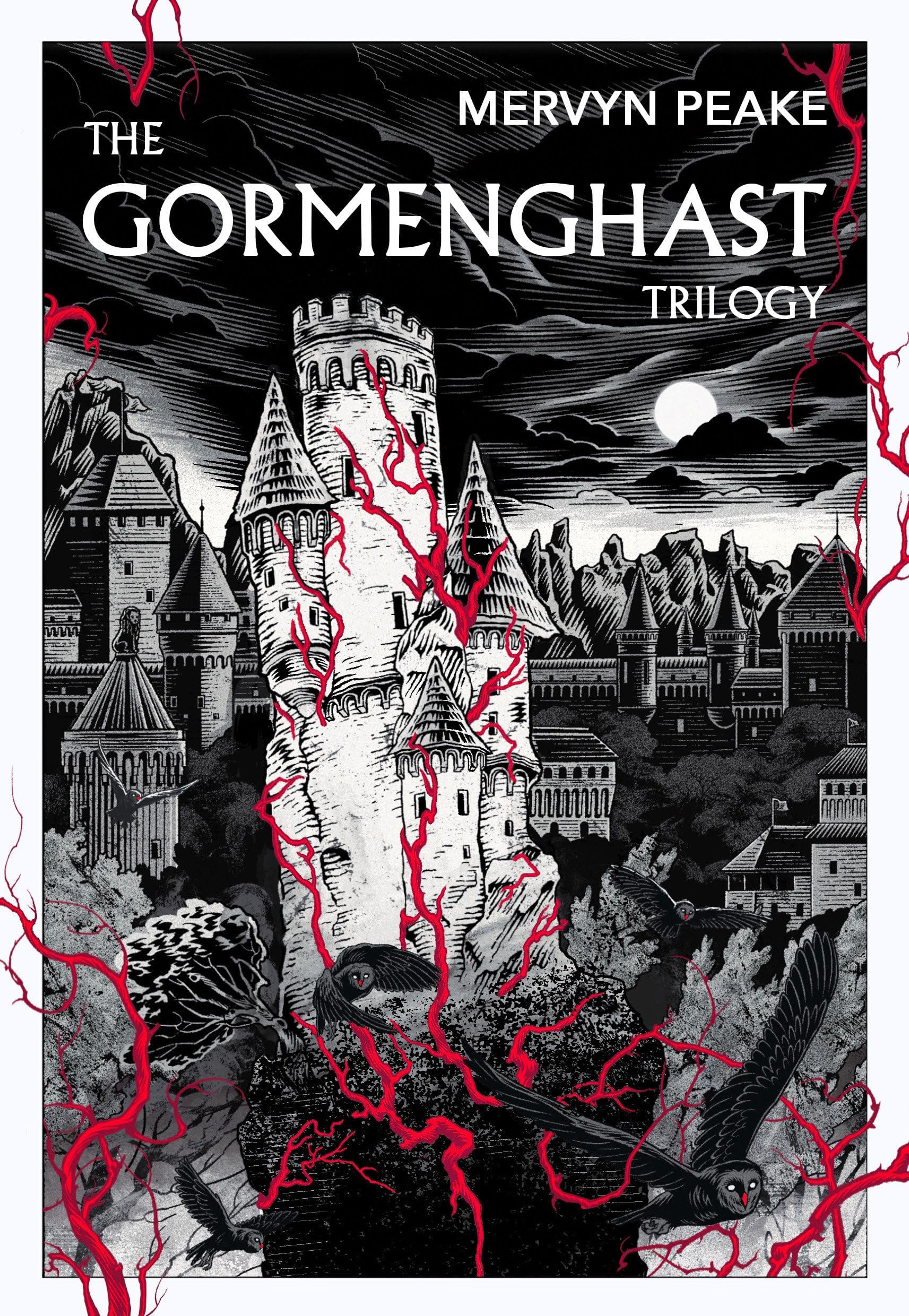
Vintage Classics The Gormenghast Trilogy
Product ID: 439666528
Buy anything from 5,000+ international stores. One checkout price. No surprise fees. Join 2M+ shoppers on Desertcart.
Desertcart purchases this item on your behalf and handles shipping, customs, and support to Spain.
ENTER THE CRUMBLING WORLD OF GORMENGHAST... 'A modern classic' Anthony Burgess 'A gorgeous volcanic eruption... A work of extraordinary imagination' New Yorker 'A perfect creation' Neil Gaiman Gormenghast is the vast, crumbling castle to which the seventy-seventh Earl, Titus Groan, is lord and heir. Titus is expected to rule this gothic labyrinth of turrets and dungeons (and his eccentric and wayward subjects) according to strict age-old rituals, but things are changing in the castle. Titus must contend with treachery, manipulation and murder as well as his own longing for a life beyond the castle walls. 'Peake's books are actual additions to life; they give, like certain rare dreams, sensations we never had before' C. S. Lewis Review: Excelentes livros, edição porca - Sobre o conteúdo não há muito o que falar, Gormenghast é um clássico e assim como anunciado, as ilustrações parecem estar todas aqui. Essa avaliação é sobre a qualidade física da edição capa comum da Tusk Overlook. Além de algumas avarias leves na capa, que eu acredito serem perfeitamente normais e toleráveis, assim que abri o pacote e folheei o livro me deparei com vários conjuntos de páginas que vieram coladas, que rasgaram levemente, mas de maneira perceptível, quando tentei separá-las. Decepcionante. Review: Nice - The dust jacket has an amazing texture and feels good in hand, without the dust jacket it is just the standard hardback, the spine is a little thin but oh well, and the pages are thin but that’s to be expected cause of the thickness, overall it is good and the illustrations are just the best by the author himself.
| Best Sellers Rank | #106,449 in Books ( See Top 100 in Books ) #69 in Norse & Viking Myth & Legend #303 in Historical Fantasy #416 in Sword & Sorcery Fantasy |
| Customer Reviews | 4.6 out of 5 stars 661 Reviews |
J**O
Excelentes livros, edição porca
Sobre o conteúdo não há muito o que falar, Gormenghast é um clássico e assim como anunciado, as ilustrações parecem estar todas aqui. Essa avaliação é sobre a qualidade física da edição capa comum da Tusk Overlook. Além de algumas avarias leves na capa, que eu acredito serem perfeitamente normais e toleráveis, assim que abri o pacote e folheei o livro me deparei com vários conjuntos de páginas que vieram coladas, que rasgaram levemente, mas de maneira perceptível, quando tentei separá-las. Decepcionante.
A**H
Nice
The dust jacket has an amazing texture and feels good in hand, without the dust jacket it is just the standard hardback, the spine is a little thin but oh well, and the pages are thin but that’s to be expected cause of the thickness, overall it is good and the illustrations are just the best by the author himself.
P**E
Highbrow Dark Escapism - brilliantly written (details)
I've read three books per week for years and this is perhaps the finest, best-written series of escapism novels I've ever come across. I'll give you some story details momentarily (and please bear in mind that I'm appraising three books here so this review is lengthy), but I feel compelled to first present a few edifying comments as these works might well suit your fancy and, then again, they might not. There are tons of "reader myths" concerning the three "Titus Books" or "Gormenghast Novels," (either of which is appropriate, thereby dodging the deceptive "trilogy" word), and I wish to disclose the facts about this series to the degree that I'm able, sidestepping spoilers as I do so. As I've mentioned, this edition (The Overlook Press paperback, 1995) contains three books: "Titus Groan" (1946), "Gormenghast" (1950), and "Titus Alone" (1959.) They comprise a trilogy only in the sense that there happens to be three books in the series. Mervyn Peake kept each book's conclusion a bit open-ended (but each one is "resolved" and stands on its own) because he had planned to publish a fourth... and possibly even more than that. But before he could produce further entries, Mervyn Peake sadly fell to a devastating mental affliction which impaired his ability to concentrate (he ultimately died in 1968) and so we regretfully lost a gifted author, quite prematurely, and we now have only the three books - but what a three! I'm going to review these works as if they were a single volume (which is how it is paginated in the Overlook version), injecting some supplementary comments that apply to each specific book. First, what it is not: Devoted Gormenghast fans would almost certainly fancy Tolkien's The Lord of the Rings trilogy -- but it's quite likely that the reverse would not necessarily hold true. In Gormenghast, there are no magical spells, no sub-human primates (such as "orcs," although some look and act like monsters of various sorts), and no dragons. Gormenghast is an isolated kingdom, the residents functioning within a rural agrarian, humanistic community, at the heart of which sits a huge deteriorating castle by the same name. Mud peasants' huts are plastered along the exterior walls like so many barnacles. This kingdom's various and well-defined societies are represented by assorted cultures which can be split into roughly two communities: those who live within the castle walls and those who live outside this fading edifice. Of the latter, the most notable residents are "The Bright Carvers," so named for their proficient skills in producing intricately carved wooden statuary which is gravely judged in an annual ritualistic craft fair of a sort, which has witlessly prevailed for well over 300 years. (In the third book further characters and cultures, outside the realm of the Gormenghast kingdom, appear.) Inside the castle walls, the reader is introduced to most (but not all) of the important characters of the first two books: Sepulchrave Groan (the grim Seventy-Sixth Earl of Groan and Lord of Gormenghast); Countess Gertrude (his eccentric cat- and bird-loving wife); Fuchsia (their frolicsome and untamed teen daughter); Titus (their son and the stories' central protagonist); Lady Cora and Lady Clarice (Titus' aged and imbecilic twin aunts); Flay (the cunning, personal servant to the Earl); Rottcodd (the uninformed curator of the dust-laden carvings); Sourdust (an ancient resident ritualist); Abiatha Swelter (the blubbery, noxious chef and procurator of kitchen misery); Mrs. Nannie Slagg (Fuchsia's beleaguered elderly servant); Steerpike (a shrewd, sociopathic, scheming loner); Dr. Prunesquallor (the only independent mind at Gormenghast); Irma (Prunesquallor's lamentable, love-starved shrew of a sister); Barquentine (Sourdust's one-legged, 74 year-old son and apprentice), and; Bellgrove (an academic scholar with very regrettable teeth.) Out in the kingdom's landscape the two most important characters are Keda (Titus' wet-nurse), and Keda's daughter, a.k.a. "The Thing." In the third book we are introduced to a further nine noteworthy principals, (and to avoid spoilers I won't describe them beyond their own curious sobriquets): Muzzlehatch; Juno; Acreblade; Anchor; Crack-Bell; Crabcalf; Slingshott; the Black Rose, and; Cheeta. I mention all these extraordinary names primarily to furnish prospective readers with a broader sense of the books' intriguing ambiance. The Groan family has largely become dissolute and seems to persevere for no objective beyond that of perpetuating this genetically-attenuated line of rulers. They behave and function almost exclusively as individuals, having virtually no contact with one another except when they assemble to carry out assorted unchanging and ageless rites and rituals for various arcane purposes. None of these interminable observances appear to obviate any religious or spiritual significance, with the possible exception of the occasional funeral. Beyond the rituals, everyday life for the Groans around Gormenghast castle is as each chooses to spend it - any one of the hundreds of symbiotic servants stand ready at their beck and call but they, too, tend to while away the time. The hallmarks of the Groans (and of many of the servants) include intrigue, furtiveness, paranoia, greed, hubris, suspicion, phobias, mistrust and, blind devotion to ceremony. Serial murder becomes a familiar central theme as the story develops. The castle itself is colossal in both its enormity and its innumerable rooms. If it existed in the non-fictional world it would imaginably compare to the Russian Tsar's Winter Palace or the Pentagon in its geological vastness. Not even the oldest and most tenured servants know their way about in certain wings of this crumbling stronghold. No one makes repairs. No one is asked to. As a room becomes unusable, residents and servants alike simply move to another room - there are plenty available; however, a certain admonition of warning is counseled by the servants as specific wings of the castle are widely renowned for their "bad reputations." The Hall of Spiders (Page 335) is one such locality. At the conclusion of "Titus Groan," (Book One) Titus, (the heir apparent), remains a toddler in age. So the reader can correctly anticipate that the first book is much about the activities of the adult characters as well as the history of Gormenghast. Some say that this is the best book of the three but I like them all equally. You might be thinking, when is this guy going to tell me what the story is all about? Well, I am - it's all about day-to-day life for the people at Gormenghast castle and its hinterland. There is a sort of meandering plot in that Steerpike escapes the horror of Swelter's kitchen and seeks to rise quickly within the service of the Groan hierarchy. This theme continues throughout "Gormenghast" (Book Two) but there are many additional subplots which blossom in that title as well. Your other big question: "Why is this guy holding back on the content of `Titus Alone' (Book Three)?" Well if you've done even a smidgen of research on this so-called "trilogy" then you've assuredly grasped that numerous people continue to cry foul about "Titus Alone" (Book Three.) Some of this discourse has justifiably resulted from "bombshell," for lack of a more apt term. Remaining necessarily vague, but to arm you just a tad, this is where Titus Groan metaphorically sidetracks down Alice's Hole. Each of these titles depicts a slightly different genre, the final entry diverging most of all - so perhaps this is an opportune moment for me to attempt (however feeble my efforts) to append a label to each one: As an all-encompassing description, one might characterize the Titus Books as "Highbrow Dark Escapism" - but as that doesn't yield much I'll try to whittle it down some: "Titus Groan" - A Gothic Novel (Peake loathed this depiction because it really does mischaracterize his subsequent two works - but as I am classifying this one solely on its own merit, I'll stay with that.) "Gormenghast" - A Mythical Tale-Noir "Titus Alone" - A Surrealistic Adventure of Chivalry So you see, the genres broadly mesh in terms of reader interest but not precisely cog-for-cog... there are incongruities. But I feel strongly that what I call the Titus Groan Chronicle holds together seamlessly and, what's more, it's utterly captivating. I was recently queried: "Does `Titus Alone' (Book Three) attend a specific purpose?" Yes, more than one actually. In addition to the obvious extension of the Titus Groan legend, the third book does something that I've never encountered elsewhere. It retrospectively establishes an aggregate paradigm of the overall fable, assimilating backwards into the first two books while doing so. In other words, when you finish the third book you can then look back and extract significantly more from the first two that simply did not emerge as you were reading them -- an epiphany. And it's that epiphany which has caused many a disconcerted reader to experience an actual sense of emotional anxiety. I think that Peake could have been a first-class psychologist! Here's where most people fail with The Gormenghast Novels, (and most readers seem to respond truthfully about this): They don't finish the third book. They read about one-fourth of it, or less, and they call it quits because they feel betrayed. But abandoning the book is a huge mistake because by completing the series, one ultimately garners a wholly new slant on the overall work, in its aggregate. So, enough on that. Let there be no uncertainty that this is a dark tale, no doubt about it -- but it's not at all a gloomy one. You can't make shadows without some light, my friends. Peake even intermittently inserted sniglets of subtle hilarity, albeit most of these lighter moments smack of the "gallows humor" sort: "The Doctor [Prunesquallor] found him extremely quick to learn and within a few weeks Steerpike was in control of all the dispensary work. Indeed, the chemicals and drugs had a strong fascination for the youth and he would often be found compiling mixtures of his own invention. Of the compromising and tragic circumstances that were the outcome of all this, is not yet time to speak." (Page 146) For many of us, (overgrown boys anyway), Peake really brought home the bacon by pulling us right into the story by means of his perceptive, nostalgic prose: "His [Titus'] mind, and the minds of his small companions in that leather-walled schoolroom, was far away, but in a world, not of prophets, but of swopped [sic] marbles, birds' eggs, wooden daggers, secrets and catapults, midnight feasts, heroes, deadly rivalries and desperate friendships." (Page 410.) So if "Gormenghast" isn't reminiscent of "The Lord of the Rings," then what is it like? Critics have plainly struggled with this enigmatic question and in all the critical commentaries I've read to date, (there are 13 of them covering over 100 total pages in the back of this edition alone, plus two critical introductions!), I have not seen anyone land a knockout on this issue. Maybe it was just luck (and maybe I'm completely misguided) but I recently read a book which much reminded me of the Titus Books in both writing style and substance: Puck of Pook's Hill (Illustrated Edition) (Dodo Press) . Granted, this is a completely different story and just a bit more fairy-tale-ish but I sensed a patent connection between the two. "Puck" is a short work at just over 200 pages but I think the tenon here is that since both Kipling and Peake were Englishmen, they shared a particular realm of experience and personal values. Additionally there is this parallel: With both Peake and Kipling it's difficult to distinguish much between their heroes and their villains. This is not the case with Tolkien - one can anticipate without much difficulty as to where his characters are going to alight, ethically speaking. The real key to the Gormenghast Books is time. During a first-round reading one doesn't typically detect the significance of what happens with time as the story clicks along - it moves, but roundabout like a snake, to the left and then to the right, inching forward with covert stealth. So by the end of "Titus Groan" (Book One), only two years have transpired, (not counting all the backlog of Gormenghast history that we glean from dialogue. That's not time spent - it's time discussed.) But in "Gormenghast" (Book Two), Titus grows from about age seven through to adulthood (about age 20)... it speeds right along but again, we don't really detect the difference. In "Titus Alone" (Book Three), not much time passes but so much more happens within that abbreviated period. This manipulation of time versus activity becomes a Mervyn Peake signature which greatly enhances literary value and reader interest. Getting back to comparisons, there is a terrific 1980s film available on DVD (notably under-rated) which might give one a sense of Gormenghast. Again, this is an entirely different story but I came away from the book thinking about the many connections between the two media: Gothic . Each of the three Gormenghast Novels is about 400 pages long and it is adult reading simply because it's clearly not a child's fairy tale. Surprisingly, the sexual content is nearly non-existent although Peake did manage to deposit an occasional vaguely hormonal paragraph here and there. And someone is sure to launch on me about the single paragraph in "Titus Alone" where Titus emerges from sleep following an illness and utters an obscene proposition to Cheeta - and to that I would just say that the verbiage was more the inherent orneriness of male 20 year-olds than it was about sex per se - when you read the passage I think that you'll agree with my appraisal. Gormenghast is a work for bibliophiles. Peake's prose is incredibly expressive and artful (of course it would be because he was actually a poet more so than a novelist) -- Edward Abbey has nothing over Mervyn Peake. Peake takes no prisoners, he handles his characters brusquely, and he's not averse to leaving spent characters behind. (Old Rottcodd sort of fades into the sunset after having served a rather pointless role.) I think that a few critics have revealed their pretentious colors with their emphasis on Gormenghast as a "flawed work." I see it this way: Peake simply refused to remain within academic literary parameters. He simply wrote down his stories the way he imagined them, scholarly drones be damned. If it's flawed, it's a Rolex that's missing a second hand. I could easily generate a tome-ish analysis of "Gormenghast" that would exceed the weight of the books themselves - but I'll spare you that. In summary, The Gormenghast Novels are as unconventional as Heinlein's Stranger in a Strange Land . They broke new ground in literature much as Igor Strawinsky: Le Sacre du Printemps did in classical music. They're grotesque, much like Peake's primitive illustrations scattered throughout the work, and yet charismatic... a timeless bildungsroman. I loved this series - I hope you do too.
R**O
The Gormanghast Trilogy
A beautifully printed work of art. Easily the greatest fantasy novel ever written bar none.
S**A
Eigenwillig, aber lohnenswert
Peakes Trilogie wurde mir von einer Mitstudentin empfohlen, deren Literaturtipps bislang sehr gut meinen Geschmack getroffen hatten. So brachte sie mir Neal Stephenson ebenso nahe wie Dilys Rose und Douglas Coupland (den ich bis vor gut einem Jahr nur als Microserfs-Autor kannte). Nach den ersten Seiten Gormenghast dachte ich, dies sei nun der erste Fehlgriff gewesen. Zu sperrig, zu kindisch - ich fand mich kaum in die Welt des Werks ein. So ließ ich den Wälzer zunächst einmal liegen und stürzte mich auf 'seichtere' Lektüre. Einen Monat später kehrte ich zurück, nahm mir Zeit und gab dem Buch eine zweite Chance. Und wurde belohnt. Reich belohnt. Peake baut seine Szenerie, seine Charaktere langsam und systematisch auf, vom Schroffen in die Feinheiten. Er stürzt den Leser nicht mitten hinein in eine bunte Welt, setzt ihn nicht an den Tisch mit Freunden und Gesellen wie es Tolkien etwa im Hobbit tut. Der Leser kommt als Fremder nach Gormenghast und muss seine Gestalten erst von ihrem Staub, ihrem grauen Schleier befreien bevor er ihre Nuancen sehen, in ihre Gedankenwelten einblicken kann. Das dauert. In meinem Fall etwa bis zum Ende des zehnten Kapitels. Doch ab diesem Punkt habe ich Gormenghast lieben gelernt. Der sperrige kalte Duktus, der am Anfang wie eine Mauer zwischen mir und der erzählten Geschichte stand, begann selbst Teil der Welt zu werden. Das Bild wurde stimmig. Peake ist es gelungen, die verschiedenen skurril-überzeichneten Figuren in Balance zu bringen und ihre zunächst disparaten Erzählungen zu einem fesselnden Plot zu verweben. Die Episodenhaftigkeit der Expositionen, die zu Beginn eher störend wirkt, löst sich in ein geschickt gestaltetes mitreissendes Spiel auf. Gormenghast ist keine S-Bahnlektüre, dazu verlangt es einen zu großen Sprung zum Eintauchen. Aber es ist eine schrullig-schöne Erzählung die Eindruck hinterlässt. Zur Edition: Druck und Bindung sind wertig, auch die Illustrationen gefallen in ihrer Schlichtheit. Einzig der Druck des Einbands hätte schöner ausfallen können, Hintergrundmotiv und runde Ecken sind grieselig bis unscharf, was angesichts des sehr gelungenen Rückendrucks verwundert - kein Herstellungsfehler also, sondern vom Designer offenbar beabsichtigt. Die im Produktfoto gezeigte schwarze Bauchbinde ist ein sehr unpraktisches "Stückchen" Schutzumschlag, das verrutscht und beim Lesen stört - ich habe es entsorgt.
Trustpilot
1 month ago
2 weeks ago