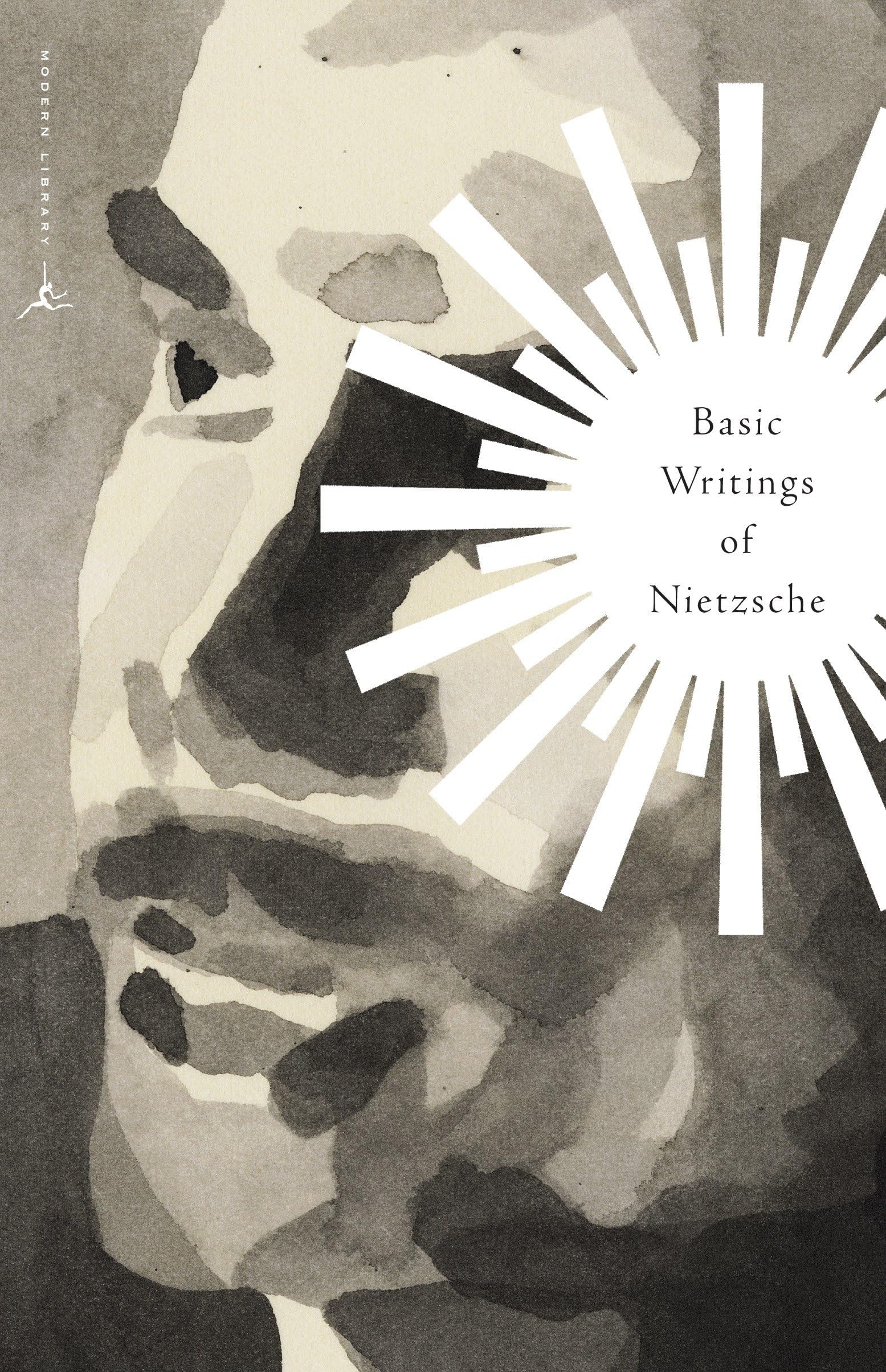
Basic Writings of Nietzsche (Modern Library Classics)
Product ID: 4153797
Buy anything from 5,000+ international stores. One checkout price. No surprise fees. Join 2M+ shoppers on Desertcart.
Desertcart purchases this item on your behalf and handles shipping, customs, and support to Spain.
This captivating collection brings together five of Friedrich Nietzche’s most important philosophical works, exploring themes such as nihilism, metaphysics, and the nature of morality—featuring an introduction by Peter Gay and commentary from Martin Heidegger, Albert Camus, and Gilles Deleuze More than one hundred years after his death, Friedrich Nietzsche remains the most influential philosopher of the modern era. Basic Writings of Nietzsche gathers the complete texts of five of Nietzsche’s most important works, from his first book to his last: The Birth of Tragedy, Beyond Good and Evil, On the Genealogy of Morals, The Case of Wagner, and Ecce Homo . Edited and translated by the great Nietzsche scholar Walter Kaufmann, this volume also features seventy-five aphorisms, selections from Nietzsche’s correspondence, and variants from drafts for Ecce Homo . It is a definitive guide to the full range of Nietzsche’s thought. This edition includes a Modern Library Reading Group Guide Review: A fascinating human being of exceptional complexity and integrity (P. Gay) - Nietzsche was the greatest polemist ever. He played the role of Saint-Michael, the dragon slayer, in his Homeric battle with the existing dragons (the Christian moralists). He tried to revalue all generally accepted `good and evil' values and really felt that mankind was pregnant with a new super-species, the `Übermensch'. His influence on philosophy, literature, psychology and politics is immense. Of course, some aspects of his vision on mankind are unacceptable. The all important influence on his Nietzsche's life and philosophy came from Schopenhauer: `I very earnestly denied my `will to life' at the time when I first read Schopenhauer.' The life of a Nietzschean immoralist Life is to express one's will to and lust for power. The cardinal instinct of man is not self-preservation, but the discharge of strength. Everything evil, terrible, tyrannical in man, everything that is kin to beasts of prey and serpents serves the enhancement of the species `man'. This enhancement has always been the work of an aristocratic society. The noble man creates his own morality, his good and bad, with egoism and exploitation as his real nature. He despises the slaves, the unfree, the doglike people who allow themselves to be maltreated. Christian morals, democracy When the aristocratic value judgments declined, the plebeians imposed their own morality of unegoism, pity, self-sacrifice, self-abnegation and ascetic ideals on mankind. The egoistic `good' of the masters became the `evil' of the Christian faith. This faith constitutes not less than a sacrifice of all freedom, enslavement and self-mutilation. By preserving all that is sick, it breads `a mediocre herd animal'. Democracy, `the nonsense of the greatest numbers', with its `equality of rights', is the heir of Christianity. It is a gruesome fact that an anti-life morality received the highest honors and was fixed as a law and a categorical imperative. Art Art is a saving sorceress. She alone knows how to turn the nauseous thoughts about the horrors of life into the sublime and life's absurdity into the comic. Musically speaking, Nietzsche himself was a composer. `The Case against Wagner' compares the Dionysian opera `Carmen' by Bizet, with the Christian opera `Parsifal' by Wagner, the redeemer. Evaluation Besides his unacceptable profound misogyny (`woman's great art is the lie, her highest concern is mere appearance'), Friedrich Nietzsche's brutal evangel is not less than a call for war, not peace. But in an age of nuclear, bio- and chemo-weapons, of veiled State terrorism and of demographic explosions, his call for an uninhibited exploitation of man's basic instincts to fight for the spoils should be categorically rejected. His romantic anti-rational and anti-scientific stances became pipedreams. On the other hand, his attacks on the power of the moralists, his sincere call to live in `Dionysian' freedom and not for `eternal bliss', as well as his vision that art is the only truly metaphysical activity of man, will continue to appeal strongly to many and remain the bright parts of his virulent diatribes. His work is a must read for all philosophers and lovers of truly essential polemics. Review: Nietzsche For English Readers - These are arguably the best modern translations of Nietzsche's major works available. There are some other very good versions by Hollingdale, but Kaufmann is at least his equal, if not superior. (I base this on how the translations read, because I don't read German; German speakers may have a different opinion, but I doubt it.) You can either read about Nietzsche (Kaufmann has also written one of the best critical studies of his oeuvre), or read him and come to your own conclusions; or better yet, you can do both--but read Nietzsche first. He's an eminently readable writer and since he never wrote a systematic treatise but spead his insights over all his books in the form of aphorisms, short treatises, and some lengthy (but not too lengthy) essays, he's not difficult to understand. "God is dead" is not his central thesis, in spite of that becoming the received idea connected with him. If there is an overriding vision it would probably be more like this: what you understand of reality is a matter of perspective, and apodictic truths are as much an illusion as God. Definitely the Nietzsche collection to own, along with Kaufmann's Portable Nietzsche.


| Best Sellers Rank | #88,448 in Books ( See Top 100 in Books ) #34 in Philosophy Aesthetics #56 in Modern Western Philosophy #6,213 in History (Books) |
| Customer Reviews | 4.6 out of 5 stars 738 Reviews |
L**T
A fascinating human being of exceptional complexity and integrity (P. Gay)
Nietzsche was the greatest polemist ever. He played the role of Saint-Michael, the dragon slayer, in his Homeric battle with the existing dragons (the Christian moralists). He tried to revalue all generally accepted `good and evil' values and really felt that mankind was pregnant with a new super-species, the `Übermensch'. His influence on philosophy, literature, psychology and politics is immense. Of course, some aspects of his vision on mankind are unacceptable. The all important influence on his Nietzsche's life and philosophy came from Schopenhauer: `I very earnestly denied my `will to life' at the time when I first read Schopenhauer.' The life of a Nietzschean immoralist Life is to express one's will to and lust for power. The cardinal instinct of man is not self-preservation, but the discharge of strength. Everything evil, terrible, tyrannical in man, everything that is kin to beasts of prey and serpents serves the enhancement of the species `man'. This enhancement has always been the work of an aristocratic society. The noble man creates his own morality, his good and bad, with egoism and exploitation as his real nature. He despises the slaves, the unfree, the doglike people who allow themselves to be maltreated. Christian morals, democracy When the aristocratic value judgments declined, the plebeians imposed their own morality of unegoism, pity, self-sacrifice, self-abnegation and ascetic ideals on mankind. The egoistic `good' of the masters became the `evil' of the Christian faith. This faith constitutes not less than a sacrifice of all freedom, enslavement and self-mutilation. By preserving all that is sick, it breads `a mediocre herd animal'. Democracy, `the nonsense of the greatest numbers', with its `equality of rights', is the heir of Christianity. It is a gruesome fact that an anti-life morality received the highest honors and was fixed as a law and a categorical imperative. Art Art is a saving sorceress. She alone knows how to turn the nauseous thoughts about the horrors of life into the sublime and life's absurdity into the comic. Musically speaking, Nietzsche himself was a composer. `The Case against Wagner' compares the Dionysian opera `Carmen' by Bizet, with the Christian opera `Parsifal' by Wagner, the redeemer. Evaluation Besides his unacceptable profound misogyny (`woman's great art is the lie, her highest concern is mere appearance'), Friedrich Nietzsche's brutal evangel is not less than a call for war, not peace. But in an age of nuclear, bio- and chemo-weapons, of veiled State terrorism and of demographic explosions, his call for an uninhibited exploitation of man's basic instincts to fight for the spoils should be categorically rejected. His romantic anti-rational and anti-scientific stances became pipedreams. On the other hand, his attacks on the power of the moralists, his sincere call to live in `Dionysian' freedom and not for `eternal bliss', as well as his vision that art is the only truly metaphysical activity of man, will continue to appeal strongly to many and remain the bright parts of his virulent diatribes. His work is a must read for all philosophers and lovers of truly essential polemics.
R**N
Nietzsche For English Readers
These are arguably the best modern translations of Nietzsche's major works available. There are some other very good versions by Hollingdale, but Kaufmann is at least his equal, if not superior. (I base this on how the translations read, because I don't read German; German speakers may have a different opinion, but I doubt it.) You can either read about Nietzsche (Kaufmann has also written one of the best critical studies of his oeuvre), or read him and come to your own conclusions; or better yet, you can do both--but read Nietzsche first. He's an eminently readable writer and since he never wrote a systematic treatise but spead his insights over all his books in the form of aphorisms, short treatises, and some lengthy (but not too lengthy) essays, he's not difficult to understand. "God is dead" is not his central thesis, in spite of that becoming the received idea connected with him. If there is an overriding vision it would probably be more like this: what you understand of reality is a matter of perspective, and apodictic truths are as much an illusion as God. Definitely the Nietzsche collection to own, along with Kaufmann's Portable Nietzsche.
A**K
Kaufmann Translations with all Footnotes
The Birth of Tragedy-75 Aphorism-Beyond Good and Evil-The Genealogy of Morals (3 Essays)-The Case of Wagner-Interpretations/commentaries A great collection, though a strange chronological leap from BOT to BGE. Right for the price and a great review of the later published books of FN. All of Kaufmann's footnotes are maintained. You'll at least want to have had read The Gay Science before coming to this, or even TSZ; Beyond Good and Evil and The Genealogy of Morals are NOT the place to get your feet wet and FN is not joking in Ecce Homo when he says that a close reading and familiarity with his earlier writings is necessary to delve and dredge up all that he has thought through--and to then move on to further possibilities presented by the various threads lain therein. But if you are really eager to get to these later works, do at least have some familiarity with Hegel and read the Untimely Meditations and then make the leap to this volume. Caveat: I cannot recommend the Zarathustra translation by Kaufmann, as available through the Viking Portable Library or Penguin; it is truly facile. Hollingdale's translations of the TSZ, Twilight and the AntiChrist are much preferable, thought they lack K's commentary.
J**S
Not for the faint of heart, but good reference material
I think you have to be highly intelligent or very bored to read Nietzsche, and understand him. It seems you have to live with his books for a long time to really get it. While I love to read, I have taken a few stabs at this one, and I find I don't have the dedication to finish just yet, and will reserve full judgment until I do. In the meantime, I see Nietzsche being quoted in almost everything else I read, so maybe over time I'll pick up enough in passing that I will be spared having to read him first hand. From what I've gathered so far he is tedious, depressing and often insightful. When Nietzsche says "I am not a man, I am dynamite" he means to explode all preconceptions of morals, or the concept of good and evil. He questions everything, while enjoying nothing. I think he was one miserable wretch, but that is his loss and our gain. It could take years to crack his code...don't know how necessary that is, so I choose to keep him around as reference material instead. He is easier to digest that way, on your own terms, in small chunks rather than as an elephant, although you are likely to get indigestion either way.
L**E
Whose Morals and Values Do You Follow?
The best introduction Nietzsche available. I would recommend starting with "Genealogy of Morals" then read "Beyond Good and Evil." Jordan Peterson places Nietzsche as a 1 in a billion man. He places his mind in the stratosphere of human intelligence. "Genealogy" actually changed my life. This isn't an exaggeration. You can listen to people talk about Nietzsche's idea, but it's not until you actually read the words yourself the ideas truly come to life. The mindset shift I experienced isn't unique to me. Many people's lives have been changed by the mind warp of the words inside this book. When you put the book down, and really think about the ideas and apply them to society as a whole, you might just realize how society really works. What civilization is meant to do for us, or against us. Whose morals do you follow? Sometimes it's best when more questions come to you instead of answers. I still haven't finished all the works in the "Basic Writings" but I recommend starting with the two above. I will be reading Zarathustra next. (And Walter Kaufman remains the numero uno in translations).
E**E
Excellent
Walter Kaufmann's learnedness of German & English, as well as his deep insight into the mind of this genius, bring light to the path for those trying to summit Mt Nietzsche: tendentiousness is not found in these translations . FWN was too complicated a personality to be trusted to just anyone's interpretation. Kaufmann provides rational discussion to the reader for why he opts for the translations he does. He even reveals how other translations (particularly in the first several decades after FWN's death) were not only misleading, but clouded FWN's writings to such a degree that many still do not understand FWN.
L**S
Pumping Iron with Nietzsche
A real intellectual work-out. If you are looking for some light reading - say something for a beach vacation or something to fill time on public transportation or waiting rooms, look elsewhere . . . this is not for you. This is a collection of dense works that present some ideas that are not easy to translate into modern terms, such as the author's ideas on "the will to power," the ideal of "the superman." the discarding of archaic morality by going "Beyond Good and Evil," and "the will to power." The most infamous twister of these ideas, Adolf Hitler, and the most famous work to be inspired by such ideas - "Triumph of the Will" by Leni Riefenstahl (?), are easily identified as offspring of these works. But, if you're up for some mental muscle-building, boost up on your protein and carbs and dive on in.
N**R
Kaufmann's translations are a wonderful gift to English-speaking students of philosophy
These are the books that I think of first when i think of Nietzsche, and Kaufmann's translations bring them across to my imagination in ways that deepen my respect for a philosopher so often dismissed by people who have not tried him out. I want to commend especially The Birth of Tragedy, a seminal text in psychological literary criticism; Beyond Good and Evil, possibly the most powerful argument for atheism written to date; and The Genealogy of Morals, a shorter book which I teach to Christian college students to show them that atheists have not always been as dull and illiterate as Richard Dawkins. Just those three texts would be worth more than the cost of this volume, but Behold! One also gets a lively translation of Ecce Homo, the great anti-Augustinian self-promotion book! If you enjoy an afternoon of bold thinking, this book is for you, friend.
閑**閑
もうひとつ・・・
この本の中には、ニーチェの代表作である5編と75個の格言が訳され、しかもこの価格なのでお買い得であることは確かです。 ただ、訳者、編纂者であるKAUFMANNの個人的なニーチェに対する評論や意見も聞きたかった自分としては、少しもの足りなさを覚えました。 本の中身とは関係ありませんが、表紙の絵に感動しました。
D**A
5 stars
Excellent
H**R
Five Stars
A very well translated compilation, price is very cheap when compared to buying Netzsche books separately.
S**E
Good price
Bought for my grandson
C**3
Great
Wonderful author and great translation
Trustpilot
2 months ago
1 month ago