
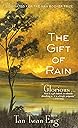
The Gift of Rain: A Novel
Product ID: 3770467
Buy anything from 5,000+ international stores. One checkout price. No surprise fees. Join 2M+ shoppers on Desertcart.
Desertcart purchases this item on your behalf and handles shipping, customs, and support to Spain.
In the tradition of celebrated wartime storytellers Somerset Maugham and Graham Greene, Tan Twan Eng's debut novel casts a powerful spell. The recipient of extraordinary acclaim from critics and the bookselling community, Tan Twan Eng's debut novel casts a powerful spell and has garnered comparisons to celebrated wartime storytellers Somerset Maugham and Graham Greene. Set during the tumult of World War II, on the lush Malayan island of Penang, The Gift of Rain tells a riveting and poignant tale about a young man caught in the tangle of wartime loyalties and deceits. In 1939, sixteen-year-old Philip Hutton-the half-Chinese, half-English youngest child of the head of one of Penang's great trading families-feels alienated from both the Chinese and British communities. He at last discovers a sense of belonging in his unexpected friendship with Hayato Endo, a Japanese diplomat. Philip proudly shows his new friend around his adored island, and in return Endo teaches him about Japanese language and culture and trains him in the art and discipline of aikido. But such knowledge comes at a terrible price. When the Japanese savagely invade Malaya, Philip realizes that his mentor and sensei-to whom he owes absolute loyalty-is a Japanese spy. Young Philip has been an unwitting traitor, and must now work in secret to save as many lives as possible, even as his own family is brought to its knees. Review: "We were beings capable mainly of love and memory - "We were beings capable mainly of love and memory. These capabilities are the greatest gifts given to us, and we do nothing else but live out the remembered desires and memories of our hearts." So says the narrator of this powerful, lyrical novel, and perhaps this is the overall message of the book too: despite the horrors of war, despite the difficult choices and mistakes, what is most important in the end is love an memory. This book is indeed a gift, and complex one--there are no easy answers here. The young Phillip Hutton is torn between the need to protect his family and his love and loyalty to his Japanese sensei, and his choices are difficult ones. Beyond the lyrical language and the ability to of this writer to capture, beautifully, a world long gone before his own birth, I was most captivated by this skill at characterization. I always believed in these characters. There were times I was frustrated with the decisions the young narrator made, but in the context of the book, it was always clear why he made those decisions, just as it was clear to me why other characters made very different decisions. I was also moved by this young writer's wisdom and maturity--this book is narrated by a much older Phillip, and his thoughts on his life and the consequences of his actions are moving and mature--with the kind of wisdom that does indeed come with age. I haven't read a book in a long time that lent itself to so much highlighting--there were so many passages of beauty and wisdom here, and the idea of these two people who loved each other across ages--a small but important part of the book--had a great power, as did the questions of predestination vs free will. And yet this book is always rooted, too, in the time and place, and the characters lives, and it is well-plotted and well paced. (I have to disagree here with readers who found it "boring" as there is plenty of action in this novel. It makes me think that those readers were not readers of literary fiction, and perhaps had been expecting something else--a thriller perhaps, though why anyone would come to this book thinking that is beyond me). This is a beautiful novel, powerful and compelling, and I know I will read it again. I came to it first because of my enjoyment of my own visits to Penang, but was happy to discover a book that has resonance well beyond my interest in that place. It is a book that instead touched me in very deep ways, and made me think a lot about the role of predestination and free will, about what we do for family and friends, about hard decisions that I, as a child of peace who has never experienced war, have been blessed to never have to make. It made me think, too, a lot about what my grandparent's generation knew and suffered. It is a beautiful book, suitable for any readers of literary fiction. (And for the record, I never give 5 star reviews, because to me, five stars means the book is near perfect, one I will want to read again and again. A few other books would fit this: Toni Morrison's Beloved. Jeannette Winterson's The Passion. John Edgar Wideman's Cattle Killing and a handful of others. This book--and this author--will be added to that list of literary greats). Review: Great Writing - I really enjoyed 'The Gift of Rain', despite the historical and technical inaccuracies. For one who has studied the military history of the region, reading about Australian troops in Penang in 1940 when none were in theater until 1941, or troops of the RNF wearing their red and white hackles on their slouch hats, or being the first to land in Penang (it was the Royal Marines) and so on doesn't detract from the narrative. It doesn't claim to be an accurate historical account although there is plenty of accurate historical detail included. it claims to be a story of people caught up in situations beyond their control, living and reliving their lives and as literature, it hits the mark. It was refreshing, as a writer and indie publisher, to see there were typos and formatting glitches in a book coming from a major publishing house. Even the big guys have gremlins when it comes to converting to .mobi, it seems. Again, none of these detracted from the power of the story and the presentation of the characters. Tan has done a superb job. It is a book that covers a few genre including historical fiction, literary fiction and even queer lit as the relationship between Philip Hutton and Endo-san is clearly a homosexual one as well as teacher-student, although this relationship is very nicely managed by Tan. As a martial artist myself who has trained in Aikijutsu and other arts, I enjoyed the many passages relating to the arts and training and they are intrinsic to the story. I look forward to reading more by this Malaysian author.
| Best Sellers Rank | #88,703 in Books ( See Top 100 in Books ) #749 in Contemporary Literature & Fiction #965 in Historical British & Irish Literature #4,677 in Literary Fiction (Books) |
| Customer Reviews | 4.5 out of 5 stars 7,298 Reviews |
D**O
"We were beings capable mainly of love and memory
"We were beings capable mainly of love and memory. These capabilities are the greatest gifts given to us, and we do nothing else but live out the remembered desires and memories of our hearts." So says the narrator of this powerful, lyrical novel, and perhaps this is the overall message of the book too: despite the horrors of war, despite the difficult choices and mistakes, what is most important in the end is love an memory. This book is indeed a gift, and complex one--there are no easy answers here. The young Phillip Hutton is torn between the need to protect his family and his love and loyalty to his Japanese sensei, and his choices are difficult ones. Beyond the lyrical language and the ability to of this writer to capture, beautifully, a world long gone before his own birth, I was most captivated by this skill at characterization. I always believed in these characters. There were times I was frustrated with the decisions the young narrator made, but in the context of the book, it was always clear why he made those decisions, just as it was clear to me why other characters made very different decisions. I was also moved by this young writer's wisdom and maturity--this book is narrated by a much older Phillip, and his thoughts on his life and the consequences of his actions are moving and mature--with the kind of wisdom that does indeed come with age. I haven't read a book in a long time that lent itself to so much highlighting--there were so many passages of beauty and wisdom here, and the idea of these two people who loved each other across ages--a small but important part of the book--had a great power, as did the questions of predestination vs free will. And yet this book is always rooted, too, in the time and place, and the characters lives, and it is well-plotted and well paced. (I have to disagree here with readers who found it "boring" as there is plenty of action in this novel. It makes me think that those readers were not readers of literary fiction, and perhaps had been expecting something else--a thriller perhaps, though why anyone would come to this book thinking that is beyond me). This is a beautiful novel, powerful and compelling, and I know I will read it again. I came to it first because of my enjoyment of my own visits to Penang, but was happy to discover a book that has resonance well beyond my interest in that place. It is a book that instead touched me in very deep ways, and made me think a lot about the role of predestination and free will, about what we do for family and friends, about hard decisions that I, as a child of peace who has never experienced war, have been blessed to never have to make. It made me think, too, a lot about what my grandparent's generation knew and suffered. It is a beautiful book, suitable for any readers of literary fiction. (And for the record, I never give 5 star reviews, because to me, five stars means the book is near perfect, one I will want to read again and again. A few other books would fit this: Toni Morrison's Beloved. Jeannette Winterson's The Passion. John Edgar Wideman's Cattle Killing and a handful of others. This book--and this author--will be added to that list of literary greats).
P**Y
Great Writing
I really enjoyed 'The Gift of Rain', despite the historical and technical inaccuracies. For one who has studied the military history of the region, reading about Australian troops in Penang in 1940 when none were in theater until 1941, or troops of the RNF wearing their red and white hackles on their slouch hats, or being the first to land in Penang (it was the Royal Marines) and so on doesn't detract from the narrative. It doesn't claim to be an accurate historical account although there is plenty of accurate historical detail included. it claims to be a story of people caught up in situations beyond their control, living and reliving their lives and as literature, it hits the mark. It was refreshing, as a writer and indie publisher, to see there were typos and formatting glitches in a book coming from a major publishing house. Even the big guys have gremlins when it comes to converting to .mobi, it seems. Again, none of these detracted from the power of the story and the presentation of the characters. Tan has done a superb job. It is a book that covers a few genre including historical fiction, literary fiction and even queer lit as the relationship between Philip Hutton and Endo-san is clearly a homosexual one as well as teacher-student, although this relationship is very nicely managed by Tan. As a martial artist myself who has trained in Aikijutsu and other arts, I enjoyed the many passages relating to the arts and training and they are intrinsic to the story. I look forward to reading more by this Malaysian author.
S**A
Most favorite book of the past year
This is so poetically written. Even in tragedy there are so much beauty, wisdom, and lightness of heart. Can’t wait to discuss it at my Book Club. This is my most favorite book. I have read in the last year, and I have read plenty.
B**D
Like is like a river.
the pace of this book is deceiving; there are no huge dramatic incidents; instead it flows like a river towards the sea, sometimes calm with hidden currents underneath and sometimes a series of rapids. Once I saerted to read I don't want to put it down, but never feel that I will be deprived if I do. Its a story of FAMILY, past and present, of lives lived past and present. from the first chapter when the aged hero is asked "where is your family" and he says "they are all dead"; you know this is a book of a tragedy. and one by one it the deaths unfold. But first you get to know them as they were and remain in the heros mind. So this is a book of Memories, and it even says at one point, memories are all we have, once we are old. This is also a book of Love. This is the first time I've read a book about the love of two men, Not sexual but spiritual. Young readers won't catch that. There are no sex scenes unless " he breathed my air" or "he lived in my body" are taken so. the most physical contact is the martial arts they practice. The lesson of their practice and of thier lives is to know how to defend yourself, but use it as last resort and to never kill. and so the hero doesn't, though as the reader I would have loved to see a few of the characters in the book killed by him. this book is also a story of questions, such as "are our lives fated?"; "do we live again?", Many readers know how the book ends before the end of the first chapter, yet we are drawn into it; not as watching a train wreak, but as watching the lives of the characters play out; like watching life, period. so , another question is life only saddness and pain? answered by the descriptions of the food, the beauty of the land, the rain, and the love of those that lived within the book. Its a book that stays with you after you read it. (which is the sign of a great author) but I can't read another of his books just yet. I need a break from life. which is why I read, as I deal with Life every day at work; I need to check out some fantasy for a bit. enjoy this book, its worth the read.
T**S
Beautiful Writing, Heartbreaking Personal Conflicts
This is a lyrical portrait of WWII Penang, an exploration of conflicting loyalties and resolute friendship in the face of terrible realities, and a peek into an evolving multi-cultural society. The strong points of this novel are the writing, which manages to be both breath-taking and engaging, and also the personal conflicts that it describes in the protagonist. Philip is not always easy to like at each step of the book (although the author does give you time to get to know the character before things fall apart), but unlike other novels where an unsympathetic protagonist destroyed my interest in the story, this book prompted me to think deeply about how I would handle the same competing loyalties, and which path is better -- personally, for family, friends, and society. Novels that prompt this type of deep thought without coming off as at all preachy are rare, and I value the book for handling the issue so deftly. I have a couple minor quibbles. The first of which was the most distracting for me -- Philip witnesses and participates in quite a few atrocities, and while he seems to harbor no illusions about his role in them and is certainly appalled by what happened, I feel that in similar circumstances I would be significantly more scarred psychologically. Reading through these chapters is difficult, and while the author does a good job of explaining why the choices Philip made seemed the best to him at the time, he doesn't explain why the things he sees and participates in don't drive him mad. The second quibble is more of a personal aversion to the quick dips into visions of past lives, which just strikes me as hokey and unrealistic. You don't need those dips to explain his relationship with Endo-san. Their relationship is the center of the story and it stands clearly and beautifully on its own. Given my tendency to eye-roll at these glimpses, it's hard for me to feel comfortable with the necessity of the ending of their story. Overall, I loved the book and would highly recommend it to anyone interested in international fiction. However there are scenes of disturbing violence, and if you're the type of reader that doesn't enjoy a book that you know from the beginning is going to end badly, you won't enjoy the tension that laces this story. And it is heart-breaking, in the most beautiful way possible.
P**H
Love and Betrayal in Occupied Malaya.
I had been looking forward enormously to reading this book after enjoying The Garden of Evening Mists. It is beautifully written with evocative images of Malaya in the 40's. I lived in Malaysia for 12 years, and now can't wait to revisit Penang with new eyes. Philip Hutton is a privileged teenager, half British and half Chinese who finds himself having to make decisions no 16 year old should have to face. How can he best ensure that the people he loves are kept safe during the Japanese occupation. Philip is guided in his decisions by his Japanese sensei and his estranged grandfather. When he realises that he has been unwittingly providing information to the Japanese through his Sensei whom he trusted, he feels let down and lost. He has already lost the trust of his family and now is very much alone. This is a harrowing story of love, betrayal and survival, but with an enormous price to pay. I was quite relieved when I finally finished the book, which I feel ended weaker that it commenced. However a great read.
R**R
Layer upon layer of story, brilliantly told
Layer upon layer of story -- events during WW II in Malaysia remembered fifty years later, the relationship of a half-Chinese half-English boy with his Japanese sensei martial arts teacher who was also a Japanese spy, the moral ambiguities and difficult choices of life after the Japanese conquest. I internalized the story as if I were living it, to the extent that halfway through the book I woke up in the morning with a sharp pain in my right shin and an indentation a couple inches long, an inch wide and a quarter inch deep, as if any injury from a kick in a fight. The indentation was in the bone. It wasn't a muscle spasm. But no cut, no bruise. A few hours later both the pain and the indentation were gone. That was spooky. I had recently read and greatly enjoyed the author's second book, The Garden of Rising Mists, which had ben recommended to me by the widow of a close friend of mine who died twice. I had also recently read the Complete Stories of Somerset Maugham, many of which were set in Malaysia and its environs, and Maugham himself merits a brief cameo almost appearance in this novel. I had read Maugham and I read much of this as well sitting on a bench, looking out at the sand and waves of Long Island Sound. And aside from the story, which at times and especially near the end, had me near tears, the language, the turns for phrase, the metaphors were often magical. I certainly wish that I could write like that. The magic began with the first sentence, "I was born with the gift of rain, an ancient soothsayer in an even more ancient temple once told me." Here are a few other samples: p. 11 "If one steps out of time what does one have? Why, the past of course, gradually being worn away by the years as a pebble halted on a riverbed is eroded by the passage of water. p. 23 "The life I had lived was folded, only a blank page exposed to the world, emptiness wrapped around the days of my life; faint traces of it could be discerned, but only if one looked closely very closely. And so, for the first and last time, I gently unfolded my life, exposing what was written, letting the ancient ink be read once again." p. 43 "Picture your breath as a long slender string." p. 45 "Ad there were the smells, always the smells that remain unchanged even to this day -- the scents of spies drying in the sun, sweetmeats roasting on charcoal grills, curries bubbling on fiery stoves, dried salted fish swaying on strings, nutmeg, pickled shrimps -- all these swirled and mixed with the scent of the sea, fusing into a pungent concoction that entered us and lodged itself in the memory of our hearts." p. 47 "... the islands that collectively formed the nation of Japan made it look like a tilted seahorse swimming against the currents of the ocean." p. 62 "...the storm clouds had come in low, scraping the tops of the range of hills like a dragon's underbelly moving over rocks... On days like these, when the clouds are thick, heaven seems closer, and I almost feel I can touch it." He looked at me, hearing the wistful tone of my words. "You can touch heaven any time you wish. Let me show you." p. 103 "Endo-san's lessons had taught me that there is often movement in stillness, and stillness in movement." p. 186 "Far away the surf raced along the sand, hissing as it melted into the beach." p. 187 "Thoughts floated by like intoxicated butterflies..." p. 218 "In an instant I saw that I had unconsciously replicated Musashi's drawing, the drawing that had been copied by Endo--san and for the briefest moment I saw how everything and everyone and every time was connected in some manner." p. 223 "The sea was so bright it was almost without color, just a shifting sheet of light." p. 275 "Blood was curdling on the tarmac, thick as engine oil." p. 349 "...we waited there on the bench, shielded from the world by the palace of the rain..." p. 355 "Michiko and I sat on a bench along Gurney Drive, which had once been the North coastal road, facing the narrow sea, doing what most people do along here, makan angin -- eating the breeze." p. 398 "That is what growing old consists of, mostly. One starts giving away items and belonging until on the memories are left. In the end, what else do we really require?" p. 420 "The monsoon returned like a family guest, to be tolerated by some, hated by others, loved by one or two, and the brilliant sunshine of our days became a clouded memory again a fleets of storm clouds sailed in and anchored themselves in the sky." p. 424 "... the sand gleamed brightly, white as angel bones... Endo-san was right. In the end, we fellow travelers across the continent of time, across the landscape of memory, we did not need words."
D**T
After being bored during the first half of the book I started ...
After being bored during the first half of the book I started to quit reading; but I am not a quitter. To my surprise, I enjoyed the second half of the book....some action at last. The author actually writes beautifully. I have read several books that even I could have done a better job of writing, and I am not a writer. How some have actually sold their book is a mystery to me. But Tan Twan Eng is, in my opinion, a gifted writer. If I were rating only the first half, I would have given the book a 1. On the secong half I would give it a 4. So I compromised on the 3. I will try another book by him soon and hope I can come up with a 5.
T**N
Realistic account of Japanese Occupation of Malaya.
Excellent poetic language, realistic war accounts, an exciting read. Too much reference on Japanese martial art. Confusing to those have have no interest in it.
C**S
An absorbing read.
I found this book absorbing from beginning to end. It's themes are thought provoking, with unexpected twists and turns, but always allowing the reader to make up his or her own mind whilst the naturally beautiful writing seamlessly binds the often painful story together perfectly. This is the first review I have felt compelled to write having enjoyed the book so much. It is a page turner in an unconventional way, one wants to know how the story unfolds but the lyrical writing also compels one to read just a few more pages for the sheer enjoyment afforded by the skill of the author to combine words so effectively.
D**R
An engaging novel, ideal for book clubs
I suggested this for our book club and it was excellent. I won't go over the plot, the publisher does a good job there. At book club this novel led to some really interesting discussion. I hardly know where to begin it was so good. It was a strong and interesting storyline and the author uses beautiful imagery in this well told story. This is not a fluffy pulp fiction but is a meaty literary novel. Something I learned by reading this novel was about the invasion of Malay by the Japanese during WWII. There were also a number of aspects regarding both the Chinese culture and Japanese culture demonstrated to the reader which also meant for a more meaningful understanding about why some of the characters did or acted in ways we may not have otherwise understood. He fleshed out his characters so well that we wanted to be with them and follow them throughout the novel. I was so impressed with this novel and how it was written that I plan to seek out more of his writing. Definitely recommended.
V**A
Utterly compelling exploration of the meaning of life
I discovered this relatively late; as a 2007 Booker prize winner, it's one that passed me by until recently. In a nutshell, I'm blown away by narrative, plot, central characters and, more importantly, the thought provoking elements to this tale. It's one difficult to summarize. It's set, initially, in Penang, 1939. Philip Hutton is a mixed race ( British/Chinese) son of an established and wealthy trader. He meets with a Japanese aikijitsu master, Endo San, where a master/pupil relationship develops. Hutton develops a spiritual, intellectual and physical awareness which remains with him. An inexorable bond is born between pupil and sensei. This bond challenges truth, trust, family ties and more in the second part of the book, following the Japanese invasion. This is very much a book of two halves; the first part is thoughtful and esoteric. The second part is fast paced, dramatic and brings to fruition all the moral, ethical and familial challenges set up by Hatton's friendship with an enemy. It explores the meaning of truth, trust, betrayal, family relationships, friendship...the lust is almost endless. It's a difficult book to explain without giving away the essence of the the story. A supernatural thread which transcends time and where previous and future lives are inexorably entwined. There are moments of unremitting brutality in the second part of the story. As a reader, I was totally compelled to engage with the reality on which much of this was based. And thereby lies the author's skill. Unpalatable events are recounted in a way that any reader must follow and from those events, lessons are drawn. I found the first part of the book slow. Stick with it as a foundation for later challenges. Certainly one of the best and most challenging titles I read in 2015. It's one which will stay with me.
B**R
Penang during WWII - a senstive read with much new information
What a delightful writer - this is a whole new world for me - a non European take on the Japanese occupation of Penang in Malaya during WWII. This is a very cleverly crafted book and a well-worthwhile read. The narrator is believable despite a plot that could stretch the imagination. The story canvasses the experiences of a sad teenager caught between the European and Chinese worlds and the tragic circumstances of how to survive during the occupation. Amazingly this is a tale of survival against huge odds - and a tender love that was never acknowledged beyond the pupil and his master and the appalling treachery caused by that love and respect. Having just read Richard Flanagan's The Narrow Road to the Deep North and Tan Twan Eng's other excellent view on that period; The garden of Evening Mists (set in the Cameron Highlands), the appalling callous treatment by the Japanese to their captured subjects, as well as to their own is heartbreaking. Both Eng's books explore the dichotomy - the gentle sensitivity and respect for art and culture and the other face of savage cruelty. In both there is a sage Japanese character that you almost like. These characters could almost be comical in their teaching and mentoring, but somehow Eng manages to make their actions resonate. Both books, indeed all three, are very worth while reads if you are interested in that period and the depths to which humankind can plumb. All are descriptive of their environment in a lively and informative way.
Trustpilot
2 months ago
1 month ago