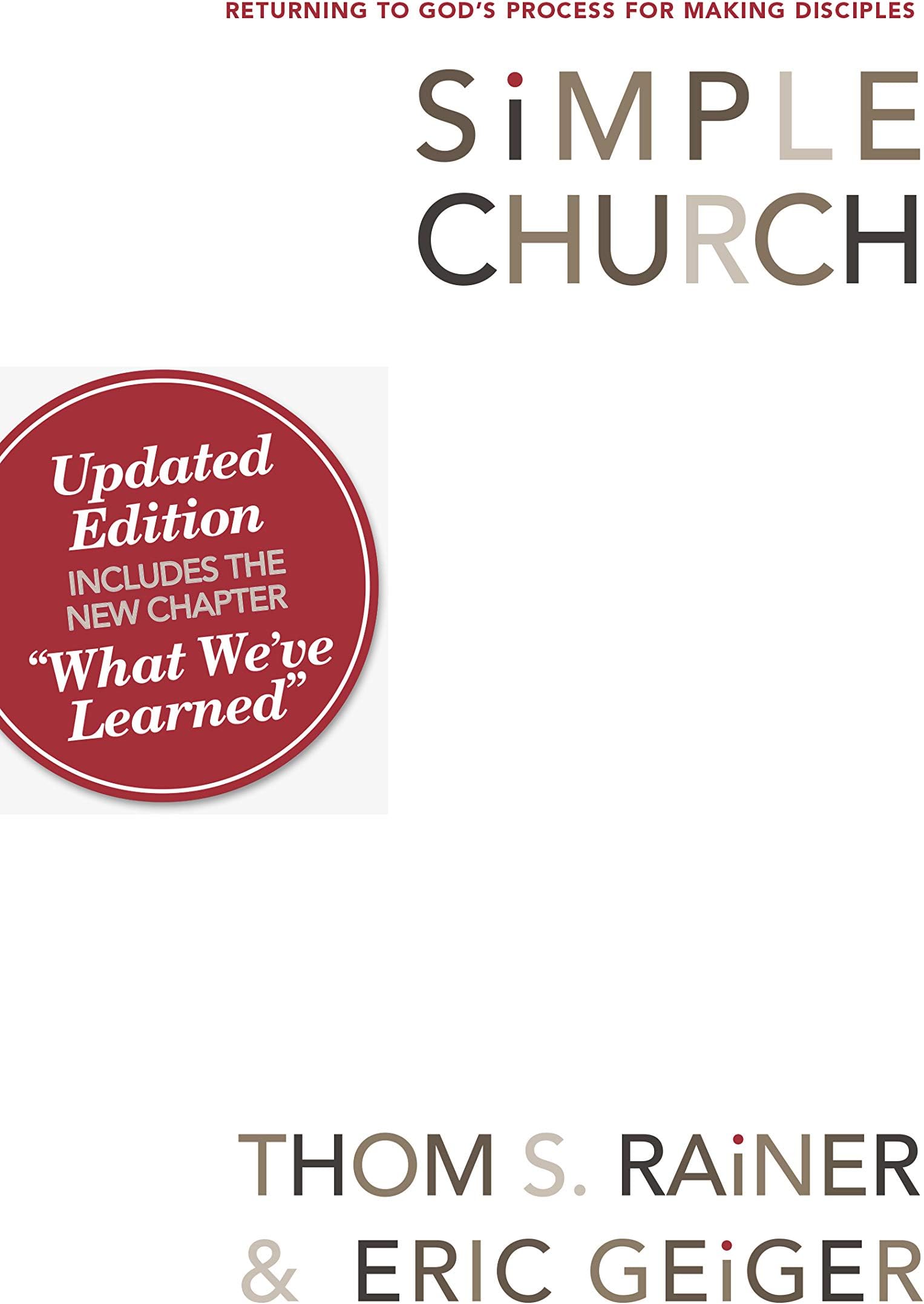
Simple Church: Returning to God's Process for Making Disciples
Product ID: 3699647
Buy anything from 5,000+ international stores. One checkout price. No surprise fees. Join 2M+ shoppers on Desertcart.
Desertcart purchases this item on your behalf and handles shipping, customs, and support to Spain.
The simple revolution is here. From the design of Apple products to Google's uncluttered homepage, simple ideas are changing the world. Now in paperback, multi-awarded #1 national bestseller Simple Church guides Christians back to the simple gospel-sharing methods of Jesus. No bells or whistles required. With insights based on case studies of 400 American churches, Thom Rainer and Eric Geiger prove the disciple-making process is often too complex. Simple churches thrive by taking four ideas to heart: Clarity. Movement. Alignment. Focus. Simple Church examines each idea, clearly showing why it is time to simplify. This updated trade paper edition includes a new chapter with further insights the authors have gained through hundreds of conversations with church leaders since this landmark book's original release. Review: Unlearning is harder than learning - "Simple Church" gently but firmly explains the short-comings of contemporary church models while also providing an excellent process for constructive, productive change. My church is using its principles to form a disciple-making DNA. Observations from "Simple Church": This is not a book that promotes a system or methodology. It does provide an outstanding re-introduction to principles that the American church has forgotten or misplaced. It asks and answers to two essential questions. 1. "For what purpose does the church exist?" To make disciples of Jesus Christ. 2. "How best is that accomplished?" By simply and primarily focusing on that such that any competing, distracting structures or values either adapt or get set aside. Until about 7 years ago when a light came on, I had promoted, participated and led in a typical American church culture for 35 years. This church culture is overly complex, consisting of disconnected, competing statements and programs that hinder, or even prevent, the making of disciples. Their models are designed to populate programs with as many people as can be attracted to "do church" and pay the bills. If a disciple happens emerge from their programs and activities here and there along the way, well, the job must be getting done. Thus it could be concluded that change is not necessary. But the making of a disciple as described by Jesus Himself should not be the occasional byproduct, but the core value and heartbeat, of all that any church does. At the end of the change to a simpler process, more disciples will be produced with less effort, time, and resources than is now expended for much lesser results. "Simple Church" shines a light hope and reason on all of this. To embrace the philosophy of ministry that simple is better and more effective takes more than mere vision. It requires the courage to walk into it and stay in it. As revealed by the authors, simple does not mean simplistic. Change from complexity to simplicity is hard. It initially requires as much unlearning as it does learning. Few will take this on, choosing to stay with the familiar... with what they know how to do. To honestly and objectively evaluate the results of those familiar efforts is rare and threatening. The means and intentions for such evaluations are not in place and thus the beat goes on uninterrupted and unaltered. The status quo will be necessarily exposed, upset, and likely disassembled in the move to simplicity. People already aboard who came to "do church" within their corner of personal interest or need will find this shift uncomfortable or threatening and may move on. New people looking for that same environment will not come aboard. A church has to be so confident and invested in their disciple-making vision and process to be okay with that. Staying simple is also hard, if not harder. As organisms grow, by default they trend toward complexity. Courage and focus to maintain the simple vision and process is ongoing. Obviously, I highly recommend "Simple Church". Review: Clear and profound - Simple Church provides a thoughtful, clear, and evidence-based approach to “How” the church manages, communicates, and executes a vision. I’m a couple of decades late to the game, but I am now glad to be playing.


| Best Sellers Rank | #33,613 in Books ( See Top 100 in Books ) #16 in Christian Church Growth (Books) #75 in Christian Discipleship (Books) #88 in Christian Pastoral Resources (Books) |
| Customer Reviews | 4.6 out of 5 stars 1,008 Reviews |
D**K
Unlearning is harder than learning
"Simple Church" gently but firmly explains the short-comings of contemporary church models while also providing an excellent process for constructive, productive change. My church is using its principles to form a disciple-making DNA. Observations from "Simple Church": This is not a book that promotes a system or methodology. It does provide an outstanding re-introduction to principles that the American church has forgotten or misplaced. It asks and answers to two essential questions. 1. "For what purpose does the church exist?" To make disciples of Jesus Christ. 2. "How best is that accomplished?" By simply and primarily focusing on that such that any competing, distracting structures or values either adapt or get set aside. Until about 7 years ago when a light came on, I had promoted, participated and led in a typical American church culture for 35 years. This church culture is overly complex, consisting of disconnected, competing statements and programs that hinder, or even prevent, the making of disciples. Their models are designed to populate programs with as many people as can be attracted to "do church" and pay the bills. If a disciple happens emerge from their programs and activities here and there along the way, well, the job must be getting done. Thus it could be concluded that change is not necessary. But the making of a disciple as described by Jesus Himself should not be the occasional byproduct, but the core value and heartbeat, of all that any church does. At the end of the change to a simpler process, more disciples will be produced with less effort, time, and resources than is now expended for much lesser results. "Simple Church" shines a light hope and reason on all of this. To embrace the philosophy of ministry that simple is better and more effective takes more than mere vision. It requires the courage to walk into it and stay in it. As revealed by the authors, simple does not mean simplistic. Change from complexity to simplicity is hard. It initially requires as much unlearning as it does learning. Few will take this on, choosing to stay with the familiar... with what they know how to do. To honestly and objectively evaluate the results of those familiar efforts is rare and threatening. The means and intentions for such evaluations are not in place and thus the beat goes on uninterrupted and unaltered. The status quo will be necessarily exposed, upset, and likely disassembled in the move to simplicity. People already aboard who came to "do church" within their corner of personal interest or need will find this shift uncomfortable or threatening and may move on. New people looking for that same environment will not come aboard. A church has to be so confident and invested in their disciple-making vision and process to be okay with that. Staying simple is also hard, if not harder. As organisms grow, by default they trend toward complexity. Courage and focus to maintain the simple vision and process is ongoing. Obviously, I highly recommend "Simple Church".
C**E
Clear and profound
Simple Church provides a thoughtful, clear, and evidence-based approach to “How” the church manages, communicates, and executes a vision. I’m a couple of decades late to the game, but I am now glad to be playing.
Z**H
Slightly Helpful, but also Problematic
This is a book I struggled with. Overall, I love the general idea of the book: simplifying the ministry of the church to more effectively disciple people in their Christian walks. But there were a few elements which gave me pause: First, the emphasis upon research data. They touch on the fact that a healthy church is not about numbers, but about people living as God called them, but that acknowledgement is buried beneath chapter and chapters which point towards the size or numerical growth of a church as an indicator of whether or not it was healthy. I love research data, but there were also times when their research indicated that there were a decent amount of churches which did not meet their definition of "simple" yet were still thriving. This latter reality did not seem to be addressed. I would have appreciated at least a chapter or (minimally) a few pages discussing why this might "work." But most troubling, the emphasis upon data instead of an emphasis upon what a healthy spirituality looks like. Second, there is minimal scriptural support for the principles expressed in the book. This is the most troubling to me. While scripture is quoted and referenced (in some chapters more sparingly than others), upon a closer examination frequently the scripture doesn't actually support or advocate the point. It is used illustratively or to support a peripheral point supporting the main thesis of the chapter. All this adds up to a "sense" of scriptural support, but without there really being too much solid, scriptural exegesis supporting the points of the book. The research data supports it, but the scriptural support is weak (in this, I'm referring to what is communicated in the book; Rainer and Geiger are smart guys, and I'm sure they have more scriptural support than they actually communicated in the book). Third, I was sorely disappointed by the lack of an articulation of any sort of ecclesiology in the book. I think this flows from the first two problems mentioned above. Better scriptural support would have led them to summarize scripture in a theological manner, which would have led to at least a minimal articulation (a single chapter, at least) outlining primary biblical elements of a church. For what this book was arguing. With the subtitle "Returning to God's Process for Making Disciples" a failure to adequately point towards some biblical foundations for discipleship for a church (even if these would be general values) is a pretty huge oversight. This book is, at best, a book focusing on leadership principles for leading a religious organization. But the leadership principles advocated are more commercially based than scripturally founded. Lastly, the writers refer to themselves as "nerds" and the book as a "nerdy" book. As a "nerd" myself, I found the simplistic writing style of the book insulting and ultimately detrimental to the book's argument. The simplicity glossed over elements which needed a deeper treatment. I suspect the simple writing style was an attempt for the execution of the argument to match the title, but as a pastor who wanted to really dig his teeth into this idea, I was left with more questions than answers. The reason I really wrestle with recommending this book, and why (in the end) I gave it four stars instead of three, is that overall the book does advocate some good principles which actually have some scriptural merit. Unfortunately I think the book over-values its research data (an entirely different cultural and social problem in the West), and that undercuts how a leader should be truly evaluating his/her church: through eyes and values shaped by scriptures. Rainer and Geiger do not deny the latter (they actually advocate it in the postscript), but their practice in the book elevates data points over scriptural exegesis. Can it be a helpful book? Yes...but it need to be balanced with other books that do proper exegetical and ecclesiological book. This book would probably best be used after studying books that do the proper scriptural and theological work, because then the ideas contained in Simple Church could be critiqued and analyzed in light of the scriptural and exegetical work that has already been explored.
J**H
Book
Interesting book recommended by a friend.
J**R
Great read
easy to read, short, and full of information necessary for today.
C**S
My Eyes are Open
So many problems that I have tried to seek answers for are in this little but profoundly eye opening book. As a seminary student, I had to create a strategy for a Chris and all I could think of was amassing program after program while lacking vision, process, and simplicity. The Gospel is simple, then why can’t church be? This book helped me and I will recommend it to any pastor currently stuck in a heavy rotation of liturgy and church planning that seems to be going nowhere.
R**S
An excellent resource for church planning!
This book was so helpful to me in thinking about how we "do church". A lot of what the authors say should be common sense, but the practice of churches have shifted away from it. I love that they have backed up their assertions about how simplicity leads to church health through not only anecdotal evidence, but statistical surveys. If you are starting a new church, looking to revitalize an existing church, or just looking at ways to make things less stressful, I would highly recommend reading this book. Although it is clearly targeted at pastors and serious church leaders, it is written in a way that most Christians should be able to understand their points.
J**F
Outdated Church Model
I should write an elaborated review of this book. But alas, time. Overall, the intention of the 2 authors is solid and helpful for certain church applications. One thing that these two guys do well is pushing the mandate for making disciples. As it is, well, a mandate. The American church does a horrid job of bringing this transformation to our countrymen. My major letdowns with the book are three-fold: 1. The thinking is very well-developed, but the writing is painfully repetitive, even in the first three chapters. By the time you reach chapter six, it's unbearable. I can see the value in repeating information that's brand-new to some older folks. But this goes way beyond what's necessary. 2. My second letdown with the book may have to do with the authors' generations. They do a fanatastic job in celebrating the various ways "simple church" can be applied broadly across the body. But when it comes down to it, it vastly oversimplifies the diversity in that same body, and completely overlooks God's designing these tens of thousands of communities differently, on purpose. After reading thru, their approach is good but applies a one-size-fits-all approach to making churches simple. Fine. But there is a huge loss in individuality as under their guidance, it seems churches would lose sight of the niche things they were created for. 3. A third thing: although the Sunday church may not disappear any time soon, they state in the book the worldwide bricks and mortar church is in great decline. That is clear and well-documented for two decades now. But they don't seem to address why. Old, simplistic church models and old mindsets seem to be the reason. The younger generation wants less and less to do with a Sunday service, or any formal service, regardless of how "innovative" they may appear. So the whole model of "inviting people to church" presumably to get saved and be transformed (made into disciples) is horribly outdated and painfully oblivious of the modern culture we all live in. And by the way, Jesus told [us] to go. Not to tell others to [come] to church. Ah, the comfort mindset of our people. I'm sorry for the criticisms. Though these authors do a decent, albeit cumbersome, job in explaining the simple church approach, it's almost like: too little too late for our generation. We need models for doing community [outside] the four walls rather than new models for getting people to come to a bland and demeaning and disrespected existence. Just because a simple church may appear to be thriving doesn't indicate that they're doing all they were designed to do. We settle for so little, it's disheartening to watch. Cmon people, God never intended the Body of Christ to beckon the world to tie themselves to the four wall model. The most powerful transformation doesn't happen in the Sunday services anyway. The authors even say that Sunday's aren't where real community happens. Transformation (not just for church-goers, but for the rest of the world) happens when the church dispersed and made themselves useful [in] the world, not by camping out on Sundays (or midweek). ie: God forcing them out of their comfortable lifestyles into the needy world by sending Roman persecution on them. There's a lot to be said for getting discipled on-the-way when you're already in motion [outside] the church and productive in the world. Ok, the book is fine. It's a decent read for those stuck in church, especially if they lack cohesive vision and a simple strategy for discipling. But it would've been better back in the 1960's and 70's when churches stared to get too complicated. These days, I'd say it's a very basic starting point. For other world-focused believers and ministries, "simple church" can help streamline your thought processes. But please apply it and move on. There's so much to do and so little time.
K**R
Thought provoking
I was recommended this book on Tuesday, I had finished reading it within a matter of days. There is much to think through, but I am convinced that developing a simple process will help to achieve a ministry that wins, disciples and equips people to follow Christ.
E**.
Simple Church
Are Church recommends us to read it as Leader, looks like a good book
V**Y
Truth.
I'm loving this book. It speaks to what I've been saying among friends for quite a while now.
M**S
This book is packed full of wisdom and research!
I was given this book by a mentor of mine, someone who leads a big church in UK standards after I asked him to recommend me some books that have shaped his thinking and affected him within ministry for the positive of the church he runs. This book is packed full of wisdom and research that will open your eyes up to the effect a simple church structure will have over a complicated church structure and how so often we think to do more we need to do more, when in this day and age, to do more we need to do less more effectively! I've you run a church, pastor a church or want to get involved in church leadership at some point in your life this will have been a fantastic book to have gone through, easy to read, understandable and with a few fun moments! Well worth the few pounds it will cost you to learn a few life lessons we all need!
S**N
Clear and Cogent
A great read for anyone interested in an effective vision and a church which fulfils the great commission and the great commandment.
Trustpilot
1 day ago
2 weeks ago