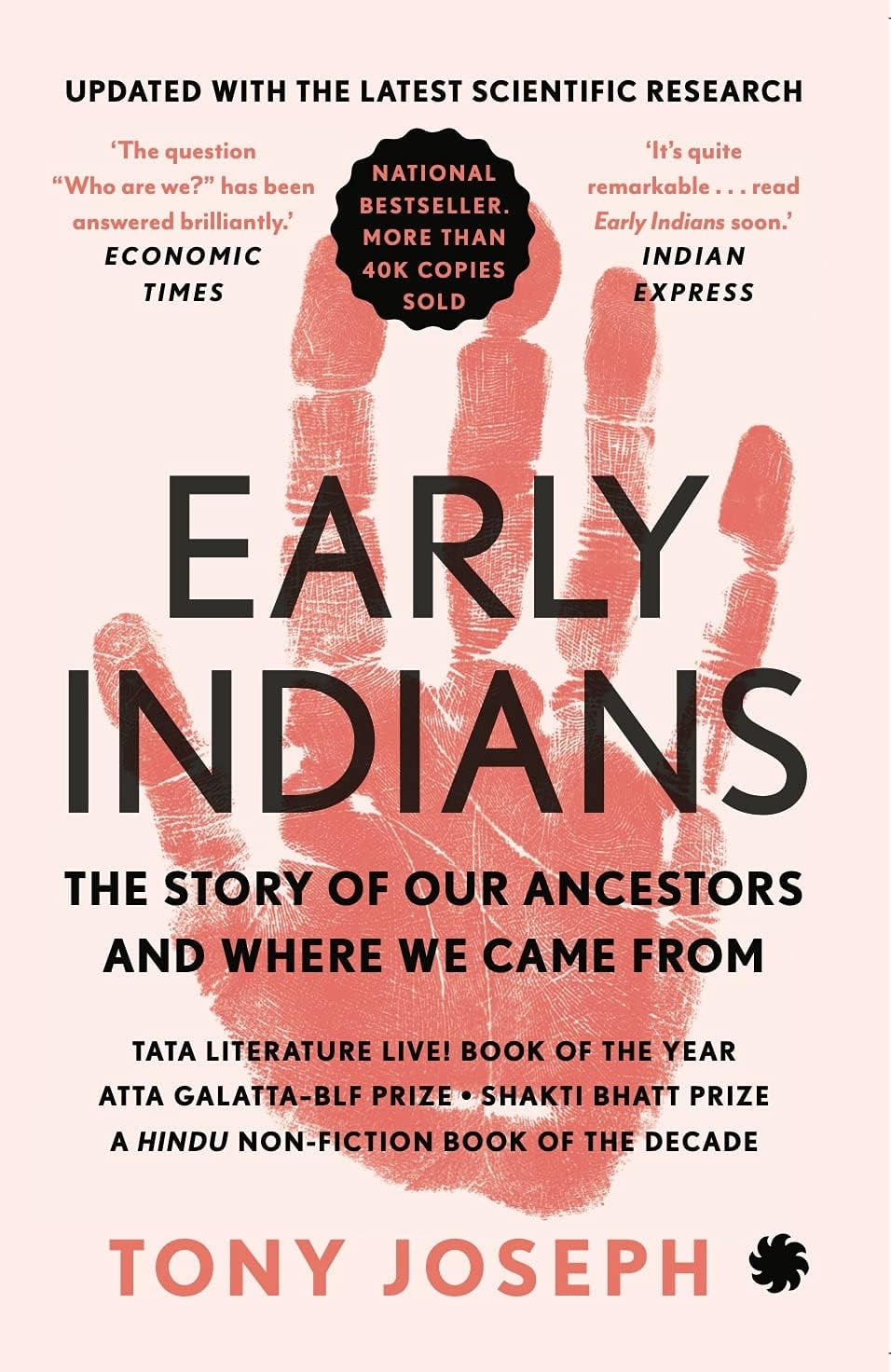
EARLY INDIANS : The Story of Our Ancestors and Where We Came From (Updated Edition)
Product ID: 354619431
Buy anything from 5,000+ international stores. One checkout price. No surprise fees. Join 2M+ shoppers on Desertcart.
Desertcart purchases this item on your behalf and handles shipping, customs, and support to Spain.
Who are we Indians? Where did we come from? To tell us the story of our ancestry, journalist Tony Joseph goes 65,000 years into the past – when a band of Homo sapiens first made their way from Africa into the Indian subcontinent. These were the First Indians. Citing recent DNA evidence, he traces the subsequent large migrations of modern humans into India – of a people related to early farmers of Iran who mixed with the First Indians at the latest between 5400 BCE and 3700 BCE and of the ‘Arya’ between 2000 BCE and 1500 BCE, among others. As Joseph unravels our past, he takes head-on some of the most controversial and uncomfortable questions of Indian history: Who were the Harappans? Are north Indians genetically different from south Indians? When did the caste system emerge? A hugely significant book, Early Indians bravely puts to rest several fierce debates on the ancestry of modern Indians. Review: A terrific work on the story of our origins - Tony Joseph's "Early Indians" is a terrific work that accessibly summarizes the state of the art research on our nation's prehistory. It is a book that every Indian, and certainly every Hindu, must study deeply. Tony Joseph's quest into India's ancient history was triggered by his curiosity about the Indus Valley Civilization (which he calls Harappan civilization). This led him into a rabbit hole chasing research works leading him to the origin story of the Indian people. It is his findings that are summarized in this book, in which he has brought together research from archaeology, linguistics, ancient texts, and recent developments in population genetics. The people whose ideas are mentioned in this book are renowned experts in their fields whose works he quotes liberally throughout. It is a treasure trove of facts and insights, all expertly woven together into a truthful and humanistic narrative that uplifts our hearts and souls as much as it informs. As the timeless mantras say, asato mA satgamaya! tamaso mA jyotirgamaya! satyameva jayate! Tony Joseph has taken these slogans to heart. I propose that we all join him in this critical and important journey. Review: Updated take on India's Pre-History. Perfect read bringing latest research to readers. - India has had a weird relationship with its history prior to Mauryan empire. History by its nature is imprecise but, in this case, confusion is compounded by the fact that Harappan script remains undeciphered and there are very few archaeological remains of Vedic society. The confusion has only been furthered by ideologically motivated or imaginative thinkers who have colored this phase of history with their own agendas. Top example remains forcibly trying to conflate Harrapans with Vedic society by force fitting Harrapan civilization as Sarasvati civilization. Other examples include myths of Aryan purity, artificial divide between Dravidians & North Indians and nature and scale of Vedic society itself. What remains underappreciated in this mess is that Harappan Civilisation was the largest and most widespread of its time with large population and huge cities – which ideally should make us proud. We somehow have failed to relate to our Harrapan ancestors (yes ancestors) in our cultural consciousness. This book masterfully breaks through all this confusion and provides clarity and perspective to answer all such questions. The modern science of genetics, linguistics, paleo-geology, anthropology, and archaeology are now beginning to provide a clearer picture and this book translates the latest ideas for laymen. The narrative that emerges only makes us prouder as Indians and brings us closer to our own heritage. The message of unity in diversity is not only a slogan but is integral part of our own genetic makeup and our rich historical story. P.S. I am further excited to pay a visit to scores of Harappan sites after reading this book.
| Best Sellers Rank | #2,721 in Books ( See Top 100 in Books ) #1 in Prehistory #11 in Anthropology (Books) |
| Customer Reviews | 4.6 out of 5 stars 2,635 Reviews |
A**V
A terrific work on the story of our origins
Tony Joseph's "Early Indians" is a terrific work that accessibly summarizes the state of the art research on our nation's prehistory. It is a book that every Indian, and certainly every Hindu, must study deeply. Tony Joseph's quest into India's ancient history was triggered by his curiosity about the Indus Valley Civilization (which he calls Harappan civilization). This led him into a rabbit hole chasing research works leading him to the origin story of the Indian people. It is his findings that are summarized in this book, in which he has brought together research from archaeology, linguistics, ancient texts, and recent developments in population genetics. The people whose ideas are mentioned in this book are renowned experts in their fields whose works he quotes liberally throughout. It is a treasure trove of facts and insights, all expertly woven together into a truthful and humanistic narrative that uplifts our hearts and souls as much as it informs. As the timeless mantras say, asato mA satgamaya! tamaso mA jyotirgamaya! satyameva jayate! Tony Joseph has taken these slogans to heart. I propose that we all join him in this critical and important journey.
A**V
Updated take on India's Pre-History. Perfect read bringing latest research to readers.
India has had a weird relationship with its history prior to Mauryan empire. History by its nature is imprecise but, in this case, confusion is compounded by the fact that Harappan script remains undeciphered and there are very few archaeological remains of Vedic society. The confusion has only been furthered by ideologically motivated or imaginative thinkers who have colored this phase of history with their own agendas. Top example remains forcibly trying to conflate Harrapans with Vedic society by force fitting Harrapan civilization as Sarasvati civilization. Other examples include myths of Aryan purity, artificial divide between Dravidians & North Indians and nature and scale of Vedic society itself. What remains underappreciated in this mess is that Harappan Civilisation was the largest and most widespread of its time with large population and huge cities – which ideally should make us proud. We somehow have failed to relate to our Harrapan ancestors (yes ancestors) in our cultural consciousness. This book masterfully breaks through all this confusion and provides clarity and perspective to answer all such questions. The modern science of genetics, linguistics, paleo-geology, anthropology, and archaeology are now beginning to provide a clearer picture and this book translates the latest ideas for laymen. The narrative that emerges only makes us prouder as Indians and brings us closer to our own heritage. The message of unity in diversity is not only a slogan but is integral part of our own genetic makeup and our rich historical story. P.S. I am further excited to pay a visit to scores of Harappan sites after reading this book.
R**K
The ancestry of Indians in the light of Genetic findings
As the author had pointed out in the beginning, this book is bound to be controversial and would not be acceptable to most Aryan invasion/migration (AIT/AMT) theory denialists. However, if one takes an open mind approach,the genetic evidence along with linguistic and archaeological evidence strongly brings out a very convincing explanation of what and how things panned out during a period covering a period from 7000 BCE to 1 CE. It is really a good thing to know that almost all Indians have inherited their genealogy from the Harappan and earlier settlers of this land. While we have been subjected to waves of migration, we still can trace our ancestors to the modern man out of Africa some 65000 years ago. In a work of this kind it is impossible to conclusively establish one line of thinking and the author has done an extremely good job tracing our ancestry and presenting good evidence to believe his line of analysis and history. His analogy of the Indian ancestry to a pizza is exceedingly well suited. It is a must read book for every student of Indian history as well to the general public who are genuinely interested in answering the question of-"who our ancestors were,in the light of modern genetic research?" The epilogue of the book has covered most of the major arguments presented to disprove the AIT/AMT and analysed the same in the presence of genetic evidence. The book has been written in a simple English without too much of scientific terms and terminology. Even the terms used have been well explained. I do hope more supportive and conclusive evidence come about in the coming years as more and more ancient human remains are found and genetically analysed.
H**T
Knowledgeable 💯
Book received on given time. Hardly 20 pages read until now. Pros. Book is very interesting and informative. I liked it very much. I should have such a beautiful book. Cons. Page quality looking cheap seems to be a pirated. copy. Thanks.
S**S
Compelling, intriguing, and eminently readable
A compelling book distilling the fascinating story of peopling of India. Eminently readable and accessible to most people, despite being research data driven. Tony Joseph brilliantly weaves the history of “who we are” based on genomics, ancient DNA studies, archeological finds, linguistic analysis, historical evidences. It is truly a confluence between population genetics, archaeology, history, linguistics and geography. Joseph’s sources include very well known research monographs such as David Reich’s “ “The Horse, the Wheel and Language: How Bronze Age Herders from the Eurasian Steppes Shaped the Modern World”by David W. Anthony and David Reich’s “Who We Are and How We Got Here” in addition to a host of research papers and books. Indeed, genetics has, on the whole, confirmed and augmented what had already largely been deduced by archaeological and linguistic evidence. There is enough evidence to conclude that we Indians are composed of the first migrants—the Homo sapiens ‘Out of Africa’ some 65000 years ago( the First Indians); Harappan people who were a mix of migrant agriculturists from the Zagros region of Iran some 9000 years ago who created the Harappan Civilisation (or the Indus Valley Civilisation); the East Asians who reached India around 2000 BCE and brought Austroasiatic languages; and lastly, the Central Asian Steppe pastoralists who migrated to India between 2,000 BC and 1,500 BC, bringing Indo-European languages to South Asia. I guess we need to wait and find the Rosetta Stone that would help decipher the Harappan script to put to rest other theories about we the Indians.
A**R
History of Indians, through the rigor of Science. Very readable and engaging.
For a novice, non-technical person who wanted an introduction to understanding who our ancestors were and who we Indians today are, I doubt I could've grabbed a better book. The book is a pleasure to read. It reads as detective novel and grabs you right from the get go. If you want to learn about the First Indians, The Zagros Agriculturalists, The Harappans, The Aryans and how they all relate to Indians living in India today, and why this is so unique in the world, do read this important book. Keep any and all political/cultural/religious preconceptions aside and listen to the fantastic history encoded in your DNA and the DNA of our ancestors. The author has taken every effort to make sure the reader does not get lost amidst a ton of technical content. He takes us slowly through each of the concepts explaining in plain and simple terms, never using more words than necessary. He repeats and recaps important points, dates and data where necessary to drive home some points. However at no point does it feel like the science has been "dumbed down" to make it understandable, or that the author has compromised on the quality for clarity. Even though he uses analogies like comparing the genetic makeup of Indians to a pizza, he quickly qualifies each of his conclusions with hard science and data. The author takes us on this journey from observation to data to information to interpretation to conclusion. This way it does not feel like you are memorising a history textbook but that you are actually figuring out the science yourself. The style, format and structure of this book is as much a star as the content itself. I hope the author continues his writing and incorporates new recent findings as in Rakhigarhi in Haryana and Keezhadi in TN.
K**H
Sets the record straight on the Indian identity
The book spans a period of thousands of years since the first migration into India to the last significant migration of the so called Aryans. It analyses scientifically the genes that unite us as Indians and tries to make sense of a diverse sub nationalities. By the end of it, the book reinforces or common roots and emphasise that the best periods of far civilisation have derived from periods of unity and not from fragmentation. A must read book for all those want to wider view devoid of propaganda driven theories.
A**R
Quality of the product received
For me, the book is highly informative and the content is well organized.
V**R
Torn pages
The rating I gave for the content of the book. The book is undoubtedly a gem. However, the copy of the book I received has several torn pages... the seller should check the quality and condition of the book before sending to the buyer.
N**C
interesting
Very interesting and easy to read.
D**N
Fantastic book
This is one of the best-books I've ever read, as someone of Indian ancestry. It provides a detailed historical, biological, linguistic, etc. analysis of Indian history as an anthropological book.
R**R
Must read for anyone from South Asia
It is a must read for anyone from South Asia, who wants an unbiased account of the early genetic and historical developements pertaining to the peopling of India. Especially keeping in mind of the fact that, there is almost negligible ancinet DNA evidence coming from inside the present borders of the country of India, being a great handicap in drawing conclusions. It covers the populaion movements to India from Middle Paleolithic (300,000 to 50,000 BP) to Late Bonze Age (1200 BC to 1150 BC) and what effect it has on the genetics of an average North Indian or South Indian induvidual among others. The emphasis given on understanding the Harappan Civilization is commendable. Like Sir Mortimer Wheeler said all those years ago "Indra stands accused!" is persuasively proven to be in some cases true.
E**S
Early indians
Fantastic book, I good for the scholar and the average person.
Trustpilot
1 month ago
2 weeks ago