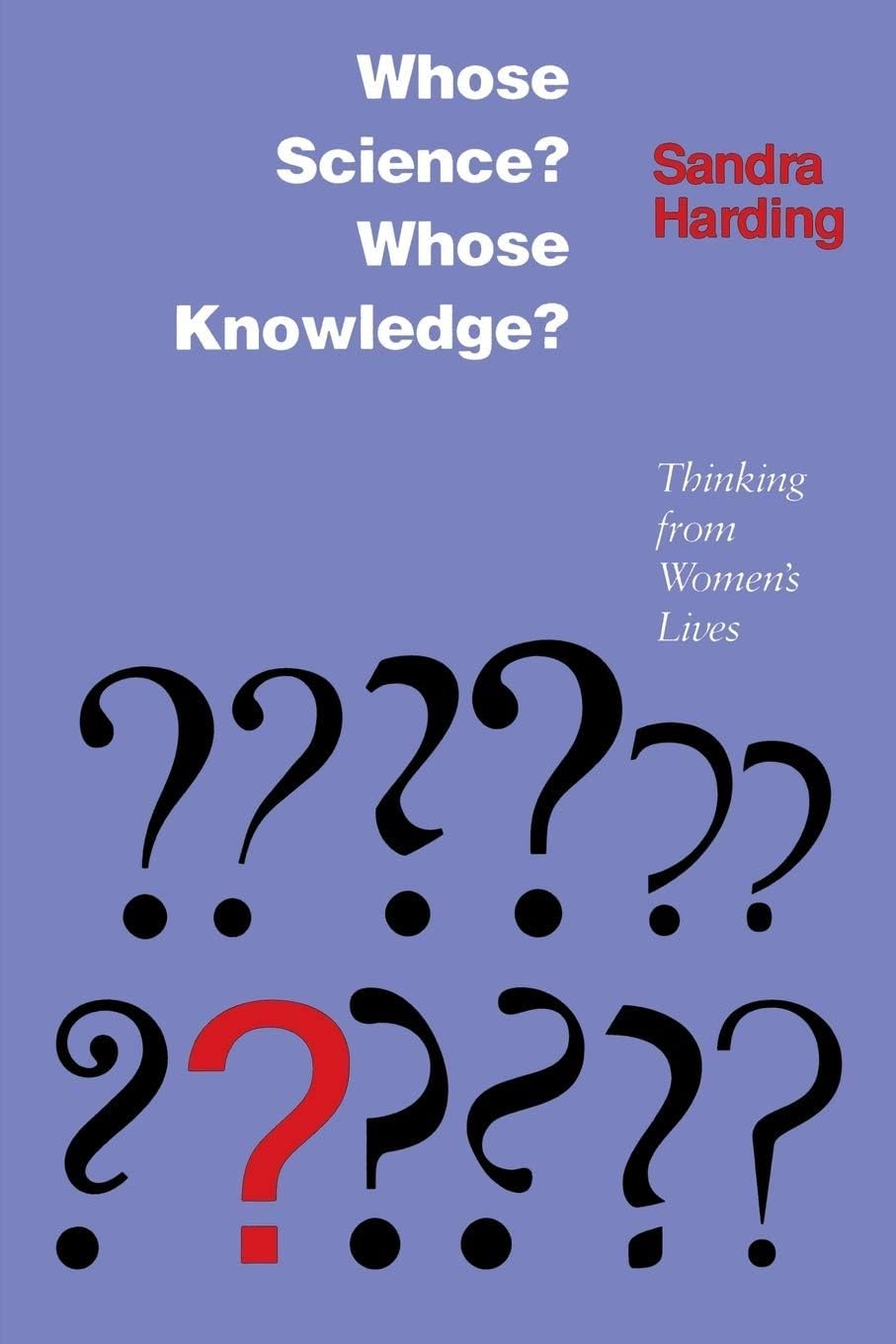
Whose Science? Whose Knowledge?: Thinking from Women's Lives
Product ID: 33671596
🌍Inclusive perspectives on knowledge
📚Rich feminist epistemology insights
🔍Critical analysis of science bias
Buy anything from 5,000+ international stores. One checkout price. No surprise fees. Join 2M+ shoppers on Desertcart.
Desertcart purchases this item on your behalf and handles shipping, customs, and support to Spain.
📖 Unlock the power of knowledge from every angle — don’t get left behind in the old science game!
Whose Science? Whose Knowledge? by Sandra Harding is a seminal feminist critique that challenges traditional scientific objectivity by emphasizing the importance of women's social experiences and diverse perspectives. This used copy is in good condition and offers a transformative framework called 'strong objectivity' that redefines how knowledge is produced, making it essential reading for anyone invested in feminist theory, sociology, and the philosophy of science.
| Best Sellers Rank | #980,109 in Books ( See Top 100 in Books ) #1,320 in Feminist Theory (Books) #2,899 in History & Philosophy of Science (Books) #6,405 in Sociology Reference |
| Customer Reviews | 4.9 out of 5 stars 13 Reviews |
R**L
Good deal
Although used, the book is in perfect condition
S**Y
Wonderful and needed critical thinking
I've struggled with issues in my attempts to operate within the domain of "science" (soiology) - and I have formulated many critiques on my own, and then I came across this book, which gave me a vocabulary of critique and connected a lot of the thoughts I had been having, with new ones. Harding's work is original, fair, and very thought-provoking. It's a deconstruction of the concept of "objectivity" as it often is understood (implicitly) by practitioners of science. She explains that supposedly "value-free" science is actually very much situated and biased. She offers the beginnings of a new paradigm or epistemology, which she calls "strong objectivity". This is a mode of knowledge production that is more self-aware of its own situatedness, and, for this, generates more reliable, more responsible and more useful knowledge.
E**E
Good example of feminist philosophy of science
A feminist critique of the mainstream themes in the philosophy of science. Argues for a 'stand-point' approach, which entails the explicit incorporation of value-judgements into science and giving greater weight to the 'subjects' of study in social science. It is argued that by taking the stand-point of the subjective and lived-experiences of the oppressed into one's theories and practices, one's understanding of social phenomena can be both more 'objective' (in a special sense) and potentially empancipatory.
M**T
This book makes you think about a lot of issues around misogyny.
What an important book!
Trustpilot
1 week ago
2 weeks ago