We remain fully operational. Our teams are working around the clock to ensure your deliveries continue safely.

DOWNLOAD THE APP


Customer Services
Copyright © 2025 Desertcart Holdings Limited
DOWNLOAD THE APP
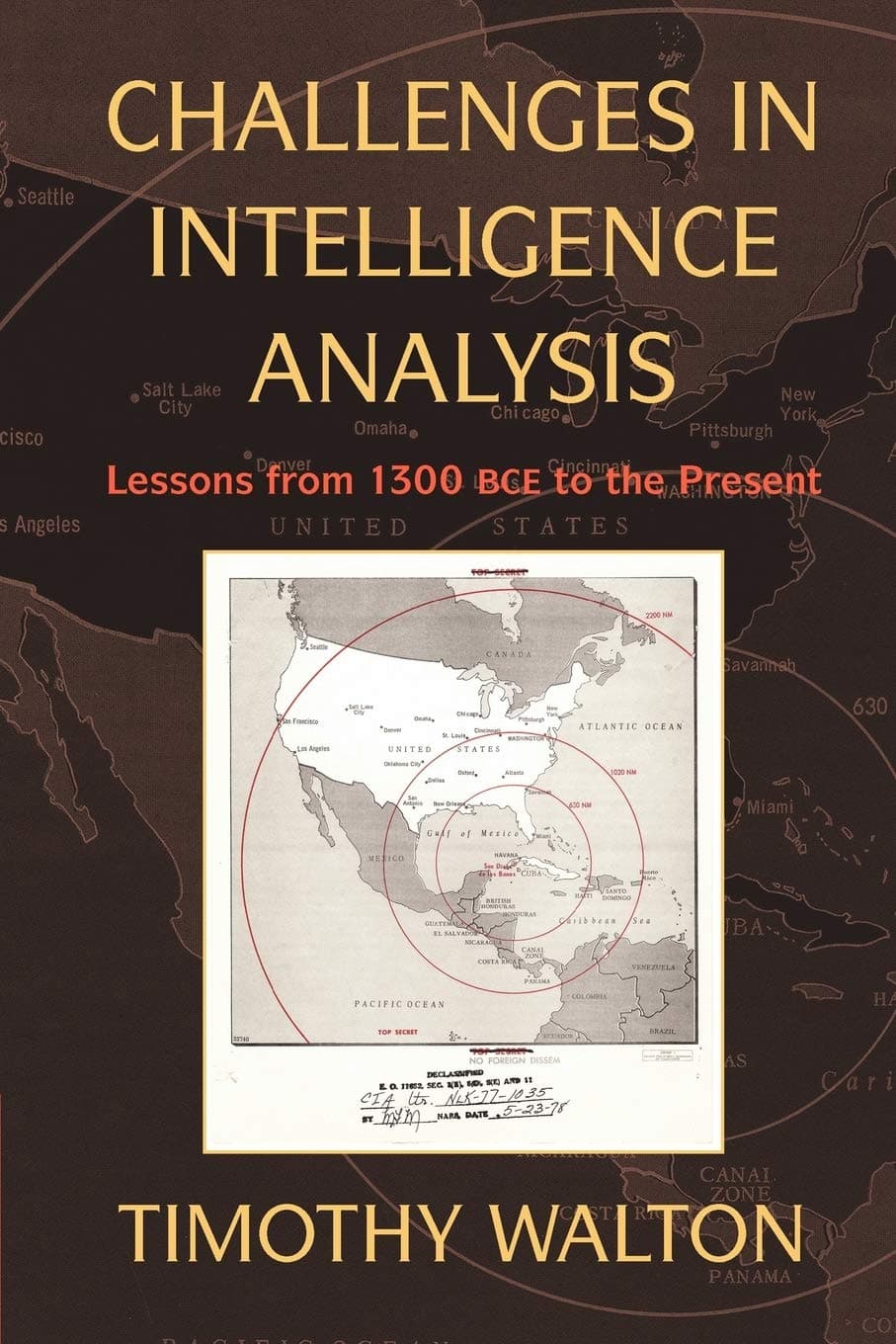

desertcart.com: Challenges in Intelligence Analysis: Lessons from 1300 BCE to the Present: 9780521132657: Walton, Timothy: Books Review: Five Stars - Very in-depth and informative Review: Great - Great price, like new and came quickly. It was much cheaper than the ones my school bookstore was selling & it looks new. I can’t remember if I purchased it used or not but it looks new!
| Customer Reviews | 4.5 4.5 out of 5 stars (43) |
| Dimensions | 6.13 x 0.7 x 9.25 inches |
| Edition | 1st |
| ISBN-10 | 0521132657 |
| ISBN-13 | 978-0521132657 |
| Item Weight | 15.2 ounces |
| Language | English |
| Print length | 310 pages |
| Publication date | August 30, 2010 |
| Publisher | Cambridge University Press |
H**H
Five Stars
Very in-depth and informative
K**K
Great
Great price, like new and came quickly. It was much cheaper than the ones my school bookstore was selling & it looks new. I can’t remember if I purchased it used or not but it looks new!
K**L
Usefully structured and accessible
I have always believed in interdisciplinary studies. Specifically, I like to read about approaches taken in superficially-dissimilar fields where the underlying problems or useful solutions have stronger connections when examined more closely. For example, nearly 10 years ago I read Level 4: Virus Hunters of the CDC and found a number of useful lessons for combating malware outbreaks and dealing with large-scale incidents. More recently, my interest has turned to applying lessons from intelligence analysis. This isn't much of a reach, truthfully, because those of us working in infosec ("cyberintelligence") frequently do the same work as those in military intelligence and related agencies. As part of this effort, I recently finished reading Challenges in Intelligence Analysis by Timothy Walton. Out of all the books I've read recently on intelligence, this offered perhaps the most direct application in any number of fields (including mine). I read the Kindle edition, so I can't say much about the quality of the printing, readability of the text, or appearance of the figures. The structure makes it particularly straightforward to read. After the initial chapters dealing with challenges and solutions in somewhat general and abstract terms, Walton runs through nearly 40 case studies ranging from the Israelite spies in Canaan (as recounted in the Book of Numbers, chapter 13) to George Washington to the pre-WWII Luftwaffe to Aldrich Ames to Aum Shinrikyo. Apart from the history lessons, each case study examines the intelligence analysis techniques used and discusses what could have possibly improved upon the approach. "Questions for Further Thought" provide utility for classroom settings or those simply interested in taking the time to structure their thoughts in response. Each case also has a recommended reading list, which I find particularly useful because a number of historical cases have striking parallels in current situations (beyond their own intellectual appeal). For example, Chapter 10 "Estimating the Strength of the Luftwaffe in the 1930s" immediately resonated with me in thinking about challenges regarding `cyberwar' with China and understanding their strengths. The same challenge would apply in looking at the US, I'd think. And Chapter 17 "Counterinsurgency in Malaya" has a number of connections to the US' recent conflicts in Iraq and Afghanistan, something not lost on General David Petraeus and Lieutenant General James Amos when they wrote the new Counterinsurgency Field Manual. Several techniques appear frequently in the text. It does not limit discussion to easily-understood tools like timelines, flow charts, and matrices. Walton also reviews link and network analysis (particularly applicable in cyberintelligence), analysis of competing hypotheses, indicators (sound familiar?), and red teaming. This latter goes beyond a simple penetration test to emulate the tactics, techniques, and procedures of specific adversaries. Decision trees and especially scenario analysis also recur throughout the case studies. Cognitive biases also play a significant role in the discussions, especially confirmation bias, groupthink, and even hindsight bias given the context of the book. A few of the case studies seem a little rushed. Even when we have less data on the situation for historical review, Walton doesn't always take the opportunity to explore analysis techniques in greater detail. Related to this, a few case studies seem a little forced ("Sun Tzu" has a lot to say about intelligence analysis, but he isn't a case study per se). And I would have liked a little more description on why he recommends certain books for further reading, especially in the general (non-case-specific) list at the end of the book. In general, I highly recommend this book to anyone with an interest in intelligence analysis, world history, or critical and analytical thinking.
T**9
Five Stars
Brand New, fast shipping!
K**S
Five Stars
It was a wonderful textbook.
N**C
valuable introduction to the work of intel analysts
Useful books about the oft-misunderstood world of intelligence analysis are few and far between. Descriptions of the analytic profession are often out of print (Jack Smith's The Unknown CIA or Ray Cline's Secrets, Spies, and Scholars) or are buried in bigger tomes (Robert Gates, From the Shadows). Others, dealing with the analytic process in clinical detail, are frankly boring. Walton's unique approach is historical--he tells succinct, readable stories about analytic challenges, thereby showing that the bases for today's intelligence analysis can be found thousands of years ago--Caesar's contemplation of Gaul, for example. He prefaces his historical case studies with two chapters--the best short treatment I've seen--on what makes intelligence analysis difficult, how analysts get things wrong, and specific techniques that can help lead to analytic success. Marching straight up to present times, subsequent chapters describe not only challenges, but successes and failures as well. Walton's chapters on the analytic failures surrounding the Korean War,the Cuban Missile Crisis, 9/11, and Iraqi WMD are excellent and objective synopses of complex issues. This would be an ideal textbook for any undergraduate introductory course on intelligence dealing with analysis and estimates. Highly recommended.
B**X
Nice overview, but nothing useful.
The author says in the Introduction that he did no "archival research" and included no "footnotes", meaning this was intended to be a general discussion of the events, and nothing more. That is an honest description, but the book is so general there is very little useful information or "lessons". It is informative as to the events, but of no value beyond it. The "lessons" that are mentioned are the usual analytical flaws outlined in most intelligence literature. For this price, I would liked to have seen more information on the actual collection, how it was analyzed and what the specific errors were. The examples and scenarios were interesting, but the lessons were ordinary and hardly worth the current $24 price tag.
M**T
Easy reading, good sum-up history lessons. With many lessons for the future. Everybody who cares about security should read it.
D**N
Reflecting on the limits of intel after events have played out is an excellent exercise with applicability in many areas of life. We all make critical decisions based on incomplete information that is coloured by our emotions, expectations, aspirations and beliefs about the future. Marriage and starting a business are two examples. The book is a scorecard of critical thinking at the high-stakes game of international relations; but the lessons are universal. The stories are quite short, and the questions at the end of each are probing; it would make an excellent text, and a student would be well advised to spend a few hours digging up additional material to properly go after the answers for discussion at the next class. HIGHLY RECOMMENDED.
W**S
Bei diesem Buch handelt es sich wirklich um einen zugänglichen Überblick zum Thema Intelligence Analysis. Es wird chronologisch vorgegangen und jedes Kapitel ist gleich aufgebaut; kurze Schilderung der geschichtlichen Umstände und der Bezug zur intel analysis, dann Besprechung der aufgetretenen Probleme und Lösungsvorschläge, zum Schluss Fragen zu denen man sich Gedanken machen kann und empfohlene Vertiefungsliteratur zum speziellen Thema. Wenn man sich zum ersten mal mit dem Thema beschäftigt, dann kann man annehmen, dass ich hier 5 Sterne vergebe. Für Personen, die sich schon etwas auskennen ist die Abhandlung zu oberflächlich, teilweise viel zu oberflächlich um überhaupt etwas von diesen "lessons" zu lernen.
S**N
Great Read. Lots of interesting information and stories. Really interesting stuff!
Trustpilot
2 weeks ago
1 month ago