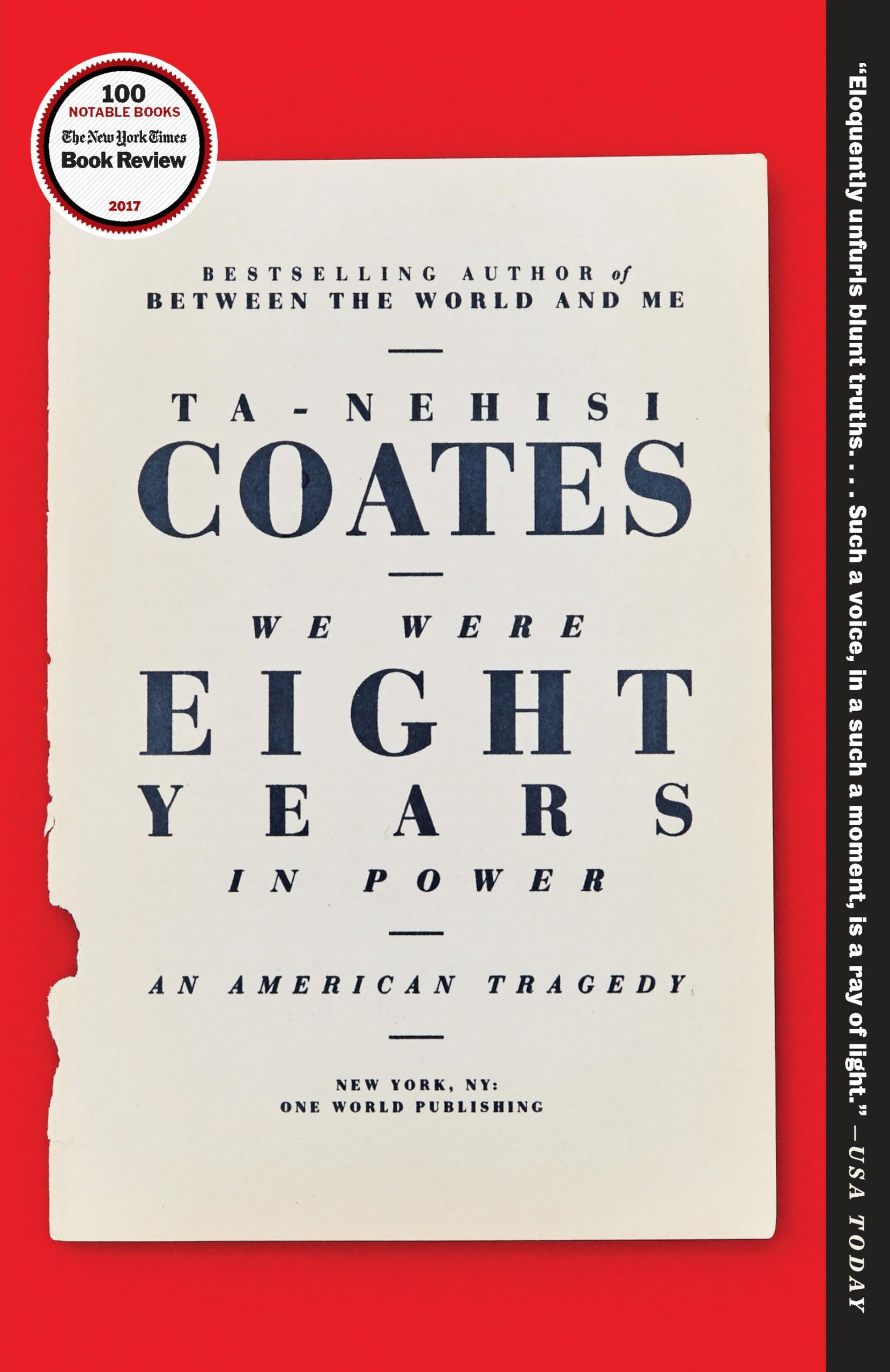
One World We Were Eight Years in Power: An American Tragedy
Product ID: 253603354
Buy anything from 5,000+ international stores. One checkout price. No surprise fees. Join 2M+ shoppers on Desertcart.
Desertcart purchases this item on your behalf and handles shipping, customs, and support to Spain.
Buy One World We Were Eight Years in Power: An American Tragedy by Coates, Ta-Nehisi online on desertcart.ae at best prices. ✓ Fast and free shipping ✓ free returns ✓ cash on delivery available on eligible purchase. Review: There were two reaons why I, a white Dutchman, bought and read this book. First of all, the book is very well written. On pag.89, he explains why he writes the way he does:" This was the voice in my head I was constantly trying to unlock to get out and onto the page. I wanted to produce writing that was not just correct on its merits but, through its form and flow, emotionally engaged the receiver, writing that was felt as much as it was understood." And, in my opinion, he succeeds in this. It is a delight to read it. There is a second reason why I read this book: I, partially, disagree with it. But it would be lazy to dismiss a book without having actually read it: Here are my objections to his reasonings: 1. Discrimination was not always only directed to the Afro-Americans. But also against the Catholics and the Chinese. In particular, the life of a Chinese working on a railway line, wasn't worth anything. Look at them now. But not only the Chinese, but also the Koreans etc. 2. There will be no reparations. Ever. In my opinion of course. But why argue for reparations, if there is such a thing as Socialism. Not equality for all but equal opportunity for all. Coates would probably argue that that didn't work out in the past, but it has worked in Europe. 3. The majority of people that voted were not only the deplorables but moreover the white men and women who are, on the contrary, better off (pag.346), He makes the point that the white people voted for Trump for his whitism. But in his argument, Coates leaves out a single and very important element of Donald Trump: he is a businessman. And businessmen stand in high regard in the USA. The businessman is the fixer, the one who gets things done, the alpha-male who bounces people off the road if they become a hindrance. And his racism, his sexism and all his negative qualities make him what he is today: a succesfull businessman. To illustrate my argument: I have seen on television a news report: a Dutch tv-crew went to the US-Mexican border and asked some young women of clearly Mexican descent, busy working for the Trump campaign, why they did that. Donald Trump had been negative about Mexicans and women ..... Their anwer was clear and concise:" Donald Trump is a businessman, so he will be good for business." Nevertheless, regardless of my objections, I give this book five stars. It was wonderful to read it and at the same time, it made me think. Review: Que dire? Superbe, engagé, documenté.
| Best Sellers Rank | #42,497 in Books ( See Top 100 in Books ) #91 in Government #935 in Sociology #1,389 in Biographies & Memoirs |
| Customer reviews | 4.8 4.8 out of 5 stars (1,625) |
| Dimensions | 13.06 x 2.11 x 20.19 cm |
| Edition | Reprint |
| ISBN-10 | 0399590579 |
| ISBN-13 | 978-0399590573 |
| Item weight | 1.05 Kilograms |
| Language | English |
| Print length | 400 pages |
| Publication date | 30 October 2018 |
| Publisher | One World |
E**E
There were two reaons why I, a white Dutchman, bought and read this book. First of all, the book is very well written. On pag.89, he explains why he writes the way he does:" This was the voice in my head I was constantly trying to unlock to get out and onto the page. I wanted to produce writing that was not just correct on its merits but, through its form and flow, emotionally engaged the receiver, writing that was felt as much as it was understood." And, in my opinion, he succeeds in this. It is a delight to read it. There is a second reason why I read this book: I, partially, disagree with it. But it would be lazy to dismiss a book without having actually read it: Here are my objections to his reasonings: 1. Discrimination was not always only directed to the Afro-Americans. But also against the Catholics and the Chinese. In particular, the life of a Chinese working on a railway line, wasn't worth anything. Look at them now. But not only the Chinese, but also the Koreans etc. 2. There will be no reparations. Ever. In my opinion of course. But why argue for reparations, if there is such a thing as Socialism. Not equality for all but equal opportunity for all. Coates would probably argue that that didn't work out in the past, but it has worked in Europe. 3. The majority of people that voted were not only the deplorables but moreover the white men and women who are, on the contrary, better off (pag.346), He makes the point that the white people voted for Trump for his whitism. But in his argument, Coates leaves out a single and very important element of Donald Trump: he is a businessman. And businessmen stand in high regard in the USA. The businessman is the fixer, the one who gets things done, the alpha-male who bounces people off the road if they become a hindrance. And his racism, his sexism and all his negative qualities make him what he is today: a succesfull businessman. To illustrate my argument: I have seen on television a news report: a Dutch tv-crew went to the US-Mexican border and asked some young women of clearly Mexican descent, busy working for the Trump campaign, why they did that. Donald Trump had been negative about Mexicans and women ..... Their anwer was clear and concise:" Donald Trump is a businessman, so he will be good for business." Nevertheless, regardless of my objections, I give this book five stars. It was wonderful to read it and at the same time, it made me think.
R**S
Que dire? Superbe, engagé, documenté.
A**R
Excellent livre! aide à comprendre la réalité des noirs aux USA et l'impact d'Obama sur cette société au cours de son mandat. Tellement bien écrit.
Z**❗
We Were Eight Years in Power is an astonishing read. Deeply nuanced and unafraid of the treacherous ground it treads, this volume of previously published essays on race in America is buttressed by new prologues written by Ta-Nehisi Coats for this book, which seek to frame (and sometimes qualify) each essay with hindsight across the last decade. I subscribe to The Atlantic where these essays were originally published and they were (and are) not only engaging essays but also shots across the bow of race relations in the U.S. that spurred quite a bit of conversation and debate when originally published. Some more than others, i.e. The Case for Reparations and Fear of a Black President. What I really enjoyed about this book were the prologues to each essay and also re-reading essays that I didn't connect with as much at the time. Especially enlightening for me was Why Do So Few Blacks Study the Civil War? Reading all of these together, consecutively, I realize that together they form a cohesive illumination of and an argument for why race is not just a contributing factor or even a dominating one in understanding every aspect of American history and culture... it's is THE defining element of what, who, why, where and how when it comes to comprehending the multitudinous, interlocking facets of the United States of America. That is not to say that one must agree with this conclusion to enjoy or get something out of reading this book. However, I would wager that anyone reading this book with an open mind will have their concept and scope of race in America broadened to a great extent. These essays are intellectual without being pompous, opinionated without being one-sided and deeply thoughtful and personal without being meandering or self-involved. It's difficult to read these essays, which include a lot of personal information about Coates and his life influences and not come away without a huge respect and love for the personality painted by the words. There are a couple of places where Coates contemplates his appeal to readers across the color barrier and specifically the fact that so many white readers seem to enjoy his work and connect with it in a meaningful way. I would suggest that his writing occupies a rare place in literature where themes and subjects which are normally very divisive are dissected so thoughtfully and with such aplomb that those normally divisive subjects are able to be elevated to a higher plane of consideration above the usual slings and arrows that typically meet even the anticipation of their debate. In short, Ta-Nahesi Coates is simply such a talented journalist and essayist that he is able to defy gravity here and make points in ways that are by turns brutal and tender in their honesty, yet never veer into cliche, invective, circular arguments, ad-hominem attack or any other sort of trap that awaits those who strike out on the trail he has chosen to brave. He makes the bold claim along the way that his desire is to be a modern-day James Baldwin. Coming from just about any other writer that would come off as naive or even laughable. From Coates, it is chill-inducing and sobering it its veracity. Like Baldwin, Coates is that rarest of gems - a writer who runs towards a potentially perilous topic when most are running away from it, then when tackling it - not only refuses to be defined by it but also refuses to define that topic in traditional ways - instead digging down deep to get at the truth and communicate it in a way that is artful, meaningful and beautiful in its simplicity of meaning yet complexity of style. It's obvious that Coates sweats the details, down to individual word choices and turns of phrases. In the end, his writing here is comparable to a symphony where many elements come together to form one overall composition that is more than the sum of its parts. This is not a hopeful book. But it is also not a fatalistic one. It shuns the usual narrative of race throughout the history of America while holding up to the light a different narrative that will not be to every citizen's liking, but when viewed as a whole is certainly difficult to outright ignore or deny. Like any other "big" topic, race is dizzyingly complex in its nuance, yet as laid out here, much more direct and simple than some might expect or believe. The lines drawn are not pretty, but they are clear and unwavering. To embrace the message delivered here will take courage on both sides of the issue. However, for anyone who feels that the relationship between Black America and White America is not just damaged, but perhaps irreparably so, We Were Eight Years in Power is required reading. The way out of a problem this pervasive and soaked through to the foundation of a culture is never going to be easy or quick. But with time, thoughtful consideration, a massive dose of honest self-reflection on all sides and a willingness to not only compromise out of mutual respect and love - but also to roll up our sleeves and work hard - there IS a way to sanity and fairness for all involved. Will it happen in decades or even centuries? That's not for us to decide. All we can do is begin to move in the right direction and set up future generations with the tools they will need to keep the ball rolling downhill until one day people look back and think "What was all the fuss about?"
S**E
Ta-Nehisi Coates' We Were Eight Years in Power: An American Tragedy is an insightful yet uneven collection of essays that examine race, history, and the presidency of Barack Obama. The book weaves personal reflections with cultural critique, offering a nuanced look at America’s racial landscape. I found Coates' writing powerful, particularly in essays like The Case for Reparations, which lays out the systemic injustices that continue to shape Black life in America. His prose is sharp, and his arguments are deeply researched, making it hard to look away from the realities he presents. However, some essays felt repetitive, and while his reflections on Obama's presidency are compelling, they occasionally veer into hero worship. The book's strongest moments come when Coates dissects historical patterns, showing how America’s past informs its present. But at times, the narrative felt detached, as if he was observing rather than engaging with the issues at hand. I appreciated his honesty about his own evolution as a writer, yet I wished for a broader range of perspectives. Overall, We Were Eight Years in Power is thought-provoking but not always cohesive. It’s an important read, but I didn’t find it as gripping as Between the World and Me.
Trustpilot
5 days ago
2 weeks ago