Desertcart purchases this item on your behalf and handles shipping, customs, and support to Spain.
⚡ Empower your DIY projects with precision sensing — don’t get left in the dark!
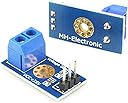
The WayinTop ACS712 Hall Effect Current Sensor and Voltage Sensor combo offers a professional-grade solution for measuring DC current up to 30A and voltage up to 25V. Featuring high sensitivity and fine analog resolution, this kit is perfect for Arduino enthusiasts and electronic designers seeking reliable, dual-parameter monitoring in a compact, easy-to-integrate package.
| ASIN | B08BZKPSFY |
| Best Sellers Rank | #111,224 in Industrial & Scientific ( See Top 100 in Industrial & Scientific ) #18 in Current Sensors |
| Brand | WayinTop |
| Brand Name | WayinTop |
| Coil Voltage | 25 Volts |
| Connector Type | Terminal Block |
| Contact Current Rating | 30 Amps |
| Contact Material | Copper |
| Contact Type | Normally Open |
| Current Rating | 30 Amps |
| Customer Reviews | 4.3 out of 5 stars 118 Reviews |
| Item Weight | 28 Grams |
| Manufacturer | WayinTop |
| Maximum Switching Current | 30 Amps |
| Maximum Switching Voltage | 25 Volts |
| Mounting Type | Surface Mount |
| Number of Terminals | 3 |
| Operation Mode | Automatic |
| Part Number | FC#WYTP74 |
| UPC | 744678327440 744678328140 |
| Unit Count | 4.0 Count |
R**N
Works as expected
Nice units that are exactly what I needed! The construction is well done and each unit was separately wrapped.
U**T
Did the job perfectly
Was iffy about this but it turns out pretty well
D**N
Pretty good, but a couple things to know
These work OK and will do the basic job. Don't expect the precision of an expensive multimeter or data acquisition system, though. Sampling with the Analog pins of (most) Arduinos, you'll get 10 bits of resolution (1024 levels). On the current sensor: the chip on mine responds at about 66 mV per Ampere sensed (that's about .066 V - same number, expressed differently, for the noobs). It's important to know this because much of the online information says you'll have from .170 V to .2 V per Ampere. The difference is the particular chip on the board. Mine is an ACS712T ELC-30A (optimized for a 30 Amp range). The data sheet mentions a -5B (185mV/A) and a -20A (100mV/A) version. If you're getting crazy results, look into which chip is on your supplied board. Needed my microscope to read the top of this chip, but found "30A" in the part number, which fixed a lot that was wrong about my readings. Safety-wise, Arduino is isolated from the metered current by the Hall-effect sensor chip. The voltage sensor is just a simple voltage divider. Sure, the screw terminals are really nice, but if you've got to make a quick measurement, then take the circuit apart, you can build this out of precision resistors from your junk box. (If you're going to install something permanent-ish, this board may be worthwhile). As far as I can tell, there's no circuit isolation here, so your Arduino is exposed directly to a circuit that could be pumping out _any_ voltage, if you're not watching out for it. I don't think it's even fused. Maximum sense-able voltage with this device is 25vdc. Not sure what the safe max is, but that probably depends on your Arduino: this voltage divider will knock the input voltage down by a factor of 5 or so. Finally, getting a good measurement out of these requires that you measure and take into account your Arduino's Vcc voltage. If the Arduino thinks its supply voltage is 4.726 vdc, and your example code uses 5vdc, and a center voltage of 2.5v (5vdc/2), your measurements won't make sense. Your sketch needs to use the measured Vcc and Vcc/2 for the center to make the measurements match reality. Also, the Arduino has an internal Vcc measurement (_most_ boards do, anyway), which may differ from an external measurement (with a meter) of Vcc. I'd go with the internal value, if pressed to choose. Getting Vcc and center point right affect your math greatly. The price is right, and I'd buy these again, for simple hobby uses.
P**2
Read this listing carefuly first
This vendor is listing this product along with others and in my opinion doing so wrongly. There are actually two products mixed here 1. Hall effect 2. Voltage sensor. The voltage sensor is simply fluff with no real purpose in most cases. This combo is listed right along with the 4 and 5 packs of the Hall Effect - Buy THOSE, not this listing. A nice way to get rid of useless stock (Volt sense).
E**T
Capteur de tension
Pour l’instant, je n’ai essayer que le capteur de tension, il fonctionne très bien
A**A
Works as described. Do read the specs carefully.
Useful little boards that work as intended. The only issue is the low resolution of the current meter, but I can't really blame the seller, as that is given in the spec sheet
C**Y
Utilizzo semplice ed intuitivo. Anche per profani
Semplicità di utilizzo. Non necessitano di librerie. Fare una media (10 letture) prima di utilizzare il valore letto.
A**R
livraison rapide
Conforme à la description.
L**O
Buono
Buono ma poco preciso e con molta oscillazione nei risultati. Funziona bene su Arduino nano e Uno, ma non molto bene su ESP32.
Trustpilot
2 months ago
2 weeks ago