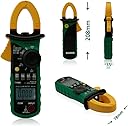
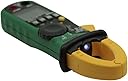

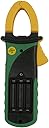


The newly released Mastech MS2108 is a versatile and invaluable tool for electricians, technicians, professionals and alike. It's small in size and can be easily be used with one hand. You can use it to measure AC/DC voltage and current, resistance, capacitance, frequency, duty cycle, continuity and even diode test. This true RMS clamp meter has inrush current measurement, which is designed to capture inrush current accurately and , most importantly synchronously and provide readings that accurately depict what the circuit protector experiences. Other features include back-lit LCD display, jaw lighting, MAX/MIN, data hold and etc. Review: So far, So Great.... - I purchased this meter to use in less than perfect conditions. Because I also own and use a Fluke and a Greenlee for various jobs, I have a little experience with which to evaluate this meter. For the last year or so I have had several occasions to use a clamp meter under a house and inside a large wet vat/container. I really did not want to expose my Fluke to those conditions, so after some thought I decided to take a chance on a less expensive alternative. I chose the Mastech MS2108 for two reasons. First, my Fluke does not have a way to measure Inrush current and the Mastech does. Second, The Mastech is a "true RMS" meter. With both of these parameters met, I was amazed at the price for this meter. Amazed, and a little sceptical as well. Well, I shouldn't have been sceptical, but I am still amazed.!! This meter is very well thought out, and apparently well made. I have been using it almost continuously since purchase, and it has showed no signs of a fault anywhere inside of its usage parameters. That doesn't mean that that it won't fail at some point. It might in fact fail tomorrow, but until it does I am going to consider it a fine instrument and a tremendous value. The clamp opens smoothly, but holds firmly in use. The plastic body appears to be well made and solid with all screen printing and settings plain and legible. All switches are firm and positive and there are no misnamed or misapplied designations. Everything works on this meter exactly like I expected it to. I checked this meter against my Fluke with common measurements and they were within tiny fractions of each other....well within the margin for error that I would allow on any instrument. So, if this meter is inaccurate, so is my Fluke. There are a couple of things that I wonder about though (not worry about..). I can't understand why the rotary switch has two "off" positions.?? Maybe convenience..?? I don't know, but I am not going to worry about it. The second thing is why the A/C and D/C voltage settings are combined on one switch setting, causing you to have to push a select button to toggle between them....and therefore the always present possibility of making a mistake..??? It would seem that one of the "off" positions could have been used instead for one of the Voltage measurement positions..??? Anyway, that's all I can say about this meter that could have been done a little differently. So five stars for a meter that performs like a champ....With INRUSH for around $80.00.!!!!! That's unheard of.... :-) Review: This is a very nice, basic AC/DC clamp meter - This is a very nice, basic AC/DC clamp meter. Documentation was okay, and the usual oddly worded translation I've come to expect from Chinese import products. I'm a telecom engineer, and I had purchased this meter so I could always have one in my bag for measuring current on our central office devices (which are DC powered). I used a couple of our much more expensive DC clamp meters here to compare it against, and I'm very happy to report that it is just as accurate (as it measured the same current) as our higher end-meters. This is well worth it to purchase if you need to measure DC current (including peak current) and you need it to be fairly accurate. The included probes work well, even if they're rather short on the tips (I'll be replacing them with a set of Klein probes I have spare). All in all, a good value for the price.
| ASIN | B0017WRH7O |
| Brand | Mastech |
| Brand Name | Mastech |
| Color | MS2108 |
| Customer Reviews | 4.0 out of 5 stars 115 Reviews |
| Item Dimensions | 3 x 5 x 10 inches |
| Item Weight | 12 ounces |
| Item dimensions L x W x H | 3 x 5 x 10 inches |
| Manufacturer | Mastech |
| Model | MS2108 |
| Part Number | MS2108 |
| Power Source | Corded Electric |
| UPC | 796299908645 |
T**N
So far, So Great....
I purchased this meter to use in less than perfect conditions. Because I also own and use a Fluke and a Greenlee for various jobs, I have a little experience with which to evaluate this meter. For the last year or so I have had several occasions to use a clamp meter under a house and inside a large wet vat/container. I really did not want to expose my Fluke to those conditions, so after some thought I decided to take a chance on a less expensive alternative. I chose the Mastech MS2108 for two reasons. First, my Fluke does not have a way to measure Inrush current and the Mastech does. Second, The Mastech is a "true RMS" meter. With both of these parameters met, I was amazed at the price for this meter. Amazed, and a little sceptical as well. Well, I shouldn't have been sceptical, but I am still amazed.!! This meter is very well thought out, and apparently well made. I have been using it almost continuously since purchase, and it has showed no signs of a fault anywhere inside of its usage parameters. That doesn't mean that that it won't fail at some point. It might in fact fail tomorrow, but until it does I am going to consider it a fine instrument and a tremendous value. The clamp opens smoothly, but holds firmly in use. The plastic body appears to be well made and solid with all screen printing and settings plain and legible. All switches are firm and positive and there are no misnamed or misapplied designations. Everything works on this meter exactly like I expected it to. I checked this meter against my Fluke with common measurements and they were within tiny fractions of each other....well within the margin for error that I would allow on any instrument. So, if this meter is inaccurate, so is my Fluke. There are a couple of things that I wonder about though (not worry about..). I can't understand why the rotary switch has two "off" positions.?? Maybe convenience..?? I don't know, but I am not going to worry about it. The second thing is why the A/C and D/C voltage settings are combined on one switch setting, causing you to have to push a select button to toggle between them....and therefore the always present possibility of making a mistake..??? It would seem that one of the "off" positions could have been used instead for one of the Voltage measurement positions..??? Anyway, that's all I can say about this meter that could have been done a little differently. So five stars for a meter that performs like a champ....With INRUSH for around $80.00.!!!!! That's unheard of.... :-)
J**R
This is a very nice, basic AC/DC clamp meter
This is a very nice, basic AC/DC clamp meter. Documentation was okay, and the usual oddly worded translation I've come to expect from Chinese import products. I'm a telecom engineer, and I had purchased this meter so I could always have one in my bag for measuring current on our central office devices (which are DC powered). I used a couple of our much more expensive DC clamp meters here to compare it against, and I'm very happy to report that it is just as accurate (as it measured the same current) as our higher end-meters. This is well worth it to purchase if you need to measure DC current (including peak current) and you need it to be fairly accurate. The included probes work well, even if they're rather short on the tips (I'll be replacing them with a set of Klein probes I have spare). All in all, a good value for the price.
T**D
Maybe for Generator Sizing and Planning - Accuracy Questionable
I bought this for the primary purpose of measuring inrush current on a variety of applications as part of generator sizing. This is a cheap, partial (and questionable) solution (see the end of this review), not a perfect solution, but it does what it says and I'm happy with it. Beyond that, it's a utilitarian device and I like the convenience. I also have a Fluke 117, and checked a couple of battery and household voltages with both and the variances where in the final digit, close enough for my work. I also purchased an Extech AC line splitter to use with this for convenience. To measure peak inrush current, turn the meter on, "SEL" inrush current and clamp the meter around the load. Wait, the meter will detect the inrush current and save the value. So, if you're checking something like a refrigerator or water pump, it's easy to wait for it to cycle. For example, on one water pump, running current is 10.8 amps, peak inrush is 63 amps, which settles to someplace between 20 and 30 amps for a couple of seconds. Ideally, you would have a full profile on both the device and the protection on a generator, but that data costs a lot more money unless the vendor will provide it. Usually, they don't have a way of finding it for a retail consumer. Some generators can handle short, high peak inrush, others, like Honda generators (inverters) have circuitry that trips much faster than conventional breakers and can only handle modest inrush. The Honda 2000i for example, is rated for 120v, 13.3 amps continuous duty, but won't start the water pump that draws 10.8 amps continuous. Not criticizing Honda, the 2000i is reliable, quiet and I have 2 of them. The point is, you need data to size generators and the Mastech MS2108 is a relatively inexpensive source of that data. (that also doesn't mean you need a 6,000 watt generator to handle a 63 peak amp inrush, it will depend on the generator, but someplace between 3,500 watt and 4,500 watt is probably adequate). At this point, I've had the meter for two weeks and used it for a total of 40 measurements. It has paid for itself in "rightsizing" a generator, rather than "oversizing" to be safe. The problem with oversized generators is in part the first cost, but the bigger problem is the fuel use at idle. When you're using a generator, fuel is precious. Added edit: The manual specifies the inrush current accuracy as follows: It says "below 60 amps, use only for reference" (whatever that means) For above 60 amps, is says "+/- 10% + 60 digits" (yeah, "60" digits) That makes it nearly worthless for measuring inrush current for household devices.
R**N
Well worth your coin. INRUSH Current for less than $100!!!!
O'Laney pretty much hits the nail on the head. I would add a few thoughts. The DC current issue. I was surprised that they even tried for 10 mills. It is very important to CENTER the jaws around the loop. Don't just clamp on and expect the best reading. Just moving the clamp affects the pickup and if you don't have one get a AC line splitter(EXTECH)and use the 10X loop (Mr Sinclair reiterates). Best $15 you can spend. I suspect they don't measure through the probes to keep some idiot from frying the meter due to overloads. YES...AC/DC Voltage selection is tedious... ditto. Fit and finish just as good as Fluke. I have a Fluke 902(for years) and a really old 77 and this Sino beats them handily on both AC and DC accuracy. I set up a test circuit and made several "runs". I had to calculate variances based on resistance and voltage but there is no doubt that the Sino beat the Fluke especially at low current and voltages. As much as 10% of the reading. Now the reason I bought it. I live in Florida and deal with generators. Motor inrush was almost impossible to measure until this new crop of meters. I never understood "true" current spikes until I got this meter. I can now setup my own custom transfer switch and be sure I have sized the breakers current and the breaker RESPONSE time correctly. That keeps me from having to do resets for over-current spikes. Don't expect much from the manual (like inrush sample rate and sample time) as a matter of fact don't expect much of anything from the manual except settings and readings. Conclusion... a little less than professional, a lot cheaper than professional, and reads low readings better than professional.
H**Y
Much to be desired
When I first got this meter I was surprised how small it was. And of course the first thing I noticed was that as a Solar RV specialist, was that I could barely and I mean barely get the clamp around a 4/0 cable. The next thing I noticed was that the back light button was a combo button for the auto range to manual range. If you hold the far right button for two seconds it will turn the back light on but at the same time it changes the auto range to manual at the lowest setting. So then you have to change it back to auto before your measurement. This is a major fail in design and I have seen it in other meters. The next thing I noticed and for this reason I sent it back to Amazon was when getting ready to take a AC Current measurement and before clamping it to any wire it would show a reading of 3/10ths of an amp. There is no way to zero out a AC amp reading so I always had to add that to my measurement. It is sad that they cannot make sure that the calibration is right before leaving the factory. Another problem with this meter is the display. It is small and hard to read and when using the back light the lights are too close to the edge of the display and leave glare streaks across the display. I would not recommend this meter to anyone especially because of the back light multi-button issue.
L**I
Has Some Limitations, but still offers Good Value for the Money!
Purchased the MS2108 primarily to make current and voltage readings on my travel trailer. Knowing the 12 vdc current draw for the lights, inverter, pump, heater fan, etc. is helpful to determine the most efficient use of the travel trailer's battery when "dry" camping (using only 12 VDC when no 120 volt commercial power or water/sewer is available). The "inrush" current function was very helpful to determine start-up current for the air conditioner and microwave in my travel trailer. This inrush/startup current data is especially useful when trying to find a compatible generator. For the most part this meter performs well. I've compared its readings to a much older Fluke clamp-on meter and it appears to be reasonably accurate. I have noticed a few irregularities that some with more critical needs may find deal-breakers. There doesn't appear to be a zero function for AC current or ohms/resistance. It appears the ONLY zero function available is for the DC current mode (still difficult to get absolute zero). Unfortunately, the manual isn't written very well, so it's hard to know for sure. In AC current mode, the display occasionally jumps around from 0 to .5 amps randomly. This doesn't instill much confidence when making AC current readings below 1 amp. In ohms/resistance mode the display usually hovers between .2 and .4 ohms when the pos & neg leads are shorted. For the money, I still think this meter offers good value, especially considering it's true RMS, has the inrush current function, and is reasonably accurate. However, if you need accuracy and precision at very low current/resistance/voltage levels one may want to consider a more expensive, "professional" meter like a Fluke. Note: when I ordered the MS2108 from Amazon I was mistakenly sent a MS2108A. The MS2108A is less expensive, is not true RMS, and does not have the inrush current function. I returned the MS2108A and Amazon overnighted the MS2108 (no suffix) to me the next day at no cost!!
R**Y
Great little meter at a great price
I purchased this for work, mainly since it is a tough environment and I didn't want to pony up for a Fluke only to see it destroyed in some future mishap. The fit and finish is high quality, comparable to high end meters. The display is a little hard to read but functional. The current clamp has a very solid quality feel to it. Overall this is simply a very affordable alternative to high end meters that has comparable qualities, unlike the discount tool store meters in similar price ranges. Update: 8/2013 Still a great meter. Almost a year of tough on the job use and no problems.
J**E
AC/DC clamp meter
This is an excellent meter for the price, in fact it is just an excellent meter, period! True RMS with AC/DC clamp and inrush current measurement? WOW! I bought this one for my son and he loves it. He hasn't had it for very long but it is already proving to be just what the doctor ordered. I have one somewhat like it except I don't have inrush current measurement! My meter has been very reliable for more than a year. Any sensitive meter requires care, given that it will be a great investment for anyone.
J**Y
Appears to be a good product, with room for improvement
Bought meter to confirm in-rush loads for generator sizing. Seems well built but I have no reference metre against which to judge its accuracy. No English instructions were included - I had to download and print my own and these instructions are not very clear, especially when interpreting different scale readings. A good price for what you get. Took several months to arrive, so be patient.
B**A
Good product at reasonable price
The product sold at reasonable price while same quality product are sold above 10K.
C**N
Like this meter very much
Like this meter very much, voltage accuracy is very good, input from a stabilised lab power supply of 15 volts gave a reading of 14.96 v, just 40 millivolts lower, this agreed closely with my other digital meters. Current measurement through the clamp section also agreed with my other clamp meter, so I am happy with that. Testing the capacitance function with a close tolerance 2mfd motor start capacitor gave a reading of 2.068 mfd., a good result. Next test was resistance, using a close tolerance 300 ohm hi stab resistor indicated 300.3 ohms, another good result. Checking frequency with my digital frequency generator at 1000 Hz gave a reading of 1000Hz, at sine wave, square wave and saw tooth wave forms. Duty cycle also indicated correct at 50% for sine and square waves. Because this is an auto ranging meter and has a high input impedance it sets the range to its most sensitive one at switch on and this causes the display digits to continuously change due to static pick up on the test leads which are acting like aerials. This is not a problem as the meter will disregard this initial instability as soon as it is connected to a circuit. Some people have commented on this as if it is a fault, it is not, any meter when switched to its most sensitive range will exhibit similar results under similar conditions. Switching to manual higher voltage or current range will reduce the effect if it bothers you. It does not affect the final reading. The grey on grey pointer on the knob is a bit difficult to see sometimes but a dab of Tipp-Ex on the pointer soon corrected that. Test leads supplied are similar to ones supplied with a lot of imported meters and seem of reasonable quality with removable tip insulators. The soft case is of stout material and well made and the meter itself is well made. The led illumination of the clamp is good with the led itself protected by a lens, the back light for the display also works well. There is an auto off after 15 mins, but this can be over ridden to stay on if required. Some other reviews have mentioned that the probe sockets are a lose fit, initially that seems to be the case, this is because the metal inner pins have not entered the socket to the correct depth, it requires a further firm press to push them in fully (another 5mm) they are then a very firm fit indeed. Oh and one final mention, the instruction book for this is in English and is easy to understand, not the case for some other cheaper ones. All in all a good instrument, no serious problems encountered, hope it proves reliable in the future, will update if any issues occur.
M**S
Cheap and cheaply made - the leads are not good at all - I had to 'adjust' them with ...
Cheap and cheaply made - the leads are not good at all - I had to 'adjust' them with a small screwdriver before they would provide a steady reading - the 4mm banana is a solid post with two saw cuts and does not have natural spring to make good contact with the meter. I bought new probes. I don't have any confidence in low value readings as the meter wanders all over the place - this covered in the manual - it says ignore them ???? The LED which illuminates the jaw works occasionally. When reading a few amps things seem OK and the inrush function is OK (which is what I bought it for). As a GP meter it's OK and has adequate functions - you get what you pay for,
M**L
Mastech MS1208 AC/DC Clamp
Having tried 3 other manufacturers, I was recommended this model by an electrician. I do have a large number of 5-32Amp cables to clamp each month so it is a good test. Firstly the unit is a Chinese import - the packaging and included instructions confirm this but there was an additional translated manual included as well. However, from the very first reading there were issues which forced me to do a side by side comparison of various clamp meters I have available. When clamping AC and DC supplies with the Jaw clamp, the readings were both variable (despite approximately the same power being drawn +/- 0.05% but the variation was always >5%) and not comparable with the other clamp meters I have which were within 0.02% of one another. I took the unit home and tried reading various points from my consumer units and the inconsistences and variability continued. It is not possible to reset the reading easily usually requiring a switch off and back on which if your doing >10 readings is time consuming and a hassle. I would not recommend this unit.
Trustpilot
3 days ago
1 month ago