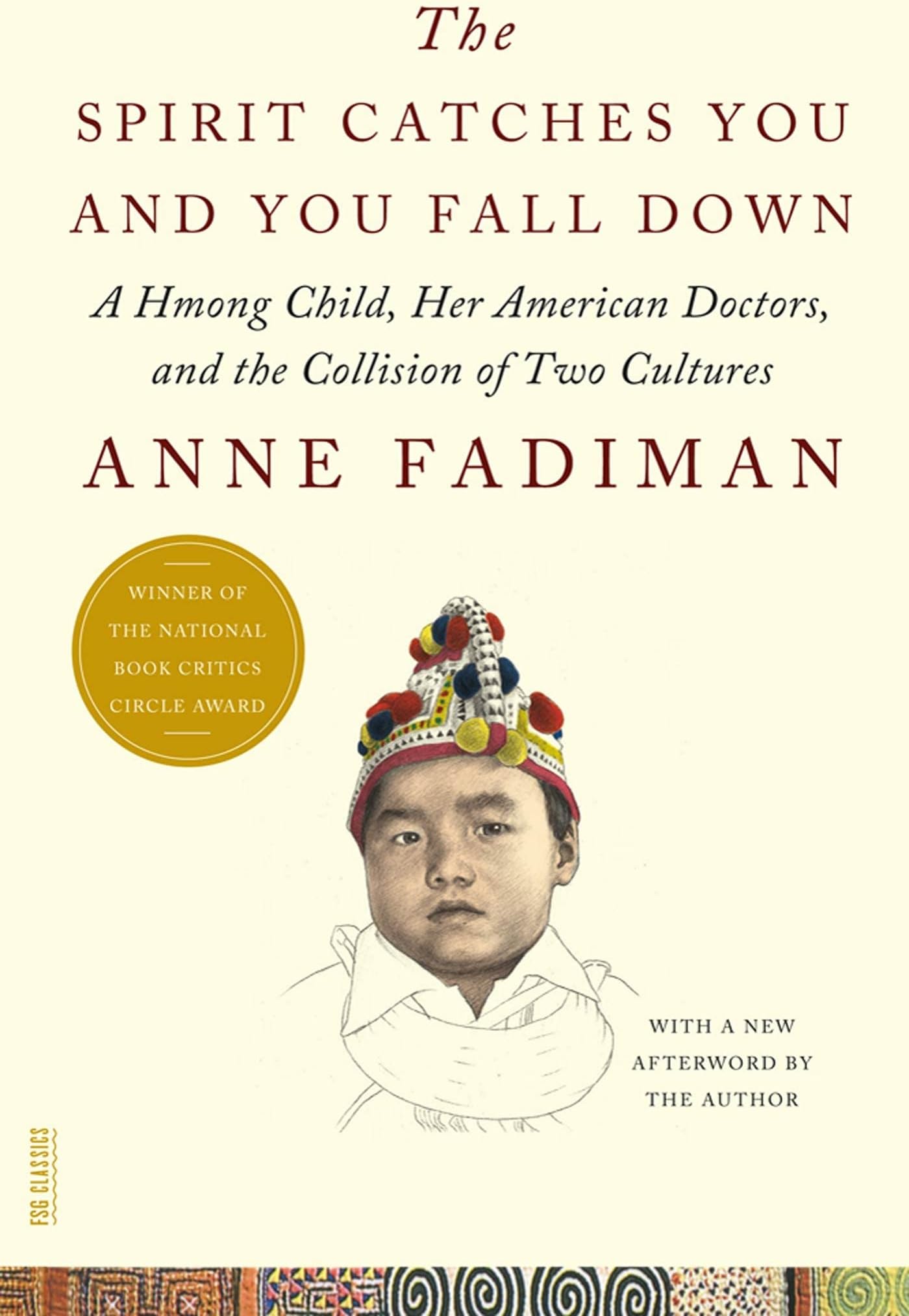
The Spirit Catches You and You Fall Down: A Hmong Child, Her American Doctors, and the Collision of Two Cultures
Product ID: 199649
Buy anything from 5,000+ international stores. One checkout price. No surprise fees. Join 2M+ shoppers on Desertcart.
Desertcart purchases this item on your behalf and handles shipping, customs, and support to Spain.
When three-month-old Lia Lee Arrived at the county hospital emergency room in Merced, California, a chain of events was set in motion from which neither she nor her parents nor her doctors would ever recover. Lia's parents, Foua and Nao Kao, were part of a large Hmong community in Merced, refugees from the CIA-run "Quiet War" in Laos. The Hmong, traditionally a close-knit and fiercely people, have been less amenable to assimilation than most immigrants, adhering steadfastly to the rituals and beliefs of their ancestors. Lia's pediatricians, Neil Ernst and his wife, Peggy Philip, cleaved just as strongly to another tradition: that of Western medicine. When Lia Lee Entered the American medical system, diagnosed as an epileptic, her story became a tragic case history of cultural miscommunication. Parents and doctors both wanted the best for Lia, but their ideas about the causes of her illness and its treatment could hardly have been more different. The Hmong see illness aand healing as spiritual matters linked to virtually everything in the universe, while medical community marks a division between body and soul, and concerns itself almost exclusively with the former. Lia's doctors ascribed her seizures to the misfiring of her cerebral neurons; her parents called her illness, qaug dab peg --the spirit catches you and you fall down--and ascribed it to the wandering of her soul. The doctors prescribed anticonvulsants; her parents preferred animal sacrifices. Winner of the National Book Critics Circle Award for Nonfiction. Review: Fascinating Culture, Fascinating Book - WARNING: SPOILERS AHEAD, If you don't want to know how things turn out, don't read.--MS As the title implies, this book offers an alternative perspective of epilepsy, or seizures, as seen through the lens of the Hmong people. It also provides a fresh view of Western so-called civilization itself, and most particularly Western medicine. I doubt there's any American today who doesn't harbor at least some ambivalence about how medicine's practiced in the United States, and I'm not just talking bills and insurance. Foua and Nao Kao Lee didn't trust the doctors who tended to their baby daughter Lia when she began to have seizures; they worried about doing damage to their baby's soul. In the Hmong culture, sickness is a signal of disturbance to the soul, and healing is a matter of tending to that soul. When did you last see an American doctor do that? Even had the doctors who cared for Lia known of this tenet of the Lees' belief system, they probably wouldn't have given it consideration. As things were, they knew little about their patient's family: not only did the Lees not understand English, but the Hmong culture is so far from that of anything remotely American, the doctors hadn't the ears to hear, eyes to see, or consciousness to absorb any of it. To them, as to many Americans, the Hmong are a "Stone Age" people, ignorant and superstitious. Certainly Hmong rituals and healing ceremonies are strange and arcane--but no stranger than those of the Catholic or Jewish faith: all utilize symbols, whether it's wine standing in for the blood of Jesus, drops of wine spilled onto a plate for Egyptian plagues, or a wooden bench transformed into a winged horse carrying a healer in search of a sick person's soul. Why is it that the good citizens of the United States laugh only at the latter? Writer Anne Fadiman decided to look at American medicine through the prism of Lia Lee's sad story. She discovered, and conveyed to readers, the richness of Hmong culture, devoid of sentimentality. Fadiman is careful not to imbue the Hmong with the kind of romanticism that European Americans tend to hold about Native Americans: she does not evade the fact that they can be extremely difficult. By allowing them full humanity, she brings them vividly to life the same way a novelist does her characters--though non-fiction, thi book is as compelling as a great novel. The Hmong came to America in the 1980s courtesy of war in Southeast Asia. They'd been living in the mountains of Laos, to which they'd migrated from China. The Hmong never assimilate into the culture of the country they inhabit, and have suffered persecution for centuries. Much like the Roma or the Jews, they're a migratory tribe without a homeland--but I doubt they ever felt quite as displaced as they did when they got to the United States. Because they helped the CIA in Laos, the Hmong were promised they'd be welcome in the U.S.--but when the troops left, they jetted only generals and hotshots out of the country, leaving the rest of the populace to fend for themselves. With the Laotian army hunting them down as enemies of the state, Hmong families set off on foot, carrying whatever they could manage. Many, particularly the old and the young, died along the way. Most possessions were shed, too heavy to carry, on the days-long journey. When they arrived in Thailand they were placed in refugee camps, where they waited to be rescued by the Americans. Those who were finally brought to America were `resettled' all over the map, without regard for family cohesion or transferability of survival skills: in Detroit, Minneapolis, Utah, Vermont--the Hmong were distributed all over the country so as to not unduly `burden' any one locality. The Hmong tend to have large broods of 12 or 13 children, who they deeply adore, and they view disability as a consequence of some parental transgression, for which they atone by treating children with disabilities extra lovingly. They're used to living near relatives, who they see frequently, if not daily. The diaspora of the Hmong represented unspeakable hardship--which they resolved with what they call their `second resettlement.'One family would pack up a hastily purchased jalopy and drive off, looking for a spit of land hospitable to growing vegetables and the herbs necessary for healing rituals. They'd end up where all pioneers do, in California, and send news to relatives in Detroit or Chicago or Billings, Montana. Eventually, pockets of Hmong were clustered in a few locations around the country. Of these, Merced, California, where the Lee family settled, is one of the largest. About one in every six residents of Merced, formerly an all-white rural area, is now Hmong. Here their culture and community thrived, parallel to the dominant culture, assimilating as little as possible. One way they did have to assimilate is medically: since 80% receive some form of government assistance, social services closely monitor them. American social workers do not have a high level of tolerance for cultural difference, and many Hmong practices, like gardening on the living room floor, or animal sacrifice, put parents in danger of losing their children to foster care--an unthinkable consequence that did occur, for a period of time, to Lia Lee. The Hmong had heard about Western medicine even before arriving on these shores. They approved of antibiotics--swallow a pill and get well in a week--but not of much else. Surgery was anathema, since cutting the flesh or removing organs risks the flight of the soul. When their daughter Lia fell into the hands of the medical establishment, the Lees suffered deep agony over every procedure, from IV insertion to spinal taps. Fadiman explores the interactions between the Lees and their daughter's medical caretakers in exhaustive detail. Whenever Lia suffers a setback, the Lees blame the doctors and their methods. The doctors accuse the Lees of "noncompliance" when they fail to properly dose Lia with three different kinds of anti-convulsants at the various times of day prescribed, not realizing that the Hmong don't even use clocks. Fadiman presents a balanced picture, blaming neither the family nor the hospital, but cultural barriers, for what goes wrong--and eventually things do go terribly wrong. By the age of four Lia is brain dead. The hospital hooks her up to feeding tubes, expecting her to die within days, but the Lees insist on taking her home, where they disconnect every tube and treat Lia as a favored family member. They take turns carrying her around on their backs; like a mama bird, Foua pre-chews her daughter's food and feeds it to her orally; they sacrifice pigs in healing ceremonies; and Lia sleeps with her parents every night. To the astonishment of the medical community, Lia does not die, and by the end of the book, years after being declared brain dead, she's still alive. As I write this, Lia Lee is still alive and lovingly cared for by her mother and siblings. Her medical condition has not changed. Her father, Nao Kao Lee, died in January of 2003. This book enriched, and possibly changed, my life. I can't recommend it too highly. Review: What else is there to say? Essential reading! - By the time more than two hundred people have reviewed a book and a hundred and seventy people have given it five stars, adding one's own two cents to the mix seems almost beside the point. Yet the significant minority who have written highly negative reviews seem to call out for response. Besides, I happened to love the book and want simply to share that fact. I knew nothing about the Hmong before reading this book and, from it, learned a lot about their history and traditional culture. I don't think there is any need to fear that readers of this book will imagine all Hmong to be like the ones Fadiman depicts, any more than, if I wrote a book about my Sicilian-immigrant great-grandparents (who probably had more in common with Fadiman's subjects than one might at first suspect) people would think it revealed much about Italian-Americans, or Italians in Italy, today. This book is "woven" out of two main strands: alternate chapters tell the story of the family whose daughter has major epilepsy, and alternate chapters describe the history and culture of the Hmong. Each strand is brilliantly done and as the book progresses each sheds light on the other. But there is a class of readers to whom I would recommend this book even if they have no interest in the Hmong, and that is anyone who cares about medicine in general and the state of health care in today's America in particular. I am an articulate, educated native speaker of English and I've had frustrating experiences. When I was seven I was in hospital with severe asthma. I was alone in the room when a nurse came in with what I now know was an intravenous bag, on its large metal rack, with tubes and needles dangling from it. I had never seen IV before and had no idea what this was. I asked the nurse; she said she was going to give me a blood test. She inserted the needle into my arm, wrapped a bandage around it, and walked out of the room. This terrified me: I knew very well that a blood test involves inserting a needle for about one minute. Why did the woman lie? Too busy? Too arrogant or stupid? I am fortunate today to have an excellent doctor but in the past I've had no shortage of this sort of "just obey and don't ask questions" attitude. Now imagine that I am a relatively uneducated American and I'm in a village in Laos with my child, who suddenly becomes gravely ill. I don't understand a word anyone is saying, but they're bringing my child some strange boiling liquid. Do I pull my child away, refusing to let other people do potentially harmful stuff to her? Or do I trust them because there's at least a chance that it might help her, and doing nothing is the greatest risk at all? But here is what Mrs. Fadiman's book shockingly reveals: the American doctors were sometimes more wrong than the girl's parents were. At least one of the medicines which her parents refused to give her really did turn out to be harmful to her. When the parents had custody of her and took care of her in their own way she flourished--who knows whether she would still be well now if they had been able to keep her? Mrs. Fadiman interviews the various doctors extensively. Most of them emerge as fiercely intelligent, thoughtful people who are examining their own mistakes. One of them points out the harmful assumptions behind a lot of the language used--"compliance", for example. It reduces the patient to a child, or the subject of a tyranny, from whom nothing is expected but obedience. Finally, this book asks us to ponder a difficult political problem. How much freedom should parents have over the raising of their own children? The parents in this book had their child taken away because they were not giving her the medicines prescribed by the doctors. Was this just? It seems to me that the government, in this case, did either too little or too much. If they had taken the child away for good, then perhaps, with consistent application of the prescribed medicines, she would have done well. If they had left her with the parents entirely, then she still might have done well (remember the parents are demonstrated to have been right more than once about their daughter's health on occasions when the doctors were wrong) and at least the parent-child bond would not have been violated as horribly as it in fact was. But the shuttling of the little girl back and forth between her parents and other families was inexcusable. All in all, a thought-provoking, balanced, and humane book, worth reading by anyone who cares about health, culture, family, folklore, and the human condition. And by the way, I despise political correctness and although I am living a genuinely "multi-cultural" life, most trendy talk about 'multi-culturalism' makes me run in the opposite direction. This book is a model of how to talk about the clash between two cultures in a way that is neither condescending (on either side) nor superficial or politically-loaded.


| Best Sellers Rank | #5,227 in Books ( See Top 100 in Books ) #2 in Medical Ethics (Books) #3 in Sociological Study of Medicine #13 in Anthropology (Books) |
| Customer Reviews | 4.6 out of 5 stars 6,041 Reviews |
M**R
Fascinating Culture, Fascinating Book
WARNING: SPOILERS AHEAD, If you don't want to know how things turn out, don't read.--MS As the title implies, this book offers an alternative perspective of epilepsy, or seizures, as seen through the lens of the Hmong people. It also provides a fresh view of Western so-called civilization itself, and most particularly Western medicine. I doubt there's any American today who doesn't harbor at least some ambivalence about how medicine's practiced in the United States, and I'm not just talking bills and insurance. Foua and Nao Kao Lee didn't trust the doctors who tended to their baby daughter Lia when she began to have seizures; they worried about doing damage to their baby's soul. In the Hmong culture, sickness is a signal of disturbance to the soul, and healing is a matter of tending to that soul. When did you last see an American doctor do that? Even had the doctors who cared for Lia known of this tenet of the Lees' belief system, they probably wouldn't have given it consideration. As things were, they knew little about their patient's family: not only did the Lees not understand English, but the Hmong culture is so far from that of anything remotely American, the doctors hadn't the ears to hear, eyes to see, or consciousness to absorb any of it. To them, as to many Americans, the Hmong are a "Stone Age" people, ignorant and superstitious. Certainly Hmong rituals and healing ceremonies are strange and arcane--but no stranger than those of the Catholic or Jewish faith: all utilize symbols, whether it's wine standing in for the blood of Jesus, drops of wine spilled onto a plate for Egyptian plagues, or a wooden bench transformed into a winged horse carrying a healer in search of a sick person's soul. Why is it that the good citizens of the United States laugh only at the latter? Writer Anne Fadiman decided to look at American medicine through the prism of Lia Lee's sad story. She discovered, and conveyed to readers, the richness of Hmong culture, devoid of sentimentality. Fadiman is careful not to imbue the Hmong with the kind of romanticism that European Americans tend to hold about Native Americans: she does not evade the fact that they can be extremely difficult. By allowing them full humanity, she brings them vividly to life the same way a novelist does her characters--though non-fiction, thi book is as compelling as a great novel. The Hmong came to America in the 1980s courtesy of war in Southeast Asia. They'd been living in the mountains of Laos, to which they'd migrated from China. The Hmong never assimilate into the culture of the country they inhabit, and have suffered persecution for centuries. Much like the Roma or the Jews, they're a migratory tribe without a homeland--but I doubt they ever felt quite as displaced as they did when they got to the United States. Because they helped the CIA in Laos, the Hmong were promised they'd be welcome in the U.S.--but when the troops left, they jetted only generals and hotshots out of the country, leaving the rest of the populace to fend for themselves. With the Laotian army hunting them down as enemies of the state, Hmong families set off on foot, carrying whatever they could manage. Many, particularly the old and the young, died along the way. Most possessions were shed, too heavy to carry, on the days-long journey. When they arrived in Thailand they were placed in refugee camps, where they waited to be rescued by the Americans. Those who were finally brought to America were `resettled' all over the map, without regard for family cohesion or transferability of survival skills: in Detroit, Minneapolis, Utah, Vermont--the Hmong were distributed all over the country so as to not unduly `burden' any one locality. The Hmong tend to have large broods of 12 or 13 children, who they deeply adore, and they view disability as a consequence of some parental transgression, for which they atone by treating children with disabilities extra lovingly. They're used to living near relatives, who they see frequently, if not daily. The diaspora of the Hmong represented unspeakable hardship--which they resolved with what they call their `second resettlement.'One family would pack up a hastily purchased jalopy and drive off, looking for a spit of land hospitable to growing vegetables and the herbs necessary for healing rituals. They'd end up where all pioneers do, in California, and send news to relatives in Detroit or Chicago or Billings, Montana. Eventually, pockets of Hmong were clustered in a few locations around the country. Of these, Merced, California, where the Lee family settled, is one of the largest. About one in every six residents of Merced, formerly an all-white rural area, is now Hmong. Here their culture and community thrived, parallel to the dominant culture, assimilating as little as possible. One way they did have to assimilate is medically: since 80% receive some form of government assistance, social services closely monitor them. American social workers do not have a high level of tolerance for cultural difference, and many Hmong practices, like gardening on the living room floor, or animal sacrifice, put parents in danger of losing their children to foster care--an unthinkable consequence that did occur, for a period of time, to Lia Lee. The Hmong had heard about Western medicine even before arriving on these shores. They approved of antibiotics--swallow a pill and get well in a week--but not of much else. Surgery was anathema, since cutting the flesh or removing organs risks the flight of the soul. When their daughter Lia fell into the hands of the medical establishment, the Lees suffered deep agony over every procedure, from IV insertion to spinal taps. Fadiman explores the interactions between the Lees and their daughter's medical caretakers in exhaustive detail. Whenever Lia suffers a setback, the Lees blame the doctors and their methods. The doctors accuse the Lees of "noncompliance" when they fail to properly dose Lia with three different kinds of anti-convulsants at the various times of day prescribed, not realizing that the Hmong don't even use clocks. Fadiman presents a balanced picture, blaming neither the family nor the hospital, but cultural barriers, for what goes wrong--and eventually things do go terribly wrong. By the age of four Lia is brain dead. The hospital hooks her up to feeding tubes, expecting her to die within days, but the Lees insist on taking her home, where they disconnect every tube and treat Lia as a favored family member. They take turns carrying her around on their backs; like a mama bird, Foua pre-chews her daughter's food and feeds it to her orally; they sacrifice pigs in healing ceremonies; and Lia sleeps with her parents every night. To the astonishment of the medical community, Lia does not die, and by the end of the book, years after being declared brain dead, she's still alive. As I write this, Lia Lee is still alive and lovingly cared for by her mother and siblings. Her medical condition has not changed. Her father, Nao Kao Lee, died in January of 2003. This book enriched, and possibly changed, my life. I can't recommend it too highly.
C**K
What else is there to say? Essential reading!
By the time more than two hundred people have reviewed a book and a hundred and seventy people have given it five stars, adding one's own two cents to the mix seems almost beside the point. Yet the significant minority who have written highly negative reviews seem to call out for response. Besides, I happened to love the book and want simply to share that fact. I knew nothing about the Hmong before reading this book and, from it, learned a lot about their history and traditional culture. I don't think there is any need to fear that readers of this book will imagine all Hmong to be like the ones Fadiman depicts, any more than, if I wrote a book about my Sicilian-immigrant great-grandparents (who probably had more in common with Fadiman's subjects than one might at first suspect) people would think it revealed much about Italian-Americans, or Italians in Italy, today. This book is "woven" out of two main strands: alternate chapters tell the story of the family whose daughter has major epilepsy, and alternate chapters describe the history and culture of the Hmong. Each strand is brilliantly done and as the book progresses each sheds light on the other. But there is a class of readers to whom I would recommend this book even if they have no interest in the Hmong, and that is anyone who cares about medicine in general and the state of health care in today's America in particular. I am an articulate, educated native speaker of English and I've had frustrating experiences. When I was seven I was in hospital with severe asthma. I was alone in the room when a nurse came in with what I now know was an intravenous bag, on its large metal rack, with tubes and needles dangling from it. I had never seen IV before and had no idea what this was. I asked the nurse; she said she was going to give me a blood test. She inserted the needle into my arm, wrapped a bandage around it, and walked out of the room. This terrified me: I knew very well that a blood test involves inserting a needle for about one minute. Why did the woman lie? Too busy? Too arrogant or stupid? I am fortunate today to have an excellent doctor but in the past I've had no shortage of this sort of "just obey and don't ask questions" attitude. Now imagine that I am a relatively uneducated American and I'm in a village in Laos with my child, who suddenly becomes gravely ill. I don't understand a word anyone is saying, but they're bringing my child some strange boiling liquid. Do I pull my child away, refusing to let other people do potentially harmful stuff to her? Or do I trust them because there's at least a chance that it might help her, and doing nothing is the greatest risk at all? But here is what Mrs. Fadiman's book shockingly reveals: the American doctors were sometimes more wrong than the girl's parents were. At least one of the medicines which her parents refused to give her really did turn out to be harmful to her. When the parents had custody of her and took care of her in their own way she flourished--who knows whether she would still be well now if they had been able to keep her? Mrs. Fadiman interviews the various doctors extensively. Most of them emerge as fiercely intelligent, thoughtful people who are examining their own mistakes. One of them points out the harmful assumptions behind a lot of the language used--"compliance", for example. It reduces the patient to a child, or the subject of a tyranny, from whom nothing is expected but obedience. Finally, this book asks us to ponder a difficult political problem. How much freedom should parents have over the raising of their own children? The parents in this book had their child taken away because they were not giving her the medicines prescribed by the doctors. Was this just? It seems to me that the government, in this case, did either too little or too much. If they had taken the child away for good, then perhaps, with consistent application of the prescribed medicines, she would have done well. If they had left her with the parents entirely, then she still might have done well (remember the parents are demonstrated to have been right more than once about their daughter's health on occasions when the doctors were wrong) and at least the parent-child bond would not have been violated as horribly as it in fact was. But the shuttling of the little girl back and forth between her parents and other families was inexcusable. All in all, a thought-provoking, balanced, and humane book, worth reading by anyone who cares about health, culture, family, folklore, and the human condition. And by the way, I despise political correctness and although I am living a genuinely "multi-cultural" life, most trendy talk about 'multi-culturalism' makes me run in the opposite direction. This book is a model of how to talk about the clash between two cultures in a way that is neither condescending (on either side) nor superficial or politically-loaded.
M**E
Great book, must read for healthcare providers
We had to read this book for class. I'm going to be honest, I'm not really a big fan of nonfiction books, so I was not super enthusiastic about reading this book. However, I was pleasantly surprised. Fadiman does a great job telling the story of the Hmong and Lia's journey with the healthcare system. It opened up many perspective's I hadn't thought of before and it brought issues to my attention that are important as a future healthcare provider. I would recommend this book to anyone who will be working in medicine, it tells an important story with an even better message.
S**B
An absolute masterpiece
As an interpreter, this was essential reading for me. I can’t remember a book that touched me as much. Cheers to the Hmong, an inspiring example of connected community and anti-authoritarianism.
Y**)
magnificent work, the 15th anniversary edition is GLORIOUS
I've bought hundreds of books and read thousands. This is one I'd put in my top 25. Fadiman is a credit to our species. I read the first edition in 1997 and read this edition a few times over the last couple years. It's no mystery to me at all why Foua referred (on p. 302) to babies present as if they were Fadiman's nieces and nephews (May Ying interpreted), because by then, Fadiman was considered as family and "like a daughter" to her. Therefore the babies were Fadiman's family too. That is a great honor. Fadiman was ahead of the game on inter-cultural communication ethics. She impressed me immensely with all the ways her character and integrity is demonstrated, and in her diligence, her tireless and extensive effort, her purposeful application of all her intelligences, and with a consistent attitude of unbiased observation. Fadiman's sources are staggering. She turned a magazine piece assignment (approved by her original editor and canceled by the successor), into an early and seminal work in the nexus field of study bridging cultural anthropology, social and health services, and intercultural communication. Largely because she wanted to honor all the time people had already granted to her for interviews before the original assignment got the axe. Perhaps mostly (although not stated directly), she did so due to her recognition of how important the events were that she became privy to, and due to respect for the lives and the humanity of all the people who were too little known and far too misunderstood, if known of at all. Fadiman won me over for my own affinity to the sharing of information akin to the "Fish Soup" and style Nao Kao too sees as essential. To tell the story, one must tell it thoroughly and include everything --because it matters, and it is relevant. Fadiman's data gathering from myriad and various types of sources and her persistent incentive to learn from every opportunity and every single person and event is moving and deeply impressive. I am grateful for her telling of Lia's life and for knowing that she lived approximately 30 years longer than any of the doctors expected. This would not have been possible if not for the fact that the Hmong arrived from Laos (despite extensive traumas and tribulations) maintaining stalwart and loving dedication as exemplary parents (statistics and studies in the book), and belong to a highly admirable interdependent cultural community that the dominant US culture could really benefit a lot from emulating in more than a few ways.
S**0
Extremely well written and emotional account
My wife got this book for a reading assignment as part of a college nursing course. I started reading it and found it hard to put down. It is the tragic non-fictional account of many cultural barriers, difficulties, and the backgrounds of a patient, her refugee family, her doctors, and the community in which she lived. Though this story happened in the 1970s, it highlights some of the problems and conditions that have improved but that we're still struggling with when providing culturally competent medical care today. It is a heartbreaking, thought-provoking, and eye-opening story that is well worth the time to read. If more people took to heart the many lessons captured there, there would be more empathy and our society would benefit greatly from it.
A**J
An overall good book, slightly tedious, and choppy
The book was an assigned reading in my Social Epidemiology class. This book is a great demonstration of how situations are not always black and white or right or wrong. The Lee family and the doctors treating their daughter Lia wanted the same thing...Lia to get better. The conflict between the family and doctors have everything to do with a clash of two cultures. Fadiman did a great job of explicating the events that occurred on both sides. While I am apt to lean to the doctor's way of care, I can empathize with the Lee family. What I did not like about the book is the change in narration and the overwhelming amount of detail. The narration changed from a first, second, and third person character in the book to the first person as the author and back again. I felt the author was trying to fit as much information into this one book that should have been explained in three. Fadiman spoke of the Lee's, the doctors, the history of the Hmong before, during, and after the war, as well as other people important in the Hmong community. The change in narration and the change in topic interrupted the flow of the book made it tedious and at times disinteresting. The only thing the different topics had in common was that it centered on the Hmong which in my opinion is not the best reason to include it. As for the conflict of culture. I got the impression that Fadiman had a positive bias towards the Lee family and a negative bias towards the western medicine and the doctors. While I agree that the medical professional should take culture into account and realize that their way is not the golden and best way. There should also be limitations and understanding on a person from a different culture as well. It seems egotistical for a group of people to move to a new culture and expect others to adapt to them without any adaptation on their part. Why should Americans be demonized for continuing their culture in their country? Why are the immigrants not expected to be as open-minded? It appeared the responsibility of open-mindedness and compassion should fall ONLY on the shoulders of the medical professionals as if they do not deserve the same respect. While the immigrants are beyond reproach. I believe that if the Lees did not agree with the medical treatment, then they should not have taken their daughter to the hospital. Why go to the doctors you disagree with and then castigate them when they do their jobs? The truth is if Lia did not have western medicine she would have died as a toddler; whether that would be better or not is a moot point. My opinion is, it would have made more sense for the Lees or any Hmong in the 80's to have used their traditional medicine and then use the western medicine when all else fails. Many in the United States today, use western medicine and when that fails, they try alternative medicines, so it is not unrealistic. It is stated in the book if the Hmong used their medicine and it was unsuccessful, then it was considered at no fault of the spirit healer or the medicine. When the Hmong used western medicine, and it failed, the medicine was blamed, as opposed to the illness itself. I was also perplexed why the Lees initially took their daughter to the doctor if they truly believed she was not ill but special and talking to the spirits. Again, this left me wondering if the Lees were as transparent as they should have been. Regardless, what happened cannot be changed and I must digress. I believe western medicine was used as a scapegoat because it is much easier to do so than to realize that the severity of this child's seizure would have left her in a vegetative state or dead no matter the change in course. In the end, I am glad American health professionals has done it's best to have better interpreters and try to be culturally sensitive and aware. At the same time, I wished the medical professionals were given gratitude and respect for dealing with impossible situations many of us would be unable to handle. It is disheartening that the Hmong supported the Americans in the Vietnam war and then punished severely for their involvement. It would have made sense to have the Hmong work in the field in the United States using their great farming skills. Maybe this oversight can be remedied in future refugee groups.
N**1
Amazing story, great gift for anyone in the medical field.
I found an old well worn book and for some reason, I was drawn to read it. I was blown away - so many lessons to be learned, and the doctors who wrote this book and revealed the many mistakes that were made - to admit mistakes in such a public manner is so brave. What really hit home is that I have had several elderly relatives for whom many of the instructions for the many medications they have to take is confusing. Add in the beginning of dementia, and keeping track of time and doses and whether to eat or not with the medicines, etc. becomes a confusing morass. Add being a foreigner that doesn't speak English well, and you have a recipe for failure. Any of us going to the doctor and getting an unexpected diagnosis - particularly a devastating one like cancer - has difficulty taking anything after hearing that word. This book is a lesson for medical personnel to grasp the capacity of their patients to listen, understand, and meet patients at their level, "where they are at" so to speak, and make sure they have what they need to be able to follow through on the doctor's instructions. (For instance, giving a prescription for a newer drug that the patient can't afford, will be useless; an inquiry/discussion could result in the doctor instead prescribing an older version of the drug at much reduced cost. The object being to help the patient get well. Which requires understanding "where the patient is at". This book brings that to the forefront.
M**Z
Muy interesante
Aún no lo he terminado, pero me gusta mucho la historia y cómo escribe la autora.
L**N
fascinating
Well-written and intriguing the way the author weaves the family story with the recent history of the Hmong people and a description of their culture. I was very touched by the stubborn way they adher to their values and customs and especially by the depth and commitment of their love and. Ari g for each other. An important counter model to our own very individualistic society.
N**Y
One of the most important books I've ever read!
The Spirit Catches You and You Fall Down absolutely wrecked me—in the best way possible. It’s the true story of a Hmong family in California whose daughter, Lia, has epilepsy, and how everything goes sideways when their cultural beliefs clash with the American healthcare system. As someone who works in healthcare, I found this book incredibly powerful and frustrating and eye-opening all at once. It’s not preachy or dry; it reads like a story, but hits like a case study in how good intentions can still lead to heartbreaking results when people just don’t understand each other. Anne Fadiman does an amazing job of showing every side with compassion—there’s no clear villain here, just people doing what they believe is right, and a system that wasn’t built to bridge the gap. Honestly, I think this should be required reading for anyone working in medicine, social services, or education. 📝 Would love to see more books like this featured on Amazon. Honest, powerful stories that need to be heard. (And hey Amazon, I’d gladly review more of them—just saying. 😉)
A**R
Good
Good
W**N
Should be compulsory reading in medical schools
When a doctor sees a patient for a consultation, it is easy to assume that everyone wants the same thing. The patient wants help with their ailments. The doctor wants to provide that help. But sometimes things can get in the way. We have all experienced it to some degree. Perhaps the patient wants a kind of help that the doctor believes is not appropriate. But what about the opposite scenario? What if the doctor wants to give treatment, but the patient refuses? What if the patient in question is a child, and the parents are the ones refusing? This book, researched over 8 years, takes a massively in-depth look at this problem, crystallised in the relationship between a family of Vietnamese Hmong immigrants in California, and their doctors, when one of their daughters develops life-threatening epilepsy. The doctor-patient relationship is massively challenging. The family don’t speak English, but even once the language barrier is overcome (to an extent) with interpreters, they have unrealistic expectations from the American medical system, and a completely different set of beliefs about illness. The doctors believe epilepsy is a pathological process in the brain, while the family believe “the spirit catches you and you fall down”. Aside from the medical parts, which are described carefully and objectively, and without portioning any blame, this book is a very touching story of a family coping with adversity in a brave and dignified way, as well as a simple history of the Hmong people of Vietnam, covering some of their early history, their legends, their beliefs, their tragic involvement in the Vietnam war, and their forced immigration. The three tales are woven into a coherent narrative. There is certainly an element of drama in Lia’s repeated admissions to hospital, prolonged seizures and brushes with disaster. The odds are stacked up against Lia, her family and her doctors, all of whom have the child’s interest firmly at heart. Some of the doctor-patient interactions are terrifying. For the first few visits to the emergency room, the doctors and the family have no means of communication whatsoever. Since the seizures had generally finished by the time Lia reached hospital, the entire reason for her visit to hospital was missed. It was only after being sent home several times that she arrived at hospital still having a seizure and the doctors realised she had epilepsy. Later, despite complex treatment regimes, Lia would repeatedly turn up at hospital with no anti-epileptic medication in her bloodstream. Her parents believed the drugs were not working, or even made Lia worse; this may have been true, or it may not have been, and none of the protagonists could really be sure. The book skates carefully through some of the dilemma’s faced by the officials trying to care for Lia – the doctors, nurses, social workers, lawyers and translators. At one stage, Lia is forcibly removed from her loving family and placed in foster care, a decision which is easy to understand but hard to justify knowing the full facts. The end of the book revolves around a particularly severe episode. Could this story have had a different ending? The events of the book occurred in the 1980s – how would this play out 30 years later? Maybe the ending would be no different – medicine does not have all the answers. But some things have changed for the better. Researchers have studied compliance (now correctly called “adherence”). Doctors are less paternalistic, more open to allowing alternative “healers” to be involved, and there would hopefully now be more dialogue around treatment decisions. Translators are more widely available, either in person or by phone, and modern doctors would hopefully find it easier to communicate with Lia’s family. Hopefully they would also make more of an effort than featured in some of Lia’s early encounters with doctors. But failures like this still occur today. This book is far more than just a case history. I defy anyone to read this without caring about Lia, her indomitable parents, and even her doctors, who tried their hardest to fight for her and her family when others might have given up. Attitudes and standards have changes in the 30 years that have passed, and this book was one of the catalysts for change. It is compulsory reading in some medical schools, and I think all doctors should read it.
Trustpilot
4 days ago
2 months ago