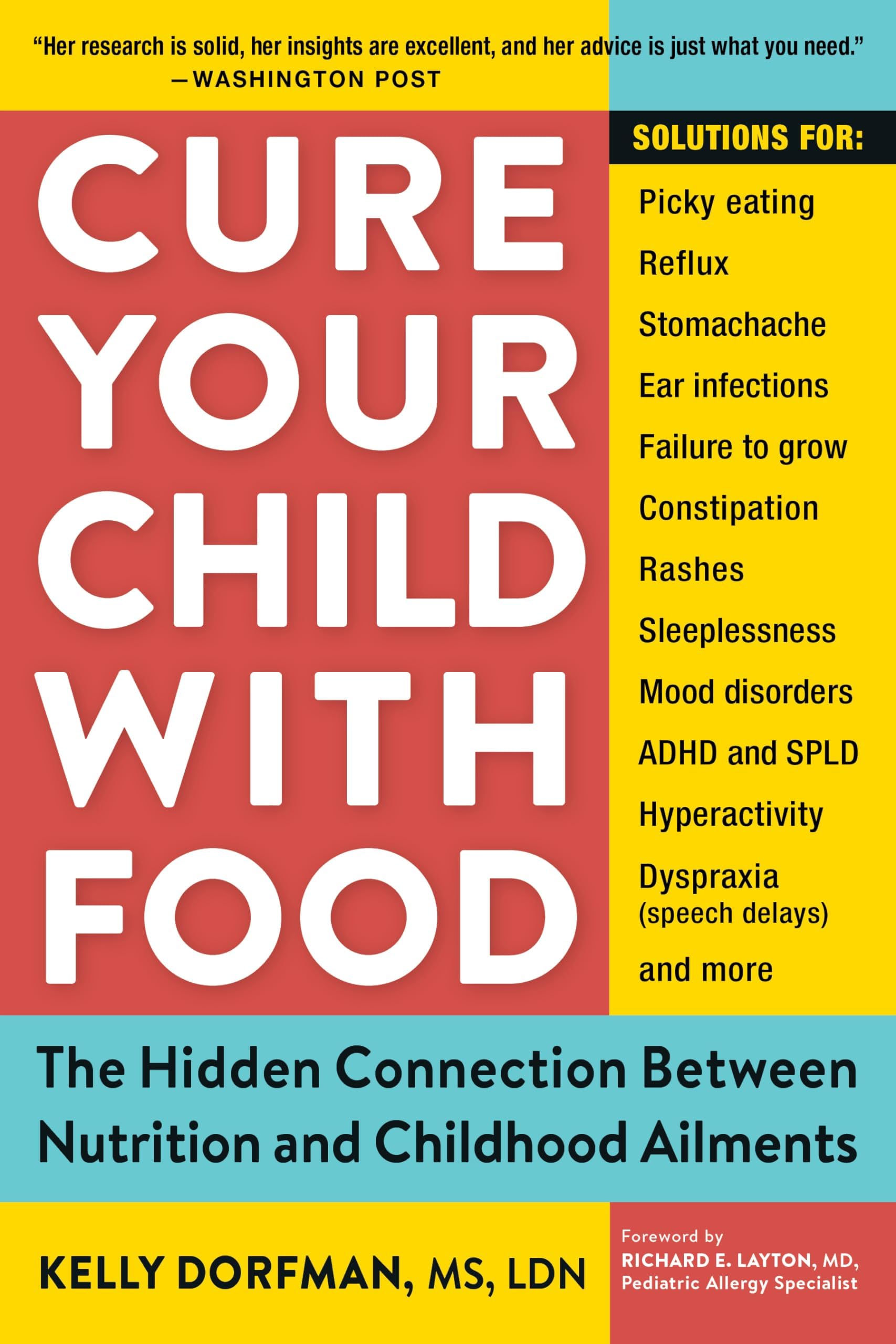
Cure Your Child with Food: The Hidden Connection Between Nutrition and Childhood Ailments
Product ID: 1831247
Buy anything from 5,000+ international stores. One checkout price. No surprise fees. Join 2M+ shoppers on Desertcart.
Desertcart purchases this item on your behalf and handles shipping, customs, and support to Spain.
Grounded in cutting-edge science, Cure Your Child with Food reveals the hidden connections between nutrition and chronic childhood ailments, and gives parents the simple, straightforward solutions they need to help their children thrive. Discover how zinc deficiency can cause picky eating and affect growth. The panoply of problems caused by dairy and gluten. How to cure sleep disorders with melatonin, hyperactivity with magnesium, anxiety with fish oil. Kelly Dorfman, a nutritionist whose typical patient arrives at her practice after seeing three or more specialists, gives parents the tools to become nutrition detectives themselves. She shows how to recalibrate children's diets through the easy E.A.T. program, and how to get kids off drugs—antibiotics, laxatives, Prozac, Ritalin—and back to a state of natural well-being. "In her terrific book, Kelly Dorfman clearly explains how to decipher the clues to nutritional disorders that affect the body and brain. Parents will find it packed with sound advice and useful information." —Maurine Packard, MD, pediatric neurologist A Nautilus Book Award Gold winner. Review: I am no longer overwhelmed at the thought of eliminating gluten and dairy - Since he was an infant, my seven year old son, Henry, has been difficult. He was a colicicky baby, a violent toddler, and recently, an increasingly disruptive student. He also suffers from chronic, year round eczema and constipation, violent outbursts at times and general hyperactivity. When he was four, we put him on the Feingold program. It has been around since the 70s and is known to help kids with ADHD and ODD, which I suspected he had. That program eliminates artificial color, sweetener, flavoring, and petroleum based preservatives. For two years we followed the program exactly, with very little improvement. His eczema got a little better, but was still painful. His behavior improved slightly, but we still got notes home from teachers and he never had a "green" (problem free) day at school. I have long suspected that either dairy or gluten might be something problem for Henry, but the thought of eliminating these from our diet is overwhelming. I know just enough about nutrition and how to read labels to know that either dairy or gluten is hiding in just about everything, in some form. I work full time, I have other kids and I am 8 months pregnant - there are only so many hours in the day! A friend recommended this book, and I downloaded it immediately. I am so very glad I did. Kelly has written this book in such a way that it calmed this overextended mother's fears about the amount of work that will go into an elimination trial. She recommends a six week trial of what you suspect your child's problem food is. She stresses that you don't have to go all out, in most cases. For example, if you are eliminating dairy, don't stress about the small amount of milk that is in bread. if you are eliminating gluten, don't stress about the small amount that is in dressings and sauces (unless you suspect true Celiac disease). This was a huge relief to me! most of the other material I have read in the past insists you eliminate all traces from the diet. I love the way Kelly explains things. over the past decade I have often rolled my eyes at the gluten free movement, thinking of it as just another fad diet. In her book, she explains how wheat processing has changed since the late 90s, truly making the gluten we consume today much harder to digest than it was when I was a kid. She expands this in simple terms, with no hysteria or extremism. I love the supplement advice in this book. She has many practical tips on how to choose a good supplement for your child, what to look for and what quantity of each mineral is most beneficial. She is a big fan of fish oils, and has many great tips for finding one that your child will tolerate that is still effective. She never recommends any particular brand or formulas, which makes it easy to trust her advice, as she has nothing to gain by suggesting certain amounts of any one vitamin or mineral. I haven't begun our elimination trial yet, but after reading this book I am prepared to begin next week. I am going to go back through my highlighted notes and order the supplements I think would most help my child, and fill the family and school in on the plan. I will update this review in May with our results. If you have been considering an elimination trial for your child, but have been dragging your feet like me out of information overload, buy this book! It is an easy read and has no filler, just incredibly insightful, helpful information that she backs up with hard facts and research studies in the back of the book. Review: ESSENTIAL - This is the book to buy your friend who's having a baby, or your friend who's child has medical issues that can't seem to be resolved with their doctors. This is the book to buy yourself, even if you don't have children, but especially if you do. I found that most of the medical issues are focused on newborns to elementary age children but I was actualy able to learn a lot about my own adult health so it can be useful for any age. Dorfman covers constipation, acid reflux, picky eaters, sleep issues, delayed speech, low muscle tone, how to pick a probiotic, and a lot more. She gives specific recommendations on what dietary changes to make or supplements to add, from her years of clinical experience with her patients. Along with her straight-forward answers Dorfman includes just enough of the information as to why a particular supplement is useful, what it's main purpose in the human body is, and how it fits into the bigger picture of overall nutrition. She also includes several "case studies" of her patients, which makes the book more interesting (in my opinion) but if you just want to get straight to her recommendation it's easy to skim over them. I found the book well-organized, although the table of contents could contain more about the medical aliments, symptoms, and advice and less about the names of the children in the case studies (which means nothing to anyone looking for medical advice.) However the index is solid, as is the references. Any minor complaints I have about this book aren't even worth mentioning when compared to how valuable AND ACCURATE the information inside the book is. I wish Dorfman was able to provide more descriptive recommendations for dosing some of the vitamins and supplements, and ideally provide recommendations on which specific brand of supplements to buy, but I'm sure she intentionally avoided that to reduce her legality risk. You know how everyone and anyone nowadays has so many disclaimers to go along with their medical advice telling you obvious things such as "to call 911 if it's a medical emergency" and "ask your doctor before doing anything, including a diet or exercise change." It's amazing Dorfman put so many specific recommendations in her book at all, really, given the medical climate. But one thing really upset me when reading this book. Why don't doctors give nutrition information to patients? Why don't they know this stuff? Why hasn't anyone told me this before!! Why are so many children suffering with medical issues that are safely treatable AND OFTEN CURABLE with a simple vitamin or supplement? I'm afraid I already know the answer. Who is funding the scientific studies on nutrition and dietary changes? Currently, almost no one is. Pharmaceutical companies only fund studies on things they can can patent, and that's why most of the studies that are being done are on pharmaceuticals. Who is funding the studies on the possibly MUCH more effective dietary, exercise, and lifestyle changes that can be made to actual CURE the underlying medical issues rather than mask the symptoms? /end rant Anyway, get the book and do what it says. It's not just for children's ailments as it includes Gluten issues, acid reflux, and sleep issues, and much more.


| Best Sellers Rank | #140,401 in Books ( See Top 100 in Books ) #251 in Children & Adolescent's Health #412 in Nutrition (Books) #1,074 in Parenting (Books) |
| Customer Reviews | 4.6 out of 5 stars 435 Reviews |
L**G
I am no longer overwhelmed at the thought of eliminating gluten and dairy
Since he was an infant, my seven year old son, Henry, has been difficult. He was a colicicky baby, a violent toddler, and recently, an increasingly disruptive student. He also suffers from chronic, year round eczema and constipation, violent outbursts at times and general hyperactivity. When he was four, we put him on the Feingold program. It has been around since the 70s and is known to help kids with ADHD and ODD, which I suspected he had. That program eliminates artificial color, sweetener, flavoring, and petroleum based preservatives. For two years we followed the program exactly, with very little improvement. His eczema got a little better, but was still painful. His behavior improved slightly, but we still got notes home from teachers and he never had a "green" (problem free) day at school. I have long suspected that either dairy or gluten might be something problem for Henry, but the thought of eliminating these from our diet is overwhelming. I know just enough about nutrition and how to read labels to know that either dairy or gluten is hiding in just about everything, in some form. I work full time, I have other kids and I am 8 months pregnant - there are only so many hours in the day! A friend recommended this book, and I downloaded it immediately. I am so very glad I did. Kelly has written this book in such a way that it calmed this overextended mother's fears about the amount of work that will go into an elimination trial. She recommends a six week trial of what you suspect your child's problem food is. She stresses that you don't have to go all out, in most cases. For example, if you are eliminating dairy, don't stress about the small amount of milk that is in bread. if you are eliminating gluten, don't stress about the small amount that is in dressings and sauces (unless you suspect true Celiac disease). This was a huge relief to me! most of the other material I have read in the past insists you eliminate all traces from the diet. I love the way Kelly explains things. over the past decade I have often rolled my eyes at the gluten free movement, thinking of it as just another fad diet. In her book, she explains how wheat processing has changed since the late 90s, truly making the gluten we consume today much harder to digest than it was when I was a kid. She expands this in simple terms, with no hysteria or extremism. I love the supplement advice in this book. She has many practical tips on how to choose a good supplement for your child, what to look for and what quantity of each mineral is most beneficial. She is a big fan of fish oils, and has many great tips for finding one that your child will tolerate that is still effective. She never recommends any particular brand or formulas, which makes it easy to trust her advice, as she has nothing to gain by suggesting certain amounts of any one vitamin or mineral. I haven't begun our elimination trial yet, but after reading this book I am prepared to begin next week. I am going to go back through my highlighted notes and order the supplements I think would most help my child, and fill the family and school in on the plan. I will update this review in May with our results. If you have been considering an elimination trial for your child, but have been dragging your feet like me out of information overload, buy this book! It is an easy read and has no filler, just incredibly insightful, helpful information that she backs up with hard facts and research studies in the back of the book.
M**Y
ESSENTIAL
This is the book to buy your friend who's having a baby, or your friend who's child has medical issues that can't seem to be resolved with their doctors. This is the book to buy yourself, even if you don't have children, but especially if you do. I found that most of the medical issues are focused on newborns to elementary age children but I was actualy able to learn a lot about my own adult health so it can be useful for any age. Dorfman covers constipation, acid reflux, picky eaters, sleep issues, delayed speech, low muscle tone, how to pick a probiotic, and a lot more. She gives specific recommendations on what dietary changes to make or supplements to add, from her years of clinical experience with her patients. Along with her straight-forward answers Dorfman includes just enough of the information as to why a particular supplement is useful, what it's main purpose in the human body is, and how it fits into the bigger picture of overall nutrition. She also includes several "case studies" of her patients, which makes the book more interesting (in my opinion) but if you just want to get straight to her recommendation it's easy to skim over them. I found the book well-organized, although the table of contents could contain more about the medical aliments, symptoms, and advice and less about the names of the children in the case studies (which means nothing to anyone looking for medical advice.) However the index is solid, as is the references. Any minor complaints I have about this book aren't even worth mentioning when compared to how valuable AND ACCURATE the information inside the book is. I wish Dorfman was able to provide more descriptive recommendations for dosing some of the vitamins and supplements, and ideally provide recommendations on which specific brand of supplements to buy, but I'm sure she intentionally avoided that to reduce her legality risk. You know how everyone and anyone nowadays has so many disclaimers to go along with their medical advice telling you obvious things such as "to call 911 if it's a medical emergency" and "ask your doctor before doing anything, including a diet or exercise change." It's amazing Dorfman put so many specific recommendations in her book at all, really, given the medical climate. But one thing really upset me when reading this book. Why don't doctors give nutrition information to patients? Why don't they know this stuff? Why hasn't anyone told me this before!! Why are so many children suffering with medical issues that are safely treatable AND OFTEN CURABLE with a simple vitamin or supplement? I'm afraid I already know the answer. Who is funding the scientific studies on nutrition and dietary changes? Currently, almost no one is. Pharmaceutical companies only fund studies on things they can can patent, and that's why most of the studies that are being done are on pharmaceuticals. Who is funding the studies on the possibly MUCH more effective dietary, exercise, and lifestyle changes that can be made to actual CURE the underlying medical issues rather than mask the symptoms? /end rant Anyway, get the book and do what it says. It's not just for children's ailments as it includes Gluten issues, acid reflux, and sleep issues, and much more.
A**C
🌟🌟🌟🌟🌟 Potentially life changing read
Every parent should read this book. We have been challenged for years how to support my daughter and have been to multiple specialists. This book screamed at me in so many scenarios - and nutrition supplements have not been recommended. I am anxious to start to put Kelly’s protocol in place in hopes of changing my 5yo’s life.
P**A
A bit of a "one trick pony", but still useful
Cure Your Child With Food is a book about nutrition and the impact nutrition has on children's health and growth. It's an interesting book in that it's organized with each chapter meant to be read independently, which leads to a lot of repetition. For instance, my impression of the first half of the book is that she's a one-trick pony. She seemed to have only two solutions for the patients who come to her: get rid of the diary in the diet, and ditch the gluten. Get rid of the American "white diet". That's it. The second half of the book, however, does demonstrate that she doesn't just prescribe one thing for all patients. For instance, one patient came to her with sleep problems and an otherwise healthy diet. Getting her onto 0.5mg of melatonin supplement an hour before bedtime meant she could sleep through the night. She explains why melatonin is a good solution and why it is not addictive. Another patient came to her from a vegetarian background with muscular development issues. Adding choline and fish oil to his diet resolved his issues. She does caution that sometime fish oil by itself isn't enough and that other forms of intervention are required. She diagnosed one case of a patient ingesting pesticide from fruit. She presents interesting theories about why there's been a recent rise in gluten sensitivity (not the same as celiac disease): the amount of gluten in wheat that has been harvested has gone up, due to "improved breeding" and other interventions. She also explains why she recommends fish oil supplements over just adding more fish to the diet: the risk of mercury poisoning. While the book is wordy and repetitive, I found it useful in thinking about children's nutrition. For instance, once you take your kid off infant formula, you should think about where his Omega-3 is going to come from. In our case, it was more palliative than anything else, but it's not quite a "one trick pony" book that the first half of the book presents itself to be. Recommended.
P**S
This book is worth every penny. Highly recommended.
This is such an interesting book. I would explain more but I think you can browse the book online before buying like I did. It is a must read if your child has any of the issues listed on the front cover. My daughter was diagnosed with ASD about 4 months ago at age 3. The developmental pediatrician pretty much made my husband and I feel like there was nothing we could do for our child except get ABA therapy and Occupational therapy. He discouraged special diets and supplements beyond the standard RDA allowance found in children's multi-vitamins (and other things like chelation). What a crock! After reading this book, I realized my daughter may have been diagnosed with ASD but the reason she didn't have receptive language is because she has Speech Dyspraxia as described in this book. Anyhow, the author notes that this is an issue for children who don't get enough essential fatty acids and lists three that will help as well as the dosage level. Its titled under, The Best Dyspraxia Program Ever. She also notes that speech therapy won't get you very far by itself. But if you add the essential fatty acids she recommends through supplements or the food it will improve speech greatly. I had been using one of the EFA's as a supplement but not the other two. When combined it worked really well. My daughter was finally able to get words out to ask questions. Before she really struggled. Yesterday while I was washing the dishes, she tugged on the back of my shirt and asked me, "Mommy, can I paint?" and she now responds to questions with one to two word answers routinely and sometimes a short sentence. The gains have been slow but steady. She did not call us mommy or daddy 4 months ago before adding essential fatty acids. I was really impressed with this book. Its worth the money.
A**Y
Full of good information
I read this book in about 3 days because it’s really interesting and full of good information. I will say that a lot of the general info I already knew, but it does go into more specifics about what kind of deficiencies your child (or you) may be having, etc.
M**.
EVERY PARENT NEEDS THIS BOOK!
After reading this book myself (I'm a grandmother now) I suggested it to my children and gave my copy to a daughter so she could check it out before buying her own copy. This information is VITAL, educating parents about the nutritional needs of their children, needs that, if left unmet, may never be able to made up! I was lucky being raised by first-generation city dwellers who still held on to many of their frugal farming habits, raising their own vegetables, denying us the "joys" of fast food and daily sugary treats, and making sure we ate foods we NEEDED, not just those we "liked". I raised my children in much the same way, but the pressure today is different, and many parents need the information and support this book provides to give their children a solid nutritional start in life - something that will serve as the very foundation of a healthy body for as long as they live. There is no better gift!
M**W
Quality input = Quality Output!
I bought the book out of desperation because I didn't know what else to do. I noticed my child was becoming easily angered, moody, defiant and anxious, on top of constantly having ear infections and a runny nose. Note after Note from school letting me know my toddler wasn't listening to his teachers and he was throwing violent tantrums I was like.."that's it" I read so many stories that reminded me of my little one and we changed his diet, implemented the recommendations and the behavior is finally what I consider a normal calm and consistent behavior. He is still happy and friendly but finally calm and mostly compliant and the best part, he's eating better, sleeping better and no longer taking antihistamines. No more runny nose, and the teachers send notes about his calmer demeanor have me feeling at ease. I love love love and am so thankful for this book.
R**H
kids Qua Nutrition clinic loves this book
As one of India's leading Nutrition clinics, we use this book as a training guideline for kids nutrition plans. At Qua Nutrition we actually upgraded our nutrition supplements matrix with help from this book
N**T
Excellent book , every parent should read
Real food and real nutrition can certainly heal many illnesses or at the very least make one feel much better physically and mentally , highly recommend
S**A
This book has changed our son's life!
Such a shame there is no German translation. I cannot reccomend this book more! Two Kindergartens wanted us to get our son tested for psychological issues - he was sometimes so crazy at kita and had difficulty making friends as a result - knocking down there towers didn't make him popular. He would switch lights on on off and be constantly challenging. At home he was much easier to handle, but we'd also got so used to his reastlessness that it was normal. We got the usual - try occupational therapy (ergotherpie) tips - but other than coordiation problems nothing was found. Then the therapist went to his kita (preschool) and was quite shocked and diagnosed sensory processing disorder (spd). I went out and bought a number of books and somehow stumbled on this one and ordered it too for good measure. What a life saver!!! Our son's problem turned out to be solved - not by Dorfmann's recommendations for spd but rather through a different chapter where she recommended trying a gluten elimination diet - and commented 'the apple doesn't fall far from the tree'. That got me thinking that my mother has ibs and difficult digesting bread and also had me on a gluten free diet as a child because I wasn't putting on weight and also often had digestive problems. Noone in the family had heard of neurological problems connected to gluten. Anyway, we cut out gluten for 6 weeks. The change was gradual and we just kept putting the better situation down to other things - the new kindergarten our therapist suggested, a new friend, less stress at home since I'd settled into a new job etc.. Then we decided to reintroduce gluten, still thinking it wouldn't change much. How wrong we were!!!! Within a couple of days our son was totally restless, grabbing things every two minutes, not able to sit still for a second, much naughtier both at kita and at home. It was incredible - as I said it didn't happen overnight, but in the end even my sceptical husband had to admit the change was dramatic. We hadn't been able to see before how difficult/restless he was because we had got so used to the situation. I therefore, can highly recommend reading all of this book and not just the specific chapter you think relates to your child. Many symptoms/ behaviour patterns are similar and hard to tell apart. What I also recommend is changing just one thing at a time, so you know later what has had an effect. We wanted to introduce fish oils and I'm glad we decided not to do so immediately, as we then would not know what effext came form removing gluten, and what from adding fish oils. I would recommend all parents of ADHD/ SPD kids to just try a gluten free diet for 6 weeks. If it doesn't work than also cut out cassein - i.e dairy next and then wait and see. It won't work for everyone, but they are the two chief irritants and you can then rule them out.
G**E
Worth a read
An easy read with useful case studies. Helped to narrow a rash causing food intolerance in my 5 year old. We are now rash free. Useful vitamin tips. Certainly worth a read. Thank you, author.
E**S
Great read
Everyone who has a child with issues should read this. I would like to have seen more treatment plans though.
Trustpilot
1 week ago
2 weeks ago