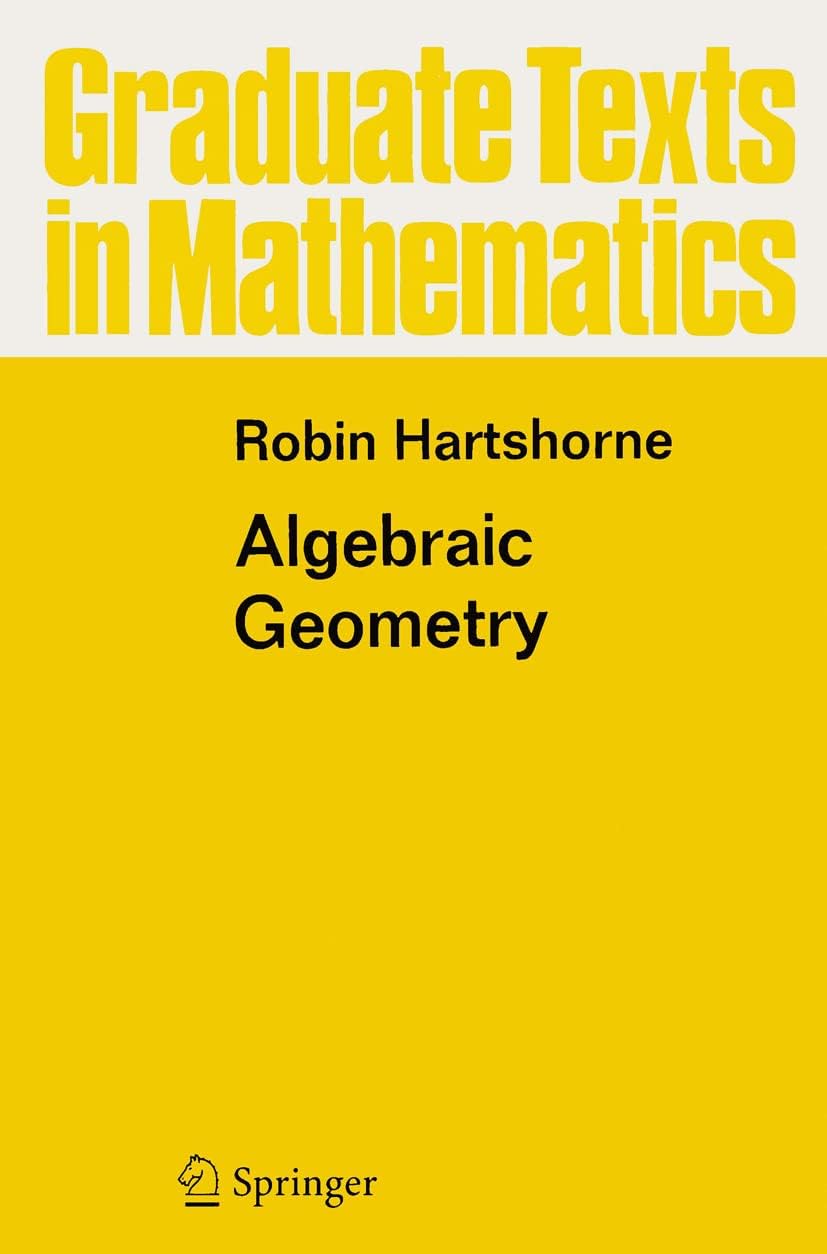
Algebraic Geometry: 52 (Graduate Texts in Mathematics, 52)
Product ID: 181938084
Buy anything from 5,000+ international stores. One checkout price. No surprise fees. Join 2M+ shoppers on Desertcart.
Desertcart purchases this item on your behalf and handles shipping, customs, and support to Spain.
Robin Hartshorne studied algebraic geometry with Oscar Zariski and David Mumford at Harvard, and with J.-P. Serre and A. Grothendieck in Paris. After receiving his Ph.D. from Princeton in 1963, Hartshorne became a Junior Fellow at Harvard, then taught there for several years. In 1972 he moved to California where he is now Professor at the University of California at Berkeley. He is the author of "Residues and Duality" (1966), "Foundations of Projective Geometry (1968), "Ample Subvarieties of Algebraic Varieties" (1970), and numerous research titles. His current research interest is the geometry of projective varieties and vector bundles. He has been a visiting professor at the College de France and at Kyoto University, where he gave lectures in French and in Japanese, respectively. Professor Hartshorne is married to Edie Churchill, educator and psychotherapist, and has two sons. He has travelled widely, speaks several foreign languages, and is an experienced mountain climber. He is also an accomplished amateur musician: he has played the flute for many years, and during his last visit to Kyoto he began studying the shakuhachi. Review: Très bon livre et qualité très bien - Un très bon livre pour les géomètres. Qualité très bien, lisible. C’est un peu cher, mais vu que c’est pour une utilisation à vie, je pense que ça mérite. Review: Do all the exercises! - This might be one of the most difficult books on the subject matter, and is definitely the most difficult book I read, but if you put in the hard work into it, do all the exercises, you will learn a lot from it. One really cannot blame Hartshorne for the difficulty of this book. Algebraic geometry is a hard topic that requires a large list of prerequistes. If you want to learn algebraic geometry on the level of actual mathematicians then there is no way around the topics in this book. Hartshorne made it possible for the rest of the mathematical community to actually learn this topic, which before him was highly inaccessible. The disadvantage is that much motivation is non-existent. However, if you learn the vocabulary and basic theorems of this topic, then you can try to look for motivations else where. Perhaps, this is a backwarks way of learning the subject but it is very direct and to the point. The advantage is that this book slaps you over the face with all the technical stuff. It is not wordy and to the point. The exercises are helpful and I learned way more from them than reading the actual text. Perhaps a possible compromise to Hartshorne is to learn AG from other sources and then do all of his exercises. I do wish that Hartshorne did a better job on Chapter 1. It is not necessary for the remainder of the text but it helps develop intuition. A problem with Hartshorne's approach is that he defines varieties living in some affine space. This is a bit annoying, he should have defined them with reference to an ambient space (just like the definition of "manifolds" in differential geometry, no reference to an ambient space). I think this would have made the introduction of sheaves more natural. Just a disclaimer. Make sure your basic algebra is solid, especially commutative algebra, and be well-versed in point-set topology.
| Best Sellers Rank | 469,024 in Books ( See Top 100 in Books ) 5,731 in Popular Mathematics 19,486 in Scientific, Technical & Medical |
| Customer Reviews | 4.6 out of 5 stars 104 Reviews |
N**U
Très bon livre et qualité très bien
Un très bon livre pour les géomètres. Qualité très bien, lisible. C’est un peu cher, mais vu que c’est pour une utilisation à vie, je pense que ça mérite.
G**.
Do all the exercises!
This might be one of the most difficult books on the subject matter, and is definitely the most difficult book I read, but if you put in the hard work into it, do all the exercises, you will learn a lot from it. One really cannot blame Hartshorne for the difficulty of this book. Algebraic geometry is a hard topic that requires a large list of prerequistes. If you want to learn algebraic geometry on the level of actual mathematicians then there is no way around the topics in this book. Hartshorne made it possible for the rest of the mathematical community to actually learn this topic, which before him was highly inaccessible. The disadvantage is that much motivation is non-existent. However, if you learn the vocabulary and basic theorems of this topic, then you can try to look for motivations else where. Perhaps, this is a backwarks way of learning the subject but it is very direct and to the point. The advantage is that this book slaps you over the face with all the technical stuff. It is not wordy and to the point. The exercises are helpful and I learned way more from them than reading the actual text. Perhaps a possible compromise to Hartshorne is to learn AG from other sources and then do all of his exercises. I do wish that Hartshorne did a better job on Chapter 1. It is not necessary for the remainder of the text but it helps develop intuition. A problem with Hartshorne's approach is that he defines varieties living in some affine space. This is a bit annoying, he should have defined them with reference to an ambient space (just like the definition of "manifolds" in differential geometry, no reference to an ambient space). I think this would have made the introduction of sheaves more natural. Just a disclaimer. Make sure your basic algebra is solid, especially commutative algebra, and be well-versed in point-set topology.
C**N
Still the standard book to learn schemes
Well printed and still the best book to learn schemes and sheaf cohomology through its exercices.
し**ん
よかった
よかった
T**O
Fine
It might be due to the scan and reprint, clearly the quality is not as good as the original print.
Trustpilot
4 days ago
3 days ago