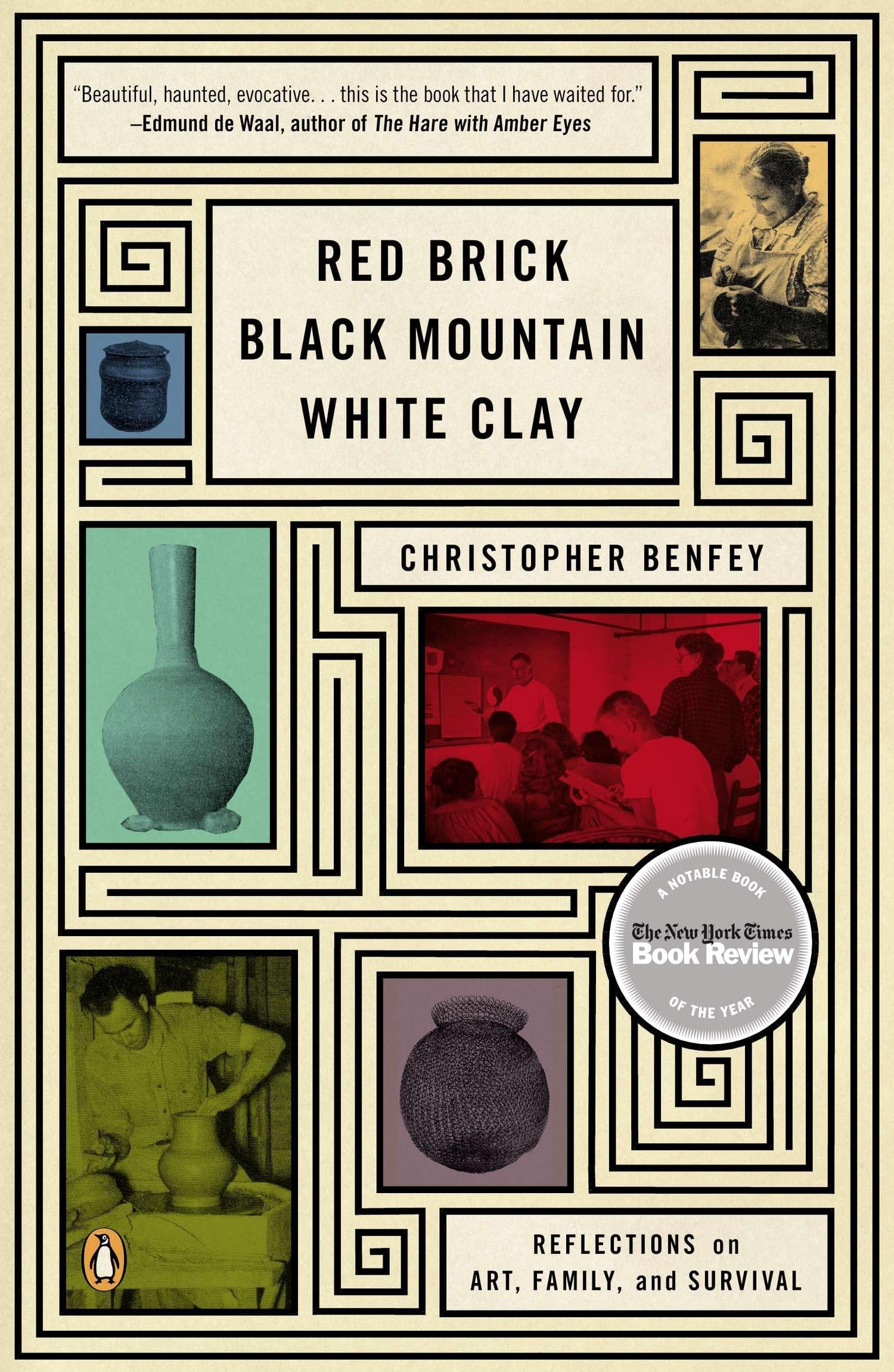
Red Brick, Black Mountain, White Clay: Reflections on Art, Family, and Survival
Product ID: 16641410
Buy anything from 5,000+ international stores. One checkout price. No surprise fees. Join 2M+ shoppers on Desertcart.
Desertcart purchases this item on your behalf and handles shipping, customs, and support to Spain.
Red Brick, Black Mountain, White Clay: Reflections on Art, Family, and Survival [Benfey, Christopher] on desertcart.com. *FREE* shipping on qualifying offers. Red Brick, Black Mountain, White Clay: Reflections on Art, Family, and Survival Review: Earlham, Black Mountain, clay as a craft or clay as object d’art, it’s all here - What an amazing quirky book, I was not expecting it at all. Earlham College/Richmond, Indiana, Black Mountain, Anni & Josef Albers, clay deposits in North Carolina, a year in Japan with the folk potters, so many correlations. So many parallels for me & my husband as craftsman butting up against academia and art. Benfey has strung it all together and made it entertaining. I’d never have picked up this book from the title, but the title does cover it all. A fellow Earlhamite suggested the book otherwise I’d probably never looked at it twice. Review: Clay and People - This book is a fascinating interweaving of North Carolina family history, and the development of North Carolina pottery. It is a fascinating and informative read that covers more than two centuries.
| Best Sellers Rank | #914,400 in Books ( See Top 100 in Books ) #285 in Biographies of Artists, Architects & Photographers (Books) #370 in Arts & Photography Criticism #766 in Art History (Books) |
| Customer Reviews | 4.3 4.3 out of 5 stars (48) |
| Dimensions | 5.59 x 0.79 x 8.39 inches |
| Edition | Reprint |
| ISBN-10 | 0143122851 |
| ISBN-13 | 978-0143122852 |
| Item Weight | 10 ounces |
| Language | English |
| Print length | 304 pages |
| Publication date | February 26, 2013 |
| Publisher | Penguin Publishing Group |
K**K
Earlham, Black Mountain, clay as a craft or clay as object d’art, it’s all here
What an amazing quirky book, I was not expecting it at all. Earlham College/Richmond, Indiana, Black Mountain, Anni & Josef Albers, clay deposits in North Carolina, a year in Japan with the folk potters, so many correlations. So many parallels for me & my husband as craftsman butting up against academia and art. Benfey has strung it all together and made it entertaining. I’d never have picked up this book from the title, but the title does cover it all. A fellow Earlhamite suggested the book otherwise I’d probably never looked at it twice.
M**L
Clay and People
This book is a fascinating interweaving of North Carolina family history, and the development of North Carolina pottery. It is a fascinating and informative read that covers more than two centuries.
M**A
Microhistory of Benfey’s family and American Pottery tradition
RB,BM ad WC is the latest of Christopher Benfey’s books. I read one of his books every summer and it’s like giving myself a present of a cultural romp through…. Well at the beginning the Gilded Age and Japan, then the Amherst intellectual club and now…. Pottery tradition! Who would read a book on that if not an expert? Well you will be surprised of how interesting this topic actually is. Among Benfey’s books this one has a particular aspect: that of being based on his own memoires. It is also the history of let’s say “clay” in the American cultural tradition. Benfey’s family has a double ascendency, on one side of North Carolina bricklayers, on the other side from European immigrants to America who with their artistic qualities influenced deeply the American art tradition tied to the Bauhaus movement. Distant relatives at the end were somehow interested also in the “white clay” tradition which is the basis for porcelain production. These three “paths” serve as an inspiration for the three section book, which however doesn’t stick all the time to the traced itinerary but “serendipitously” meanders among references, people, artists, many artists and traditions….. and religion! Because religion is, or was at least in those times, a founding aspect of relations and behaviors. Here we are talking about Quakers, with their simplicity and straightforwardness of which the CB is very proud of. Red Brick is the story of the iron rich clay used to build bricks at the feet of the Appalachian mountains and of people connected to this tradition together with CB grandfather: Levi Coffin the slave-saver, Randall Jarrell the poet, the Jugtown pottery with the Busbees, the Owens, the Japanese influence on American pottery, Mark Hewitt. But it is also the story of the parents and relatives of Benfey’s father from Germany among whom the renowned publishers Ullsteins, Theodor Benfey the linguistic and inspirer of the word “serendipity”, through his transcription of the tale of “The Three Princes of Serendip”. Black Mountain is the story of the 24- year Black Mountain College community illuminated by the experience of the Albers (also Benfey’s relatives) Anni and Joseph and their many friends and acquaintances: Diego Rivera, Oskar Kokoschka, John Cage, Merce Cunningham and Buckminster Fuller and many others. The inspiration of the German Bauhaus passed directly into the American Culture (fusion of form and function and honest use of materials) gaining in its passage relatedness and contrast. Just mentioning famous students (Ruth Asawa, Karen Karnes, David Weinrib, Rauschenberg, Charles Olson, etc etc), Benfey drags us through modern American art, leaving tidbits of knowledge and curiosity to further explore. White Clay is a branched essay on American kaolin, the clay used for porcelain, not the more humble earthenware and bricks spoken about till now. It stems from the exploration by Thomas Griffith, Wedgewood’s agent in search of white clay for his master’s factories, to America and the Cherokee Indians who in the late 18th century were the keepers of the secret ingredient. Even in this historical passage Benfey has a relative, William Bartram that together with Andrew Duché (probably the first to make porcelain in US with however no success) made it into history books. William Bartram independently of his own fame seems to have been the inspirer of some of Coleridge’s poems. The book ends with a hasty description of Whistler’s mother’s portrait and the painter’s fascination with pottery and many cross references to Benfey’s interest in this topic. The book makes a quick read, but if you decide to deepen the knowledge on the mentioned characters the question changes a lot. Compared to the Author’s other books, I think it is less polished and meditated, however the compulsion of writing a family memoire must have been great and a tingling of emotion runs through this work. The comparison with Edmund De Vaal’s “The Hare with Amber Eyes” is a must and probably RB, BM and WC follows De Vaal’s stereotype even if De Vaal himself has been inspired by Benfey’s books and essays as he openly recognizes. One fact that disturbed me a bit is the tendency of the Author to transpose into history all he narrates. We have the impression episodes he describes took place many years ago, while the history he is talking about is really very recent. I write from a European perspective where history is so long, so even that close to us seems recent, but the American outlook is probably different. One of WB phrases has captured my imagination as descriptive of CB book: “some of these steep soft rocky banks or precipices seem to be continually crumbling to earth, and in these moldering cliffs I discovered veins or strata of most pure and clear white earth”. Some episodes as pieces of shining mica glitter in front of our eyes on a background of much marginal information.
A**R
great book
I got this from the library and read it and realized I needed this book. It has the kind of combination of personal story and fact that work so well with creative nonfiction. It also has information I didn't know. I've made a fair number of pots and the information on clay and clay formations was fascinating. The same can be said in the stories and history of Black Mountain. Christopher Benfey explores his Quaker/Jewish heritage with a light hand and a sense of humor and wonder.
G**S
Black Mountain College and Kaolin
This book by Christopher Benfey is well written in an academician’s way. It is more about Mr. Benfey’s erudition in the arts and history of Black Mountain College in Black Mountain, NC and its connection to the pottery tradition of NC and the Kaolin (white clay) deposits in South Carolina, North Carolina and north Georgia. Benfey has family connections with some of the artists who used to make up the faculty of Black Mountain College before its closure in 1957. He follows the careers of some of these people as the move from NC to New York and New England. I am familiar with the pottery traditions of North Carolina, western Massachusetts and Vermont since I learned to make pottery in Amherst and in Cullowhee in the western mountains of NC. I also observed small traces of kaolin on my land in Caney Fork, NC. So, I was well entertained by this book, but it can give you “whiplash” as it jumps from one small vignette to the next in a disjointed, and seemingly incomplete story promised by the title. These vignettes are crafted by a man with a good command of story telling, but the disjointedness of their juxtaposition is disappointing. A part of the story that is untold is the Red Brick portion centered on the Cherokee people of Muscogee, GA and Muskogee, OK. And of interest would be the present day use of the White Clay (kaolin) in food products such as bread. If you know part of the story already, then you can manage to knit it together for your entertainment. I recommend it to you, as it was recommended to me by a friend from Amherst, MA who remembered my interest in pottery.
N**R
Wonderful book.
A beautiful, soul nourishing book. It appealed to me as an artist and as someone with an interest in history. A lovely gift from Christopher Benfey.
J**P
Wonderful take on a little known part of of our Arts and Crafts history
Benfey makes wonderful family connections in a factual book that is neither too technical nor too sentimental. A really good read.
S**O
Author mines rich vein of family, art, history, ambition
My daughter, Emily, recommended this book as a good read. She was so right! It's a strange and sinuous journey which starts in Central Indiana and weaves and winds its way through the Eastern U.S., Mexico, Europe and England, Asia, and back, adding insight and information at every twist or turn. Benfey makes it personal by tying some of the 20th centuries most influential visual arts movements to his relatives, letting artistic and personal curiousity drive the narrative rather than some atavistic need for personal aggrandizement. The characters and moments he unearths in his intellectual quest are memorable: the Bartrams, explorers, naturalists, the Black Mountain arts movement, and much more. My only regret is that I bought this as a Kindle book and therefore cannot share it with others. Sally Vallongo
D**D
Delivered as promised.
Trustpilot
3 weeks ago
2 months ago