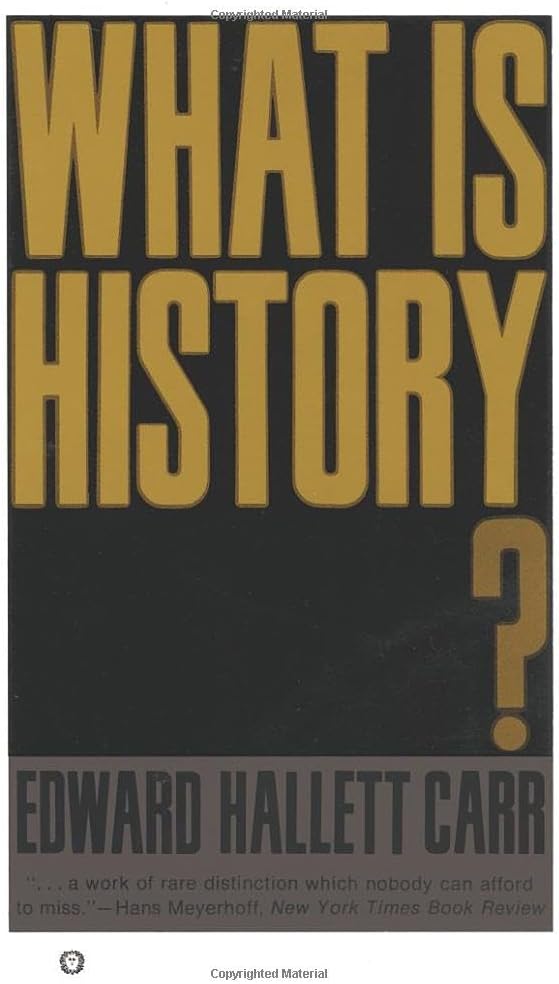
What Is History?
Product ID: 16557030
Who is to say how things really were? In formulating a modern answer to the question 'What is History?' Professor Carr shows that the 'facts' of history are simply those which historians have selected for scrutiny. Millions have crossed the Rubicon, but the historians tell us that only Caesar's crossing was significant. All historical facts come to us as a result of interpretative choices by historians influenced by the standards of their age. Yet if absolute objectivity is impossible, the role of the historian need in no way suffer; nor does history lose its fascination. With lucidity, Carr casts a light on the proper function of the historian and the vital importance of history in modern society. “This is an admirably stimulating and intrepid book, a bold excursion into a region of central importance where most contemporary philosophers and historians, unaccountably, either fear or disdain to tread.”—Isaiah Berlin, New Statesman Review: Very interesting take on history. - The book arrived timely and in pristine condition. Haven't read it completely, but so far it is a very interesting take on history. Review: What is History? - . This superb old book is a thoughtful attempt to define the study of history and historiography. Carr's basic thesis is that people's opinions change throughout their life times, are maleable, and depend on what is going on in the world at any given moment. The following quote from the book sums up the author's thesis nicely: . ....."I am fully aware that, if anyone took the trouble to peruse some of the things I wrote before, during, and after the war, he would have no difficulty at all in convicting me of contradictions and inconsistencies at least as glaring as any I have detected in others. Indeed, I am not sure that I should envy any historian who could honestly claim to have lived through the earth-shaking events of the past fifty years without some radical modifications of his outlook. My purpose is merely to show how closely the work of the historian mirrors the society in which he works. It is not merely the events that are in flux. The historian himself is in flux. When you take up a historical work, it is not enough to look for the author's name on the title page: look also for the date of publication or writing--it is sometimes even more revealing. If the philosopher is right in telling us that we cannot step into the same river twice, it is perhaps equally true, and for the same reason, that two books cannot be written by the same historian." (Carr 51-52) . The book was written in 1961 but is bright and sparkling and applicable to our own generation's thinking and perceptions. Kim Burdick Stanton, Delaware
| Best Sellers Rank | #157,402 in Books ( See Top 100 in Books ) #69 in Historiography (Books) #79 in Education Research (Books) #150 in Historical Study & Teaching |
| Customer Reviews | 4.6 out of 5 stars 655 Reviews |
U**M
Very interesting take on history.
The book arrived timely and in pristine condition. Haven't read it completely, but so far it is a very interesting take on history.
K**K
What is History?
. This superb old book is a thoughtful attempt to define the study of history and historiography. Carr's basic thesis is that people's opinions change throughout their life times, are maleable, and depend on what is going on in the world at any given moment. The following quote from the book sums up the author's thesis nicely: . ....."I am fully aware that, if anyone took the trouble to peruse some of the things I wrote before, during, and after the war, he would have no difficulty at all in convicting me of contradictions and inconsistencies at least as glaring as any I have detected in others. Indeed, I am not sure that I should envy any historian who could honestly claim to have lived through the earth-shaking events of the past fifty years without some radical modifications of his outlook. My purpose is merely to show how closely the work of the historian mirrors the society in which he works. It is not merely the events that are in flux. The historian himself is in flux. When you take up a historical work, it is not enough to look for the author's name on the title page: look also for the date of publication or writing--it is sometimes even more revealing. If the philosopher is right in telling us that we cannot step into the same river twice, it is perhaps equally true, and for the same reason, that two books cannot be written by the same historian." (Carr 51-52) . The book was written in 1961 but is bright and sparkling and applicable to our own generation's thinking and perceptions. Kim Burdick Stanton, Delaware
K**E
Good intro to historiography
It’s a great introduction to the discipline of history for newbies without getting too technical or philosophical.
F**Y
Valuable perspective
I remember this book from when I was in college and have spoken about it a lot over the years. I didn't realize I gave my copy to a friend so I ordered another one. Fabulous book!
L**M
A classic on philosophy of history
E. H. Carr's classic gives a precise and succinct analysis of the nature of History, both as a discipline and a way of thinking. His rejection of empiricism is persuasive and constructive to the understanding of historical views. The key theme of progress (or changes, in a more neutral way) is undoubtedly the pillar of History. Carr's call for a more inclusive approach to history is remarkable. In my opinion, his alarming warning on the parochialism prevalent in Britain greatly improved the perception of other peoples and cultures in the English-speaking world. A must-read for all.
,**.
Great read
Got this for a class and I thought I would return it but end up being one of my favorite books
C**S
Does History have meaning?
Though published more than forty years ago, this book has contemporary relevance. A series of lectures given by the author at Cambridge University, it covers topics such as "The Historian and His Facts" and History as progress." The author rejects the notions of Hegal and Marx that history automatically has transcendent meaning. On the other hand neither it it series of random events. He tells us that all history is rinsed through the background filters of those who write it. Therefore "revisionist history" is not an occasional accident produced by over zealous observers, it is the only kind of history available to us. This a good read, perhaps marred slightly by over generalizations. The group discussion in which I participated was simulating.
J**T
If your interested in how historical writing is influence by its own history this is the book for you.
Edward Hallet Carr makes a great contribution to meta-history by producing this book. He uses examples from antiquity until his contemporary time to critique the way the craft of history has been undertaken. He offers great examples and a great structure for both the book and his argument. I had to read this for a graduate class but had I known it was as good as it was I would have picked it up well beforehand.
S**E
ottimo libro
avevo letto questo libro negli anni '70 nella versione italiana, è stata un'ottima esperienza quella di rileggerlo in edizione originale con la coscienza dell'evoluzione del contesto storico, delle sue predizioni in parte avveratesi in parte no. Un classico da leggere per ogni seria cultura sul metodo storiografico. Ho apprezzato le citazioni di Benedetto Croce e del suo pensiero sulla Storia.
B**D
Envoi rapide livre bon état comme prévu
Envoi rapide, livre d'occasion en bon état comme prévu. Parfait
F**A
Satisfied with the service
The book was in the description it was promised and within timefrime it was promised. Thank you for your services!
Z**2
良い商品でした。
良い商品でした。
L**S
Livro muito interessante para quem se interessa por história
Para além da qualidade do texto em si que fica ao critério de quem o lê devo dizer que a qualidade da impressão tipográfica é má em muitas páginas devido ao excesso de tinta o que dificulta a leitura tendo em conta de que se trata de um livro de pequenas dimensões. Tão cedo não volto a comprar um livro da Penguin online.
Trustpilot
1 month ago
2 weeks ago