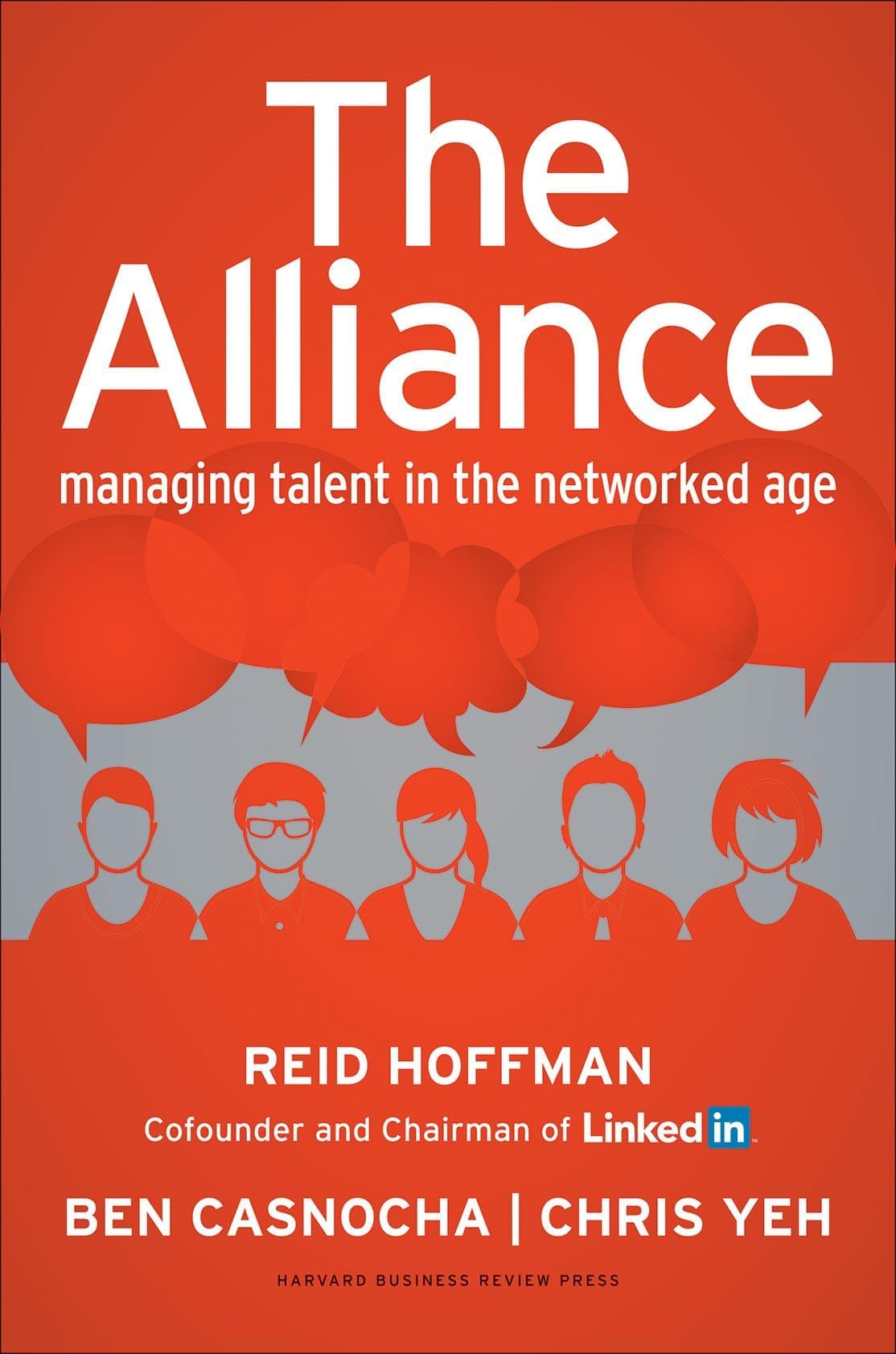
The Alliance: Managing Talent in the Networked Age
Product ID: 1652978
Buy anything from 5,000+ international stores. One checkout price. No surprise fees. Join 2M+ shoppers on Desertcart.
Desertcart purchases this item on your behalf and handles shipping, customs, and support to Spain.
The New York Times Bestelling guide for managers and executives. Introducing the new, realistic loyalty pact between employer and employee. The employer-employee relationship is broken, and managers face a seemingly impossible dilemma: the old model of guaranteed long-term employment no longer works in a business environment defined by continuous change, but neither does a system in which every employee acts like a free agent. The solution? Stop thinking of employees as either family or as free agents. Think of them instead as allies . As a manager you want your employees to help transform the company for the future. And your employees want the company to help transform their careers for the long term. But this win-win scenario will happen only if both sides trust each other enough to commit to mutual investment and mutual benefit. Sadly, trust in the business world is hovering at an all-time low. We can rebuild that lost trust with straight talk that recognizes the realities of the modern economy. So, paradoxically, the alliance begins with managers acknowledging that great employees might leave the company, and with employees being honest about their own career aspirations. By putting this new alliance at the heart of your talent management strategy, you’ll not only bring back trust, you’ll be able to recruit and retain the entrepreneurial individuals you need to adapt to a fast-changing world. These individuals, flexible, creative, and with a bias toward action, thrive when they’re on a specific “tour of duty”—when they have a mission that’s mutually beneficial to employee and company that can be completed in a realistic period of time. Coauthored by the founder of LinkedIn, this bold but practical guide for managers and executives will give you the tools you need to recruit, manage, and retain the kind of employees who will make your company thrive in today’s world of constant innovation and fast-paced change. Review: Reframing the employer/employee relationship. - "We're happy to have you on the team. We expect a great future. Now, please sign this form that says we can fire you at any time for any reason." The classic model for employment is gone. The days of job security are no more. While there are benefits to employees being able to easily switch companies, it has slowly created a culture with a problem. The employee/employer relationship has turned adversarial. Employers are trepidatious to support employee growth because they fear employees are just waiting to hop ship. Employees want to look out for themselves, and have a problem with loyalty when they know they're expendable. The Alliance addresses these issues and provides a solid foundation for how to reframe the relationship. Yes, spending your full career with a company is no longer likely. That doesn't mean there shouldn't be a lifetime relationship between companies and their employees. The Alliance explains how these can be mutually beneficial. Companies should accept that most employees are only there for a short time. "Tours of Duty" are a good way to make sure that both the company and employee get the most of their time at the company. Employee networks are becoming more and more valuable. Companies need to be harnessing these to help both themselves and their employees. Finally, companies need to think about how they'll maintain contact with their employees if and when they leave the company. If any of these sound like issues you've seen as an employer or employee, you definitely need to pick this book up. It's a quick read with a lot of pragmatic advice. It's time we start changing the employment paradigm, and I hope the Alliance catches on. Review: That is true in good times and in bad - People with talent have more options. That is true in good times and in bad, for high-level skilled workers and for those with low-level skills. In almost every country in the world, staff can be “let go.” This can be a protracted process, or a simple one. If the company does not need or want you, your employment will be terminated. The employees are expected to be loyal and committed, and to work in the best interests of the company until they retire. This is despite the clear but rarely ever stated, understanding that your job might disappear as a result of a restructuring, or a decree from a boardroom in another country. Should you, in turn, inform you company that you have accepted an offer of better employment, you might be asked to leave immediately. This is instead of working out your notice period, because you cannot be trusted to work out your time in the best interests of the company. After all, you have left before your retirement. No thoughtful person should be unaware of this imbalance – the employee must commit, but the company cannot be expected to. The days when “employers and employees committed to each other, for better or worse, through bull and bear markets, until retirement did them part,” are over. Loyalty is scarce, long-term ties are rare. The past will not, and cannot return The Alliance, Hoffman’s latest book, addresses this problem. You cannot get a person’s talent working for the good of the company if you do not have their commitment. Employees who fail to fully invest in their current positions are constantly scanning the marketplace for new opportunities. What we can expect, and what the book sets out to sketch is a framework that encourages a different employer-employee relationship. Reid Hoffman is an internet entrepreneur, venture capitalist, and author, best known as the co-founder of LinkedIn, The Alliance describes a relationship based on both employer and employee adding value to each other: “Help make our company more valuable, and we will make you more valuable.” This is a team where mutually adding value secures the bond. It is not a family were commitment is unchanging. No one asks their child to leave because she scored an “F” in biology, The Alliance has already taken root in the high-tech, start-up community of Silicon Valley. The secret of success in Silicon Valley is really about the way the companies build alliances with their people. Talent is Silicon Valley’s most valuable resource, and they treat this resource accordingly, explains Hoffman. Most people will know about the geniuses of the Valley, but few about it’s management practices. Employers use the alliance to recruit, manage, and retain incredibly talented, entrepreneurial employees. Hoffman uses the term “Tour of Duty” to describe how employment is understood. The term comes from the military where a tour of duty refers to a single specific deployment. A soldier will see a number of tours of duty in his career, each for a predetermined time, and to accomplish a specific task. One might be to assist with the evacuation effort after the earthquake, and another to secure a hospital in a remote area. In the business context, a tour of duty is a clearly defined task to be achieve within a finite period of time. It is an ethical, reciprocal, commitment between employer and employee. The company commits to honouring its obligations to the employee during this tour of duty, and the employee commits to honouring the needs of the company for this finite period. The expectation of value from each party are made explicit, and are accepted by the other. You, the employee will be exposed and trained in the merchandising methods of the firm for the next 18 months, and will learn about our state-of-the-art systems. This, we agree is something necessary for the career you desire to pursue, here or somewhere else. You will fulfil your task thoughtfully, and will look for ways the company can improve their systems and alert us to new possibilities. There are three general tours of duty. The most basic one is the Rotational Tour. This is a fairly structured tour designed for entry-level staff, often to get acquainted with the company and to be exposed to various facets of the business they might wish to contribute to. Google, for example, puts recent college graduates through a structured, twenty-seven-month Rotational tour that exposes them to three different roles each for nine months. Both the staff member and the company benefit from this fixed term commitment. The second level tour of duty is the Transformational tour. This tour will be tailored to the specific needs of the company, and the specific aspirations of the employee. It is called “Transformational” because it is intended to transform both the company and the career of the employee. An initial transformations tour will last between and two and five years. Violating the commitment during what is essentially a short period, would not be in the interests of any mature employee. Who would hire talent that did not honour commitments made, and who would choose to work for an organization that does not honour commitments made to employees? The third tour of duty is only offered to those employees who are a perfect cultural fit with the organization. The employee “sees working at the company as his last job, and the company wants the employee to stay until he retires.” This is called the Foundational tour of duty. Mutual respect underlies this alliance. Expectations are required of both sides, as well as the satisfaction of each other’s needs. The duration of the relationship is, for the most part, relatively short, making commitment possible to honour. The book describes all aspects of the implementation, and forewarns of challenges you might encounter. Our workplaces will benefit from this re-think. Readability Light --+-- Serious Insights High --+-- Low Practical High --+-- Low *Ian Mann of Gateways consults internationally on leadership and strategy and is the author of Strategy that Works.
| Best Sellers Rank | #274,408 in Books ( See Top 100 in Books ) #160 in Business & Organizational Learning #1,451 in Business Management (Books) #2,045 in Leadership & Motivation |
| Customer Reviews | 4.3 out of 5 stars 730 Reviews |
K**A
Reframing the employer/employee relationship.
"We're happy to have you on the team. We expect a great future. Now, please sign this form that says we can fire you at any time for any reason." The classic model for employment is gone. The days of job security are no more. While there are benefits to employees being able to easily switch companies, it has slowly created a culture with a problem. The employee/employer relationship has turned adversarial. Employers are trepidatious to support employee growth because they fear employees are just waiting to hop ship. Employees want to look out for themselves, and have a problem with loyalty when they know they're expendable. The Alliance addresses these issues and provides a solid foundation for how to reframe the relationship. Yes, spending your full career with a company is no longer likely. That doesn't mean there shouldn't be a lifetime relationship between companies and their employees. The Alliance explains how these can be mutually beneficial. Companies should accept that most employees are only there for a short time. "Tours of Duty" are a good way to make sure that both the company and employee get the most of their time at the company. Employee networks are becoming more and more valuable. Companies need to be harnessing these to help both themselves and their employees. Finally, companies need to think about how they'll maintain contact with their employees if and when they leave the company. If any of these sound like issues you've seen as an employer or employee, you definitely need to pick this book up. It's a quick read with a lot of pragmatic advice. It's time we start changing the employment paradigm, and I hope the Alliance catches on.
I**N
That is true in good times and in bad
People with talent have more options. That is true in good times and in bad, for high-level skilled workers and for those with low-level skills. In almost every country in the world, staff can be “let go.” This can be a protracted process, or a simple one. If the company does not need or want you, your employment will be terminated. The employees are expected to be loyal and committed, and to work in the best interests of the company until they retire. This is despite the clear but rarely ever stated, understanding that your job might disappear as a result of a restructuring, or a decree from a boardroom in another country. Should you, in turn, inform you company that you have accepted an offer of better employment, you might be asked to leave immediately. This is instead of working out your notice period, because you cannot be trusted to work out your time in the best interests of the company. After all, you have left before your retirement. No thoughtful person should be unaware of this imbalance – the employee must commit, but the company cannot be expected to. The days when “employers and employees committed to each other, for better or worse, through bull and bear markets, until retirement did them part,” are over. Loyalty is scarce, long-term ties are rare. The past will not, and cannot return The Alliance, Hoffman’s latest book, addresses this problem. You cannot get a person’s talent working for the good of the company if you do not have their commitment. Employees who fail to fully invest in their current positions are constantly scanning the marketplace for new opportunities. What we can expect, and what the book sets out to sketch is a framework that encourages a different employer-employee relationship. Reid Hoffman is an internet entrepreneur, venture capitalist, and author, best known as the co-founder of LinkedIn, The Alliance describes a relationship based on both employer and employee adding value to each other: “Help make our company more valuable, and we will make you more valuable.” This is a team where mutually adding value secures the bond. It is not a family were commitment is unchanging. No one asks their child to leave because she scored an “F” in biology, The Alliance has already taken root in the high-tech, start-up community of Silicon Valley. The secret of success in Silicon Valley is really about the way the companies build alliances with their people. Talent is Silicon Valley’s most valuable resource, and they treat this resource accordingly, explains Hoffman. Most people will know about the geniuses of the Valley, but few about it’s management practices. Employers use the alliance to recruit, manage, and retain incredibly talented, entrepreneurial employees. Hoffman uses the term “Tour of Duty” to describe how employment is understood. The term comes from the military where a tour of duty refers to a single specific deployment. A soldier will see a number of tours of duty in his career, each for a predetermined time, and to accomplish a specific task. One might be to assist with the evacuation effort after the earthquake, and another to secure a hospital in a remote area. In the business context, a tour of duty is a clearly defined task to be achieve within a finite period of time. It is an ethical, reciprocal, commitment between employer and employee. The company commits to honouring its obligations to the employee during this tour of duty, and the employee commits to honouring the needs of the company for this finite period. The expectation of value from each party are made explicit, and are accepted by the other. You, the employee will be exposed and trained in the merchandising methods of the firm for the next 18 months, and will learn about our state-of-the-art systems. This, we agree is something necessary for the career you desire to pursue, here or somewhere else. You will fulfil your task thoughtfully, and will look for ways the company can improve their systems and alert us to new possibilities. There are three general tours of duty. The most basic one is the Rotational Tour. This is a fairly structured tour designed for entry-level staff, often to get acquainted with the company and to be exposed to various facets of the business they might wish to contribute to. Google, for example, puts recent college graduates through a structured, twenty-seven-month Rotational tour that exposes them to three different roles each for nine months. Both the staff member and the company benefit from this fixed term commitment. The second level tour of duty is the Transformational tour. This tour will be tailored to the specific needs of the company, and the specific aspirations of the employee. It is called “Transformational” because it is intended to transform both the company and the career of the employee. An initial transformations tour will last between and two and five years. Violating the commitment during what is essentially a short period, would not be in the interests of any mature employee. Who would hire talent that did not honour commitments made, and who would choose to work for an organization that does not honour commitments made to employees? The third tour of duty is only offered to those employees who are a perfect cultural fit with the organization. The employee “sees working at the company as his last job, and the company wants the employee to stay until he retires.” This is called the Foundational tour of duty. Mutual respect underlies this alliance. Expectations are required of both sides, as well as the satisfaction of each other’s needs. The duration of the relationship is, for the most part, relatively short, making commitment possible to honour. The book describes all aspects of the implementation, and forewarns of challenges you might encounter. Our workplaces will benefit from this re-think. Readability Light --+-- Serious Insights High --+-- Low Practical High --+-- Low *Ian Mann of Gateways consults internationally on leadership and strategy and is the author of Strategy that Works.
F**G
Employment - an alliance, not a family
An easy, but useful, read. In my experience, most business books have about 30 pages of information that the author repeats 5 or 6 times to get to book length. This book isn't like that. It is actually useful. The authors attack the tired concept that a business is like a "family" by, in my opinion, more accurately analogizing the relationship to that of an alliance. The employer and employee are allies initially, and perhaps the alliance will continue for a long time, but the alliance will change with time. Indeed, the authors argue that the alliance may continue after the employer-employee relationship has ended. They present examples (e.g., alumni groups) of how this might work. I was also impressed with the authors' emphasis on the ethical dimensions of an alliance. Lifetime employment may be rare, but long-term relationships may still be formed. Social media's integration into the alliance will undoubtedly occur. The authors suggest some ways to do so. This process will probably require more management attention than anticipated. I am in higher education and the prescriptions of the authors will not apply there as completely as it might to high tech and other businesses. However, for me, the book inspired consideration of how some of its ideas might be applied in my world. I recommend it.
S**L
Great ideas, not the greatest read
I read a blog post by Reid Hoffman with the introduction of the ideas in this book, and thought the post offered a really insightful way to think about career management in the coming years. So when it alluded to more detail in this book, I was looking forward to hearing more detail about it. The ideas are expounded upon a bit more in this book, but I think they stayed too high level to be that much more valuable than the blog. The other issue I had was that I thought the writing plugged LinkedIn too much. 'LinkedIn' seems to appear on almost every other page, and this got really annoying about a third of the way through the book. Though it is not very long, you may have a better experience not reading every word and just skimming through each chapter. Overall, more disappointed than not.
T**I
This is the best business book I've ever read.
The authors make a very simple proposition - The employee and the employer should form an alliance to help each other and both sides will see phenomenal results if they do so - pretty easy, right? Then why don't more companies do this? Maybe it's because they need help understanding how to accomplish this goal. If so, then this is the book for them. The authors lay out a great approach to managing talent in our current business environment. Companies need to understand that employees can leave at any time for greener pastures, so the best thing to do is give them a great work environment with a well defined path (or tour of duty) in which to make themselves happier and more productive employees. The employees have to understand that the company can terminate them at any time, so the employee must give their best effort and also leverage their personal network to help the company succeed. If they both can accomplish this, both sides will reap the benefits and if they ever split, it will be on good terms. A great concept. A great book. You should buy this for yourself, your boss and everyone else at your company. It will make it a better place to work.
G**Y
and the fading affiliations citizens have for traditional political groupings like parties, unions
Why We Need a New Alliance Between Workers and Employers “Identity, not ideology, is moving the world.” So argued commentator Fareed Zakaria in a recent Washington Post column. Zakaria was referring to political identities, and the fading affiliations citizens have for traditional political groupings like parties, unions, or civic associations. A parallel can be drawn here to the modern workforce. With an increasing volatile economy, individuals don’t feel the same loyalty or attachment to their companies that they did in past decades – a rational response to an environment in which corporations have abandoned long term commitments to their employees. With “at will” employment and frequent career changes now the norm, mistrust between employer and employee has grown. “Thanks to this reciprocal self-deception, neither side trusts each other, and neither side profits as fully as it might from their relationship,” says Reid Hoffman, the author of a new book The Alliance. The founder of online business networking site LinkedIn and author of The Start Up of You, Hoffman argues in his most recent book that the current state of affairs is here to stay. In The Startup of You, published in 2012, Hoffman argued that all workers should think in terms of becoming their own independent “startup,” rather than depending on the largesse of employers. In our professional careers, that is, we should develop entrepreneurial qualities such as adaptability, ongoing acquisition of new skills, and constant networking for opportunities to expand our careers. Now, in his new book, he carries this idea forward by expanding on how the employee-employer relationship is broken – and how it might be repaired. A company that isn’t loyal to its employees is one that doesn’t think in the long term, and which doesn’t value the most important asset there is: human capital. Thus, a cutthroat approach to employee management is ultimately counterproductive and uncompetitive in today’s networked world. “Employers continually lose valuable people,” Hoffman writes. “While employees fail to fully invest in their current position because they are constantly scanning the marketplace for new opportunities.” The Alliance, co-authored with entrepreneurs Ben Casnocha and Chris Yeh, focuses on how to rebuild a healthy business ecology based on cooperation. “If we can’t go back to the age of lifetime employment, and the status quo is untenable, then it’s time to rebuild the employer-employee relationship,” Hoffman explains. “The business world needs a new employment framework that facilitates mutual trust, mutual investment, and mutual benefit.” So how do we rebuild this broken alliance? Hoffman looks to Silicon Valley for the answer. The Valley “is the best place in the world for adaptation and innovation, as demonstrated by its economic growth over the past decade” – and there, companies have pioneered a new labor model defined by what he calls “tours of duty.” By “tour of duty,” the authors of The Alliance mean a mutual, ethical commitment on the part of both employer and employee to the completion of a specific mission, rather than the current unspoken assumption that employment will continue indefinitely. By agreeing on the terms of a work project beforehand, much of the implicit mistrust is dissipated. Companies acknowledge that employees will almost certainly leave one day, and employees are free to be clear about their career objectives and maximize their contributions. The book digs deep into numerous examples of the tour-of-duty concept, including examples from big as well as small companies, for-profits and non-profits, and new as well as established firms. Still, the focus is largely on those who are already entrepreneurs, rather than the average worker in the mainstream labor force. Employees who would consider the tour-of-duty model are already risk takers, and, from a company’s point of view, likely to be highly productive and thus worth such a deal. But this is not necessarily representative of the modern corporate world. In several other areas, as well, The Alliance opens the door to a number of important questions. One has to do with one of the biggest challenges facing today’s workforce: a lack of skills that not only lower workers’ value but also make it difficult to move from one job to another as Hoffman advises. Labor market regulation, too, is an area left unexplored – what do tours of duty mean for local rules about part time jobs, hiring and firing, and health insurance in which governments mandate certain standards? Finally, a major question is how Hoffman’s insights can translate from Silicon Valley, not just to the rest of the United States, but to up-and-coming emerging markets like Latin America. There, the need to foster entrepreneurship and innovation is central to economic development. Hopefully, his book can trigger a much needed conversation in offices and boardrooms from New York to Buenos Aires.
T**T
Truth in the workplace??? REALLY???
Here's a scary thought: What if we actually told the truth at work? An awesome premise fleshed out through the lens of the talent/company relationship in The Alliance. I've worked for a 25 years and the idea of a company being a life long solution or truly being a "family" in the misguided way it's used often has long been set aside. Unfortunately I've mostly sat befuddled on what to do about it. I've spent an awful lot of time doing my best to navigate work without explicitly addressing how to thrive personally and professionally while also providing the company the value it should expect and receive (and it's not just profits... see below!). This book has opened my eyes to a model that will work for me and is alive and well in companies like Linkedin and others. Personally I prefer business books that not only get to the point but do so in a way that I *gasp* actually enjoy the writing. The authors have a way of expressing the concepts in a matter of fact way with humor that had me laughing out loud on occasion. I love the "Tour of Duty" idea . I can manage people and my career in a new way to fit personal and professional goals to this new mid term way of thriving. (Candidly, it's one of those great ideas that is so simple it's a "I could have thought of that, but didn't" idea, like South Park or Instagram.) This quote really got me: "...the company helps the employee transform his career; the employee helps the company transform itself and become more adaptable" and no, I'm not particularly sharp, it was just one of the few things in the books in italics, and for good reason. (Spoiler alert!!!!) If you can read the whole book through first and you will be delighted reading Appendix B's Top 9 Lists and you may, like me, think THAT'S why I loved reading this book. And, candidly, wonder based on the top 2 for each of them how the hell they got anything done..... The book will be a reference and tool for me. I feel like I have a fresh start.
A**E
Great ideas stretched unnecessarily into a full length book. Definitely worth a read.
In the past forty years, the relationship between employers and employees has changed. Lifetime employment has become a thing of the past while talent is now expected to hop from job to job. While this state of affairs offers unprecedented labor mobility, it also reduces trust. Employers don't invest in their employees as much because they don't want to waste resources on people that won't stay. Employees aren't loyal to their companies because they feel that they are expendable. It is this lack of trust that "The Alliance" seeks to alleviate through a simple brilliant idea: employers and employees should be honest about the transitory nature of jobs and look at them as "Tours of Duty" where an employer gets something concrete accomplished for the company while the employee gets an experience that will help them develop their careers. In short, employer and employee form an alliance. Through this experience, everyone gets what they want, and on top of that, everyone is left happier. It's a brilliant idea that seems highly relevant to American society. This book is worth reading just to get a good understanding of this simple idea. Unfortunately, there isn't all that much other than this idea in the book. It feels like it could have been published as a Kindle Single. Overall, an excellent, if quick, read.
S**S
Excellent
Excellent book, and interesting and lucid. Must read for anyone at manager or above position.
S**H
Ein Muss für Unternehmen die junge Talente gewinnen und langfristig halten möchten
Die Zeit verändert sich und auch die Zusammenarbeit zwischen Mitarbeiter und Manger ändert sich. The Alliance zeigt ein Weg für neue und zeitgemäße Umgang für beide Parteien.
G**H
How career planning should (and will) be done!
I really enjoyed The Alliance! I found the concepts really described my career trajectory and planning. I had learned some of the ideas over the course of my career, but this book puts them into a concise package. Reid Hoffman's ideas are a combination of current best practices and a peek into the future. I think this is important reading for people that want a different approach to planning their careers or for anyone involved in other people's career development! I think the ideas are very powerful. I have purchased copies for the people managers that I know.
J**R
Amazing book
This book reveals the importance to have a career planning for employees and employers. If you have difficult to draw your career path this book is for you. And if you are manager and find a way to controls the turnover maybe this book can help you to create a long term relationship.
C**N
THe alliance
Very helpfull. It doesn't rediscover the wheel. Just say what we dont really want to see in the daily routine hiring new staff. After reading it i discovered a new way to see candidates for a job when I interview people
Trustpilot
1 month ago
2 weeks ago