
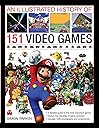
An Illustrated History of 151 Video Games: A detailed guide to the most important games of the past five decades
Product ID: 1613408
Buy anything from 5,000+ international stores. One checkout price. No surprise fees. Join 2M+ shoppers on Desertcart.
Desertcart purchases this item on your behalf and handles shipping, customs, and support to Spain.
Updated and extended in 2025. More than any other entertainment medium, video games offer the chance for us to participate in a world beyond the ordinary. Whether you are playing as a supersonic hedgehog, an athletic archeologist, or a moustachioed Italian plumber, video games allow their players to inhabit spaces where the usual parameters of existence do not apply. The medium's history is chronicled through the individual stories of the most iconic video games. Beginning in the early 1970s, the book charts five decades of the pixel revolution. The story of each game is accompanied by trivia and quotations, and illustrated with photographs, screenshots and artworks. This celebratory reference and up-to-date history will enthral any video games aficionado. Chronicles the history of gaming through an analysis of the world's most-iconic and best-loved games. Expert analysis of the story of each game, accompanied by fascinating trivia, memorable quotes, and information on the year of publication and where the game can be played today. Includes titles across all platforms, including arcade, console, PC, online and handheld games. Charts five decades of video game evolution, from Computer Space to Fortnite and Elden Ring. Illustrated with over 1000 action screenshots, game artworks and photographs. Review: Perfect Gift for Any Gamer! - I picked up this 151 Video Game Book as a gift for my husband, and I just know he’s going to love it! It’s packed with awesome details, fun facts, and nostalgic throwbacks to classic games. The layout is clean and visually appealing — great for flipping through or diving into for hours. If you have a gamer in your life, this is a great pick! Review: Wonderful book on the evolution of video games - This is a wonderful book that looks at the evolution of video games over the last few decades. I can sense the nostalgia when reading about the games that I used to play, and the consoles that I owned. This book covers in chronological order, selected video games and the consoles that were released since the early 1970s. The first game in the book is Computer Space, something I've never heard of, and there are many other games I don't know of that are also in the book, and I think it's great. As with books that talk about video games, and list them, the criteria for inclusion is not going to please everyone. I feel that the 151 video games included are quite well chosen. There are a few games which I thought should be in but are not, but it's not a big deal. Overall, there's a huge variety of games included which makes for an interesting read. The text about the history of each game and console is informative. It's obvious they are properly researched and hence quite insightful. Author Simon Parkin has done a great job with the book. The last game featured is from April 2012 so this book doesn't have anything on the PlayStation 4 and XBox One. Again, not a big deal, but it would be great if this book could be updated in the future. Another thing I like about the book is, they included information on where you can play all the games, even the very old ones. They could be on the web, PSN, emulators or somewhere else, and all that is included in the book. Highly recommended to all who are interested in video games. (See more pictures of the book on my blog. Just visit my desertcart profile for the link.)
| Best Sellers Rank | #96,534 in Books ( See Top 100 in Books ) #30 in Digital Art #50 in Computer & Internet Game Strategy Guides #110 in Video Game Art (Books) |
| Customer Reviews | 4.6 out of 5 stars 433 Reviews |
K**M
Perfect Gift for Any Gamer!
I picked up this 151 Video Game Book as a gift for my husband, and I just know he’s going to love it! It’s packed with awesome details, fun facts, and nostalgic throwbacks to classic games. The layout is clean and visually appealing — great for flipping through or diving into for hours. If you have a gamer in your life, this is a great pick!
P**A
Wonderful book on the evolution of video games
This is a wonderful book that looks at the evolution of video games over the last few decades. I can sense the nostalgia when reading about the games that I used to play, and the consoles that I owned. This book covers in chronological order, selected video games and the consoles that were released since the early 1970s. The first game in the book is Computer Space, something I've never heard of, and there are many other games I don't know of that are also in the book, and I think it's great. As with books that talk about video games, and list them, the criteria for inclusion is not going to please everyone. I feel that the 151 video games included are quite well chosen. There are a few games which I thought should be in but are not, but it's not a big deal. Overall, there's a huge variety of games included which makes for an interesting read. The text about the history of each game and console is informative. It's obvious they are properly researched and hence quite insightful. Author Simon Parkin has done a great job with the book. The last game featured is from April 2012 so this book doesn't have anything on the PlayStation 4 and XBox One. Again, not a big deal, but it would be great if this book could be updated in the future. Another thing I like about the book is, they included information on where you can play all the games, even the very old ones. They could be on the web, PSN, emulators or somewhere else, and all that is included in the book. Highly recommended to all who are interested in video games. (See more pictures of the book on my blog. Just visit my Amazon profile for the link.)
M**E
An enjoyable and interesting primer on video game history
An Illustrated History of 151 Video Games is a history book about landmark games in gaming history. Most of the images are screenshots. The final entry in the book is about a game released in 2012, so there isn’t anything more modern than that. Overall, it’s a very good video game history book, but it would likely be of limited interest if you’re expecting development artwork like in traditional video game art books. Quality of Physical Book - Average -It’s 8.5x11 inches. -It has about 250 pages of content. -It comes with a dust jacket with the same image as the cover, and the cover and pages are of average quality. -There don’t appear to be any blurry images or similar issues, even with the old images. Content/Innards - Exceptional Quality of writing. -I think the writing is very good. It’s clearly a book for adults who are interested in video game history. I’ve read other books that are sort of defensive or apologists for the video game industry and they come off as a bit immature and insecure. The tone of this book is one that assumes you are already on board with video games and are non-judgemental of them. -I liked that the writing doesn’t feel forced. What I mean is, the author doesn’t spent two pages on a game if it’s only worth talking about for one page or less. Just because a game is worthy to be in this book doesn’t mean we need to wax philosophical or pretend that the games are more important that they are. There are a few exceptions to this, but overall I found the book engaging due to the pace. -I haven’t played all of the games in this book, but the author does such a good job describing the ones I have played that I have confidence that he’s also accurate about the ones I haven’t. Is there writing or insight from the artists and developers themselves? -Yes, pretty much every game has some sort of remark from the lead developer. It seems like the author really tried to include something from them on each game he covered. Organization, does it make sense -All of the games are presented in chronological order of their release date. Interspersed between the games are summaries of major console releases, and there’s also a few pages that summarize gaming history for the decade. So even though the book mentions 151 games, there are actually closer to 180 entries. -On each entry there’s a large number showing which of the 151 games is being discussed, the date it was released, and an image of the start screen. -It also includes where you can play the game today, which by now is often out of date or incomplete. For example, many games listed as being on the Xbox store are also on the PlayStation store. I also think it’s funny that a lot of them just say MAME, which is an emulator; so it’s basically saying “well, if you want to play this you’ll have to pirate it.” -There are some errors, but not many. For example, on the Sonic the Hedgehog page there’s a cool illustration of the entire first level; however, it’s actually the first level from Sonic 2. -Overall I think the book is well organized. Variety of images and image types -With regard to the images, they’re almost entirely screenshots of the finished product, but there is some promotional art for older games and some occasional development art. There are also some other images that have been put together, like all of the Pokemon, the Marble Madness levels, and some levels from Mario. Does it have what you want it to have? -That depends on whether or not you agree with the games that were selected for this book. The main idea is that each game is exceptional or influential in some way or another. This criteria does lead to the exclusion of certain well-loved games. For example, though Halo 2 was very popular and is fondly remembered by millions of people, it was really the first Halo that had a huge impact on the industry. There are certain series that rightly deserve multiple spots, like Metal Gear and Resident Evil. Resident Evil 1 essentially started the modern survival horror genre, and Resident Evil 4, among other things, pretty much popularized the over-the-shoulder shooting perspective. -I’m more likely to disagree with the inclusion of the more recent games. For example, I don’t think Red Dead Redemption or Super Mario Galaxy really did anything that hadn’t been done before and just as good. However, I think it would have been hard for Simon Parkin to know which games released in the past year would be considered influential down the line. I mean, if you had to pick two games that were released this year that would be considered as influential as Pac-Man, I doubt you could do it. Though I didn’t personally agree with the inclusion of every entry, I thought the content was very well selected and appropriately placed in its historical context. Aesthetics - Below average Artistic/pleasant layout -As I read through the book I found it easy to see what was going on with each page. The pages look pretty crowded but I think everything flows pretty well. -I liked the little design touches, like how there‘s a symbol for each game and system, and the front and back covers have all of them. -Throughout the book the title pages have these image conglomerations that I didn’t find aesthetically pleasing at all. In fact I find many of them quite unpleasant to look at. Full pages of art? -Other than the conglomeration monstrosities, not really. Images of the systems usually take up a whole page, and there are some images that are pretty big like a map from the original Zelda. Anything else about the book like the cover, binding, feel, etc. -The cover of the book is, in my opinion, not very good. It feels more appropriate for a poster than for this very well written and considered history book. I honestly almost didn’t buy it because it looked like it would be a “simple” book rather than a thorough and interesting read. Any weird issues like tiny print or annoying layout, like having descriptions in weird places -Most of the “captions” under the images don’t necessarily have much to do with the images themselves. I think what happened is that they didn’t want the pages to be too busy, but they also wanted to have some screenshots and interesting extra information about each game. What they did was essentially combine the screenshots and blurbs even if they had nothing to do with each other. Perhaps they could have just had isolated floating words, or found some other way to incorporate the information. Though this was weird and makes no sense if you are casually browsing the book, I actually didn’t find it problematic at all as I read through it. Nostalgia/Affinity Evoked For The Game - Average -Several times while reading the book I was transported back to when the games were actually released. The book is a time machine of sorts. I think Parkin does a good job of describing the historical context of the games and why they were a big deal at the time, which is a part of video game culture. When Mortal Kombat was the latest craze, kids really did talk on playgrounds about how to unlock the secret character, Reptile. -I suspect the average reader will feel a lot of nostalgia for the games they have a connection with, but for many of the entries the experience will be mostly academic. Backstage -I think the premise of the whole book is to help people appreciate the strides that the industry has made, and the contributions of various creators. Here are a couple of examples: -It mentions how the original Street Fighter arcade cabinets had buttons that would do light, medium, and hard attacks based on how hard you hit the button; this led to a massive problem where the arcade cabinets broke constantly. -There’s a story about how Steve Jobs screwed over Steve Wozniak. Basically, Jobs took a $750 contract to create Breakout and would be paid a bonus if he could program the game more efficiently so it would cost less to produce the arcade cabinets - the more efficiently it was programmed the bigger the bonus. He got Wozniak to develop the game for him and since the Woz is a genius he was able to program the game in an extremely efficient way. Jobs ended up getting paid $750 for developing the game and got about a $10,000 bonus because of how efficiently it was programmed. He lied and told Wozniak he got just $700 and payed him $350. -There are some interesting insights into game design. For example, it mentions that Eugene Jarvis thought defending things would be more emotionally engaging that attacking them. Investors also thought the simple mechanic of rescuing humans in Defender was too complex for people, but the game made like 35 million dollars per week (apparently not much has changed - investors still have no idea about game design). -I really liked other little tidbits of information, like how Black Onyx in 1983 was the first game to represent health points in a horizontal bar. It’s funny the things we take for granted that someone, at some time, needed to invent and design. Closing remarks -I really like this book. Simon Parkin has an enjoyable writing style and has created something special. -Different people want different things in video game art books, but I hope this review has been helpful in showing you what you can expect from THIS book. For more video game art book reviews, click on my profile picture.
K**C
Terrific book
Given as a Christmas gift to a gamer who goes back to the late 70s. As he’s seen all of these platforms and games over the years, he’s really enjoying the book of memories. Beautiful book, amazing quality
S**N
Super book for any video game enthusiast
Most of the negative reviews I've seen talk about the use of space on the pages and a few factual errors. I haven't found any of this so far. It could be because I'm about 1/5 through. Or it could be that I'm not a hardcore enough gamer and wouldn't know these few and far between minor errors are even wrong. This book is well organized sequentially. Unlike other game history books I've written, the author seems more like a writer who loves video games than a gamer who tries his/her hand at writing. The content is a good mix of background behind the game/system development and what justified its conclusion in the book (e.g. first time a certain feature was found in a game). My only wish is that there were more screenshots of the earlier games. But whatever, I can also find those online. Great book!
L**A
Great write up and pictures/images of video games
This is a great table top book on video games we all played or should have played. I love the fact that many of the classic games have a web url to play online. In addition, the book covers the general video game history and the consoles that competed for our hearts and dollars. The book is partitioned into the decades starting at the 1970's into the 2000's. It is an enjoyable book and have decided to try to check out each and every game it features. This is well worth the price for any true video game fan!
A**R
Calidad-Texto claro
Excelente producto y muy buena calidad de las horas. Muy recomendado para los amantes de los videojuegos como yo.
J**Y
Good But Has Critical Omissions & Misinformation
Introduction: This book is pretty good. I grew up in the 80s since I was born in 1981. Video games have always played a role in my life but mainly up through my early 20s. I still own and play the latest games (Xbox One) but real life gives me little time. Despite this, I love to keep up with some video game news, subscribe to magazines, etc. These activities have waned considerably in the last couple of years but nonetheless I love video game history and a book like this is right up my alley. I will take my time reading it in small 5-20 minute sessions (I won't go into any more detail than that) and there's a ton of information to read. A lot I will likely skip so let me get to my review to explain why and what I like. What I Love: 1) I love the pages dedicated to just about every console. They give backstories on development, provide images and even factoids on the pages. It's all great stuff but could be done better so I'll get into that down below where I discuss shortcomings. 2) I love all of the great, high quality art, graphics and screenshots. The page designs and layouts are awesome. I wouldn't have bought it if it was more or less a bunch of text; I'm a sucker for pictures! 3) I love the in-depth reviews and information on the popular and meaningful games at the time. I know the backstory on a lot of this but there's certainly a lot of developmental details I did not. 4) I love the history of everything in the book. It's much more of a history and fact-heavy type of a book than a memory or just review of what certain game consoles or games are like. I prefer this approach so the book is great in that regard! What I Dislike: 1) I dislike the way they laid out the format for how they talk about different topics. Let me explain-- The consoles and console pages are more or less in chronological order which is cool but the games throughout the book are more or less as well and they're mixed-in all over the place with the consoles. You can go from the next console's page(s) of, let's say, the NES or aka Famicom. The next few pages could very well be game pages for games on the Atari or SMS. In other words, all game pages are strewn about. I'd much rather they took one of two approaches here: I'd much prefer for the games for NES to be discussed immediately following the NES page, not anywhere else in the book and the games for Sega Genesis be after the Genesis page and not anywhere else. Or, alternatively, they could have discussed all consoles in their own pages in the first section of the book then all games in the second section or half of the book. Instead they took the worst of three approaches, in my opinion. 2) I dislike that they don't go into more detail on console add-ons and accessories. Especially the add-ons. For example, on the Atari Jaguar instead of having their own page and complete section on the Jaguar CD add-on they just have a sentence or two on it, a very small image with a little caption. That's it. They do this for all other add-ons on all other consoles, too. Pretty disappointing, really. 3) I dislike that they don't give more detailed information and facts on all the consoles and games. I would like to see a little chart for all systems giving information on how many games were made, how many consoles were sold, when the date of the last game made was, complete release date information for consoles including each country, etc. You won't find all of this, sadly. 4) I've come across a few grammatical errors in word choice and sentence structure. Not a lot but there are certainly a few. 5) There appears to be some false information. I've only read maybe 2% of the book (various pages, sections, etc. not just the first 2% of all pages). One example: For all games if there is a way to play it today they will tell you where and how. For their page on Maniac Mansion they state you can play it today on Xbox 360 Live Arcade. I immediately was sure this was wrong as I was a pretty big gamer on Xbox 360 and would have known about this as I keep up with retro news like that. I went ahead and searched on Google to see if it was true but my suspicions were confirmed-- It is not available on Xbox Live Arcade and never was. For other games that may be on Xbox Live Arcade and mentioned by the book I found at least one that actually was available as they state on Xbox Live arcade but it was taken off the service way back in 2010. 2010, yes, and this book was published in 2014. It had been no longer available for years but this book still states you can get it from Xbox Live and play it on Xbox 360! Misinformation like this in books is a critical error. These are just two examples and I've only looked at that "Play Today" information for maybe 1% of all game pages in this book so I'm sure there's plenty of other mistakes. Conclusion: To conclude this review I'll state again that this book has a lot that is good and thus a lot going for it. Sadly there's still a lot of information lacking that I would have liked to have seen but the information that is there is very good and presented very well! As I said the format of how they discuss games and consoles in terms of the order of presentation and how they did this I dislike quite a bit. The worst of all, however, is the factual information that's either outright false and wrong or was true at one time but many years before publication something changed and their information is wrong. I still recommend this book to old-school video game fans, mainly those who grew up in the 80s or 90s but also those who just have a deep interest in the history of video games.
C**N
Si te gustan los libros con ilustraciones y los juegos, ésta es tu publicación
Si te gustan los libros con ilustraciones y los juegos, ésta es tu publicación. Disfrutable, hasta si no conoces el idioma inglés.
S**.
Interesting read
It's really interesting to read this book. It goes practically year by year and it really lays out the most groundbreaking games of that time. I would recommend this to every gamer (young and especially the old :))
D**5
Great book
Delivery; Item arrived fast in the typical cardboard wrap\envelope. Item; This is a great book, theres plenty of info and screenshots for each game, and a wide range of games & systems covered, the paper its printed on feels like it is good quality, i would recommend this to any gamer who likes book related content. Would recommend? Yes
E**Y
Libro interesante aunque un poco desactualizado
Llega sin mayor complicación; embalaje perfecto. Es un libro no muy pesado pero si de dimensiones medias. Consta del análisis por cada hoja de diversos videojuegos que definieron el desarrollo histórico de los mismos (cuenta historia, características, particularidades, etc.) Juegos fundamentales (Según ellos...imagino) llegan a ocupar dos hojas (es decir la izquiera y la derecha al abrir el libro) Cabe mencionar que este libro contiene el análisis de ciertos videojuegos realizados desde 1971 (Computer Space) hasta 2012 (FEZ) por lo que se mencionan juegos de PS3, XBOX360 y WII, no incluyendo ya el análisis de juegos perteneciente específicamente a consolas de octava generación.
Y**V
Not a good writer,
Very difficult to comprehend the content. Probably due to the writer’s writing style. I am avid reader including encyclopaedia, novels etc, but i found the writing style incoherent.
Trustpilot
1 month ago
5 days ago