Buy anything from 5,000+ international stores. One checkout price. No surprise fees. Join 2M+ shoppers on Desertcart.
Desertcart purchases this item on your behalf and handles shipping, customs, and support to Spain.
๐ Own the night skyโexplore 40,000+ celestial wonders with pinpoint precision!
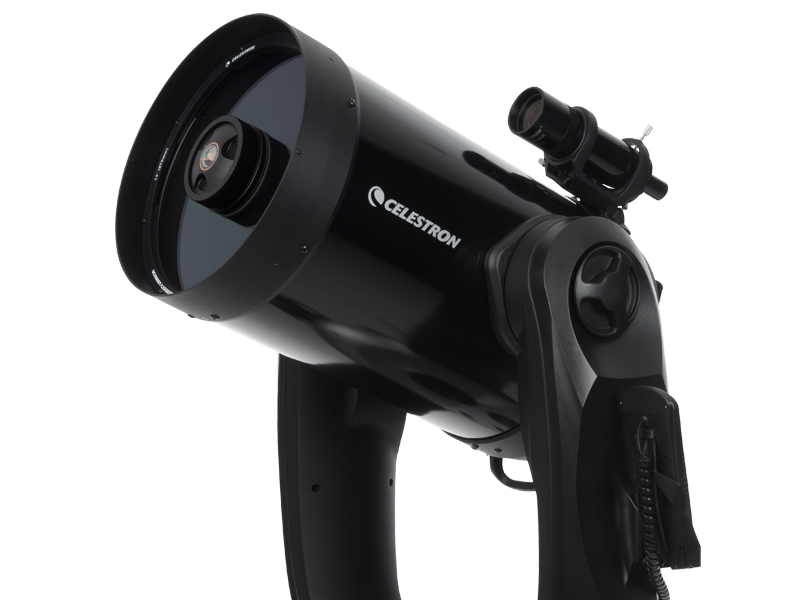
The Celestron CPC 1100 StarBright XLT GPS Schmidt-Cassegrain Telescope features a massive 11-inch aperture and 2800mm focal length, delivering exceptional light-gathering and resolution for both planetary and deep sky observation. Its built-in GPS and SkyAlign technology enable quick, accurate alignment, while the computerized dual fork arm mount offers automated tracking of over 40,000 celestial objects. Ergonomically designed for portability and ease of use, it includes a 9x50 finderscope, a 40mm eyepiece, and bonus Starry Night software, making it ideal for serious amateur astronomers and astrophotographers seeking premium performance and convenience.


| ASIN | B000ARFND2 |
| Best Sellers Rank | #3,007 in Camera & Photo Products ( See Top 100 in Camera & Photo Products ) #24 in Catadioptric Telescopes |
| Brand | Celestron |
| Built-In Media | 1.25" Star Diagonal, 40mm eyepiece, 50mm 9x50 Finderscope with Bracket, Accessory Tray, Instruction Manual, Mount and Tripod, Optical tube |
| Coating | StarBright XLT |
| Customer Reviews | 4.1 out of 5 stars 71 Reviews |
| Eye Piece Lens Description | 40mm eyepiece |
| Field Of View | 0.02 Degrees |
| Finderscope | 9x50 Finderscope with quick release bracket |
| Focal Length Description | 2800mm (110") |
| Focus Type | Manual Focus |
| Global Trade Identification Number | 00050234107518 |
| Item Dimensions D x W x H | 36"D x 32"W x 60"H |
| Item Part Number | 11075-XLT |
| Item Weight | 53.6 Pounds |
| Manufacturer | Celestron |
| Manufacturer Part Number | 11075-XLT |
| Model Name | CPC 1100 GPS (XLT) Computerized Telescope |
| Model Number | 11075-XLT |
| Mount | Computerized Altitude-Azimuth Dual Fork Arm |
| Number of Batteries | 1 Lithium Metal batteries required. (included) |
| Objective Lens Diameter | 279 Millimeters |
| Optical Tube Length | 610 Millimeters |
| Optical-Tube Length | 610 Millimeters |
| Power Source | Battery Powered |
| Telescope Mount Description | Computerized Altitude-Azimuth Dual Fork Arm |
| UPC | 050234107518 050234075015 |
| Warranty Description | Two Year |
A**D
Great Scope, Unbeatable Price
I bought this telescope as a 50th birthday present to myself, and it did not disappoint. The optics are fantastic, the setup was a breeze, and it's a joy to operate. There is some minor assembly required, but the instructions are clear and it was only about 30 minutes from shipping box to first light. One word of caution: While the CPC 1100 invoices as one item with one tracking number, it actually ships in two cartons (one for the telescope and one for the tripod). UPS dropped off just one box (the tripod) and, when asked, said he only had the one carton on the truck. About 15 minutes later, while I was on the phone with a VERY helpful Amazon agent, the UPS man pulled up again with the second box. Disaster averted! Assembly was quick and aligning the finder scope was easy. Read the manual, and you'll have no problems. Checking the optical path, the telescope's collimation was perfect, so no major bouncing around during shipping and no adjustments necessary. First light was on the pre-sunset Moon, and the Aristarchus Plateau was my first sight with the included 40mm eyepiece. The clarity was nothing short of breathtaking. Higher magnification was also quite clear down through an 8mm eyepiece before atmospheric turbulence limited the seeing. Using the SkyAlign system with the NexStar hand controller was also a snap. Just power up the system, let the GPS lock, then select three bright stars for alignment. Center the first star on the cross hairs of the finder scope, press "ENTER", then slew the telescope with the hand controller until the star is centered in the eyepiece, and press "ALIGN". Repeat for two more bright stars in different parts of the sky, and you're done. Now, you've got easy go-to access to the 40,000 objects in the NexStar database. A couple of other notes: If you're purchasing this telescope, know that it's big and it's heavy. The ergonomics of the carrying handles are good, but you better be prepared to lift and maneuver 62 pounds (28 kg). Also, the telescope comes with only one 40mm eyepiece and a 12-volt car power adapter. If you want to really start using your new telescope, I recommend purchasing the Celestron Accessory Kit for a nice selection of eyepieces and filters, as well as the Celestron 18778 AC Adapter for Computerized Telescopes to power your telescope from a standard household outlet/extension cord. I highly recommend this telescope for the fantastic optics, ease of use, and Amazon's great price.
A**N
Best amateur telescope available
I started off with a 130mm reflector, but quickly fell in love and decided I had to see more. I researched a LOT. I read reviews, I joined forums and asked opinions, I checked specs. This scope is comparable to the Meade LX200 series, but costs the same as the LX90 series. The general opinion of the community is that although it's an 11" and the Meade LX90 12" is an inch bigger, the coatings and performance of this telescope is equal or better. After using it for a month, I'd have to say I'm simply amazed. I've started taking pics - which requires a lot of additional purchases. If you want to take photos of deep space (other than planets), you'll absolutely need the equatorial wedge (or buy the CGEM instead of this one). You'll also probably want an autoguider - I chose the Orion awesome autoguider package. 2" 99% reflective dielectric diagonal is also a must, this comes with a 1.25" diagonal that's nowhere near 99% reflective. Then you have to get 2" eyepieces (EPs), which are a monster. I'd recommend starting with the Celestron 1.25" EP kit, as it comes with a variety of EPs and all filters, including a moon filter and color filters - no UHC or anything, but still a great starter kit. It's also cheap. Once you start going for decent or better 2" EPs, they're going to cost $100-900 EACH depending on style and size, so the starter kit at least gets you an array of EPs. Even if they're not the best quality, you have them and the kit is about $120 if I remember right. So, 1 EP for $100, or the kit with something like 6 EPs, a 2x barlow, color filters and a moon filter for $120'ish.. If you're spending $2700'ish on this telescope and you're an average person.. get the kit to start, and build expensive EPs later. Your wife, or husband, or parents, or whatever will thank you.
I**Z
Inside optics full of dirt
The main optics and glass came full of black dirt which lowers the quality of the view, after expending 4,000 us you dont spect having this kind of problems in a brand new telescope. I will have to open it first day of unboxing due to this dirt
R**R
Final (?) review
After all of the delays, messed up shipments, defective electronics etc. I finally was able to get the CPC 1100 out and was able to use it the way it was intended to be used. Despite rather poor weather with lots of haze and clouds, I set it up in my driveway for a quick test. Setting the scope is easy, but requires a strong back! The optical tube assembly (which includes the forks and drive system) is *heavy*. It goes around 65 pounds, and even when the scope is folded into transport position it is more than a handful. While the carrying handles (one on the side of one fork, the other under the bottom of the other fork) are well placed, it is still a very heavy object. If you have any sort of back problems, knee or hip issues, you are NOT going to be able to handle this thing by yourself. This scope is actually probably more than I really should be trying to handle by myself. Set up is simple. Just place the tripod in position and level it with the built in bubble level. Pick the scope up and rest it on top of the tripod. There is a center guide pin that slips into the base of the scope. Wiggle the scope around until the guide pin slips into place. Then push up one of the self-contained bolts on the base of the tripod and slowly turn the scope until the bolt hits the hole. Screw in the bolt, and the two others to secure the scope to the tripod. You need a 12 volt power supply for this scope (power cord with a cigarette lighter plug on one end is included). I'm using one of those automotive jump-start packs which should provide enough juice to keep the scope going for several hours. I went through the 3 star alignment procedure. Once turned on and you begin the alignment procedure, the scope's internal GPS takes a few minutes to acquire a signal and download the data it needs. Once it has done that, you can do the alignment, which is extremely simple. You use the slewing buttons on the controller to guide the scope to three different bright objects (they can be planets or stars). You don't even need to know what they are. Once the alignment is done, the scope is ready to go. After alignment, the scope worked flawlessly. Every object I selected from the menu on the controller appeared in almost the exact center of the field of view, requiring some tweaking occasionally, but pretty darn good considering I hadn't been real precise in aligning the thing. I looked at Jupiter first. Brilliant, crystal clear, sharp image, although small because the 40mm eyepiece only gives around 50x. Despite a considerable amount of haze and horrible light pollution, the view was excellent, with 3 moons lined up on one side of the planet and a 4th on the other side. After fiddling with the focus and as my eyes started to adjust, I could begin to make out some of the atmospheric bands on the planet. I went into the menu system, selected Messier objects and entered M42, the Orion Nebula. The scope slewed around quickly, came to a halt, and I looked through the eyepiece to find it almost perfectly centered in the field of view. The view was quite good considering the poor conditions we were having tonight. At a site that isn't surrounded by street lights and security lights, and with clear skies, it would have been stunning. Mars showed up crisp and clear. I tried adding my Tele Vue Barlow lens to increase power, but the atmosphere was too poor to let me get a good, crisp image. Unfortunately, I was working with only a small 'window' of sky that wasn't covered by clouds. Most of the deep space objects I wanted to look at were obscured. But Bode's Nebula (M81) was high in the sky, and even with the severe light pollution and, I discovered later, considerable dew forming on the corrector plate, I was just able to make out the ghostly image of that galaxy. So "first light" with the CPC 1100 was pretty successful, all things considered. Certainly the optics are wonderful. Even in the very poor conditions with high, wispy clouds, haze and severe light pollution, I was able to get some pretty impressive views of brighter nebula and galaxies. Pluses: Certainly the optics are wonderful. Crisp, clear, tack-sharp star images, beautiful low-power views of galaxies and nebula. The drive system seems pretty accurate. It almost always hit every object near to the center of the field of view. If I had taken more time to more accurately do the alignment it would have been spot on, I believe. Issues: Always issues, aren't there? First, of course, there's the weight. This is a heavy beast. If you are, like me, going to be out by yourself without anyone to help you lug the thing around, I would suggest you look for something less hefty. 65 pounds may not sound like much. Simply picking it up and setting it on the tripod isn't really the issue, it's moving it around, such as lugging it out of the house, getting it out of a car, etc. That's where things can get quite difficult. Second, vibration. Hands off, with just the drive tracking, it's fine, but if you reach for the focus knob, things are going to start to bounce around. Third: Focusing. Trying to focus this thing can be interesting, to say the least, and the vibrations set up by just touching the focus knob don't help. Tiny, almost microscopic adjustments are necessary. I'm not sure if this is an issue with all SCT type scopes or not, but it took me a while to get used to this, and I'm going to be looking into options to assist with focusing the thing. Fourth: The manual is outdated. The section on astrophotography, for example, discusses types of film to use, and pretty much no one has used film for astrophotography for years. While it is accurate as far as the basics are concerned, it needs to be updated. Fifth: The motors are very noisy when slewing at the higher rates of speed. When tracking or using the slower slew rates, you can't hear them at all, really. Sixth: All SCT type scopes are going to need to be collimated sooner or later. The secondary mirror mounted up by the corrector plate can be knocked out of the proper position for a variety of reasons. You need to turn a cover that hides the three collimation screws on the front of the scope, and somehow peer through the eyepiece, reach around the front of the scope with a screwdriver, make tiny, precise adjustments.... Well, I just don't see how it can be done without having an extra set of arms and a third eye on a flexible stalk. The scope is currently pretty well collimated right now, but I'm not sure how I'm going to adjust the thing with this setup. Again, I'm probably going to have to look into options to assist in that procedure, as I am with focusing. Do I recommend it? Well, that depends. So far I have mixed feelings about the scope, enough misgivings to keep me from giving it 5 stars. And I'm concerned about the drive system. This is the second unit I've had. The first failed right out of the box with an error indicating the controller couldn't communicate with the drive system. While Celestron sent me a replacement scope right away, a quick search on Google turned up the fact that I'm not the only person who had that particular issue. That makes me concerned about the overall reliability of the scope's electronics. But so far I'm pleased with the scope's performance. I can't wait to get it out to a really dark site on a clear night.
R**Y
Big and heavy.
For planetary and lunar viewing, this is hard to beat. For deep sky, it takes a little more patience, but it's not bad. The tripod is very stable. The dual fork assembly is plenty stout enough for the scope itself. I do love the alignment and star tracking (goto). It works very well. Cons: The spotting scope didn't come with the mount connected, some assembly was required, and it took some patience to get it aligned. The biggest complaint, is the weight of this thing. The tripod is almost 20 lbs. Not too bad, my wife can carry it easily. The scope on the other hand is over 60lbs. The CPC fork assembly is the majority of the weight. It doesn't disassemble from the scope (probably a good thing). Carrying this 100 yards can be a bit of a challenge. It doesn't come with a battery pack, only a car "cigarette lighter" style charger. I highly recommend the battery pack for viewing at remote locations. All in all, I'm very happy with it so far. If 65 lbs is a little heavy for you, I would go with the 9.25 inch model. I looked at the 14 inch model, but I'm glad I did not get it. I don't think I would have been able to carry it very far at all. The 11 inch is about as big as I think most people can handle. Note: This isn't really a problem, but be aware, the tripod and scope were shipped separately, Amazon showed the package as delivered, but only the tripod was delivered on the first day. A call to the seller, and they assured me the scope was on the way, it arrived the next day. They were friendly and easy to work with.
H**K
awesome toy
i love this telescope. you should know this thing is a monster when it comes to weight. I don't have a designated place for it, so i have to move it in and out of the house, it can be a pain in the a**. but the optics so far are amazing. light gathering power is amazing. it is pricey but if it keeps performing the way it has, it's worth it. i took some photos of the moon and jupiter with it, i will post them. I am an amateur amateur photographer and stargazer, the photos are not as good as some taken by some of the more seasoned folks. Reason for 3 stars? well, star align was the reason why I chose this particular telescope, and it doesn't work. I have looked up and read a lot about this problem, and unless you have a very big sky where the weak GPS system can get signal through, you won't be able to star align. hills around your house, mountains near by or tall walls around the yard will hinder the star alignment, BE AWARE! otherwise, spend the green and enjoy :)
B**.
NOT A NEW TELESCOPE
I received a used telescope. Several signs of prior use. Also the accessories boxes had already been opened.
N**H
Telescope is great!
I have had this telescope for a few years now and even though i have not had much time to use it im still glad i have it, The product is very well made, easy to use, only downside in my opinion is you have to buy a external power source in order to use the GPS function, which i still have not done yet haha, but using it on manual mode is very simple just gotta figure out how to line up your finder scope with an actual object you are trying to view, which if the moon is out its rather easy to do, I also have purchased a 2x scope for the telescope which is a nice attachment for it, happy with this telescope and i hope i can get out more to use it :D
R**E
Could be improved.
Easy to use. Optically good. But tracking failed after an hour or so of use. Would be really exellent If tracking could be cured. I believe there are a great many in use around the world, maybe I was just unlucky. I have other Celestron products with no problems at all.
J**S
Celestron
First class product made in China, plenty of extras and easy set up, turn it on GPS acquires position then point at a couple of objects... Done. Auto track works well
Trustpilot
2 days ago
1 month ago