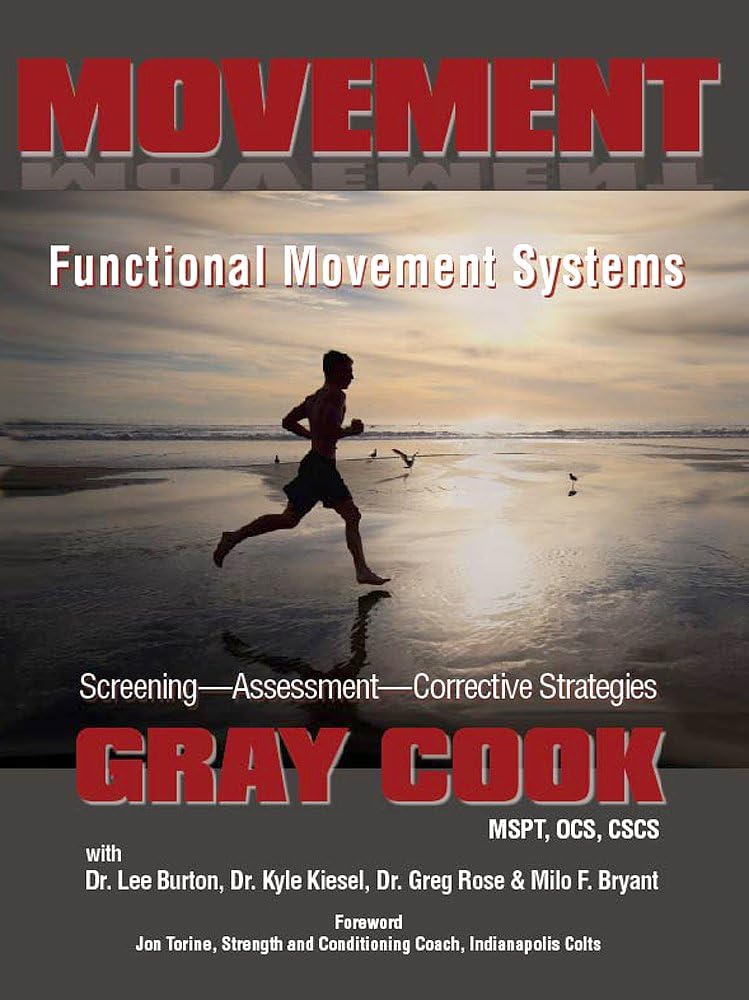

Movement is a vivid discovery, a fundamental and explicit teaching in which the return to basics takes on a whole new meaning. In it, author Gray Cook crosses the lines between rehabilitation, conditioning and fitness, providing a clear model and a common language under which fitness and rehabilitation professionals can work together. By using systematic logic and revisiting the natural developmental principals all infants employ as they learn to walk, run and climb, Gray forces a new look at motor learning, corrective exercise and modern conditioning practices. The discoveries, lessons and approaches you'll learn— * How to view and measure movement quality alongside quantity * How to ascertain dysfunctional patterns with the Functional Movement Screen * What clinicians need to know about the Selective Functional Movement Assessments * When to apply corrective strategies and how to determine which strategies to use * How to map movement patterns and understand movement as a behavior and not just as a mechanical idea This book is not simply about the anatomy of moving structures. Rather, it serves a broader purpose to help the reader understand authentic human movement, and how the brain and body create and learn movement patterns. Our modern dysfunctions are a product of our isolated and incomplete approaches to exercise imposed on our sedentary lifestyles. A return to movement principles can create a more comprehensive exercise and rehabilitation model, a model that starts with movement. Review: Book contains great insights on dynamic nonlinear muscular engagement and on creating new neural pathways. - I highly recommend this book for those who want to find new insights on ways to critique their athletic performance and improve their overall well-being. Both my long-distance running and yoga postural work is on a new and better qualitative plateau through implementing his approach on regaining fundamental movement skills through intelligent and dynamic whole-body exercises. I especially appreciate his philosophical discourse on human development and self-limiting exercises. I now use barefoot running as my default way to run. I happily engage in those mindful 'tune-ups' and energetic 'test runs' because I can see real improvements. I use my barefoot running and yoga postural work to gain new insights on how they compliment and improve each other. I have more understanding of my dysfunctions by studying this book. My guess is postural refinements can be made by everyone no matter how good these patterns may be as long we appreciate and respect nature's gift to us,'movement'. Cook is especially aware of creating neural pathways when automatic resetting of fundamental movement skills fails to spontaneously emerge. I also like his pithy saying such as: Move well and move often...and don't build sports specific training on fundamental movement dysfunctions. New York Times writer Broad would not be so negatively criticized by the yoga community at large if they could temper their critiques by first evaluating their own and their students' basic movement skills to see how 'authentic' they really are, After all, Dr Loren Fishman during his webinar at "Yoga-U Online" mentions how injuries while doing 'Hero Pose' are mostly incurred by yoga teachers themselves. Postures that injure the hamstring tendon at the sit-bone are well known to be epidemic in the yoga community. Gray Cook's and Doug Keller's insights on muscular engagement and whole body movements go a long way to both identify postural problems and apply remedial techniques to both heal and regain better postural health for both our sports and 'practices' and for our everyday movements in life. Review: Cook's Masterpiece on Movement - If you are in the strength & conditioning or performance training field or even a personal trainer this book is a must have for your library. It will change the way you think about training or reinforce what you may already be doing well. The crux of the book are the seminal screening protocols, the FMS and SFMA, which Gray Cook and his colleagues developed for the fitness/training and allied health care professionals, respectively. But the book is much more than that as it leads the reader down a path of discovery into how fundamental good movement is to our health, well being and quality of life. This is not for athletes only but all who are interested in improving movement and thus quality of life. It's reach is expansive and all inclusive. The sister website, [...] is a great resource that reinforces and expands on the information the book provides. This book should be one of the primary reference books for everyone in the training or allied health professions.
| Best Sellers Rank | #448,705 in Kindle Store ( See Top 100 in Kindle Store ) #22 in Sports Medicine (Kindle Store) #34 in Sports Medicine (Books) #41 in Physical Medicine & Rehabilitation (Books) |
M**G
Book contains great insights on dynamic nonlinear muscular engagement and on creating new neural pathways.
I highly recommend this book for those who want to find new insights on ways to critique their athletic performance and improve their overall well-being. Both my long-distance running and yoga postural work is on a new and better qualitative plateau through implementing his approach on regaining fundamental movement skills through intelligent and dynamic whole-body exercises. I especially appreciate his philosophical discourse on human development and self-limiting exercises. I now use barefoot running as my default way to run. I happily engage in those mindful 'tune-ups' and energetic 'test runs' because I can see real improvements. I use my barefoot running and yoga postural work to gain new insights on how they compliment and improve each other. I have more understanding of my dysfunctions by studying this book. My guess is postural refinements can be made by everyone no matter how good these patterns may be as long we appreciate and respect nature's gift to us,'movement'. Cook is especially aware of creating neural pathways when automatic resetting of fundamental movement skills fails to spontaneously emerge. I also like his pithy saying such as: Move well and move often...and don't build sports specific training on fundamental movement dysfunctions. New York Times writer Broad would not be so negatively criticized by the yoga community at large if they could temper their critiques by first evaluating their own and their students' basic movement skills to see how 'authentic' they really are, After all, Dr Loren Fishman during his webinar at "Yoga-U Online" mentions how injuries while doing 'Hero Pose' are mostly incurred by yoga teachers themselves. Postures that injure the hamstring tendon at the sit-bone are well known to be epidemic in the yoga community. Gray Cook's and Doug Keller's insights on muscular engagement and whole body movements go a long way to both identify postural problems and apply remedial techniques to both heal and regain better postural health for both our sports and 'practices' and for our everyday movements in life.
B**Y
Cook's Masterpiece on Movement
If you are in the strength & conditioning or performance training field or even a personal trainer this book is a must have for your library. It will change the way you think about training or reinforce what you may already be doing well. The crux of the book are the seminal screening protocols, the FMS and SFMA, which Gray Cook and his colleagues developed for the fitness/training and allied health care professionals, respectively. But the book is much more than that as it leads the reader down a path of discovery into how fundamental good movement is to our health, well being and quality of life. This is not for athletes only but all who are interested in improving movement and thus quality of life. It's reach is expansive and all inclusive. The sister website, [...] is a great resource that reinforces and expands on the information the book provides. This book should be one of the primary reference books for everyone in the training or allied health professions.
F**.
My fav book so far
Amazing book. Very under rated. I am a trainer exercise science major aspiring med school student and this is still the best book I have ever read. Most relevant. I do recommend supplementing the read with other material or you may get lost if you are just entering the world of fascial lining and tissue in general. This book will make you a more competent health professional and provide a lot of answers to questions you might have otherwise went to the grave asking. Questions as simple as why does the hip compensate when squatting when flexibility is within normal functioning range in all the lower extremities. Also find answers to questions as complex as. When squat looks functional within reason, with minimal compensation but client (be it yourself of someone else) experiences pain on the return or deceleration phase of the mid part of a squat. You will learn the facial meridians, lines they intersect and the importance and correlation between regions of the body you would have otherwise never thought of. Simple things like rehabilitative fixes for issues like this and many others.
J**I
Great book.
This is a great, well written concise text about the locomotor system and a sound approach to evaluating movement. Highly recommend this text as a must have for anyone working on improving their assessment skills and interdisciplinary communication for movement based dysfunctions.
J**R
Get the PDF version. Link on Cook's website
I think it's safe to say this book's verdict is out: it's excellent. There is gold here just in getting more ways to relate the concepts to patients/clients because Cook does a great job giving analogies. There is some repetition, but it feels like repeating key concepts and/or allowing chapters to stand on their own. It's not a book you just sit down and read. You have to take notes, think about what he's saying, and even take time to do more research. Cook's website movementbook.com has loads of supplemental information and getting certified in FMS allows you access to forums. I bought the Kindle version a couple of years ago, and I rebought the book to get the PDF version from the publisher's website (otpbooks.com). You get the Kindle and ePub formats as well for the same price. It's sometimes difficult to read textbooks in Kindle format, but it's nice to have there since it's smaller and more portable than an iPad. I think textbooks are better suited to stay in PDF format because the pictures and diagrams make sense.
M**L
Buy this book if you are a rehab professional
Seriously, if you are even considering not buying this book you are making a mistake. This book was paramount in restructuring how I looked and treated my patients. Gray Cook does a great job of making the focus on musculoskeletal care about movement, not about bits and parts of movement. I've taken FMS and SFMA, and this book was a great precursor to those courses (not to mention this book is a whole lot cheaper than taking any of the classes). The book outlines how the systems are laid out and how they can be used to better prepare individuals for activity. As some may know, there are some issues with using the FMS to predict future injury, but I think there is great benefit in structuring rehab towards whole body movements and not just isolating muscles.
J**M
Amazingly Insightful and a Great Clinical Tool
This book represents a profound seminar with one of the greats in physical therapy, strength and conditioning, and fitness training. Gray understandably explains the principles and techniques that have led to his years of successful practice. Movement is ready to be taken into the clinic or gym from day one. It is complete with the most complete and usable explaination of the FMS and SFMA to date. The flow charts alone are worth the price of purchase. As a fellow movement professional, I cannot reccomend this book highly enough. If you liked Athletic Body in Balance, Movement will blow you away.
B**S
Impressive. Worth it.
Impressive. And worth your time. Expect a book filled with useful info and data. It’s almost an academic book. This is a study. It’s not an easy read for those looking for simple recommendations. You’ll need a lot of time and write in the margin. In the end, it’s worth it. Every page.
S**L
Great book, must buy for health and fitness professionals
0bRead thoroughly for best results, we really need to apply these simple yet effective methodologies in our daily routine for a really fit body
C**N
A pillar for trainers
This book is amazing. Physical trainers that work with top athletes have to study and not only to read books like this. I can recognize people that dedicated all the life to the high quality studies and applications and that are really expert like Gray Cook and team or Michael Boyle or others. Hope you guys to meet in some place to share my method with you. Thanks to write this masterpiece. Gianluca Carbone Tennis Coach and Physical trainer author of The Awareness Game.
F**A
Movement - Gray cook
Excelente livro. O pilar base da avaliação do FMS e a filosofia por trás de um dos melhores sistemas de Avaliação de Movimento da atualidade.
C**R
Great book
Great book! I wish the book had a hard cover, but I don't regret the purchase.
G**B
Excellent
Very well written, and very informative
Trustpilot
3 weeks ago
3 days ago