We remain fully operational. Our teams are working around the clock to ensure your deliveries continue safely.

Descargar la aplicación


Servicios al cliente
Sobre nosotros
Copyright © 2025 Desertcart Holdings Limited
Descargar la aplicación

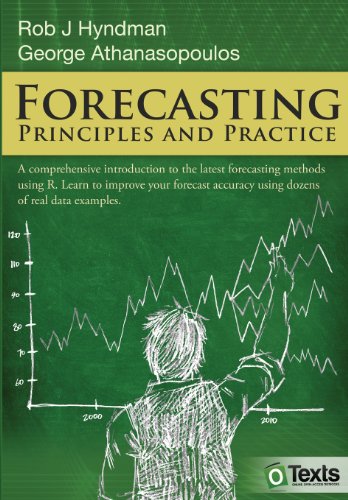


Forecasting: principles and practice [Hyndman, Rob J, Athanasopoulos, George] on desertcart.com. *FREE* shipping on qualifying offers. Forecasting: principles and practice Review: Outstanding practical book on forecasting - This book is an excellent resource for anyone trying to master practical nuts and bolts of forecasting or who is just starting to study the field. The authors explain the practical issues needed to forecast. If you want to know about the distribution of the Durbin-Watson statistic, or other recondite details, this is not the right resource. The text is tightly integrated with R examples which make it easy to start applying immediately what you have learned. Note: I read the free web version before the text was released. An index, however, would have been helpful. Review: Understand and implement forecasting algorithms - While working on forecasting (understand “time series analysis”) I found several interesting and state of the art articles from Rob J. Hyndman. He is the co-author, with George Athanasopoulos of Forecasting: Principles and Practice. This is an excellent, concise and comprehensive text explaining concepts behind forecasting, common algorithms and how to implement them in R (for a business view of forecasting, I advise "Future Ready"). The book presents key concepts of forecasting. From judgemental forecasting (which can be useful when you have no or few data) to simple/multiple regression, time series decomposition, exponential smoothing (ETS), ARIMA and a few more advanced topics such as Neural Networks. I would suggest to the author to add Support Vector Regression (SVR) and ensemble learning for the next edition of the book. Each concept of the book is covered through examples with real data. What is most appreciable about the book is how concise and readable it is. Each sentence is useful to understand the described concept, nothing superfluous. The book contains good overview and schema about each technique and how to set their meta-parameters. The R codes are well presented and easy to implement and test. The book can easily be used to teach forecasting since each chapter contains exercises. In conclusion, Forecasting: Principles and Practice is THE book to learn time series analysis algorithms and how to implement them in R.
| Best Sellers Rank | #3,534,440 in Books ( See Top 100 in Books ) #1,068 in Business Planning & Forecasting (Books) |
| Customer Reviews | 4.3 4.3 out of 5 stars (51) |
| Dimensions | 6.69 x 0.61 x 9.61 inches |
| ISBN-10 | 0987507109 |
| ISBN-13 | 978-0987507105 |
| Item Weight | 1.03 pounds |
| Language | English |
| Print length | 292 pages |
| Publication date | October 17, 2013 |
| Publisher | OTexts |
L**E
Outstanding practical book on forecasting
This book is an excellent resource for anyone trying to master practical nuts and bolts of forecasting or who is just starting to study the field. The authors explain the practical issues needed to forecast. If you want to know about the distribution of the Durbin-Watson statistic, or other recondite details, this is not the right resource. The text is tightly integrated with R examples which make it easy to start applying immediately what you have learned. Note: I read the free web version before the text was released. An index, however, would have been helpful.
S**A
Understand and implement forecasting algorithms
While working on forecasting (understand “time series analysis”) I found several interesting and state of the art articles from Rob J. Hyndman. He is the co-author, with George Athanasopoulos of Forecasting: Principles and Practice. This is an excellent, concise and comprehensive text explaining concepts behind forecasting, common algorithms and how to implement them in R (for a business view of forecasting, I advise "Future Ready"). The book presents key concepts of forecasting. From judgemental forecasting (which can be useful when you have no or few data) to simple/multiple regression, time series decomposition, exponential smoothing (ETS), ARIMA and a few more advanced topics such as Neural Networks. I would suggest to the author to add Support Vector Regression (SVR) and ensemble learning for the next edition of the book. Each concept of the book is covered through examples with real data. What is most appreciable about the book is how concise and readable it is. Each sentence is useful to understand the described concept, nothing superfluous. The book contains good overview and schema about each technique and how to set their meta-parameters. The R codes are well presented and easy to implement and test. The book can easily be used to teach forecasting since each chapter contains exercises. In conclusion, Forecasting: Principles and Practice is THE book to learn time series analysis algorithms and how to implement them in R.
P**H
If I have to buy one book on forecasting, it will be this one
Excellent book with very broad coverage. Depth may be lacking some times and you may have to resort to the academic papers cited. There is no coverage of recent deep learning models like RNN and LSTM for forecasting.
L**Z
Five Stars
Great goob, starting from simple to the complex. Good reference for the data scientist.
G**M
Rob Hyndman - Forecasting Luminary
Money well-spent. RH knows his stuff, and is a teacher so ostensibly cares about whether his students/readers actually learn something. I'm a huge fan of his work with the R package "forecast" and his various other offerings. You'd be wise to turn your attention to him.
A**R
This is a very good book for learning forecasting
This is a very good book for learning forecasting, with an emphasis on applying the ideas within the "R" environment.
M**N
Helpful reference
Great reference book for time series forecasting
G**R
Don't bother
The pdf found everywhere on the web for free, The Little Book of R for Time Series, gives you everything you need. This book is mostly fluff.
P**N
It was the textbook for my forecasting class. It came highly recommended by several professors.
J**Y
I am only half way through, but I can honestly say this is a very well written and thorough book. It is clear the writers are experts in their field. It does assume some maths knowledge (the book contains formulae), but the writers do explain it well so I would still say it is suitable for those less technical. It packs a lot in 300 pages. The examples are really good and not your standard, often too basic, examples - they use stock markets, beer production datasets etc which are more akin to the types of data you deal with if you have to do forecasting in a work context. They also highlight where people commonly make mistakes in forecasting and advise on how to avoid. To me, this is a sign of a GOOD textbook- many skirt around complex issues which means you have to hunt around on the internet/stackoverflow to get more detailed information. The only thing that was slightly annoying was the graphs are not printed in colour, however this can be cross referenced on their website. I'll be interested to see how more difficult topics are handled.
E**K
Sehr gut geschriebenes Handbuch wo rein theoretische (aber zugängliche) statistische Prinzipen verknüpft sind mit gute Vorbilden, praktische Code (in "R") und sehr gut dokumentierte Webseiten. Empfehlenswert.
C**I
Il libro è ben fatto (anche se è la versione precedente rispetto a quella disponibile on line), l'ho acquistato perché ritenevo giusto premiare gli autori per un libro così ben scritto e chiaro nelle spiegazioni che ti guida passo passo a comprendere o approfondire i temi del forecasting e dell'uso di R per fare previsioni. consigliatissimo!
P**R
this book is slim but every line has a meaning, Using R and this book really useful data and charts can be generated, it is also a low priced OText, thanks to the authors for a meaningful and useful book
Trustpilot
Hace 1 semana
Hace 1 mes