
Descargar la aplicación


Servicios al cliente
Sobre nosotros
Copyright © 2025 Desertcart Holdings Limited
Descargar la aplicación


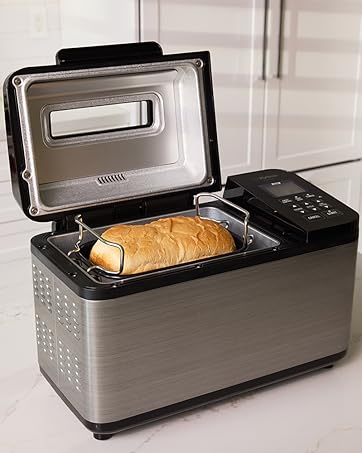
🍞 Elevate your kitchen game—artisan bread, zero hassle, all day freshness!
The Zojirushi Home Bakery Virtuoso Plus (BB-PDC20) is a premium 2-pound capacity breadmaker featuring dual heaters for even baking, double kneading blades for superior dough quality, and a rapid baking option that produces fresh bread in just 2 hours and 25 minutes. With a user-friendly LCD panel and 13-hour delay timer, it offers versatile settings including gluten-free, vegan, and multigrain courses, making it the ultimate choice for health-conscious, time-savvy home bakers.


| Best Sellers Rank | #6,635 in Kitchen & Dining ( See Top 100 in Kitchen & Dining ) #13 in Bread Machines |
| Capacity | 2 Pounds |
| Color | Stainless Steel / Black |
| Customer Reviews | 4.6 out of 5 stars 7,244 Reviews |
| Item Weight | 24 Pounds |
| Material | Stainless Steel |
| Product Dimensions | 10.5"D x 18"W x 12.87"H |
| Voltage | 120 Volts |
L**A
Zojirushi "Virtuoso"--A novice finds it a perfect breadmaking partner
We're not cooks. We live in a big city with plenty of bread for sale. We don't need something special, like gluten-free bread. Neither of us has ever baked a yeast bread in our life. So why the heck have we bought a bread machine? Desperation. We used to be able to buy good bread, but somehow everything has become Wonder (bubble) bread, more suitable as a pillow than as something chewy, substantial, and yummy. Longtime small bakeries we loved have cut back their distribution (Buona Forchetta) or vanished (StoneGround). Nobody--including Farmer's Market boutiques--sells European-style dense, flavor-packed whole-grain loaves in this town anymore. My wife and I looked at each other and said, maybe we are going to have to buy a bread machine. So this electronics engineer started exploring the world of bread machines. It's always good to see a basic design being refined. Zojirushi was doing that. I saw it in the model-to-model changes and details. Bread from their horizontal double-paddle machine would fit into our toaster, unlike the 6-inch by 7-inch slices of the vertical single-paddle machines. The latest Zoji was designed so I could start simply with standard, predefined setups, but as I got more skilled, I could program it as I wished from start to finish. Reviews and blog postings had nice things to say about the Zoji despite its cost. Zoji's US office was within reasonable driving distance if we needed to have it fixed. (Everything made in China seems to have its share of manufacturing shortcomings; all of the bread machines, including Zoji's, have some 1-star and 2-star reviews to ponder.) Now that I have made my 10th loaf of bread with our Zojirushi "Virtuoso" without a single failure, I am posting this success-story/review. I started simply, with two Bob's Red Mill bread mixes from the biggest Whole Foods Market in the area. It was really interesting to watch a collection of mixed powders be transformed by the incessant paddling of Mr. Zoji over just a few minutes into a well-behaved ball of dough, which the machine and fast-growing yeast then transformed into bread in 3 more hours. This was a good start; the two bread mixes made satisfactory loaves but I would not go out of my way to buy them in a store. Back I went to several stores, buying items new to me like Vital Wheat Gluten and King Arthur Bread Flour. I used several recipes in Zoji's colorful instruction manual for several more loaves. I was happy to see that it had measurements in grams, as I had vowed to avoid the trap of measuring large amounts of compressible powders by volume. Tablespoons, maybe, but no cups for me--I am using a small digital scale. Amazon Prime-shipped me Beth Hensperger's bread machine book, whose introductory sections I read and reread. I learned to test and adjust the dough ball just after it formed. A white bread was OK but the "Platinum" yeast I used practically pushed the Zoji lid up. A smaller wheat bread was OK but bland and soft. A cinnamon-apple bread was breakfastly sweet but its freeze-dried apple pieces from Whole Foods tasted more like styrofoam than fruit. My first really good loaf was an Italian olive-oil wheat bread in which I had replaced the recipe's basil with rosemary (an idea I stole from La Brea Bakery). That was so delicious that I made up 4 Ziplocs of essentially the same recipe and learned by making minor variations when I baked each. An artisanal baking book, by a baker who does not once use the phrase "bread machine", came home with my wife. I started measuring the starting temperature of the water and adjusting it so that it was always 80 degrees in the Zoji pan before I proceeded. All this time the Zojirushi Virtuoso behaved like a real trouper, never like a prima donna. I used four different "courses" (processes) from its repertoire--the regular and quick basic courses and the regular and quick wheat courses--and nothing ever went wrong, fell flat, burned up, jammed, refused to operate, crashed, or came apart. Cleanup has been easy with the method recommended by several Amazon reviewers: Fill the pan with water after it has cooled off, squirt in some dish detergent, let it soak at least half an hour, wash out, rinse, and dry. This is also all it takes to unpaste the paddles from their shafts. Today's bread approached what we are looking for. It was the Three-Seeded Whole Wheat from the Hensperger book (p.116). I had to convert the flour and dry milk recipes into grams using an Ingredients Chart from the King Arthur website, and have patience and then add a little flour--but with restraint--to a runny, sticky mix that only formed a dough ball when its seeds were added. All was well. I have learned to lift the lid--the Zoji safely stops and marks time--and adjust the shape of the dough ball with a nylon spatula before each dough-rise subcycle. The excellent Zoji instruction manual gives detailed cycle timing so there are no surprises. So there you have it. A total novice is now baking bread that pleases two critical people--his wife and himself. The Zojirushi Virtuoso may not be the only usable breadmaker in the world, but it has done everything it promised.
H**Y
Makes bread, cakes, etc that get you compliments galore~~~ I LOVE IT!!!
Oh, I cant tell you how much I love my zojirushi bread maker! I use it 1-2 times a day to make the most amazing breads and cakes! There are two things that I love the most in my kitchen; my zojirushi bread maker, and my zojirushi rice cooker. Whomever made this- thank you, just thank you! My bread is soft and moist and perfect each time. never over or under cooked. I thought all bread machine bread was like a hard log, but this beautiful creation proved me wrong. I get the same response from those whom eat my bread- after the first bite, their eyes widen, and I receive compliments galore. My parents are on a strict diet, and on their cheat days, they beg me to bring over bread! When the 14 year old boys in scouts (hubby is a scout master) come over, they ask for bread with honey as the "dessert". I mentioned that I make 1-2 loaves daily- that is how quickly my small family devours them. The bread that comes out of this thing is better than store bought and I only pay like $.50- $1.00 a loaf? (honestly I haven't calculated it, but is cheaper than a $5+ lump of coal (bread) from the store). Every single time I take a bite of bread from this thing, I practically cry out in song because the bread is just that good. This was the best buy ever. Along with my amazing bread maker, I bought "Bread Loaf Bags, Pack of 100 by Perfect Utopia", those will happily fit a 2 pound loaf or home made pizza; and most importantly, "The Bread Lover's Bread Machine Cookbook: A Master Baker's 300 Favorite Recipes for Perfect-Every-Time Bread-From Every Kind of Machine". I am so in love with my bread machine. It has been the best birthday present ever. I recommend the Zojirushi bread maker to everyone whom has tasted my bread, and I recommend it to you to! You wont be disappointed! This bread machine has been a life changer. Update: Well, it has been nearly a year since my purchase of the Zojirushi bread machine, and I still think it is the best kitchen purchase I have ever made (well, it is tied with my Zojirushi rice cooker). I use my bread machine at least 5 times a week, as I make bread for my family and my parents and our weekly get family get togethers. My bread loaves come out perfectly each time (given that my ingredients- especially my yeast are still good). MY bread is still adored by all we entertain and my 1st grader even says her school friends at lunch love it (I guess they trade lunches sometimes!). I love, love, love, love this bread machine and rant and rave about it every time my bread is complemented. I have saved so much money baking bread instead of buying it, and now my entire family cant stand store bought bread, even my toddler tastes the difference. I love that it takes only a few minutes to load the machine with ingredients and then all I have to do is take the fresh bread out when it is done. Thank you Zojirushi for making such an amazing and high quality product!! Update 1/4/2019 I still love this bread machine!! It makes the best bread ever. I am still praised by my kids and others for the bread this machine puts out. Even after owning it several years, this machine works like a charm. I still use it at least 6 times a week. I mainly make my white bread and the occasional banana or zucchini bread loaf. I will note that after about a year, I do need to purchase new mixing blades. I clean my bread pan/ mixing blades by filling the pan with water and letting it soak an hour or so each time, than cleaning it with a soft cloth, followed by a water rinse. After a banana bread loaf I use soap and have to be more aggressive with the washcloth, but it is easy to clean none the less. I notice when I do make banana bread, it tends to remove the nonstick finish off the mixing blades quicker. I have since just had an "older" set of mixing blades that I use just for banana bread, while I use my newer set for my regular bread, so I don't have to replace them as quickly. When it is colder in my house (guessing 60 degrees or below), there is a higher chance my bread wont rise properly. I tend to end up tossing, making grill cheese sandwiches, or french toast with those loaves when that happens. The taste is still there, just not the light fluffy texture, and it is very dense. I cure this by heating the house, specifically where my machine is at, and baking the loaf during the warmest time of the day. I also have learned that, for at least my machine, placing both mixing blades to point in the same direction (i.e. both point north), the bread will rise evenly. I am not sure if there is some magical science to this, or if it causes the dough to rise evenly, but if they are not pointed in the same direction, I notice that one side will rise higher than the other. Took me a year to figure that out. I still recommend this machine to everyone who loves my bread! I get a good laugh that every time one of my brothers comes to visit, one of the first things they do is 'causally' walk into my kitchen and conveniently stand to talk in front of the bread and than after a few minutes, just nonchalantly cut a huge slice and smother it in our raw honey, and repeat until the loaf is more than half gone (well, at least they have the decency to leave one or two slices for my children, haha). This bread machine has been the best investment, with me only having a pay a few cents a loaf in ingredients. It has more than paid for itself.
J**.
Works great! No complaints.
I reviewed this item extensively before purchasing it, especially the negative reviews. I had a previous bread maker that only had one blade (Regal Kitchen Pro) that made decent bread, but it created a loaf that frequently went over the top of the pan and created a dysmorphic end that was often not fully cooked. I had been looking at machines that made a traditional loaf, and I was afraid to buy a cheap one, but after reading some of the reviews, I almost refrained from buying this model. I am glad that I didn't. I have made bread using machines, by hand, using rapid yeast and also sour dough starter (the real wild type yeast and lactobacillus, not the overnight variety using store bought yeast) so I am not a novice, and I usually make bread by hand and sometimes just mix dough in my old machine. I have been consistently surprised by the quality of bread that comes out of this machine. It came packaged well, I didn't have the problem with a broken lid sensor that some have written about. The recipe book is decent. I particularly like the fact that the book includes weights for all items. This, in my opinion, is key to baking, and a shortcoming to many home recipes. I have learned over the years to convert measures, but it is always nice to see weights along with measures. I will say that the DVD supplied with the machine does demonstrate how to properly measure ingredients, and if followed, will give consistent results when compared to weighing ingredients, usually differing by only a few grams, which is pretty good. One of the comments that I read in other reviews is that only the recipes that are in the book work. This is not true. It is important to understand dough hydration and account for it when converting recipes, but if this is done my experience using other recipe books has been excellent. The bottom line is that this bread machine has only produced excellent bread from the first loaf. I realize that it is possible that the company has a quality control problem and some bread machines are duds, but this machine seems to be very well made and performs like a champ. It is feature rich. I haven't done much but make bread; I don't use the timer feature for overnight cooking because I don't like leaving flour in water for that long, but I have tried the other settings and they work. The breads come out fully risen, well browned with a very good crust. It is still bread machine bread; you won't find the taste that you will if you use real sourdough and preferments, but I am hoping that I can use the sour dough settings and improvise with real sour dough. I would certainly recommend this machine to anyone. It is quiet, it performs exceptionally well, and the bread tastes great for a bread machine; much better than you can buy in a store. You can use other recipes from other bread machine books. I would recommend weighing ingredients, as the manufacturer suggests, but this has nothing to do with this product, just good bread making. So if you can afford it, and you want to make bread on a regular basis, this is a good risk and well worth the money.
L**E
Easy to use Breadmaker
The Zojirushi BB-PDC20BA Home Bakery Virtuoso Plus Breadmaker is a great breadmaker. We purchased this and began making bread immediately. There is a recipe book that helps to get you started, but you can also search for other recipes. We have not purchased bread from the store since we made this purchase. Its nice knowing that there are no additional preservatives in your freshly baked bread. the breadmaker is very easy to use and the cleanup is very easy. It does accommodate a 2 lb loaf, but can also be used for 1.5 lb loafs. The larger capacity is great for making pizza dough etc. The machine seems to be built solid, but that's what Zojirushi does, build solid appliances. It costs a little more, but highly recommended.
T**2
Second day/second loaf in - color me happy!
This is our second Zoji bread machine. The original (also a horizontal loaf breadmaker) was loaned to some friends, who currently can't find it - so we figured, eh, get a new one, there are BOUND to be better features! Well, yes, indeedy - there ARE! First off, I really like the handles on either end of the baking pail. It makes it SO much easier to remove. Just tilt forward to release the base, then lift out. Simple. AND the ability to set the crust to light, medium, or dark - brilliant! I love this. I didn't so much like the light crust that the old machine produced. This one seems perfect! It has a small battery that runs the clock, so even after you've unplugged it, the clock continues to run, which means it's quite easy to use the Timer feature to have the bread ready when you want it - for example, today, I had some errands to run, so loaded up the breadbaker and set it to complete at 3:30 - easy peasy. Now, the REAL beauty of this, for our purposes, is that it can easily handle 100% whole wheat flour loaves and STILL turn out something just right for sandwich slicing! We've taken to buying hard red winter wheat, sprouting it for a couple days, dehydrating, then grinding into flour - I was actually quite surprised and pleased when the initial loaf yesterday rose up just fine and baked into a tasty loaf - following exactly the recipe included in the manual. Doing similar today with the addition of a bit of onion powder and dill weed. Next up will be the sourdough recipe in the manual! Can't wait. Then pizza dough! There are 3 customizable programs you can preset, if you find that you need to use them - so far this seems to be working fine on the preprogrammed basic/wheat setting, but when I start trying out some of my own recipes, maybe a longer rise time, or more kneading - it won't be a problem with the customization available. This machine is said to also make jam, cakes, meatloaf, etc. I really doubt I'll use those features, but who knows. I may try some of those things at some point. Overall, and with an admittedly short test time so far, I'm very pleased with our purchase. I really was leaning towards another machine, but my husband said, "Why? You liked the old Zoji, and there are so many good reviews!" He was right. UPDATE 12/17/12 - so here we are, several more loaves in, including one where I added fresh rosemary and a pinch of garlic powder - still very pleased with this machine. We also made pizza dough using the dough cycle, which worked perfectly. And I've also used the timed feature a couple times now, with perfect results - in fact maybe a little better rise than the regular wheat cycle that starts immediately! The bread has a perfect, fine texture and the machine breezes through the mixing and kneading process on the 100% whole wheat flour we're grinding. Gotta love something that works as advertised.
L**S
300 Loaves In
Update: 3-8-18 We purchased this bread machine on July 15th of 2015. Since it's purchase, we have made 300 loaves of bread in it. The bread is superb. We make the whole wheat recipe from the cookbook and operational manual that comes with the machine. The bread texture, flavor, size, shape, and best of all smell, is fantastic. The appliance still looks and performs as if we got it out of the box yesterday. Update 4-16-19 Uh-oh! One of the paddles stripped out. The good news is for a little bit of money my wife ordered new paddles. We are back to awesome bread. We are going on 4.5 years on this machine with at least 2 loaves a week. That's 450 loaves of bread before we even count any of the other goodies we have made with this machine. 450 loaves before the first problem by my reckoning the machine is long since been fully depreciated. Pros: Pretty much everything. This appliance stands out as one of the very best I have ever had the pleasure of using, in any category. If the manufacturer added a hundred dollars to the price, just for profit, I could make the case that this machine is still easily worth it and still stands above any other bread machine I have used in both performance and value. Cons: There is no way to turn off the "Keep Warm" setting. If you are not present to take your bread out of the pan, the machine will "Keep Warm" for an hour. This has the effect of turning out a firmer bread, which isn't always a bad thing, but for the whole wheat loaf, I find it turns out a loaf that is a little firmer than I like if I don't get it out of the pan immediately. Also, I have never turned off the machine after it finished and left the bread in the pan to see if it has the effect of rendering a loaf of normal softness. I suspect the reason Zojirushi didn't add an option to turn off the "Keep Warm" setting is because a loaf left in the pan with the machine off, and not allowed to cool in open air, will have a soggy crust. I can't bring myself to potentially ruin a great loaf of bread to find out. Pro Tips: Buy this machine and don't look back. Use the recipes included in the manual and go by the weights in the booklet, not the volumes. Weigh your ingredients into the pan as it rests on a digital, highly accurate, kitchen scale. Don't fiddle with dirtying measuring cups, sifting flour, and measuring spoons. Tare your scale as you go and measure ingredients in to the tenth of a gram. Baking is chemistry. Accuracy makes our loaves consistently excellent. Buy new yeast every 3 months or so. Never put anything in the bread pan that isn't bread ingredients, or warm soapy water and rinse water. Treat the interior of the pan with respect. Don't put the pan in the sink, fill it with water to soak, and then load it with silverware from the dinner table. I'm not saying it can't take the punishment, just that I don't do that and our bread pan looks brand new. It's not worth the risk. Summing up: The machine continues to be a pivotal tool in our family's commitment to never eat store bread. We make the recipes in the booklet that comes with it, and ones that don't. It performs great, always. Any miscues that come out of it can always be traced back to mistakes we have made, such as forgetting an ingredient, or using old yeast. You may buy another machine, but don't be surprised if in a year or two you are shopping again (happened to us), or wondering if maybe you should have purchased this machine instead. It's a tall endorsement I have given, I know. I stand by it and the bread, rolls, biscuits, and pizza dough I make in it.
A**N
Zojirushi BB-PAC20 VS Breville BBM800XL
My mom and I spent 5 days comparing the reviews and articles on the Zojirushi BB-PAC20 and Breville BBM800XL. We finally ended up comparing both models side by side because a friend has the Breville. For us, it ultimately boiled down to these key features: Zojirishi: +Longer loaf tub (makes a more normal sized loaf like you'd buy at the store +Heating element in the lid for consistent and even browning all around Breville: +4 loaf sizes +Nut dispenser PICTURE DESCRIPTIONS: First loaf we baked was white bread (regular speed, medium crust). I could have shaped it more evenly so it wasn't taller in the middle. Notice how small the holes are since I removed the paddles. The loaf in plastic wrap is wheat bread from the grocery store. Also compare it to a mostly eaten white bread made from the Breville. See how the top is much lighter than the sides? The Breville doesn't have a top heating element. Second bread we made was olive bread from an online recipe. I shaped this one better, also the recipe called for 2 tsp yeast instead of 2.5. Again I compared it to the size of a regular bread from the grocery store (half the bread is missing from the plastic bag). Neutral points: +Breville has a much nicer user interface. Pretty surprising Zojirushi has an interface that looks like it's from the early 2000s. But ultimately, our decision is going to be purely about bread quality. +Zojirushi allows you to create 3 custom profiles in which you can adjust the timings for each phase (Rest->Knead->Shape->Rise1->Rise2-Rise3->Bake->Keep Warm) whereas the Breville allows you to create 9 custom profiles and adjust the timings AND temperature for each phase (Knead 1->Knead 2->Rise 1->Rise 2->Rise 3->Keep Warm). We realized we didn't care too much about the number of custom profiles, because for most bread, the tried and tested standard settings provided by both machines are already sufficient. +The Zojirushi has a "Shape" option where it will beep before the first rise phase and give you an hour to open the lid, take the dough out and shape it with your hands so it looks nice and even, put it back and then close the machine. Don't recall the Breville having this specific feature, but realized it doesn't matter because the ideal shape time is right after the last punch down phase. More on that later. +The Zojirushi has 2 paddles and the Breville has one. The number of paddles isn't specifically a benefit in either machine's favor. It is more of a result of each machine's tub shape. The Breville is narrower and taller, and the Zojirushi is shorter and long. I think that the tub shape goes in favor of the Zojirushi, as I mentioned earlier. +Breville has foldable paddles. Don't really care, because we remove the paddles before the final rise even on the Zojirushi, so the holes are super small (1 centimeter diameter) +The Zojirushi has much sturdier build quality, whereas the Breville is made of thin, unpolished brushed aluminum. As others have noted, it dents very easily. In fact, our Breville arrived with a dent in it. Again, not too big a deal. Ultimately which one makes better bread? +Breville looks more modern and sleek. Zojirushi looks like a typical appliance. +Zojirushi makes less noise. At its loudest, it has the deep droning sound of a washing machine. Breville makes a banging noise as the paddles spin..which is pretty loud. +Zojirushi says it can be used for meatloaf and sourdough starter, Breville has a yeast free option or something...personally I don't care, plus you can probably customize settings on the Breville to make those work. (Just look up online instruction manuals from either companies to see what their timings are for each setting, and you can custom program that timing into the other machine) +Breville has a light you can turn on when peeking through the viewing window. I use my phone's flashlight when using the Zojirushi (though you can kinda see what's going on without it) +The nut dispenser was a pretty awesome get sure in favor of the Breville, but I want to point out that the Zojirushi will beep when it's time to add those ingredients. The automation is missing from the Zojirushi. So this isn't a neutral point - it's a big win for the Breville. But I wanted to point out the beeping of the Zojirushi as an FYI. +The Breville's marketing material goes out of its way to mention the punch down phase, but in fact not machines have this. Right before Rise 2 and Rise 3, the paddle (s) spins slowly a bunch of times in order to let trapped air escape out of the dough. +The Breville has 2 programmable knead phases. The Zojirushi has 1. I don't understand what this is about...They both knead for the appropriate amount of time, so maybe the Breville just let's you get more detailed about the process if you want? If both bake great bread, then I really don't care either way. +The Zojirushi has an optional rest phase in which it allows all your ingredients to come to room te premature for optimal baking. Don't recall the Breville has this. On both machines, you can always skip a step if you want (on the Breville, you hold down the start button, on the Zojirushi you hold down the up and down buttons on Select Course, if I recall correctly...it's in the manual) Okay, so what was our verdict? Well, it ultimately came down purely to bread quality, and here the Zojirushi is the winner. Just check out the pictures I uploaded. The browning is ridiculously consistent on all sides of the bread. Not overly chewy on one end of another. I have to attribute this to the Zojirushi's heating element in the lid, since I suspect the Breville ends up heating the sides and bottom longer in order to give the top a sufficient amount of browning. The Zojirushi also has a spectacular loaf size. The first time around, it was a bit high. But check out the olive bread we made on the second try...compared to a regular loaf you'd buy at a store, the size is spot on. I put a ruler next to the white bread pics so you can see. However, the white bread was our absolute first loaf we tried, and we could've done one or two things to make it as perfectly formed as the olive bread (see below). Loaf size was an important factor for us, because we want regular sized slices that fit in our toaster. With the Breville, you might be able to achieve these sizes by using a lower bread loaf setting and adjusting the amount of ingredients. But you'll end up with less bread. While we really liked the ability to choose multiple bread sizes with the Breville, we liked that the Zojirushi makes a standard looking loaf right out of the box. And we found out that the recipe book does show you how to make 1.5lb sized loaves of wheat bread and some others. So how did we make the perfect looking bread you'll see in the pics? Tips: 1) Read the instruction manual precisely and/or watch the first part of the DVD (liquids first, dry things second, make a little pocket for the yeast, and be EXACT for the ingredient measurements) 2) SHAPE YOUR DOUGH AND REMOVE PADDLES: Use the instruction manual to identify when the last punch down phase will begin. For the white bread regular setting, this should be 55 minutes after the Knead phase ends. The knead phase was 19 minutes and the Rest 30...so that means you should set an alarm to get back to your machine 1 hour and 44 minutes after pressing the start button. At that time, you will hear the paddles making one rotation every few seconds. It does this about 15 times. As soon as it stops doing this, it means the final rise phase will begin. Open the machine (it automatically pauses where it is in the process), and take the dough out with your hands. Put it on a table or mat or something (maybe parchment paper that is lubricated with olive oil - that's what I did), and roll the dough a bit and shape it with your hands so it looks nice and smooth. Better is if you shape it to look like a rectangle that will fit the tub perfectly, and flatten it a bit so it has an even night all the way. Then, remove the paddles (they are slippery so use something that has a good grip to pull them out). Put your loaf back in so it takes the full space of the tub, maybe pat it down one last time, and close the machine. Your bread will have a great shape. +Bonus tip: one of the reviewers mentioned putting your paddles in the same orientation before putting in the ingredients. Not sure if it helped, but I definitely did this. I pointed both my paddles in the 6 o'clock position. The first recipe we used was the Basic White Bread Regular (meaning we used active dry yeast instead of fast/instant yeast). Medium crust setting, except we left it in for 5 minutes extra after it was done to let it brown more. The second recipe we used is some southern olive bread recipe I googled in which they happened to use a Zojirushi as well! I used the dark crust setting and took it out immediately. Here's the "Kalamata Olive Bread Recipe from Southernfood/Aboutfood : http://southernfood.about.com/od/breadmachine/r/r70412a.htm Don't forget to let your bread sit for 30 minutes before slicing! Bottom line: The Zojirushi's even browning and standard loaf size make me feel it makes an overall better bread loaf. Check out the pics! After seeing the modern look, cool interface, and more granular programmable control of the Breville (e.g. temperature control) I want to take one star away from this machine. I may not use all those features, but maybe I would! But c'mon - it's the 21st century. Great looking user interfaces should be standard.
D**E
Love this machine. It makes great bread consistently.
This is my second Zojirushi bread machine and I love this one even more than the first. I gave the first one to a friend when I was moving and tried to downsize belongings, but I missed it so much I bought another. It makes great bread of great, consistent quality. It comes with a recipe book with several basic recipes. I just love this machine. For me, it’s just so easy to put the ingredients in and let it do its thing. If you’re inclined to bake in the oven instead, you can let this machine prepare your dough. I love it.
Trustpilot
Hace 3 semanas
Hace 2 semanas