We remain fully operational. Our teams are working around the clock to ensure your deliveries continue safely.

Descargar la aplicación


Servicios al cliente
Sobre nosotros
Copyright © 2025 Desertcart Holdings Limited
Descargar la aplicación
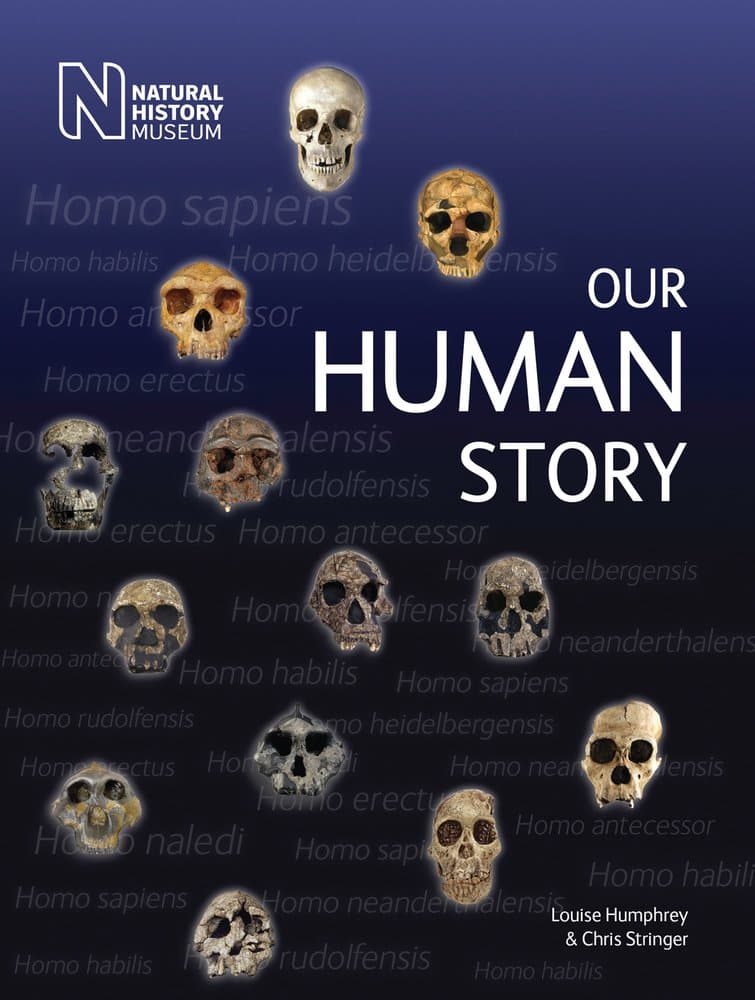

🌟 Unlock the epic saga of humanity — because knowing your roots is the ultimate power move!
Our Human Story is a first edition, expertly updated book that traces the intricate 7-million-year evolution of hominins, blending the latest fossil and DNA research with compelling narratives. At 154 pages, it offers a concise yet richly illustrated exploration of human origins, debunking myths like the 'Great Leap Forward' and shedding light on early social structures. Perfect for professionals eager to stay ahead in understanding our shared past.
| Best Sellers Rank | 48,017 in Books ( See Top 100 in Books ) 33 in Human Evolution 36 in Palaeontology 45 in Biological Sciences References |
| Customer Reviews | 4.7 out of 5 stars 205 Reviews |
P**R
The complex human family tree
As the late evolutionary theorist Stephen Jay Gould constantly used to reiterate, the evolutionary history of life is not a ladder of progress, but rather a bush or tree with many different branches. The authors of this very interesting and well-illustrated book show how true this is of human evolution. The hominin family tree is a very complicated mass of branches, beginning about seven million years ago when the hominin lineage split from the chimpanzee lineage. For most of that seven million years there has been a great diversity of hominin species, with several existing at the same time. For example, over the last two million years there have been at least ten different species of the Homo genus. And a lot is still not known: with future discoveries and DNA research, the tree will almost certainly get bushier. Only for the last 40,000 years or so has our own species, Homo sapiens, which first appeared over 200,000 years ago, been the sole surviving hominin species. The problem is, as the authors show, that it is often difficult to know exactly what the relationships are between the various branches. For example, it is difficult to know whether a particular species is an ancestor of ours, or whether it belongs to a different side branch of the hominin tree. The result of this is that there are many disagreements among scientists about how to classify various fossils and about their evolutionary relationships. What is clear is that upright stance developed long before the appearance of the large brain. Bipedalism came soon after the divergence of the hominin and chimpanzee lineages seven million years ago. The large brain came much later, leading to the intelligence, flexible behaviour, consciousness and art that we associate with humans. The large brain probably developed due to a combination of interacting factors: meat-eating, complex tool-making, social interaction and language. (My bet is that tool-making started off this feedback loop and that the previous development of bipedalism was important in that it had freed up the hands for the later development of complex tool-making.) Other primates and some birds can make and use simple tools, and some pre-Homo hominins (Australopiths) might have done the same. But humans in the Homo genus took tool-making to a quantitatively and hence qualitatively different level. As the authors mention, some scientists have in the past claimed that in the history of our own species (Homo sapiens) there was a “creative explosion” in Europe about 40,000 years ago (with the appearance of cave art etc), long after the appearance of the species itself over 200,000 years ago. They claimed that this “Great Leap Forward”/ “Human Revolution”/”Big Bang” was caused by some biological change to the brain, possibly linked to the development of language. But this idea of some (invisible and unprovable!) biological change to the brain about 40,000 years ago has been shot down in recent years by the discovery of evidence for art and sophisticated tools dating from much earlier than the time that the “Great Leap Forward” is supposed to have happened. For example, engraved pieces of ochre have been found in Africa dating from 75,000 years ago, and decorative beads have been found, again in Africa, dating back 100,000 years. As Stephen Oppenheimer has argued, language developed much earlier than 40,000 years ago and “...humans came out of Africa already painting.” There may even have been language and creativity in earlier species. For example, there is now evidence for Neanderthal art and possibly ritual burial; and there is also evidence that the Neanderthals could have vocalised in a similar way to Homo sapiens. In any case, the “creative explosion” theory wrongly assumes that behavioural change must be determined by biological change. But why does cultural change have to imply a change to the brain? It is more likely that the brain had become “modern” when Homo sapiens first evolved in Africa 200,000 or more years ago, and that any later cultural change took place for non-biological reasons. After all, the development of farming 12,000 years ago, of cities and writing 5,000 years ago, and of industry 200 years ago were also “Great Leaps Forward”, but no one believes that these were the result of genetic changes to the human brain. The final point I want to mention is that the authors refer to possible evidence of social stratification 35,000 years ago, in the form of some burials having grave goods which would have taken a lot of time to create. But, if this is so, it would surely just have been a case of respected (or at most, slightly privileged) individuals, because most evidence suggests that hunter-gatherer societies were egalitarian. Fully-fledged class differences did not appear until about 5,000 years ago, when, following the development of agriculture, “civilisations” developed in which a ruling class managed to grab the surplus created by the labouring farmers. Overall, an excellent book. Highly recommended. Phil Webster.
G**N
Clear and concise
I've been fascinated by "Early Man" (Neanderthals in particular and the pictures by Burian), since a schoolboy in the 1960s. My knowledge since has been dependent on the works (1967;1973 & 1997) of prof. (Harvard), William W. White and I felt I needed to read something "up to date". This book has not disappointed; it is clear, concise (154 pages) and updated to 2022; with information about Denisovans, etc.. It's inspired me to purchase "Britain: One million Years of the Human Story", also published by the Natural History Museum.
S**R
Our Human History
Great book, very informative and interesting
L**L
Incredibly well researched by a world leading authority.
This is a great book and the topic is among the most important to humanity. Where are we from? This paleoanthropologist is among the best in the world. No less than the leading expert at the Natural History Museum. Read this and you will never look at yourself in the mirror in the same way ever again! Hard to put down once you start. LO.
F**E
A very interesting read
I am becoming more interested in our human history and this is the second book I have read about it - the first being Britain - One Million Years of the Human Story. I did not realise that we originally co-existed with so many other human species. All this was explained very clearly and was fascinating reading. I am in my 70s and this was not touched upon when I was at school. I hope that it is now.
S**S
A Valuable Glimpse into Our History
First the negative, a few pages were incorrectly printed, but that did not detract from the wealth of information in this book, all amply illustrated with gorgeous photographs and easy to understand diagrams. My main takeaway was that around 150,000 years ago several species of humans coexisted and interbred, evidenced by modern day dna history testing. Sure there are many assumptions and speculations the further back in time you go, but that is to be expected.
L**C
Really informative
I've always been interested in human evolution and this book explains what is known and doesn't second guess any of the clues. Theories are explained but care is taken not to treat them as fact. Excellent book, well worth reading.
S**A
This is an excellent read!
This book was an excellent read. So informative and insightful. I highly recommend this book. I'm actually sad I've finished it.
Trustpilot
Hace 1 semana
Hace 3 semanas