We remain fully operational. Our teams are working around the clock to ensure your deliveries continue safely.

Descargar la aplicación


Servicios al cliente
Sobre nosotros
Copyright © 2025 Desertcart Holdings Limited
Descargar la aplicación
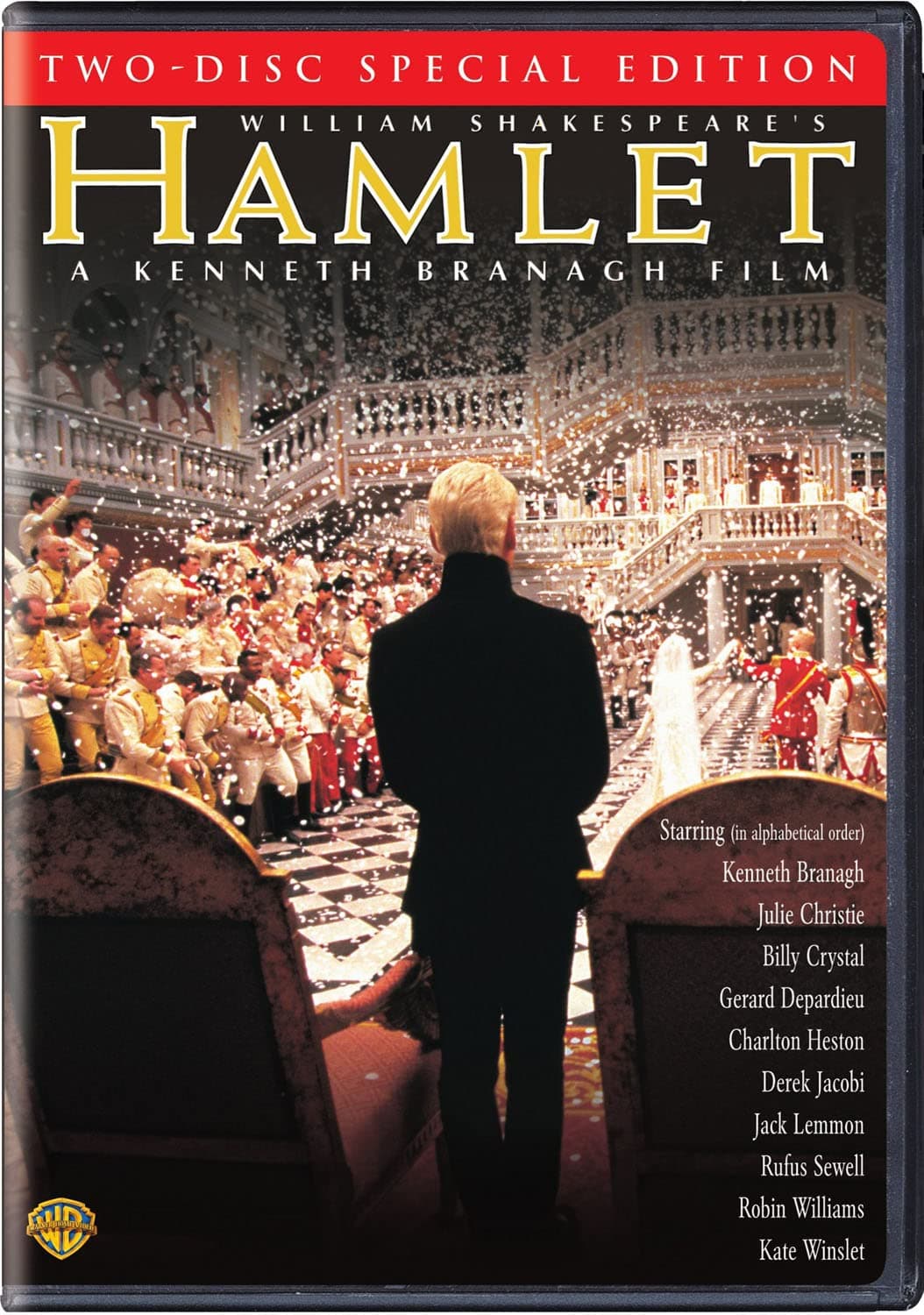


It's the greatest work of literature, but nobody had ever filmed Hamlet uncut--until Kenneth Branagh went about the task for his lavish 1996 production. The result is a sumptuous, star-studded version that scores a palpable hit on its avowed goal: to make the text as clear and urgent as possible. Branagh himself plays the melancholy son of the Danish court, caught in a famous muddle about whether to seek revenge against his royal father's presumed slayer the man who now sits on the throne and shares the bed of Hamlet's mother. (Or, as the song "That's Entertainment" summarizes the plot: "A ghost and a prince meet / And everyone winds up mincemeat.") As a director, Branagh (who shot the movie in 70 mm.) uses the vast, cold interiors of a vaguely 19th-century manor to gorgeous effect; the story might scurry down this hallway, into that back chamber, or sprawl out into the enormous main room. With its endless collection of mirrors, the place is as big and empty as Citizen Kane 's Xanadu. That all works; what doesn't work is Branagh's tendency to over-direct the big dramatic moments. He indulges in quick cutting and flashbacks as though to fend off the audience's objections to the four-hour running time, and the style sometimes looks like wasted energy. The experienced Shakespearians in the cast come off nicely; Derek Jacobi's Claudius, Richard Briers' Polonius, and Michael Maloney's Laertes are just terrific. Julie Christie is a suitably attractive Gertrude, and Kate Winslet makes the most of Ophelia's mad scenes. Branagh's habit of folding in unexpected American performers is on the mark, too: Billy Crystal is surprisingly good as the Gravedigger, Robin Williams predictably camps up Osric, and Charlton Heston is an inspired choice as the grandiloquent Player King. The biggest irony here is that Branagh himself is not quite spot-on as Hamlet. Of course he speaks the lines beautifully, but Branagh's screen personality radiates certainty and clarity of vision; there's little of the doubt that might make him Hamlet-esque. Still, tremendous credit for fending off slings and arrows to get the movie made. --Robert Horton Kenneth Branagh leads an all-star cast in this full-length production of William Shakespeare's greatest tragedy, the story of Danish prince Hamlet. Hamlet (Branagh--Harry Potter and the Chamber of Secrets, Rabbit-Proof Fence) returns home to learn that his father, the King, has recently died and his mother, Gertrude (Academy Award winner Julie Christie--Dr. Zhivago, Finding Neverland), has already married his uncle, Claudius (Derek Jacobi--Gosford Park, "Breaking the Code"). Suffering from shock and grief, the young prince is visited by the ghost of his father (Brian Blessed--Macbeth, Henry V), who claims that he was murdered by Claudius and who demands vengeance. Now, Hamlet must decide whether this tale told by an apparition is true--and whether he should exact the vengeance his father demands . Review: This is a "must watch" Hamlet. - There are many film interpretations of Shakespeare's best-known plays, and you should never depend on seeing a single one to get a good interpretation of the play. Based on watching six different film versions of "A Midsummer Night's Dream" I heartily agree with the reviewer who says versions made for film bring the special talents of the cinematographer and editor to bear, which are absent when the film is a record of a stage performance, or directed as if it were being done on the stage. And, since this is Shakespeare's best known play, and perhaps the finest play written in any language, the more versions you see the better. I already mentioned one reason, the added depth achieved by camera close ups and long range views, for recommending this version. A second reason is that this production makes a point of adding every word Shakespeare wrote, even to the point of reconciling different editions to get the best lines. Almost all versions of Shakespeare's plays, and especially Hamlet, are cut down, with one or more sup-plots shrunk or deleted. This does not, which is why it runs to over 4 hours. Added to Shakespeare's words are a number of flashbacks and "interpretation" scenes which imagine what meaning is lurking behind some of the words spoken on stage. The cast is stupendous. It is the kind of cast usually assembled for such epics as "The Longest Day" where most characters may be on the screen for about 5 minutes, so they need a familiar face in order for you to remember who that pilot was after he was shot down (Oh yes, that's Richard Burton. He was in the pub scene 90 minutes ago.) Most of the key roles are played by well known Shakespearian specialists, such as Branagh, Derek Jacobi, and Richard Briers. Several of the minor characters are Shakespearean regulars too, like Brian Blessed as the ghost. I especially liked to see Jacobi in a solid, major role, and not as window dressing in the first episodes of costume dramas, to lend weight to the cast. There are also lots of good non-Shakespearean actors in the main rank, especially Julie Christie and Kate Winslet. Among the incidental characters, talent is used with such abandon that one is almost inclined to refer to casting pearls before swine, bot so many of them work to perfection. My favorite is Charlton Heston as the leader of the traveling company of players who performs for the court of Denmark. He plays the role to perfection, and he seems perfectly cast. The other extreme is Jack Lemmon as Marcellus, one of the guards who first spots the ghost during the night watch at Elsinore Castle. It is not a comic role, and you have to look twice to recognize him. He only has two or three short scenes. Speaking of comedy roles (and Shakespeare always manages to include one or two, even in tragedies, there are Billy Crystal as the first gravedigger and Robin Williams as a courtier, who scores the fencing match between Hamlet and Laertes in the last act. Williams seems wasted, but Crystal is pitch perfect. For the first time, I get the sense that Shakespeare's main interest in this play was not justice or revenge, but madness, as two of the main characters either feign madness or actually become mad. And, dare I say it that it seems the most sane character, Polonius, is belittled by all the other characters, then killed, from madness. But an analysis like that is above my Shakespearean pay grade... Which makes me think that almost all actors in this production worked for scale (that is, peanuts). I have seen at least two other productions which are done in bright light, for the camera, and neither can hold a candle to this one. And for all the lights and cinematic expanses, the key speeches come off perfectly. Highly recommended. Review: Not For The Shakespeare Novice - I first saw this at the movie theater, with mixed feelings. I was impressed by the fact that it was an uncut Hamlet and by the great performances. The sheer majesty and gorgeousness of it on the huge screen, as it was filmed in Panavision Super 70, stunned the eyes. The sets are ornate, doing more justice to a story of royalty than most productions. It just plain looks and feels like an epic. On the down side, I grew bored a couple of hours into the 4 hour film. I read Shakespeare in high school but had only seen a production or two of any of his plays. Like most people unfamiliar with Shakespeare, I found it hard to understand much of the dialog. It is true though that a well acted Shakespeare makes more sense to the unfamiliar than just reading it. Since it's 1996 theater debut, I have seen a lot more Shakespeare, having held a subscription yearly to the Great Lakes Theater Festival for several years. (Due to this, I am also accustomed to watching Shakespeare set in more modern time periods). I also own about 10 film versions of Shakespeare plays. Still I was wary, afraid that 4 hours of Hamlet would bore me to tears. The negative reviews here didn't help that any. It is hard sometimes to tell reasonable complaints from the ones that just reflect an extreme dislike for Kenneth Branagh (his acting or his person). I took a chance and bought it. How much did I have to lose? The cost of dinner out? Maybe I could pawn it off on a friend if I didn't like it. I planned to watch 2 hours at a time but instead found myself riveted for the full 4 hours! An advantage of DVD is also that you can put on the subtitles to help with portions that you are having a harder time following. I believe you will enjoy this version more if you have a little Shakespeare under your belt first. This lush performance is a great addition to a Hamlet library, in which you may like to include the following: 2000 Ethan Hawke version - notable for the more modern setting and the addition of year 2000 technology to the story (video cameras and the like) 2009 David Tennant version - the sets are sparse as it was originally for TV, but NO ONE plays crazy like Tennant! Superb! My other favorite. 1990 Mel Gibson version - I do not like Gibson, so I do not enjoy this version 1948 Lawrence Olivier version - considered the classic, although I admit I have never seen it


| Contributor | Angela Douglas, Billy Crystal, Brian Blessed, Charles Daish, Charlton Heston, David Blair, Derek Jacobi, Gérard Depardieu, Jack Lemmon, Judi Dench, Julie Christie, Kate Winslet, Ken Dodd, Kenneth Branagh, Nicholas Farrell, Ray Fearon, Reece Dinsdale, Richard Attenborough, Richard Briers, Rob Edwards, Robin Williams, Rufus Sewell, Yvonne Gidden Contributor Angela Douglas, Billy Crystal, Brian Blessed, Charles Daish, Charlton Heston, David Blair, Derek Jacobi, Gérard Depardieu, Jack Lemmon, Judi Dench, Julie Christie, Kate Winslet, Ken Dodd, Kenneth Branagh, Nicholas Farrell, Ray Fearon, Reece Dinsdale, Richard Attenborough, Richard Briers, Rob Edwards, Robin Williams, Rufus Sewell, Yvonne Gidden See more |
| Customer Reviews | 4.6 out of 5 stars 3,349 Reviews |
| Format | AC-3, Closed-captioned, Color, Dolby, Multiple Formats, NTSC, Original recording remastered, Special Edition, Subtitled, Widescreen Format AC-3, Closed-captioned, Color, Dolby, Multiple Formats, NTSC, Original recording remastered, Special Edition, Subtitled, Widescreen See more |
| Genre | Drama |
| Initial release date | 2007-08-14 |
| Language | English |
B**D
This is a "must watch" Hamlet.
There are many film interpretations of Shakespeare's best-known plays, and you should never depend on seeing a single one to get a good interpretation of the play. Based on watching six different film versions of "A Midsummer Night's Dream" I heartily agree with the reviewer who says versions made for film bring the special talents of the cinematographer and editor to bear, which are absent when the film is a record of a stage performance, or directed as if it were being done on the stage. And, since this is Shakespeare's best known play, and perhaps the finest play written in any language, the more versions you see the better. I already mentioned one reason, the added depth achieved by camera close ups and long range views, for recommending this version. A second reason is that this production makes a point of adding every word Shakespeare wrote, even to the point of reconciling different editions to get the best lines. Almost all versions of Shakespeare's plays, and especially Hamlet, are cut down, with one or more sup-plots shrunk or deleted. This does not, which is why it runs to over 4 hours. Added to Shakespeare's words are a number of flashbacks and "interpretation" scenes which imagine what meaning is lurking behind some of the words spoken on stage. The cast is stupendous. It is the kind of cast usually assembled for such epics as "The Longest Day" where most characters may be on the screen for about 5 minutes, so they need a familiar face in order for you to remember who that pilot was after he was shot down (Oh yes, that's Richard Burton. He was in the pub scene 90 minutes ago.) Most of the key roles are played by well known Shakespearian specialists, such as Branagh, Derek Jacobi, and Richard Briers. Several of the minor characters are Shakespearean regulars too, like Brian Blessed as the ghost. I especially liked to see Jacobi in a solid, major role, and not as window dressing in the first episodes of costume dramas, to lend weight to the cast. There are also lots of good non-Shakespearean actors in the main rank, especially Julie Christie and Kate Winslet. Among the incidental characters, talent is used with such abandon that one is almost inclined to refer to casting pearls before swine, bot so many of them work to perfection. My favorite is Charlton Heston as the leader of the traveling company of players who performs for the court of Denmark. He plays the role to perfection, and he seems perfectly cast. The other extreme is Jack Lemmon as Marcellus, one of the guards who first spots the ghost during the night watch at Elsinore Castle. It is not a comic role, and you have to look twice to recognize him. He only has two or three short scenes. Speaking of comedy roles (and Shakespeare always manages to include one or two, even in tragedies, there are Billy Crystal as the first gravedigger and Robin Williams as a courtier, who scores the fencing match between Hamlet and Laertes in the last act. Williams seems wasted, but Crystal is pitch perfect. For the first time, I get the sense that Shakespeare's main interest in this play was not justice or revenge, but madness, as two of the main characters either feign madness or actually become mad. And, dare I say it that it seems the most sane character, Polonius, is belittled by all the other characters, then killed, from madness. But an analysis like that is above my Shakespearean pay grade... Which makes me think that almost all actors in this production worked for scale (that is, peanuts). I have seen at least two other productions which are done in bright light, for the camera, and neither can hold a candle to this one. And for all the lights and cinematic expanses, the key speeches come off perfectly. Highly recommended.
R**E
Not For The Shakespeare Novice
I first saw this at the movie theater, with mixed feelings. I was impressed by the fact that it was an uncut Hamlet and by the great performances. The sheer majesty and gorgeousness of it on the huge screen, as it was filmed in Panavision Super 70, stunned the eyes. The sets are ornate, doing more justice to a story of royalty than most productions. It just plain looks and feels like an epic. On the down side, I grew bored a couple of hours into the 4 hour film. I read Shakespeare in high school but had only seen a production or two of any of his plays. Like most people unfamiliar with Shakespeare, I found it hard to understand much of the dialog. It is true though that a well acted Shakespeare makes more sense to the unfamiliar than just reading it. Since it's 1996 theater debut, I have seen a lot more Shakespeare, having held a subscription yearly to the Great Lakes Theater Festival for several years. (Due to this, I am also accustomed to watching Shakespeare set in more modern time periods). I also own about 10 film versions of Shakespeare plays. Still I was wary, afraid that 4 hours of Hamlet would bore me to tears. The negative reviews here didn't help that any. It is hard sometimes to tell reasonable complaints from the ones that just reflect an extreme dislike for Kenneth Branagh (his acting or his person). I took a chance and bought it. How much did I have to lose? The cost of dinner out? Maybe I could pawn it off on a friend if I didn't like it. I planned to watch 2 hours at a time but instead found myself riveted for the full 4 hours! An advantage of DVD is also that you can put on the subtitles to help with portions that you are having a harder time following. I believe you will enjoy this version more if you have a little Shakespeare under your belt first. This lush performance is a great addition to a Hamlet library, in which you may like to include the following: 2000 Ethan Hawke version - notable for the more modern setting and the addition of year 2000 technology to the story (video cameras and the like) 2009 David Tennant version - the sets are sparse as it was originally for TV, but NO ONE plays crazy like Tennant! Superb! My other favorite. 1990 Mel Gibson version - I do not like Gibson, so I do not enjoy this version 1948 Lawrence Olivier version - considered the classic, although I admit I have never seen it
J**O
Great Hamlet!
Best version of Hamlet I have ever seen.
J**L
Dramatists' zenith
Why does Hamlet delay? I consider this play a dramatic warning of what inevitably happens when a man fails to believe in the truth of his desire. Hamlet doubts, talks, fails; Fortinbras believes, is silent, conquers. This play's life lesson, then, is DARE to believe in the truth of your desires. Always be Fortinbras; avoid being Hamlet. Put differently, "Your feelings will never lead you astray". To potential buyers of this DVD: UPSIDE 1. The dialogue is the complete Hamlet from all editions of the play. 2. Branagh's performance is majestical fire. 3. The set, the costumes, the dialogue - all beautiful. DOWNSIDE 1. Ironically, a weakness is the classic "To be or not to be" soliloquy. Branagh attempts to emotionally color this moment with eerie background music throughout the soliloquy, but his delivery feels too controlled. It requires a more reflective quality than Branagh imparts: Hamlet has crossed the Rubicon, his unconscious fury erupting into his conscious mind. The mad-playing Hamlet discovers he really has strayed into madness, and under the shocks of what he's faced - murdered father, adulterous mother, vicious uncle, betrayal of all friends (but one, Horatio), confrontation with a ghost - this surely is no surprise. This too is the moment Hamlet realizes he's failed to DARE to believe in the truth of his desire and in so doing mired his soul. This psychologically deep soliloquy can also be seen simply as a cold-blooded and pretty astute assessment of the whole nasty "down side" of life; ie, "Enough's enough". But Branagh doesn't convincingly touch one or the other key. Instead, his "To be" comes off more like a creaky Shakespearean "blue note" - a jazz note played "between the keys". 2. Act I scene 3: Laertes' farewell to his sister Ophelia. This scene fails. The weakness is inexcusable. Michael Maloney (playing Laertes) is a fine actor more than capable of fulfilling the requirements of this scene. Branagh should have focused far far more precisely here because Laertes is a central foil (the other being Fortinbras) to Hamlet. Yet the impression we receive of Laertes here, under Branagh's direction, is of a doofus showing off his foppish erudition to his innocent and impressionable sister via cloying fistfuls of gummy platitudes. Unfortunate. This is our sole opportunity to gauge, know, and respect Laertes before his vengeful return and transformation following his father's death, and Branagh - to my mind - clearly has wasted (one might say violated) this sole opportunity to breathe depth, life, and dramatic force into Laertes. (The fall of a good man with a gifted mind delivers considerably more dramatic impact than the fall of an immature fop.) This wasted opportunity dampens Laertes' dramatic force later in the play and therefore hamstrings the play itself. (If you doubt this and already have the DVD, reexamine this scene and judge for yourself.) 3. Another downside is the "Alas, poor Yorick! I knew him, Horatio; a fellow of infinite jest" scene. Try to imagine coming across a graveyard then finding yourself holding in your hand the skull of a beloved childhood friend in your hand. "My gorge rises at it." Not Branagh's apparently though. Branagh just doesn't pull this off well. It's more like he came across an old pet's skull. In fact, it doesn't seem to affect him even that much. This scene is in fact, to my mind, the entire hinge of the play. Confronting death face to face. Branagh just can't grab it by the roots. Downsides aside, this film is a *marvelous* conjunction of our greatest English playwright and (perhaps) our most perceptive modern dramatist in what I consider to be the best version of Hamlet ever produced.
M**R
to be or not to be indeed
I am, like Claudius, to "double business bound" in that while I feel this is the best realization on film of this play, it has certain glaring faults that diminish its otherwise superb interpretation. There is, first, Branagh's portrayal of the Dane himself. He is at times overly mannered to the point that we see him reaching for an emotion he doesn't seem to feel - witness his "O that this too too solid (sullied) flesh. ." soliloquy. One gets the distinct impression that he is focused not on the emotions of his character but rather on where the camera is placed. Too, his talk with Polonius in 2.1 is thoroughly misguided. He comes across not as mad, much less as crafty, but rather as smarmy and adolescent. Gibson does a much finer job with this scene as his Hamlet is more bewildered than juvenile. Overall, his portrayal lacks subtlety as well as range. His death scene could be a primer on what actors must never do - show that they are acting. Both Burton and Finnes are more exciting Hamlets. Of course there are times when Branagh excels, such as when he drags the hapless Ophelia (played magnificently by Winslet, who, for perhaps the first time in her career keeps most of her clothes on - one indeed sometimes gets the feeling she will only accept roles which allow her to disrobe)around a mirrored room (also a fine directorial flourish - where is the camera?). As for the other actors - Jacobi as a Claudius who engages our sympathy is, as always, superb. Richard Briers, who was a disasterous Malvolio in Branagh's first foray into directing Shakespeare (his Malvolio was much too florid, too angry by half) is competent here; Hume Cronyn (in Burton/Gielgud's production) remains, for me, the definitive Polonius. Now we come to Branagh as director and interpreter of the text. Having Ophelia read the love letter she received from Hamlet is an injudicious misstep, as is the intercut bedroom scene between she and Hamlet - it serves no purpose. Along the same lines, when Hamlet first spies Ophelia seemingly praying, Branagh plays it as a spurned lover - precisely what he must not do, for if he does Claudius would certainly have to agree with Polonius' assertion that Hamlet's madness is due to Ophelia's not reciprocating his love. The biggest, most unforgivable mistake Branagh makes is in the last scene. Just when all of our attention should be focused squarely on Hamlet, Laertes, Claudius, and Gertrude, it is diverted to Fortinbras' attack. This attack is at odds with the text. If Fortinbras were attacking Denmark why in the name of all that is holy, would he seems genuinely sorrowful over the many dead bodies he encounters on entering the castle? It is much more satisfying (and textually accurate) to have Fortinbras simply walk in and take the crown without having lifted a finger - the irony of the situation is delicious - here Hamlet has brooded and brooded and finally after he exacts his revenge and dies Fortinbras, who is a man of action who at first wanted revenge against Denmark for his father's death at the hands of Hamlet's father, gets his revenge by doing precisely nothing. Branagh, however, botches it. Not only that, as though there are not enough dead bodies littering the stage, he kills off Osric who, judging by his final words, is killed by a 21 gun salute given by the Norweigians to the British. I teach this play so I have to carefully explain that the attck on Elsinore Castle makes no sense textually or otherwise. I am not such a puritst that I believe that a Shakepearean text never be touched. In Patrick Stewart's Macbeth certain liberties are taken, but they work. Too, what is that business of Hamlet becoming Errol Flynn bounding down to Claudius on a chandelier? In short, the final scene is dramatic enough without Branagh inventing drama of his own. All that said however, the film has great merit. And any fans of the play would be doing themselves a disservice were they to miss it.
F**9
Excellent Film
Kenneth Branagh's "Hamlet" works so well on the big screen because the guy has a knack for Shakespeare, acting, directing, and knowing what "modern" audiences wanted out of a Shakespearean play. He takes the tale of Hamlet, prince of Denmark, and transports it to more of a modern setting (well, more modern than the 16th century). He assembles an all-star cast that includes Kate Winslett, Charlton Heston, Derek Jacobi, Billy Crystal, Jack Lemmon, Robin Williams among others in this adaptation of Shakespeare's classic. Although 4 hours in length (mainly because every word in the play is inserted in the script), the stunning effect of the play is extraordinary. The backdrop for the ghost of Hamlet in the opening scene, the mirror used when Hamlet (Branaugh) is making his "To be or not to be" soliloquy, the palace in which Hamlet and Laertes fight, and the snowy landscape in which Fortenbras and his men arrive are all instances of using scenery and directing to update this version of the play. Although the setting and interpretation of what Shakespeare intended are left in doubt, the movie itself is visually stunning and the acting is great. Although Branaugh hired a few American actors to take on some of Shakespeare's characters (for instance, Robin Williams plays Osric and Billy Crystal plays one of the gravediggers), there "American" accents are hardly noticed in the film. As an educator, I also think this is a fantastic version to use as a resource for a study of the play. Because the dialogue is accurate to the play, it works well. Also, this version seemingly makes the work of Shakespeare easier to understand. (Although, as a warning, there is one scene with Winslet (Ophelia) and Branaugh (Hamlet) that is definitely "adult" in nature). Overall, a great gamble by Branaugh to update Shakespeare's work into his own insight. There is also a few extras on the VHS version: interviews with many of the cast members as well as a behind the scenes about the movie. Also recommended: Hamlet (Mel Gibson version)
M**D
A classic movie
Excellent video, I remember seeing this movie when it came out in 1996, in one of the old movie theaters that used to exist in Richmond, VA. It is definitely a classic.
F**T
The Definitive Full Version of Hamlet Never Looked or Sounded Better Now in Blu-ray!
This release of the full-length version of Shakespeare's masterpiece is a real treat for fans. It is everything that I personally am looking for in any blu-ray release to justify any double-dipping over the standard dvd version. It firstly comes in a very well designed and assembled digibook format; the picture quality is glorious in 1080p and the sound quality in DTS HD MA is excellent as well although as this is mostly speech-driven, the DTS Surround sound doesn't really have a chance to show off its full potential but I suppose more is better than less even in this case. Other than for a very few scenes such as the ghost scenes, the film is mostly front heavy with regards the sound. While "Hamlet" is very good I personally prefer "Macbeth" as my all-time favourite play of the Bard's and as it is the second shortest of his plays, I hope that a similar treatment can be done with word-for-word scripting as it was done here. It could be like a "Braveheart" type film and would be very exciting indeed. As "Macbeth" is shorter than "Hamlet" even the complete version should clock in at quite a bit less than the 4 hours here and as a testament to how great this version is, I didn't even feel the time go by and I was even irritated at the "intermission" where I would have preferred it to continue; after all, we are watching a blu-ray and so we can make our own "intermission" at any time using the "pause" button. I watched this film while following along with the written word in my Complete Works of William Shakespeare (Barnes & Noble Leather Classic) and I realised that for a couple of scenes, other than the obvious time period setting etc Branagh took some liberties like moving them around a little e.g. the end of Act 3 Scene 2 and at least for me it was amusing catching out a couple of actors who said the wrong words e.g. Robin Williams' Osric "Sweet Lord, if your friendship were at leisure" when it should have been "lordship" and during "The Mousetrap" when the actress queen says "In either naught, or in extremity" when it should be "neither aught" etc. I guess it is very difficult for actors when they don't completely understand what they are saying. I was most impressed with Charlton Heston who was magnificent and even he miss-stated one word but all this wasn't a big deal for me as I still enjoyed the entire film a great deal which is clearly head and shoulders above the many previous versions and especially the Mel Gibson version. A highly enjoyable experience for Shakespeare fans and I wait in hope for a similar treatment of my personal favourite "Macbeth" to be made. Very highly recommended!
Trustpilot
Hace 2 semanas
Hace 2 meses