We remain fully operational. Our teams are working around the clock to ensure your deliveries continue safely.

Descargar la aplicación


Servicios al cliente
Sobre nosotros
Copyright © 2025 Desertcart Holdings Limited
Descargar la aplicación
Buy anything from 5,000+ international stores. One checkout price. No surprise fees. Join 2M+ shoppers on Desertcart.
Desertcart purchases this item on your behalf and handles shipping, customs, and support to Spain.
📘 Power up your circuit skills — don’t get left behind!
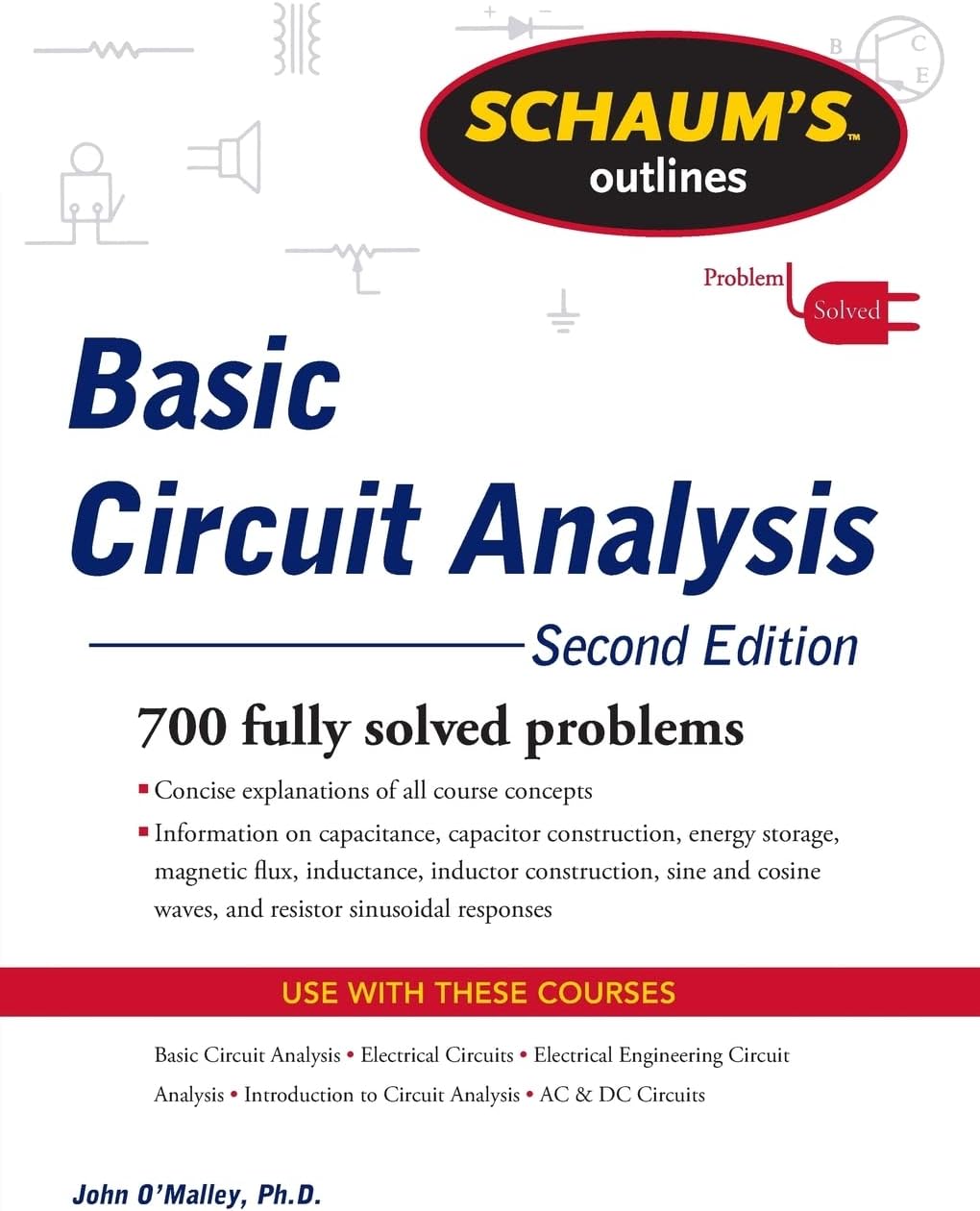
Schaum's Outline of Basic Circuit Analysis, Second Edition by J. P. O'Malley is a highly rated, practical guide designed to simplify circuit theory and problem-solving for electrical engineering students and professionals. With clear explanations and numerous solved problems, it’s a go-to resource for mastering fundamentals and excelling in exams.
| Best Sellers Rank | #180,044 in Books ( See Top 100 in Books ) #272 in Electrical & Electronic Engineering #1,478 in Education Theory #2,375 in Test Preparation |
| Customer reviews | 4.6 4.6 out of 5 stars (215) |
| Dimensions | 20.57 x 2.03 x 27.43 cm |
| Edition | 2nd |
| ISBN-10 | 0071756434 |
| ISBN-13 | 978-0071756433 |
| Item weight | 1.05 Kilograms |
| Language | English |
| Print length | 432 pages |
| Publication date | 16 March 2011 |
| Publisher | Schaum Outline Series |
R**A
This was a book I needed and will help me on this examination and through the graduation. Good insight and a great option for a first approach.
A**R
Bought to help a Cambridge first-year Engineering student who is struggling with her course. Like all Schaum titles it proceeds in easy stages and has a good index. The paper is rather flimsy but adequate. Good value for money.
P**T
This book is exactly what I was looking for! It goes over all the basics such as Ohm's Law, KVL, and KCL to more complex concepts such as sinusoidal voltage and current to transformers. It is a great cheat sheet to look up key information instead of hunting down old notes or digging through the index of a text book. The explanations are extremely clear and much better than what my professor can even offer. O'Malley has a great way of dumbing down complex material. Here's what lies in the table of contents: 1. Basic Concepts 2. Resistance 3. Series and Parallel DC Circuits 4. DC Circuit Analysis 5. DC Equivalent Circuits, Network Theorems, and Bridge Circuits 6. Operational-Amplifier Circuits 7. PSPICE DC Circuit Analysis 8. Capacitors and Capacitance 9. Inductors, Inductance, and PSPICE Transient Analysis 10. Sinusoidal Alternating Voltage and Current 11. Complex Algebra and Phasors 12. Basic AC Circuit Analysis, Impedance, and Admittance 13. Mesh, Loop, Nodal, and PSPICE analyses of AC Circuits 14. AC Equivalent Circuits, Network Theorems, and Bridge Circuits 15. Power in AC Circuits 16. Transformers 17. Three-Phase Circuits
K**N
I hesitated to rate this 3 stars - it is well written and straightforward - but it lacks in certain areas, so here are my concerns. First of all, this is really an exercise book, not a stand-alone text book. It is really intended to be an accompaniment to a good theory textbook. The "lessons" are short and lack any real detail or practical use. It dives into progressively more difficult problems, but doesn't explain all the solutions (despite claiming "fully solved problems"). You'll be left scratching your head on the more challenging ones without outside assistance. It is truly a supplementary text meant to hammer home lessons received in class or under tutorship but it is not a good solution for independent study. If you are using it as part of a course, then it will help you excel and is worthy of 4-5 stars; but if you are using it independently, you will have challenges, and that is why I can't give it more than 3 stars.
G**O
Nice book
Trustpilot
Hace 1 día
Hace 1 mes