We remain fully operational. Our teams are working around the clock to ensure your deliveries continue safely.

Descargar la aplicación


Servicios al cliente
Sobre nosotros
Copyright © 2025 Desertcart Holdings Limited
Descargar la aplicación
Buy anything from 5,000+ international stores. One checkout price. No surprise fees. Join 2M+ shoppers on Desertcart.
Desertcart purchases this item on your behalf and handles shipping, customs, and support to Spain.
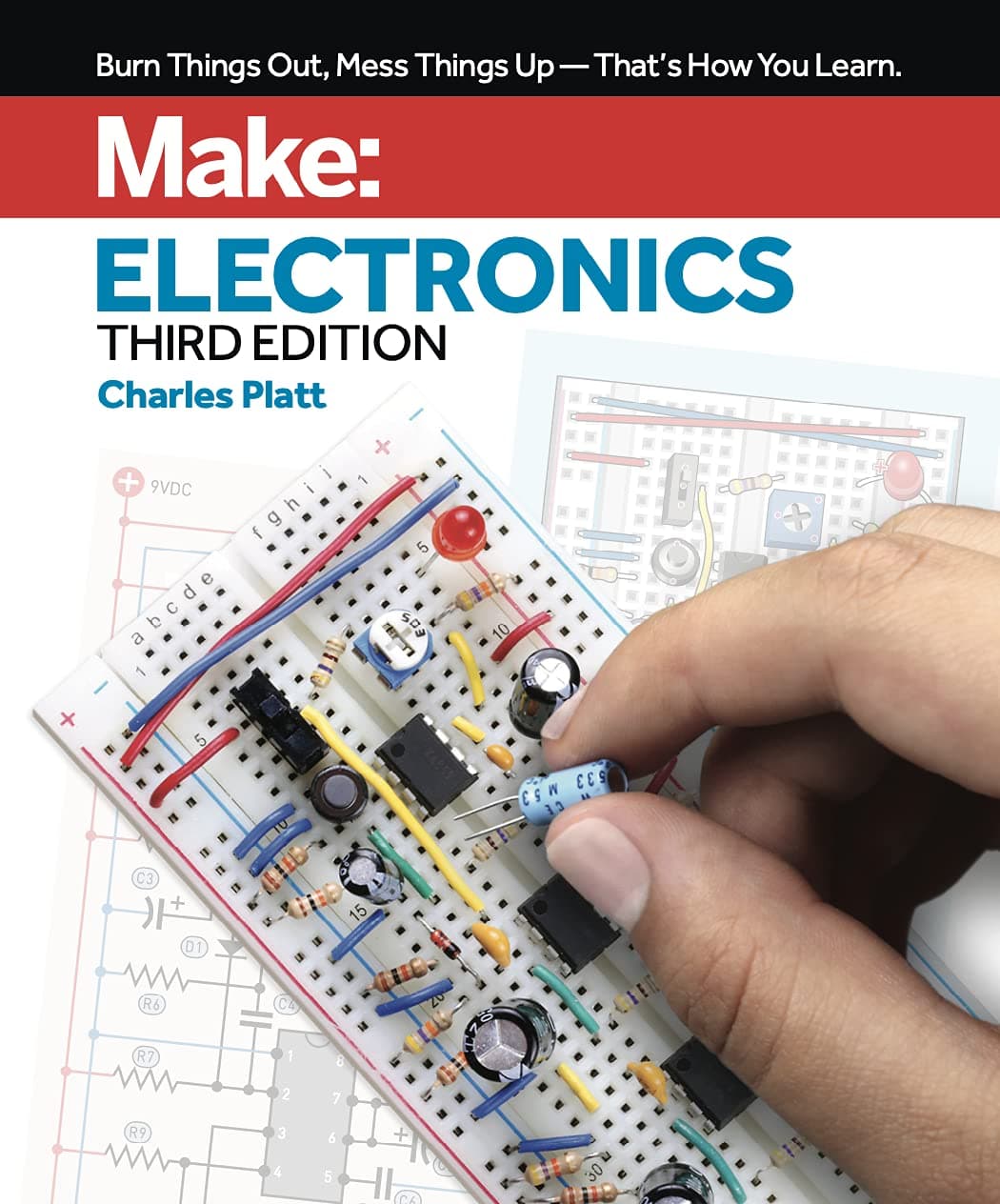
Make: Electronics: Learning by Discovery: A hands-on primer for the new electronics enthusiast [Platt, Charles] on desertcart.com. *FREE* shipping on qualifying offers. Make: Electronics: Learning by Discovery: A hands-on primer for the new electronics enthusiast Review: This looks like fun. - WOW! This is a very thick book. It looks like it has a lot of information and educational projects for beginners. I can't wait to get started. Review: Outstanding Clarity, Illustrations & Teaching By Charles Platt - This is the Starting Book you want! - For many years I have been interested in learning electronics, and I have purchased what feels like over a dozen different books, kits or online courses. The material in nearly all of them were written by engineers and it felt like for engineers. Just could not get into them. Additionally, many of the other kits and courses force your to learn Arduios, which I am not against at a future date, but for right now, I want to understand the basics of schematics and working with breadboards. I want to learn the components, what they do and how to plan to use them. I want instruction using a basic multi-meter. Happy to learn about Arduino's later. Just not what I am still wrapping my mind around the basics. Determined, I decided to just start buying all of the beginner books out there until I found an instructor whose style resonated with me. THIS IS THE BOOK! Just WOW! Such clarity and simplicity to understand. Charles Platt clearly understands how to take a complex subject matter and make it palpable for a beginner like me. That is also not to say his understanding is surface level, he has a very DEEP understanding of electronics and has many additional books on the subject. Suffice it to say, I study his book EVERY MORNING now and am LOVING it. There are some things I need to re-read, but I definitely am having much more success with Make:Electronics 3rd Edition. (Always get the latest editions!) Also, there is an electronics component kit that comes with this book. I highly, HIGHLY recommend getting this kit as well, so you can physically create the breadboards and learn hands on as you go. You will be at a huge learning disadvantage if you do not do these experiments. Thank you Charles Platt! As a teacher myself, I appreciate the effort you have taken to make this difficult subject matter so accessible- I appreciate you!


| Best Sellers Rank | #8,732 in Books ( See Top 100 in Books ) #1 in Circuit Design #3 in Robotics (Books) #4 in Robotics & Automation (Books) |
| Customer Reviews | 4.8 4.8 out of 5 stars (870) |
| Dimensions | 8 x 0.68 x 9.75 inches |
| Edition | 3rd |
| ISBN-10 | 1680456873 |
| ISBN-13 | 978-1680456875 |
| Item Weight | 2.31 pounds |
| Language | English |
| Part of series | Make |
| Print length | 325 pages |
| Publication date | October 26, 2021 |
| Publisher | Make Community, LLC |
| Reading age | 9 - 17 years |
A**R
This looks like fun.
WOW! This is a very thick book. It looks like it has a lot of information and educational projects for beginners. I can't wait to get started.
M**R
Outstanding Clarity, Illustrations & Teaching By Charles Platt - This is the Starting Book you want!
For many years I have been interested in learning electronics, and I have purchased what feels like over a dozen different books, kits or online courses. The material in nearly all of them were written by engineers and it felt like for engineers. Just could not get into them. Additionally, many of the other kits and courses force your to learn Arduios, which I am not against at a future date, but for right now, I want to understand the basics of schematics and working with breadboards. I want to learn the components, what they do and how to plan to use them. I want instruction using a basic multi-meter. Happy to learn about Arduino's later. Just not what I am still wrapping my mind around the basics. Determined, I decided to just start buying all of the beginner books out there until I found an instructor whose style resonated with me. THIS IS THE BOOK! Just WOW! Such clarity and simplicity to understand. Charles Platt clearly understands how to take a complex subject matter and make it palpable for a beginner like me. That is also not to say his understanding is surface level, he has a very DEEP understanding of electronics and has many additional books on the subject. Suffice it to say, I study his book EVERY MORNING now and am LOVING it. There are some things I need to re-read, but I definitely am having much more success with Make:Electronics 3rd Edition. (Always get the latest editions!) Also, there is an electronics component kit that comes with this book. I highly, HIGHLY recommend getting this kit as well, so you can physically create the breadboards and learn hands on as you go. You will be at a huge learning disadvantage if you do not do these experiments. Thank you Charles Platt! As a teacher myself, I appreciate the effort you have taken to make this difficult subject matter so accessible- I appreciate you!
J**N
Great book - but exp 17 feels half-baked
Excellent book. I took electronics in high school but wanted a refresher - and overall wish I'd listened better. :-) Platt's approach and writing style are excellent. There are a couple mistakes in the book so it is worthwhile to check out the Errata on the O'Reilly web page for the book. My only criticism is that Experiment 17 (Intrusion Alarm), while good practice and theory, is actually quite a lot of effort for a very underwhelming result. It's left to the reader to integrate a tone circuit - on a separate breadboard. You can use something like the single 555 tone in experiment 16 or a transistor version such as experiment 11. The information is all in the book to do this, but there's a bit of a handwave on this in experiment 17. ("Add audio output here") And even having done that, you are totally on your own for sensors or stand-ins for the sensors. The kits for the book don't include any reed sensors. And if you purchased the parts kits, you only have one 555 beyond the three needed for exp 17 and just a single breadboard. Additionally, to see this project all the way through, you need at least a stripboard style perf board - again, not included in the kits. (I realize the author doesn't create the kits, but he mentions that these optional parts won't be included so it wasn't an unknown.) I mean, you don't HAVE to solder it. And you can use push buttons to stand in for sensors, and you can figure out the audio alarm part, possibly using the lower part of the perf board...but this project stands out as sort of the least complete and ready to go end-to-end project in the book. To be honest, even if he'd said "I'm leaving out a few details that you should be able to figure out at this point" (which is true) would make it "fit" more in the spirit of the book. To be fair to this project, I do appreciate the sort of conversational "working it out" process that we see, as if we are just in the room with Platt as he works through it. That's great stuff.
B**S
Excellent Introduction to Analog Circuits by Fantastic Author
Having learned a bit about Arduino, microcontrollers, etc. I was curious about the bare essentials. Despite having built all sorts of fun circuits before, I had no idea what a capacitor actually did, nor what the purpose of a relay was. I bought this book after careful review and could not be happier! I had a lot of the components needed for the book laying around, so getting started was no issue. Charles writes in an informative and fun way that does not dissuade the reader from moving forward, experimenting, and learning. While I have not really read other books on this subject, I would have to say that it is not dry in style. If you read the prologue, you will notice that Charles gives out his email and encourages readers to write in if they run into problems. I have done so a few times and he has always gotten back to me with useful insight. My favorite project in the book so far is the reaction timer. It makes for a fun drinking game if you don't tell anyone the countdown value. If you are curious at all about how analog circuits work, then I highly recommend this book!
C**R
Good resource book on electronics
Excellent book easy to read and learn great photos and examples well documented and written look forward to his next book
B**Z
Fantastic read for a autodidact
I'm on a learning journey so I'm able to build a robot and I started off with the basics just learning about electronics and this book was a fantastic start. I also watched engineering mindsets electronics for beginners Playlist and greatscott! Electronics basics Playlist and I learned ALOT.
J**N
Very good
K**R
being a person with little knowledge of electricity and components .The way that Charlse Platt has written so that a person like me begins to have an understanding of how electricity and electrolytic components work.
I**N
I haven't start to read yet. Quality of the book is good
D**A
Good Book, Learn a lot in just a few days of reading through. The best way to learn is with a component and test it together while reading the book. Instructions and components needed are clearly stated. Auture left out the math so that you could do research and figure it out yourself.
J**L
Bem sequenciado, bem diagramado, fácil de entender.
Trustpilot
Hace 1 semana
Hace 2 días