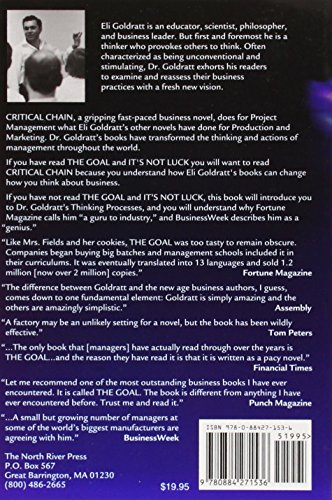

Buy Critical Chain by Goldratt, Eliyahu M. (ISBN: 9780884271536) from desertcart's Book Store. Everyday low prices and free delivery on eligible orders. Review: Interesting ideas about project management in this management novel. - I was reading Critical Chain when I heard the news that the author, Dr Eliyahu Goldratt died. The Theory of Constraints guru focuses his attention on project management in this book after looking at constraints in the production process in The Goal: A Process of Ongoing Improvement and in the marketing strategy in It's Not Luck . Again it is written as a business novel, this times from the perspective of an assistant professor at a small university whose job is at risk. The hero is offered a chance to teach on project management course on the executive MBA program. It's a subject he doesn't know much about so he has to learn as he goes and his ideas clashes with traditional project management theory. Projects are measured on three criteria - Time, Quality and Budget. As a general rule, projects are delivered late, not up to the original standard and over budget. They cost you more, give you back less and what you get is much later than expected. Projects are everywhere. I think I probably had too narrow a view when I read it the first time as I inevitably spent a lot of time reflecting back to a significant Year 2000 computer project I managed for a client and all the issues that arose. On my second reading, I reflected on smaller improvement projects where I didn't have a dedicated staff. Eli Goldratt is pushing against an open door - there's huge demand for a new way to manage projects that delivers on the original promises and commitments... and according to the author, that means managing the critical chain. If you've done any project management, you'll know of the critical path - the longest sequence of dependent activities which must be done for the project to be completed. The critical chain builds on the critical path and also assumes that one resource will be the constraint or bottleneck and activities by this resource are likely to be delayed. That constrained resource is the focus. The author makes some interesting points about why project performance is so bad. Slack is built into the time estimates because we don't go for an expected 50% success but 90% success and then miss it because we delay starting things we think we've got time on. The way around this is to take away the spare time from the individual project tasks and instead have a time buffer on the project and a buffer on individual critical activities. I like the idea and certainly agree that built in slack does happen. Many people will give themselves extra time to complete a task and still miss the deadline. I've also known people chronically underestimate the time it takes people to do a task when working on it full time and I've even done it myself. Few people will admit to padding out their time estimates when challenged but probably will confess to a high degree of confidence in getting the task done before their estimate. Few tasks get finished early because there's always a little extra you can do to make it better. Using the ideas of the normal distribution curve, you can prove the logic that time must be padded away from the median, 50% of the time. I really liked the emphasis on the cost of project time overruns because there's a temptation to scrimp and save on the resources because keeping within budget seems more important than hitting the project deadlines. The cost is much more visible than the missed revenue and profit streams that come from the project but in reality, cost may be tiny in comparison. There is an interesting section where we touch on the TOC Thinking Processes and the conflict involved with trying to manage costs and throughout with different emphasis needed on local efficiency (the cost world) and system effectiveness (the throughput world) I enjoyed reading Critical Chain but, as a novel, it's not as compelling as the classic book, The Goal: A Process of Ongoing Improvement . I had some aha moments as I was reading it and wished that I'd known about some of the ideas when I was managing large projects. This book will challenge the way you traditionally think about and plan projects. In fact, so different is this way of thinking that I feel you need to read it at least a second time. By then you'll have accepted the big ideas and you'll be ready to focus on smaller but important nuances. My one concern is that the book is fiction so it's easy to have a story of project chaos without critical chain thinking, and peaceful sanity using the ideas of the critical chain. The real world is a much harder taskmaster. I had less problem with this in The Goal because it involved repetitive manufacturing and people could learn. In projects, every time is unique. Paul Simister, a business coach who helps business owners who are stuck, get unstuck. Review: Four Stars - Theory well communicated through a story.
| ASIN | 0884271536 |
| Best Sellers Rank | 526,657 in Books ( See Top 100 in Books ) 17,541 in Business, Finance & Law |
| Customer reviews | 4.5 4.5 out of 5 stars (1,156) |
| Dimensions | 15.88 x 1.91 x 23.5 cm |
| ISBN-10 | 9780884271536 |
| ISBN-13 | 978-0884271536 |
| Item weight | 386 g |
| Language | English |
| Print length | 253 pages |
| Publication date | 4 Sept. 1997 |
| Publisher | Gower Publishing Ltd |
P**R
Interesting ideas about project management in this management novel.
I was reading Critical Chain when I heard the news that the author, Dr Eliyahu Goldratt died. The Theory of Constraints guru focuses his attention on project management in this book after looking at constraints in the production process in The Goal: A Process of Ongoing Improvement and in the marketing strategy in It's Not Luck . Again it is written as a business novel, this times from the perspective of an assistant professor at a small university whose job is at risk. The hero is offered a chance to teach on project management course on the executive MBA program. It's a subject he doesn't know much about so he has to learn as he goes and his ideas clashes with traditional project management theory. Projects are measured on three criteria - Time, Quality and Budget. As a general rule, projects are delivered late, not up to the original standard and over budget. They cost you more, give you back less and what you get is much later than expected. Projects are everywhere. I think I probably had too narrow a view when I read it the first time as I inevitably spent a lot of time reflecting back to a significant Year 2000 computer project I managed for a client and all the issues that arose. On my second reading, I reflected on smaller improvement projects where I didn't have a dedicated staff. Eli Goldratt is pushing against an open door - there's huge demand for a new way to manage projects that delivers on the original promises and commitments... and according to the author, that means managing the critical chain. If you've done any project management, you'll know of the critical path - the longest sequence of dependent activities which must be done for the project to be completed. The critical chain builds on the critical path and also assumes that one resource will be the constraint or bottleneck and activities by this resource are likely to be delayed. That constrained resource is the focus. The author makes some interesting points about why project performance is so bad. Slack is built into the time estimates because we don't go for an expected 50% success but 90% success and then miss it because we delay starting things we think we've got time on. The way around this is to take away the spare time from the individual project tasks and instead have a time buffer on the project and a buffer on individual critical activities. I like the idea and certainly agree that built in slack does happen. Many people will give themselves extra time to complete a task and still miss the deadline. I've also known people chronically underestimate the time it takes people to do a task when working on it full time and I've even done it myself. Few people will admit to padding out their time estimates when challenged but probably will confess to a high degree of confidence in getting the task done before their estimate. Few tasks get finished early because there's always a little extra you can do to make it better. Using the ideas of the normal distribution curve, you can prove the logic that time must be padded away from the median, 50% of the time. I really liked the emphasis on the cost of project time overruns because there's a temptation to scrimp and save on the resources because keeping within budget seems more important than hitting the project deadlines. The cost is much more visible than the missed revenue and profit streams that come from the project but in reality, cost may be tiny in comparison. There is an interesting section where we touch on the TOC Thinking Processes and the conflict involved with trying to manage costs and throughout with different emphasis needed on local efficiency (the cost world) and system effectiveness (the throughput world) I enjoyed reading Critical Chain but, as a novel, it's not as compelling as the classic book, The Goal: A Process of Ongoing Improvement . I had some aha moments as I was reading it and wished that I'd known about some of the ideas when I was managing large projects. This book will challenge the way you traditionally think about and plan projects. In fact, so different is this way of thinking that I feel you need to read it at least a second time. By then you'll have accepted the big ideas and you'll be ready to focus on smaller but important nuances. My one concern is that the book is fiction so it's easy to have a story of project chaos without critical chain thinking, and peaceful sanity using the ideas of the critical chain. The real world is a much harder taskmaster. I had less problem with this in The Goal because it involved repetitive manufacturing and people could learn. In projects, every time is unique. Paul Simister, a business coach who helps business owners who are stuck, get unstuck.
C**S
Four Stars
Theory well communicated through a story.
D**W
Another great Goldratt book
This book clearly explains how to use use TOC in projects. If you're interested in this arena then this book is a must-read.
M**B
Great read
You have to read this book. Great Business novel and an excellent read for anyone keen to learn more about Project Management! Highly recommend.
P**G
Book
Fast delivery, item in better condition than I expected.
M**P
Too much padding
Great concepts but is the platform of a novel really necessary? The substance of critical chain could be condensed into one concise chapter without any loss of content or understanding.
L**.
Great tead
Great read
B**L
c
Not yet had a chance to read it as I am so busy, but I expect it'l be just fine!
M**A
I am first time reading a book from this author. I loved the book. You get to learn a concept like Theory of Constraints or Critical Chain Project Management. But, you don't feel like it's boring content on a text book. I loved the story and how real life project management challenges are presented one at a time. You get absorbed into the story and travel along the project management challenges as they unravel. A great book for any one who is involved in project management or production.
C**E
Excellent livre. Je l'utilise pour concilier mon travail avec les devoirs de mes deux enfants et je commence à constater des résultats très satisfaisantes.
J**R
Critical chain est l'ouvrage de référence de la Chaîne Critique, il s'appuie sur la théorie des contraintes et de l'ouvrage "The Goal" du Même auteur, Eliyahu Goldratt. Comment faire plus avec moins de ressources du Lean avant l'heure...
M**L
Il libro è fatto veramente bene, al di la della storia che può piacere o non piacere, porta il lettore per mano attraverso i concetti sviluppati da Goldratt. Io l'ho trovato una lettura veramente interessante
P**T
What the great consultants can do that others cannot is provide a perspective that makes application and understanding simpler -- not more complicated. Goldratt's writing style, since my first exposure to his work in "The Goal" is of a remarkably clear-thinking view that is delivered in the form of very readable novels. We have all heard of "bottlenecks" and all have a clear idea of what that means -- but Goldratt made a science of the study of bottlenecks in our professional lives. As he expanded his views of the implications of bottlenecks we could find ourselves managing differently. As an example, we have all experienced the "all-hands" speech that explained we were behind in our work and we all needed to work harder to get back on track. What Goldratt taught us is that there is only one bottleneck at any given time, and that is the point that should receive focused management attention, not everyone in the organization. In a manufacturing facility, speeding everyone up means making excess inventory that cannot be used until the bottleneck catches up. It's a small thing with very relevant implications for managers.
Trustpilot
Hace 1 mes
Hace 2 semanas