We remain fully operational. Our teams are working around the clock to ensure your deliveries continue safely.

Descargar la aplicación


Servicios al cliente
Sobre nosotros
Copyright © 2025 Desertcart Holdings Limited
Descargar la aplicación

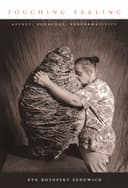
Touching Feeling: Affect, Pedagogy, Performativity (Series Q) [Eve Kosofsky Sedgwick, Michèle Aina Barale, Jonathan Goldberg] on desertcart.com. *FREE* shipping on qualifying offers. Touching Feeling: Affect, Pedagogy, Performativity (Series Q) Review: the most useful for receiving her own thinking—for reading Touching Feeling (6) - Enlisting readers' perceptive willingness, their receptivity, in the place of her own authority, a move that “requires a step to the side of antiessentialism, a relative lightening on the epistemological demand on essential truth,” Sedgwick makes her own tools and techniques for nondualistic thought, namely textural perception, the most useful for receiving her own thinking—for reading Touching Feeling (6). In one stroke of pedagogical genius, Sedgwick admits, “[if] a sentence sounds as though it’s periperformative, then it’s probably periperformative (75). Of course, not all sentences are periperformative, and, even, I will venture to assume, not all sentences that sound periperformative are, but Sedgwick's offering makes me want to touch, to reach out and ask How did it get that way? What could I do with it? Review: amazing - This is one of the best works of "post-" theory that I've read, and the essay on paranoia is a much-needed light in the haze of contemporary grad school education. My copy is dog-eared and dirty and filled with underlined passages / scrawled notes to myself (mostly reading "YES!" or "come back to this"). Sedgwick's essays are brilliant, quirky, challenging, and deeply moving. I really can't find words sufficient for my experience -- this is certainly one of the most synaesthetic and vertigo-inducing books I've read in a long time. The final essay, in particular, continues to call me back.
| Best Sellers Rank | #330,415 in Books ( See Top 100 in Books ) #18 in LGBTQ+ Literary Criticism (Books) #328 in LGBTQ+ Demographic Studies #972 in Literary Criticism & Theory |
| Customer Reviews | 4.6 4.6 out of 5 stars (64) |
| Dimensions | 5.9 x 0.5 x 9 inches |
| Edition | Illustrated |
| ISBN-10 | 0822330156 |
| ISBN-13 | 978-0822330158 |
| Item Weight | 12 ounces |
| Language | English |
| Part of series | Series Q |
| Print length | 208 pages |
| Publication date | January 17, 2003 |
| Publisher | Duke University Press |
A**R
the most useful for receiving her own thinking—for reading Touching Feeling (6)
Enlisting readers' perceptive willingness, their receptivity, in the place of her own authority, a move that “requires a step to the side of antiessentialism, a relative lightening on the epistemological demand on essential truth,” Sedgwick makes her own tools and techniques for nondualistic thought, namely textural perception, the most useful for receiving her own thinking—for reading Touching Feeling (6). In one stroke of pedagogical genius, Sedgwick admits, “[if] a sentence sounds as though it’s periperformative, then it’s probably periperformative (75). Of course, not all sentences are periperformative, and, even, I will venture to assume, not all sentences that sound periperformative are, but Sedgwick's offering makes me want to touch, to reach out and ask How did it get that way? What could I do with it?
T**S
amazing
This is one of the best works of "post-" theory that I've read, and the essay on paranoia is a much-needed light in the haze of contemporary grad school education. My copy is dog-eared and dirty and filled with underlined passages / scrawled notes to myself (mostly reading "YES!" or "come back to this"). Sedgwick's essays are brilliant, quirky, challenging, and deeply moving. I really can't find words sufficient for my experience -- this is certainly one of the most synaesthetic and vertigo-inducing books I've read in a long time. The final essay, in particular, continues to call me back.
J**A
Specious suspicion of Sedgewick summary
I just received the book, but wrote this review to challenge the Unverified Purchase review of someone "correcting" Sedgwick. While the blurb speaks of Foucault's Hermeneutics of Suspicion, the book itself contends with the genealogy of the term from Ricoeur (pg. 124) and refers to Sedgewick utilizing the term more akin to Foucault. Had the reviewer consulted the actual text or the index their concerns would be addressed.
M**N
I don’t know
I read that this was written in plain language (for bimbos like me), however it’s so tough to read. At least for a dummy like me, it was.
D**K
Suspicious hermeneutics?
Was it not the philosopher and critic Paul Ricoeur who coined the term "hermeneutic of suspicion" --- rather than Foucault?
H**.
von kaum einer aufsatzsammlung wurde ich als kulturwissenschaftler_in so sehr beeinflusst wie von eve sedgwick kosofskys essays in diesem buch. in erster linie ziele ich dabei auf ihre zuweilen messerscharfe kritik an den immer noch sehr gängigen praktiken der kritischen theorie innerhalb der westlichen akademischen welt ab, welche die autorin einst im rahmen ihrer queer theory zu großen teilen mitgeprägt hat. von paranoiden interpretationsmustern, der rigiden struktur poststrukturalistischer (!) und dekonstruktivistischer praktiken, hin zu antibiologismus-reflexen, schonungslos und in sehr bissiger art und weise versucht sich die autorin darin, die engpässe und selbstgefälligkeiten eingefahrerer literatur- und kulturtheoretischer ansätze aufzudecken, deren wissensanspruch und politischen kampf für "soziale gerechtigkeit" sie des öfteren mehr als in frage stellt. ich empfehle dieses buch auch denjenigen, die sich nicht für tomkinsche affekt-theorie oder den "affektiven turn" innerhalb der wissenschaften interessieren, sondern insbesondere denen, deren wissenschaftstheoretische ausbildung und forschungen sich um namen wie foucault, butler, kristeva, etc. drehte bzw. weiterhin drehen.
L**A
Todo llegó en tiempo y forma. El libro llegó en excelentes condiciones. Nunca había comprado en línea y esta experiencia fue un buen primer inicio.
K**E
My daughter was thrilled with this Christmas Present :)
H**A
amazing author! great book
Trustpilot
Hace 2 semanas
Hace 1 mes