We remain fully operational. Our teams are working around the clock to ensure your deliveries continue safely.

Descargar la aplicación


Servicios al cliente
Sobre nosotros
Copyright © 2025 Desertcart Holdings Limited
Descargar la aplicación
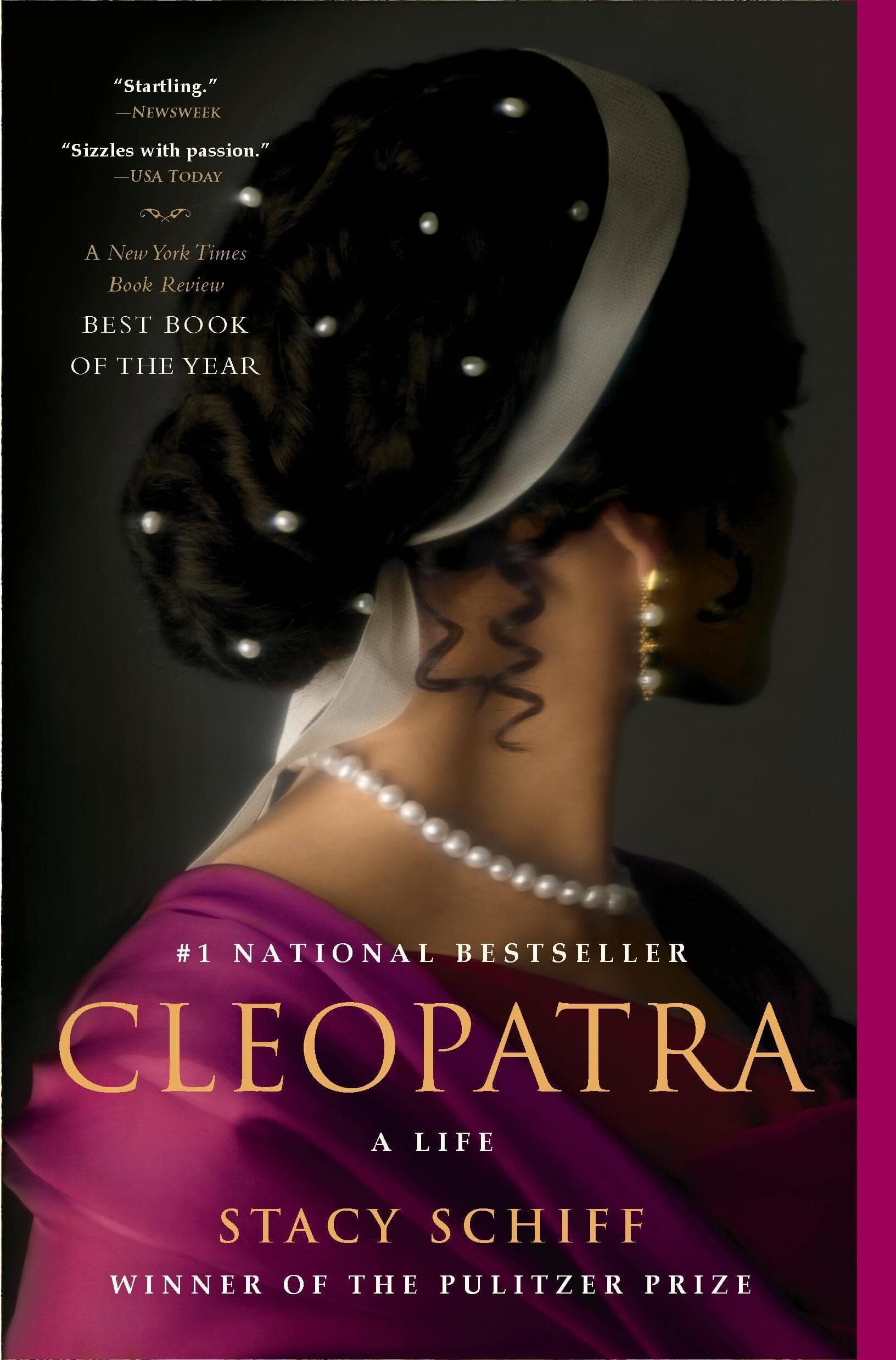
desertcart.com: Cleopatra: A Life: 9780316001946: Schiff, Stacy: Books Review: The Great Queen in Focus - The Cleopatra most of us know is a fictional creation. The story we know comes mainly from the early first century Roman writers Plutarch and Dio. According to author Stacy Schiff, that’s like reading a history of twentieth-century America written by Chairman Mao. In short, our image of Cleopatra is “the joint creation of Roman propagandists and Hollywood directors.” Schiff’s primary point is that “If the name is indelible, the image is blurry.” Her real story, as told by Schiff, is every bit as fascinating as that told by Shakespeare. Cleopatra descended “from a line of rancorous, meddlesome, shrewd, occasionally unhinged Macedonian queens,” Schiff writes and would prove to be a true daughter of her ancestors. Her name, which translates to “Glory of her Fatherland,” is fitting. Born in 69 BC, the second of three daughters in a family known for eagerly liquidating siblings, she would prove to be both the strongest and shrewdest of the brood. She may not have been as traditionally beautiful as legend would have it, but she was certainly sagacious, sophisticated, and well-educated, speaking as many as seven languages fluently, including native Egyptian, the only Ptolemaic monarch to learn the local dialect. From the Roman point of view, Egypt was a tricky subject. The richest, most agriculturally productive region in the ancient world, Egypt was, according to the classicist Ronald Syme, ”a loss if destroyed, a risk to annex, a problem to govern.” Julius Caesar arrived on Egyptian shores in 48 BC in hot pursuit of Pompey, his chief rival in the Roman Civil War, who had just been slain at Pelusium by Ptolemy XIII, a deed for which Dante would place the Egyptian king in the ninth circle of hell next to Cain and Judas. Like others who came before and after him, Caesar was entranced by the grandeur of Alexandria, “the Paris of the ancient world,” in Schiff’s romantic language, the most cultured, the most beautiful, the most refined city ever known to man. Caesar found the young Cleopatra equally intoxicating. He would make her queen – and pregnant. Caesar brought Cleopatra back from Alexandria to Rome, which Schiff likens to “sailing from the court of Versailles to eighteenth century Philadelphia.” He also brought back with him other marvelous creations of Egypt, such as the 12-month calendar, the 24-hour day, and a large public library. “It was difficult for anyone to come into contact with Ptolemaic Egypt and not contract a case of extravagance.” Indeed, one might argue, as Schiff does, that “Cleopatra properly qualifies as the founder of the Roman Empire,” because, as Lucan wrote a century after Caesar’s death, “she aroused his greed.” Cleopatra was a 26-year-old mother of Caesar’s only male child, Caesarian, living comfortably at Caesar’s villa outside of Rome when he was assassinated on the Ides of March. She was blindsided by events and would never again set foot in Rome. She would eventually fall for Mark Antony, Caesar’s most trusted lieutenant, a man “given to good living, great parties, bad women,” a brilliant cavalry officer who possessed all of Caesar’s charm but none of his self-control. Cleopatra needed Mark Antony. Octavian, the inheritor of the mantle of Caesar, was “a walking, plotting insult to her son,” Caesarian. Mark Antony’s obsession with conquering Parthia proved to be a blessing for her as only the wealth of Egypt could underwrite such an expensive campaign. Cleopatra and Mark Antony met at Tarsus in 41 BC. Her effect on the Roman general was “immediate and electrifying,” according to Schiff. The queen engaged in “a take-no-prisoners school of seduction.” The author claims that Tarsus was a rare instance when the life and legend of Cleopatra completely overlap. She brought Mark Antony back to Alexandra where he “swallowed the whole Greek culture in one gulp.” The “barrel-chested, thick-thighed Roman” fell in love with Alexandria, “a city of raspberry dawns and pearly late afternoons, with the hustle of heterodoxy and the aroma of opportunity thick in the air.” Cleopatra bore him twins in 39 BC, Alexander Helios and Cleopatra Selene; but more importantly for the stability of the Mediterranean world, Mark Antony married Octavian’s sister, a marriage alliance not unlike Pompey’s to Caesar’s daughter, Julia, in 59 BC, a union that offered a half-decade respite to internecine strife in Rome. Mark Antony’s long-awaited Parthian campaign was a failure; perhaps not on the scale of the disaster that befell Crassus in 53 BC, but bad enough that he lost 24,000 men (a full third of his army) and recorded no noteworthy victories in 18 modest battles. Meanwhile, Octavian had been piling up successes (e.g. he had crushed Sextus Pompey and kicked fellow triumvir Lepidus to the curb). Schiff writes that Antony was despondent, nearly suicidal. It was Cleopatra’s “blue ribbon rendition of the lovesick female” that rallied him. In the so-called “Donations of Alexandria” in 34 BC, Antony distributed the Roman Empire in the east to their children, who were part Roman and part Egyptian gods. The view from Rome, Schiff says, was that the Donations were “an empty gesture, a farcical overreaching by two slightly demented, power-drunk dissolutes.” In 32 BC Mark Antony divorced Octavia. The pretext for the final showdown had finally arrived. Antony was, in Octavian’s opinion, “irredeemably contaminated by the Oriental languor and the un-Roman luxuries of the East.” He relished the stories of how Antony fawned over Cleopatra like a eunuch, giving her foot rubs in public, among other embarrassing acts of servitude. With the (dubious) claim that Cleopatra was “poised to conquer [Rome] as she had conquered Antony,” the Senate declared war on Egypt in October 32 BC and then voted to deprive Antony of his consulship and relieve him of all Roman authority. “The experience, the popularity, the numbers, were all on Antony’s side,” Schiff writes, “he was the skilled commander behind whom stood the most powerful dynasties of the East” and the vast riches of Egypt with its determined queen who could not co-exist with Octavian so long as her son, Caesarian, lived. Indeed, “Antony could not win a war without [Cleopatra]. Octavian could not wage one.” The culminating battle of Actium in early September 31 BC was as decisive as it was anticlimactic. Octavian had eroded Antony’s superior land force over the course of the summer by maintaining a close blockade. Cleopatra and Antony shamefully abandoned their army and fled to Egypt. The two lovers were cornered. Antony’s army disintegrated. Whole legions defected, as did allied kings. The raucous “Inimitable Livers” of Alexandria, as Antony and Cleopatra once playfully called their retinue, changed their club name to “Companion’s to the Death.” Antony was 53-years-old, Cleopatra 38. Their end was so theatrically dramatic that Shakespeare hardly had to change a thing. When Cleopatra had her death falsely reported to Antony, he fell on his sword in inconsolable grief. He lived long enough to learn that the queen was actually still alive and breath his last breathe in her arms. Nine days later Cleopatra took her own life in turn, most likely by poison, Schiff says. “Cleopatra’s asp is the cherry tree of ancient history”: Schiff claims that there is no way a single snake could have killed the queen and her two faithful attendants, Iras and Charmion, so quickly and peacefully. “A fourth casualty of August 10, 30 BC may well have been the truth,” she writes. One thing was for certain: Cleopatra would never be the crown jewel in Octavian’s fabulous triumph parade back in Rome, where the enormity of the Egyptian riches quickly led to massive inflation and a tripling of interest rates. Schiff wants us to appreciate Cleopatra for who she truly was – and for good reason. For far too long the great queen has been a caricature, completely misrepresented, unfairly maligned, and largely misinterpreted. “It has always been preferable to attribute a woman’s success to her beauty rather than her brains,” Schiff writes, “to reduce her to the sum of her sex life.” Clearly, Cleopatra was much more than a celebrated lover. Nevertheless, Schiff bemoans, “we will remember that Cleopatra slept with Julius Caesar and Mark Antony long after we have forgotten what she accomplished in doing so, that she sustained a vast, rich, densely populated empire in its troubled twilight, in the name of a proud and cultivated dynasty.” That she was “a remarkably capable queen, canny and opportunistic in the extreme, a strategist of the first rank.” Like every other book by Stacy Schiff that I’ve read, this one comes highly recommended. It is that rare book that both layman and experts will find satisfying. Review: Engaging and well-researched - This is a pretty solid introduction to the history of the period, well-researched and serious enough to appeal to any armchair historian, and lively enough to keep anyone with a passing interest in the ancient world engaged. Schiff's point with this was that Cleopatra's myth totally obscured her reality, even in her own lifetime. There are a lot of interesting meditations on fame and power to be had there. Cleopatra died in the wake of a war with Rome, and yet we mainly know Cleopatra from contemporary Roman sources. A few people in other courts left written records of her time, but really her history was written by her enemies. That the old girl has still come off rather well is a testament to how extraordinary her reign really was. I like a good popular history- Schiff's seems very admirable, but I didn't find her prose as lovely as some people apparently did. Still, she makes a solid effort to put a little color into her history; she paints a picture, something I appreciate. It's hard to get both academic rigor and good storytelling into an account. Two thousand years, and it's debatable that anyone has ever topped Cleopatra for either extravagance or power. Imagining her and Antony meeting in Tarsus, announcing herself as "Venus come to revel with Dionysus for the good of Asia", surrounding him and his men with an overabundance of luxury, in apartments bedecked with a king's ransom in flowers, you come to understand why Cleopatra was legend in her own time. That sort of detail and description really helps. Academic history seldom indulges such details, or at least rarely frames them so delectably. Popular history seldom touches on as many legitimate sources as Schiff cites, or points out distinctions between them so regularly. Schiff is also a female historian telling a woman's story, yet mercifully she doesn't dwell too hard on that. We know Cleopatra from Roman writers, who were all dudes with a particular view of women and relationships, and so the expected sexual volleys were launched at a powerful foreign queen. Rome laid the foundation for the next twenty centuries of Western culture, so Cleopatra understandably served as a reliable shorthand for every sort of debauchery in that time. And Schiff pretty much stops there with gender. Good for her. As a queen and product of Ptolemaic Egypt, Cleopatra had a very different view of her own gender than her detractors. Schiff does a smart thing; realizing that we can only view Cleopatra culturally and personally through multiple layers of refraction, she just leaves Cleopatra the woman alone for the most part and focuses on Cleopatra in her role as queen and in her relationships to personal and political counterparts. If, like me, you don't care for histories with an overly obvious modern agenda, have no fear. Schiff did choose to follow a particular narrative of the period. She gives us the broad spectrum of opinions on an event, but I did feel like a lot of the history that's really debatable is presented more or less as fact. We know very little about most of these events. I suppose I'm willing to make that trade-off, even as a historian, for a compelling story. That's something a lot of history people wouldn't say, but I've always thought of history as being closer to literature than science. This may be one reason why I didn't go for a PhD. I am a little concerned, though, that Schiff's account seems so close to HBO's "Rome" Her book came out in 2011, so she would have been either thinking about it or working on it while the show was on in 2005 and 2007. The show is also very well researched in its depiction of Roman life, but takes quite a few liberties with the history. It's hard to say whether I just had HBO's "Rome" on the brain while reading the book, or if the book did seem to cleave suspiciously close to a similar version of events. Granted, there is nothing implausible about Schiff's account based on the sources we have; the actual personalities involved don't seem to warrant much exaggeration. But in honest truth we simply have very few accounts and little evidence of the events of these years. "Rome" and Schiff's "Cleopatra" are both aimed towards an erudite yet popular audience, so it's quite possible that their entertaining yet plausible versions of the story would have many elements in common. What makes for scrupulously documented history is not necessarily what makes for good reading or good television, but anyone partaking of either of either this book or the series will probably have figured that out already. The downside is that while Schiff may have set out to separate myth from truth, in the service of keeping people interested, she may have given us yet another myth. It's a modern myth, and more fair or at least better supported than most of what came before, but ultimately it might not be any more accurate than a hundred others. However, both "Rome" and "Cleopatra: A Life" are largely based the same period sources, so as far as I'm concerned you could do worse for either history or entertainment.


| Best Sellers Rank | #30,576 in Books ( See Top 100 in Books ) #6 in Ancient Egyptians History #58 in Women in History #145 in Women's Biographies |
| Customer Reviews | 4.2 4.2 out of 5 stars (2,484) |
| Dimensions | 5.65 x 1.35 x 8.3 inches |
| Edition | Reprint |
| ISBN-10 | 0316001945 |
| ISBN-13 | 978-0316001946 |
| Item Weight | 2.31 pounds |
| Language | English |
| Print length | 432 pages |
| Publication date | September 6, 2011 |
| Publisher | Little, Brown Paperbacks |
T**I
The Great Queen in Focus
The Cleopatra most of us know is a fictional creation. The story we know comes mainly from the early first century Roman writers Plutarch and Dio. According to author Stacy Schiff, that’s like reading a history of twentieth-century America written by Chairman Mao. In short, our image of Cleopatra is “the joint creation of Roman propagandists and Hollywood directors.” Schiff’s primary point is that “If the name is indelible, the image is blurry.” Her real story, as told by Schiff, is every bit as fascinating as that told by Shakespeare. Cleopatra descended “from a line of rancorous, meddlesome, shrewd, occasionally unhinged Macedonian queens,” Schiff writes and would prove to be a true daughter of her ancestors. Her name, which translates to “Glory of her Fatherland,” is fitting. Born in 69 BC, the second of three daughters in a family known for eagerly liquidating siblings, she would prove to be both the strongest and shrewdest of the brood. She may not have been as traditionally beautiful as legend would have it, but she was certainly sagacious, sophisticated, and well-educated, speaking as many as seven languages fluently, including native Egyptian, the only Ptolemaic monarch to learn the local dialect. From the Roman point of view, Egypt was a tricky subject. The richest, most agriculturally productive region in the ancient world, Egypt was, according to the classicist Ronald Syme, ”a loss if destroyed, a risk to annex, a problem to govern.” Julius Caesar arrived on Egyptian shores in 48 BC in hot pursuit of Pompey, his chief rival in the Roman Civil War, who had just been slain at Pelusium by Ptolemy XIII, a deed for which Dante would place the Egyptian king in the ninth circle of hell next to Cain and Judas. Like others who came before and after him, Caesar was entranced by the grandeur of Alexandria, “the Paris of the ancient world,” in Schiff’s romantic language, the most cultured, the most beautiful, the most refined city ever known to man. Caesar found the young Cleopatra equally intoxicating. He would make her queen – and pregnant. Caesar brought Cleopatra back from Alexandria to Rome, which Schiff likens to “sailing from the court of Versailles to eighteenth century Philadelphia.” He also brought back with him other marvelous creations of Egypt, such as the 12-month calendar, the 24-hour day, and a large public library. “It was difficult for anyone to come into contact with Ptolemaic Egypt and not contract a case of extravagance.” Indeed, one might argue, as Schiff does, that “Cleopatra properly qualifies as the founder of the Roman Empire,” because, as Lucan wrote a century after Caesar’s death, “she aroused his greed.” Cleopatra was a 26-year-old mother of Caesar’s only male child, Caesarian, living comfortably at Caesar’s villa outside of Rome when he was assassinated on the Ides of March. She was blindsided by events and would never again set foot in Rome. She would eventually fall for Mark Antony, Caesar’s most trusted lieutenant, a man “given to good living, great parties, bad women,” a brilliant cavalry officer who possessed all of Caesar’s charm but none of his self-control. Cleopatra needed Mark Antony. Octavian, the inheritor of the mantle of Caesar, was “a walking, plotting insult to her son,” Caesarian. Mark Antony’s obsession with conquering Parthia proved to be a blessing for her as only the wealth of Egypt could underwrite such an expensive campaign. Cleopatra and Mark Antony met at Tarsus in 41 BC. Her effect on the Roman general was “immediate and electrifying,” according to Schiff. The queen engaged in “a take-no-prisoners school of seduction.” The author claims that Tarsus was a rare instance when the life and legend of Cleopatra completely overlap. She brought Mark Antony back to Alexandra where he “swallowed the whole Greek culture in one gulp.” The “barrel-chested, thick-thighed Roman” fell in love with Alexandria, “a city of raspberry dawns and pearly late afternoons, with the hustle of heterodoxy and the aroma of opportunity thick in the air.” Cleopatra bore him twins in 39 BC, Alexander Helios and Cleopatra Selene; but more importantly for the stability of the Mediterranean world, Mark Antony married Octavian’s sister, a marriage alliance not unlike Pompey’s to Caesar’s daughter, Julia, in 59 BC, a union that offered a half-decade respite to internecine strife in Rome. Mark Antony’s long-awaited Parthian campaign was a failure; perhaps not on the scale of the disaster that befell Crassus in 53 BC, but bad enough that he lost 24,000 men (a full third of his army) and recorded no noteworthy victories in 18 modest battles. Meanwhile, Octavian had been piling up successes (e.g. he had crushed Sextus Pompey and kicked fellow triumvir Lepidus to the curb). Schiff writes that Antony was despondent, nearly suicidal. It was Cleopatra’s “blue ribbon rendition of the lovesick female” that rallied him. In the so-called “Donations of Alexandria” in 34 BC, Antony distributed the Roman Empire in the east to their children, who were part Roman and part Egyptian gods. The view from Rome, Schiff says, was that the Donations were “an empty gesture, a farcical overreaching by two slightly demented, power-drunk dissolutes.” In 32 BC Mark Antony divorced Octavia. The pretext for the final showdown had finally arrived. Antony was, in Octavian’s opinion, “irredeemably contaminated by the Oriental languor and the un-Roman luxuries of the East.” He relished the stories of how Antony fawned over Cleopatra like a eunuch, giving her foot rubs in public, among other embarrassing acts of servitude. With the (dubious) claim that Cleopatra was “poised to conquer [Rome] as she had conquered Antony,” the Senate declared war on Egypt in October 32 BC and then voted to deprive Antony of his consulship and relieve him of all Roman authority. “The experience, the popularity, the numbers, were all on Antony’s side,” Schiff writes, “he was the skilled commander behind whom stood the most powerful dynasties of the East” and the vast riches of Egypt with its determined queen who could not co-exist with Octavian so long as her son, Caesarian, lived. Indeed, “Antony could not win a war without [Cleopatra]. Octavian could not wage one.” The culminating battle of Actium in early September 31 BC was as decisive as it was anticlimactic. Octavian had eroded Antony’s superior land force over the course of the summer by maintaining a close blockade. Cleopatra and Antony shamefully abandoned their army and fled to Egypt. The two lovers were cornered. Antony’s army disintegrated. Whole legions defected, as did allied kings. The raucous “Inimitable Livers” of Alexandria, as Antony and Cleopatra once playfully called their retinue, changed their club name to “Companion’s to the Death.” Antony was 53-years-old, Cleopatra 38. Their end was so theatrically dramatic that Shakespeare hardly had to change a thing. When Cleopatra had her death falsely reported to Antony, he fell on his sword in inconsolable grief. He lived long enough to learn that the queen was actually still alive and breath his last breathe in her arms. Nine days later Cleopatra took her own life in turn, most likely by poison, Schiff says. “Cleopatra’s asp is the cherry tree of ancient history”: Schiff claims that there is no way a single snake could have killed the queen and her two faithful attendants, Iras and Charmion, so quickly and peacefully. “A fourth casualty of August 10, 30 BC may well have been the truth,” she writes. One thing was for certain: Cleopatra would never be the crown jewel in Octavian’s fabulous triumph parade back in Rome, where the enormity of the Egyptian riches quickly led to massive inflation and a tripling of interest rates. Schiff wants us to appreciate Cleopatra for who she truly was – and for good reason. For far too long the great queen has been a caricature, completely misrepresented, unfairly maligned, and largely misinterpreted. “It has always been preferable to attribute a woman’s success to her beauty rather than her brains,” Schiff writes, “to reduce her to the sum of her sex life.” Clearly, Cleopatra was much more than a celebrated lover. Nevertheless, Schiff bemoans, “we will remember that Cleopatra slept with Julius Caesar and Mark Antony long after we have forgotten what she accomplished in doing so, that she sustained a vast, rich, densely populated empire in its troubled twilight, in the name of a proud and cultivated dynasty.” That she was “a remarkably capable queen, canny and opportunistic in the extreme, a strategist of the first rank.” Like every other book by Stacy Schiff that I’ve read, this one comes highly recommended. It is that rare book that both layman and experts will find satisfying.
D**7
Engaging and well-researched
This is a pretty solid introduction to the history of the period, well-researched and serious enough to appeal to any armchair historian, and lively enough to keep anyone with a passing interest in the ancient world engaged. Schiff's point with this was that Cleopatra's myth totally obscured her reality, even in her own lifetime. There are a lot of interesting meditations on fame and power to be had there. Cleopatra died in the wake of a war with Rome, and yet we mainly know Cleopatra from contemporary Roman sources. A few people in other courts left written records of her time, but really her history was written by her enemies. That the old girl has still come off rather well is a testament to how extraordinary her reign really was. I like a good popular history- Schiff's seems very admirable, but I didn't find her prose as lovely as some people apparently did. Still, she makes a solid effort to put a little color into her history; she paints a picture, something I appreciate. It's hard to get both academic rigor and good storytelling into an account. Two thousand years, and it's debatable that anyone has ever topped Cleopatra for either extravagance or power. Imagining her and Antony meeting in Tarsus, announcing herself as "Venus come to revel with Dionysus for the good of Asia", surrounding him and his men with an overabundance of luxury, in apartments bedecked with a king's ransom in flowers, you come to understand why Cleopatra was legend in her own time. That sort of detail and description really helps. Academic history seldom indulges such details, or at least rarely frames them so delectably. Popular history seldom touches on as many legitimate sources as Schiff cites, or points out distinctions between them so regularly. Schiff is also a female historian telling a woman's story, yet mercifully she doesn't dwell too hard on that. We know Cleopatra from Roman writers, who were all dudes with a particular view of women and relationships, and so the expected sexual volleys were launched at a powerful foreign queen. Rome laid the foundation for the next twenty centuries of Western culture, so Cleopatra understandably served as a reliable shorthand for every sort of debauchery in that time. And Schiff pretty much stops there with gender. Good for her. As a queen and product of Ptolemaic Egypt, Cleopatra had a very different view of her own gender than her detractors. Schiff does a smart thing; realizing that we can only view Cleopatra culturally and personally through multiple layers of refraction, she just leaves Cleopatra the woman alone for the most part and focuses on Cleopatra in her role as queen and in her relationships to personal and political counterparts. If, like me, you don't care for histories with an overly obvious modern agenda, have no fear. Schiff did choose to follow a particular narrative of the period. She gives us the broad spectrum of opinions on an event, but I did feel like a lot of the history that's really debatable is presented more or less as fact. We know very little about most of these events. I suppose I'm willing to make that trade-off, even as a historian, for a compelling story. That's something a lot of history people wouldn't say, but I've always thought of history as being closer to literature than science. This may be one reason why I didn't go for a PhD. I am a little concerned, though, that Schiff's account seems so close to HBO's "Rome" Her book came out in 2011, so she would have been either thinking about it or working on it while the show was on in 2005 and 2007. The show is also very well researched in its depiction of Roman life, but takes quite a few liberties with the history. It's hard to say whether I just had HBO's "Rome" on the brain while reading the book, or if the book did seem to cleave suspiciously close to a similar version of events. Granted, there is nothing implausible about Schiff's account based on the sources we have; the actual personalities involved don't seem to warrant much exaggeration. But in honest truth we simply have very few accounts and little evidence of the events of these years. "Rome" and Schiff's "Cleopatra" are both aimed towards an erudite yet popular audience, so it's quite possible that their entertaining yet plausible versions of the story would have many elements in common. What makes for scrupulously documented history is not necessarily what makes for good reading or good television, but anyone partaking of either of either this book or the series will probably have figured that out already. The downside is that while Schiff may have set out to separate myth from truth, in the service of keeping people interested, she may have given us yet another myth. It's a modern myth, and more fair or at least better supported than most of what came before, but ultimately it might not be any more accurate than a hundred others. However, both "Rome" and "Cleopatra: A Life" are largely based the same period sources, so as far as I'm concerned you could do worse for either history or entertainment.
S**I
Infortmative Read!
The book clearly explains Cleopatra’s intelligence, leadership, and political skill, going beyond the usual myths about her. It is an interesting and informative read for anyone who enjoys history.
J**C
To win one Pulitzer Prize is impressive enough, but to win it twice for nonfiction works on completely unrelated subjects, and to be shortlisted for a third, makes for a considerable feat. Stacy Schiff has achieved just that, and her latest winner, `Cleopatra - A Life' is testament to her extraordinary skills of getting under the skin of a subject and presenting it to the world is a completely fascinating new way. Before I read this book my knowledge of the famous Egyptian queen was limited to the epic film with the sadly late Elizabeth Taylor in the starring role, and to Shakespeare's version of events, most recently enacted wonderfully by Kim Cattrall in Liverpool. (I hasten to add that I have never seen Amanda Barry and Sid James in the Carry On version - and absolutely do not intend to). Here Schiff makes Cleopatra come to life in a vivid and enthralling way, reading between the lines of history, and adding her own intelligent and completely plausible take on this wonderful story. Cleopatra was born into the dynasty of the Ptolemies, where there was a tradition of inter family marriages and incest as a concept just didn't exist. She was a clever girl, who was the first in her family to even bother to learn to speak the native Egyptian language of the seven million people that they ruled under. So there were early signs there of both intelligence and political astuteness. She managed the amazing feat of being the lover and bearing children for both Julius Caesar, and then later the dashing Mark Anthony too. At aged just twenty two, she must have realised that to have a child with Caesar would secure her county's future for a considerable time, and it surely did. Schiff argues that she was not an amazing beauty, as we have come to picture with the Taylor/Burton version of events, but rather she was a complete charmer, and used her alluring character to attract men in a way that was quite something to behold. And not just a relatively pretty face, she is reputed to have practiced alchemy, and to have found a cure for Caesar's baldness too - although as it included burnt mice, burnt horses teeth, bear's grease, and deer marrow, it is easy to see why it didn't really catch on. She was a rich and powerful woman in her own right, but she sought political alliances with Rome, and after Caesars's death, had her heart, or more realistically her head, set on the dashing Mark Anthony. He had a reputation for being something of a bad boy - on one occasion apparently attaching lions to his chariot for a jaunt around Rome just for a laugh. But he stood no chance against the guile and charm of Cleo - she certainly knew how to make an entrance in her golden and jewelled barge. They soon became lovers, and seem to have stayed in love with each other - admittedly through various arguments and spats - until their tragic demise. Schiff gives brilliant detail that makes this story come alive. It is a great read, and a very well argued work. She debunks many myths, and puts so much detail into the narrative that it is baffling just how much research it must have taken to complete this work. If you want a dazzling tale of power, lust, love and tragedy - then look no further.
L**L
Stacy Schiff dispels the myths surrounding this most intriguing woman, the last to occupy the throne of Egypt. It is well written and it takes a critical look at what the authors of Antiquity wrote about her and at the role of modern media in perpetuating those myths. A very worthwhile reading to those who love history.
A**N
The seller was efficient and the delivery was without problems. About the product: the letters are too tiny, reading it is difficult, not a pleasure but an effort. Possible only by daylight, outdoor or very near a window. I also find the writing very boring and unpleasant. Totally OVERRATED
A**A
Ein spannend faszinierendes Buch, so als wäre man dabei. Im Detail Kleidung, Schmuck, Essen, Männer und Macht. Übrigens Cleopatra war keine Ägypterin. Mike Stenzel
C**Y
Not really sure why this got rave reviews. Rather dull in my opinion.
Trustpilot
Hace 2 semanas
Hace 1 mes