Desert Online General Trading LLC
Dubai, United Arab Emirates
Desert Online General Trading LLC
Dubai, United Arab Emirates

Full description not available
B**N
Mandatory for Lean experts
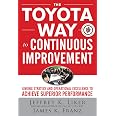
I have read all books by Jeff Liker and most of them more than once. His "The Toyota Way", "Toyota Culture" and "Toyota Talent" are classics for anyone interested in Lean (Toyota Business System). They give a good and detailed view in the way Lean works for Toyota.Many Lean Masters/Practitioners are working in a less ideal situation and are struggling to get Lean implemented or to sustain/improve Lean in an organization. As with 5S, sustaining is the hardest part of being Lean."The Toyota Way for Continuous Improvement" brings the understanding that the PDCA cycle is the necessary part in a CI process. As a consultant I notice that the CA part of this cycle is often forgotten and the operation mostly falls back to its old levels.Most companies that start with their Lean adventure, start with the ideal of getting Lean but actually look for a nice head count reduction. After a first start the operations always falls back to a basic level of Lean with every now and then an eruption of some Lean activities. Which is preferably linked with the next headcount reduction?This book gives good guidelines on what to do when such a fallback has taken place. The 8 cases Liker/Franz describe, give a good view on how to improve these operations. What I have learned from this wide variation of companies, is that it takes about 6 to 8 years to really implement Lean in companies that already understand some things about it. What I also recognized is the general feeling in such divers companies, is what I call "we are different" feeling within such companies. Often they have a Lean façade (as Jeff Liker calls it so strikingly). I've heard this "different-saying" from Banks, Hospitals, Government organizations, and so on. The cases in this book show that the Lean tools can work everywhere, whenever there is waste.Reading this book often brought a recognizing feeling of stages companies are in, who mention themselves as being Lean. No empowerment, 5S only on a basic level, only limited visual management, CI as a saving tool. This book can help every Lean Master/Practitioner to bring the company they are working for to the next level of Lean in a never ending journey.
J**Y
Much deeper than just Lean tools
Jeff Liker walks the talk. This alone makes this book truly credible and makes it a necessary read for each of us seeking process excellence.In this latest effort, Prof. Liker and coauthor Jim Franz take us deeper than kanban and hoshin kanri to the real philosophy behind Toyota's consistent expertise in manufacturing. The authors use insight and experience to tell the story of WHY Toyota has achieved excellence. The consistent theme is the PDCA cycle (Plan-Do-Check-Adjust). This practice is not new; Demming gave it to the world years ago. But just as the concert pianist and brand new piano student can both play a C-Scale, the master has done it longer, better, with more nuance and breadth. So Toyota has more deeply understood the learning from PDCA than any of the rest of us.Most useful, to me, were sections such as chapter 5; "Lean Out Processes or Build Lean Systems?" In these more philosophical chapters, Liker and Franz both force and lead the leader into deeper understanding of WHY; why does Lean work for Toyota when it seems to underperform for others? Is it a kanban card which sparkles more brightly? Is it better charts on the wall? Or is it the investment in people made in the context of process excellence? And, if so, just why is this the case?It's a long book. You won't read it in one setting. Similar to Liker's other books, there is just a lot to work through. There are more case studies here which will add for some readers and clutter for others. But, face it, it is tough to make a process-oriented business work so don't be surprised you'll have to work to understand this at a depth to be sufficiently useful.This book reaches the level of Womack and Jones' "Lean Thinking" and Spears' "Chasing the Rabbit" as necessary books for Lean leaders to read and know.
R**Y
Great continuous improvment book
I like being able to read how something worked and not just theory about how something might work. This book went into what worked and why it worked. I would recommend this book to anyone who wants to figure out how to implement continuous improvement.
A**G
Exceeding My Expectations!
I pre-ordered this book and have been eagerly awaiting it for quite a while. Started reading it a couple of days ago, and am happy to say that so far, it has exceeded my expectations. Excellent explanation of role of PDCA in creating an organization that is learning, improving, and learning together over and over again. Excellent mix of theory and case studies so far. I believe that this book will be a great read for anyone at any place along their lean journey. Can't wait to read more!
J**V
Great Book
One of the best lean books I have read. Liker strongly pushes the inch wide and mile deep philosophy of lean implementation rather than peanut buttering a bunch of tools around the shop. Great to read to really think about how you are implementing lean and why you have failed in the past.
S**R
Excellent book for continuous improvement
Excellent book for continuous improvement. Try the other Toyota way books, Talent and Lean Leadership, to gain a more wholistic view and more complementary tools to this one!
A**S
Excellent Read for those interested in PDCA Thinking
The authors do a great job with the subject material and bring it to life with stories. The Sensei reflection sections are valuable and demonstrate the power of reflection as a key part of PDCA thinking.
T**R
Four Stars
Good read
Trustpilot
Hace 5 días
Hace 3 semanas
Hace 1 mes
Hace 1 semana