
Descargar la aplicación


Servicios al cliente
Sobre nosotros
Copyright © 2025 Desertcart Holdings Limited
Descargar la aplicación
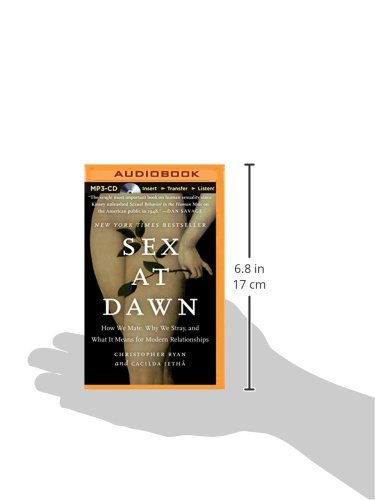


desertcart.com: Sex at Dawn: 9781491512401: Christopher Ryan, Cacilda Jetha, Allyson Johnson, Jonathan Davis, Christopher Ryan: Books Review: Incredible Facts About Monogamy and our Prehistoric Ancestors - Wish I'd read this book 30 years ago. **SPOILER ALERT** Discussion of the main themes and revelatory points follows. First, the book is extremely well written. Complex subjects are analyzed and explained clearly and concisely, and wonderful examples and metaphors are frequently offered to emphasize points. The authors also display a delightful sense of humor at various points during exploration of topics most people don't feel comfortable discussing openly. The thing that blew me away the most was his discussion of how agriculture changed the world more than any other single event or series of events. With the advent of farming, human societies invented concepts of land ownership and private property. This led to the formation of hierarchical societies, which was necessary to wage war for land and other limited resources--a circumstance that did not exist among hunter-gatherer societies, they say, because no one claimed to own the land or anything else. There simply were no wars for land or resources among prehistoric people; they lived in a world of abundance and would have had no reason to organize to control territory; nor did they store food; they were "immediate return" hunter-gatherers, meaning they consumed what they found or acquired daily. I can't find any flaws with the theories or logic. Another reader did, however, writing: “ ‘If human sexuality developed primarily as a bonding mechanism in interdependent bands where paternity certainty was a nonissue, then the standard narrative of human evolution is toast.’ If the standard narrative of human evolution is, in fact, ‘toast,’ how does their competing worldview better help explain contemporary human sexual relations?” The book answers this question with the detailed discussion of agriculture referenced above, noting the many social, cultural and legal consequences that resulted from land ownership, hoarding of food, farming, and the need to preserve and pass on private property to heirs. The authors further argue that monogamy is simply a cultural construct that arose with agriculture as the logical consequence of abandoning communal living. Once everyone stopped cooperating mutually for each other's survival and farming began, a psychological shift from abundance to scarcity occurred, as resources suddenly became limited, had to be cultivated, hoarded, and sold, rather than gathered communally and distributed equally. Sexuality followed the same path. By imposing monogamy, men could have some reassurance of their paternity, which became increasingly important, because fathers passed property to their children (unlike in communal times), so paternity certainty became vital to ensure that property was passed to true heirs, not another man's children. The whole thing is amazing and forces one to reexamine the merit and utility of monogamy, among various other cultural beliefs. Fun and fantastic read. Review: Agriculture just RUINED EVERYTHING! - (Hey! Hey, baby, baby, waitwaitwaitwait. Wait. Wait! Baby, don't... don't freak out Okay, okay, I know what this looks like, but I can explain! Quiet, Chad, let me handle this. I can explain! I'm just - please, stop crying and listen - I'm just fulfilling my evolutionary heritage and helping to cement social bonds with... um... the pizza boy, but that'snotthepoint!! That's not the point! Look, before you do anything, y'know, drastic, you just need to read this book....) Humans are really good at figuring things out. As far as we go, we have a real knack for taking things apart and figuring out how they work. Though determined curiosity and perseverance, we know what's happening at the center of the sun, we know how the continents slide across the surface of the earth, how plants turn sunlight into potatoes. We can smash atoms and cure disease and peer back to the moment of creation itself. There is almost nothing that humans cannot comprehend if we put our minds to it. Except ourselves. Don't get me wrong - we have made great strides in philosophy and psychology, and come very far in understanding human origins and our spread across the planet. But there is a fundamental problem that we have when we study ourselves, and that is that we cannot do so objectively. Try as we might, it is impossible to completely put aside our own biases, judgments and backgrounds when we study how humans behave and try to understand why they do what they do. They are still there, if you look for them, and nowhere are they more evident than in the search for the origins of foundations of human sexuality. The standard model, as it's often called, goes something like this: ancient men and women established a pattern of monogamy based on mutual self-interest. The man would keep to one mate in order to be absolutely sure that he was dedicating his efforts towards raising his own kids and not someone else's. If a man had multiple partners, he wouldn't be able to provide for them all, and his genetic investment would die out. So, in terms of efficiency, it is much better for the man to keep himself to one woman, focusing all his attention on the children he knows he has fathered and making sure they live to have children of their own. As far as women are concerned, they require the resources that the men bring. When pregnant, a woman's physical capacities are reduced and she is in a vulnerable state, so by staying monogamous, she is essentially purchasing security and resources that would otherwise be unavailable to her in a world that brought quick and merciless death to the weak. If she slept around, the man wouldn't be sure that the child she bore was his, and would therefore have less interest in taking care of the both of them. Thus, monogamy is the best bet to assure the survival of herself and her child. This is the story that's been told for a long time, and it's considered by most to be the truth. Christopher Ryan and Cacilda Jetha, however, disagree. Not only do they think the standard model is wrong, but they think it is nothing more than a relic of our own modern biases and hang-ups. The process, they say, can be referred to as "Flintstonization." As you know, the characters in "The Flintstones" were more or less just like us. They went to work, they had houses and appliances and domestic disputes. They had the same issues and amusements as we did, because we overlaid our own society onto a prehistoric setting. Now in cartoons, that's good entertainment, and in the right hands it can be used as powerful satire and commentary. In science, though, it's just no good. Starting with Darwin, people have imagined prehistoric humans to have the same sexual values that we have: a demure, reluctant female who is very choosy in deciding which male she will mate with. A bond forms, and they are faithful to each other until the end of their days. Later researchers, looking at our ape cousins, have plenty of observational research to support the idea that very early humans were monogamous. They look at chimps and gorillas and baboons and confirm what they had always suspected - that our natural sexual state is one of monogamy. The logical conclusion, then, is that our modern attitude towards sexuality, with the rising rates of divorce and teen sexuality, represents a deviation from the way things "should" be, and must therefore be fixed. A loveless marriage, a man's roving eye, a woman who cuckolds her husband, serial monogamists, all of these, according to the standard model, result from our attempts to go against our nature. Or is it the other way around? Ryan and Jetha have put together a very compelling argument that the standard model of pre-agricultural human sexuality is not only wrong, but dangerously so. By looking at modern foraging tribes and the way they live, as well as doing a comparative analysis of humans against our nearest ape cousins, they have come to this conclusion: our "natural" sexual state is one of promiscuity. Back in the day, communities were small and tightly bonded, and sex was one of the things that held those bonds tight. Rather than one man and one woman struggling to protect their own genetic line, their entire community made sure that children were cared for and raised well. Everyone was everyone else's responsibility, and in a world of plenty there was no reason to try and enforce any kind of sexual exclusivity. It was only with the rise of agriculture that it became important to know what was yours, as opposed to someone else's, and that quickly extended from fields and livestock to wives and children. Now that people were keeping their own food and making sure to divide their lands from their neighbor's lands, sharing went out of style. With so much work put into growing crops, that's where the standard model of economic monogamy settled in, and it's been with us ever since. The advent of agriculture changed everything, and not everything for the better. In addition, the very biology of humans, from the way sperm behaves to the shape of the penis, to the anatomy of the clitoris to the noises women make in the throes of orgasm - all of these point to an evolutionary history of sexual promiscuity. The evidence of our bodies tell us that being locked into a lifetime monogamous pair-bond is not what we evolved to do. Ryan and Jetha know that their view of the fundamental nature of human sexuality will not be popular, mainly because it completely undermines our vision of who we are. So much law, tradition, education, entertainment and just plain common sense relies on humans being naturally monogamous. It's something that seems so obvious to us that we cannot imagine a society built any other way. Unfortunately, if Ryan and Jetha are right, society is the problem. We have established a cultural norm that goes completely against our biological and evolutionary nature, and which makes people miserable on a daily basis. I bought this book mainly to stop Dan Savage from nagging me about it. If you listen to Savage's podcast - and you should - you will soon realize that monogamy is something that a lot of people aren't good at. We look at other people with lust in our hearts, we cheat, we stay in relationships where we're sexually miserable just because that's what we "should" do. For most people, our sexual urges are to be fought against, with everything from self-restraint to social shame to law itself. It seems like staying monogamous is one of the hardest things for many people to do. This, of course, raises the question: if it were natural, would it really be so hard? It is a fascinating read, which covers a lot of ground and makes some very compelling arguments. It's also quite funny in places, which was quite welcome. In discussing the standard model the authors note that this is, fundamentally, prostitution, wherein the woman uses sex for material resources. This sexual barter system has been assumed to be true for years, leading the authors to write, "Darwin says your mother's a whore. Simple as that." They also put in some special notes for adventurous grad students in the field of sexual research (especially genital to genital rubbing, something popular in bonobo apes, but which is rarely studied in humans) and re-titling the extremely popular song "When A Man Loves a Woman" as "When a Man Becomes Pathologically Obsessed and Sacrifices All Self-Respect and Dignity by Making a Complete Ass of Himself (and Losing the Woman Anyway Because Really, Who Wants a Boyfriend Who Sleeps Out in the Rain Because Someone Told Him To?)" I don't really know what can be made of the serious information proposed in this book. No matter how it may seem, the authors are not proposing a dissolution of marriage or compulsory orgies or anything like that, nor is this book a "Get Out of Cheating Free" card. We've spent thousands of years putting these restraints on human sexuality, and they're not going to come off anytime soon. The best we can do right now is to be aware of where our ideas about relationships come from, and stop to think about the difference between what is true and what we wish were true. This understanding might help to save relationships that would otherwise work. People cheat not because they're scum or whores, but because they're human. Being monogamous is really hard not because we're weak or flawed, but because it's not what our bodies want for us. The search for a better understanding of human nature should lead us to being better humans, and nothing should be left out. Not even our most sacred beliefs. Not even sex. ------------------------------------------------ "Asking whether our species is naturally peaceful or warlike, generous or possessive, free-loving or jealous, is like asking whether H2O is naturally a solid, liquid or gas. The only meaningful answer to such a question is: It depends." - Christopher Ryan and Cacilda Jetha, Sex at Dawn ------------------------------------------------ (Okay? Okay, baby? So you see, I wasn't really cheating - okay, I was, but you can see why, right? I was just acting in accordance with my fundamental humanity, following the biological impulses as determined by millions of years of evolution when we... Hey, where are you going? Where are you? Oh, hell, he's going for the shotgun. Run, Chad, leave your pants, you don't have time, run!)
| Best Sellers Rank | #10,937,245 in Books ( See Top 100 in Books ) #589 in Social Sciences (Books) #3,141 in General Anthropology #7,904 in Books on CD |
| Customer Reviews | 4.5 4.5 out of 5 stars (4,958) |
| Dimensions | 5.5 x 5.5 x 0.25 inches |
| Edition | Unabridged |
| ISBN-10 | 1491512407 |
| ISBN-13 | 978-1491512401 |
| Item Weight | 3.5 ounces |
| Language | English |
| Publication date | April 8, 2014 |
| Publisher | Brilliance Audio |
D**L
Incredible Facts About Monogamy and our Prehistoric Ancestors
Wish I'd read this book 30 years ago. **SPOILER ALERT** Discussion of the main themes and revelatory points follows. First, the book is extremely well written. Complex subjects are analyzed and explained clearly and concisely, and wonderful examples and metaphors are frequently offered to emphasize points. The authors also display a delightful sense of humor at various points during exploration of topics most people don't feel comfortable discussing openly. The thing that blew me away the most was his discussion of how agriculture changed the world more than any other single event or series of events. With the advent of farming, human societies invented concepts of land ownership and private property. This led to the formation of hierarchical societies, which was necessary to wage war for land and other limited resources--a circumstance that did not exist among hunter-gatherer societies, they say, because no one claimed to own the land or anything else. There simply were no wars for land or resources among prehistoric people; they lived in a world of abundance and would have had no reason to organize to control territory; nor did they store food; they were "immediate return" hunter-gatherers, meaning they consumed what they found or acquired daily. I can't find any flaws with the theories or logic. Another reader did, however, writing: “ ‘If human sexuality developed primarily as a bonding mechanism in interdependent bands where paternity certainty was a nonissue, then the standard narrative of human evolution is toast.’ If the standard narrative of human evolution is, in fact, ‘toast,’ how does their competing worldview better help explain contemporary human sexual relations?” The book answers this question with the detailed discussion of agriculture referenced above, noting the many social, cultural and legal consequences that resulted from land ownership, hoarding of food, farming, and the need to preserve and pass on private property to heirs. The authors further argue that monogamy is simply a cultural construct that arose with agriculture as the logical consequence of abandoning communal living. Once everyone stopped cooperating mutually for each other's survival and farming began, a psychological shift from abundance to scarcity occurred, as resources suddenly became limited, had to be cultivated, hoarded, and sold, rather than gathered communally and distributed equally. Sexuality followed the same path. By imposing monogamy, men could have some reassurance of their paternity, which became increasingly important, because fathers passed property to their children (unlike in communal times), so paternity certainty became vital to ensure that property was passed to true heirs, not another man's children. The whole thing is amazing and forces one to reexamine the merit and utility of monogamy, among various other cultural beliefs. Fun and fantastic read.
C**S
Agriculture just RUINED EVERYTHING!
(Hey! Hey, baby, baby, waitwaitwaitwait. Wait. Wait! Baby, don't... don't freak out Okay, okay, I know what this looks like, but I can explain! Quiet, Chad, let me handle this. I can explain! I'm just - please, stop crying and listen - I'm just fulfilling my evolutionary heritage and helping to cement social bonds with... um... the pizza boy, but that'snotthepoint!! That's not the point! Look, before you do anything, y'know, drastic, you just need to read this book....) Humans are really good at figuring things out. As far as we go, we have a real knack for taking things apart and figuring out how they work. Though determined curiosity and perseverance, we know what's happening at the center of the sun, we know how the continents slide across the surface of the earth, how plants turn sunlight into potatoes. We can smash atoms and cure disease and peer back to the moment of creation itself. There is almost nothing that humans cannot comprehend if we put our minds to it. Except ourselves. Don't get me wrong - we have made great strides in philosophy and psychology, and come very far in understanding human origins and our spread across the planet. But there is a fundamental problem that we have when we study ourselves, and that is that we cannot do so objectively. Try as we might, it is impossible to completely put aside our own biases, judgments and backgrounds when we study how humans behave and try to understand why they do what they do. They are still there, if you look for them, and nowhere are they more evident than in the search for the origins of foundations of human sexuality. The standard model, as it's often called, goes something like this: ancient men and women established a pattern of monogamy based on mutual self-interest. The man would keep to one mate in order to be absolutely sure that he was dedicating his efforts towards raising his own kids and not someone else's. If a man had multiple partners, he wouldn't be able to provide for them all, and his genetic investment would die out. So, in terms of efficiency, it is much better for the man to keep himself to one woman, focusing all his attention on the children he knows he has fathered and making sure they live to have children of their own. As far as women are concerned, they require the resources that the men bring. When pregnant, a woman's physical capacities are reduced and she is in a vulnerable state, so by staying monogamous, she is essentially purchasing security and resources that would otherwise be unavailable to her in a world that brought quick and merciless death to the weak. If she slept around, the man wouldn't be sure that the child she bore was his, and would therefore have less interest in taking care of the both of them. Thus, monogamy is the best bet to assure the survival of herself and her child. This is the story that's been told for a long time, and it's considered by most to be the truth. Christopher Ryan and Cacilda Jetha, however, disagree. Not only do they think the standard model is wrong, but they think it is nothing more than a relic of our own modern biases and hang-ups. The process, they say, can be referred to as "Flintstonization." As you know, the characters in "The Flintstones" were more or less just like us. They went to work, they had houses and appliances and domestic disputes. They had the same issues and amusements as we did, because we overlaid our own society onto a prehistoric setting. Now in cartoons, that's good entertainment, and in the right hands it can be used as powerful satire and commentary. In science, though, it's just no good. Starting with Darwin, people have imagined prehistoric humans to have the same sexual values that we have: a demure, reluctant female who is very choosy in deciding which male she will mate with. A bond forms, and they are faithful to each other until the end of their days. Later researchers, looking at our ape cousins, have plenty of observational research to support the idea that very early humans were monogamous. They look at chimps and gorillas and baboons and confirm what they had always suspected - that our natural sexual state is one of monogamy. The logical conclusion, then, is that our modern attitude towards sexuality, with the rising rates of divorce and teen sexuality, represents a deviation from the way things "should" be, and must therefore be fixed. A loveless marriage, a man's roving eye, a woman who cuckolds her husband, serial monogamists, all of these, according to the standard model, result from our attempts to go against our nature. Or is it the other way around? Ryan and Jetha have put together a very compelling argument that the standard model of pre-agricultural human sexuality is not only wrong, but dangerously so. By looking at modern foraging tribes and the way they live, as well as doing a comparative analysis of humans against our nearest ape cousins, they have come to this conclusion: our "natural" sexual state is one of promiscuity. Back in the day, communities were small and tightly bonded, and sex was one of the things that held those bonds tight. Rather than one man and one woman struggling to protect their own genetic line, their entire community made sure that children were cared for and raised well. Everyone was everyone else's responsibility, and in a world of plenty there was no reason to try and enforce any kind of sexual exclusivity. It was only with the rise of agriculture that it became important to know what was yours, as opposed to someone else's, and that quickly extended from fields and livestock to wives and children. Now that people were keeping their own food and making sure to divide their lands from their neighbor's lands, sharing went out of style. With so much work put into growing crops, that's where the standard model of economic monogamy settled in, and it's been with us ever since. The advent of agriculture changed everything, and not everything for the better. In addition, the very biology of humans, from the way sperm behaves to the shape of the penis, to the anatomy of the clitoris to the noises women make in the throes of orgasm - all of these point to an evolutionary history of sexual promiscuity. The evidence of our bodies tell us that being locked into a lifetime monogamous pair-bond is not what we evolved to do. Ryan and Jetha know that their view of the fundamental nature of human sexuality will not be popular, mainly because it completely undermines our vision of who we are. So much law, tradition, education, entertainment and just plain common sense relies on humans being naturally monogamous. It's something that seems so obvious to us that we cannot imagine a society built any other way. Unfortunately, if Ryan and Jetha are right, society is the problem. We have established a cultural norm that goes completely against our biological and evolutionary nature, and which makes people miserable on a daily basis. I bought this book mainly to stop Dan Savage from nagging me about it. If you listen to Savage's podcast - and you should - you will soon realize that monogamy is something that a lot of people aren't good at. We look at other people with lust in our hearts, we cheat, we stay in relationships where we're sexually miserable just because that's what we "should" do. For most people, our sexual urges are to be fought against, with everything from self-restraint to social shame to law itself. It seems like staying monogamous is one of the hardest things for many people to do. This, of course, raises the question: if it were natural, would it really be so hard? It is a fascinating read, which covers a lot of ground and makes some very compelling arguments. It's also quite funny in places, which was quite welcome. In discussing the standard model the authors note that this is, fundamentally, prostitution, wherein the woman uses sex for material resources. This sexual barter system has been assumed to be true for years, leading the authors to write, "Darwin says your mother's a whore. Simple as that." They also put in some special notes for adventurous grad students in the field of sexual research (especially genital to genital rubbing, something popular in bonobo apes, but which is rarely studied in humans) and re-titling the extremely popular song "When A Man Loves a Woman" as "When a Man Becomes Pathologically Obsessed and Sacrifices All Self-Respect and Dignity by Making a Complete Ass of Himself (and Losing the Woman Anyway Because Really, Who Wants a Boyfriend Who Sleeps Out in the Rain Because Someone Told Him To?)" I don't really know what can be made of the serious information proposed in this book. No matter how it may seem, the authors are not proposing a dissolution of marriage or compulsory orgies or anything like that, nor is this book a "Get Out of Cheating Free" card. We've spent thousands of years putting these restraints on human sexuality, and they're not going to come off anytime soon. The best we can do right now is to be aware of where our ideas about relationships come from, and stop to think about the difference between what is true and what we wish were true. This understanding might help to save relationships that would otherwise work. People cheat not because they're scum or whores, but because they're human. Being monogamous is really hard not because we're weak or flawed, but because it's not what our bodies want for us. The search for a better understanding of human nature should lead us to being better humans, and nothing should be left out. Not even our most sacred beliefs. Not even sex. ------------------------------------------------ "Asking whether our species is naturally peaceful or warlike, generous or possessive, free-loving or jealous, is like asking whether H2O is naturally a solid, liquid or gas. The only meaningful answer to such a question is: It depends." - Christopher Ryan and Cacilda Jetha, Sex at Dawn ------------------------------------------------ (Okay? Okay, baby? So you see, I wasn't really cheating - okay, I was, but you can see why, right? I was just acting in accordance with my fundamental humanity, following the biological impulses as determined by millions of years of evolution when we... Hey, where are you going? Where are you? Oh, hell, he's going for the shotgun. Run, Chad, leave your pants, you don't have time, run!)
T**E
A provocative look at monogamy and modern relationships
"Sex at Dawn: How We Mate, Why We Stray, and What It Means for Modern Relationships" is a provocative and highly readable book, challenging deeply ingrained assumptions about monogamy and human nature. Its core thesis—that prehistoric societies may have been more sexually egalitarian and less monogamous than traditionally assumed—is both intriguing and engaging, effectively encouraging readers to rethink prevailing narratives about relationships and sexual evolution. As Ryan and Jethá highlight, when Homo sapiens moved from egalitarian hunter-gatherer groups to more settled agricultural societies, new ideas about property, inheritance, and sexual exclusivity emerged—radically altering relationship dynamics. Ryan and Jethá write in a lucid, often entertaining style that makes the book accessible to a wide audience, not just specialists. However, the book has not won over many skeptical academic critics. Anthropologists and psychologists point out that while the authors raise compelling questions, their actual evidence is often ambiguous and selectively interpreted. Critics have frequently dismissed the work as oversimplified pop science, noting that it does not conclusively prove its central claims—particularly regarding the naturalness of non-monogamy in humans. Despite these reservations, "Sex at Dawn" remains a stimulating read for anyone interested in rethinking the history and possibilities of human sexuality.
T**D
This was a lucky find. I really just wanted to see what Amazon would spit out if I searched "Sex". After I'd read the accessible part of the introduction online I immediately bought the E-Book and went to it. Topic: The topic is everyone's favourite topic: Sex. Sex and what could be considered "natural" sexual behaviour. The authors set out (and succeed gloriously in my eyes) to replace the standard picture of human sexual behaviour. Usually the story runs like this. Man impresses woman by beating all competitors in some way (or just rapes her). Man impregnates woman, guards her (or rather his offspring) fiercely, while trying to get as many lucky shots on the side (male adultery). Woman prostitutes herself for social security to one boring but rich guy, then tries to get knocked up by the "bikers in the bar down the road" (female adultery). This is called mixed-mating strategy and stems from our will to proliferate our genes. Monogamy is still also somehow supposedly part of all this. Sounds horrible and weird? Luckily Ryan and Jetha present a heap of very different arguments why this is not "natural" human behaviour, insofar as we didn't act like this for a very long time of our history. All the misery began only 10 000 years ago when we settled down and began to acquire and defend our property... In fact, the idea of a brutal, poor (etc.) "state of nature" is so comprehensively destroyed that I recommended "Sex at Dawn" for this reason alone to my philosophy undergrads. This is a (more or less) scientific book, not a guidebook, which is just as well. The fact that we were more like happy, stressfree bonobos just 10 000 years back doesn't erase our upbringing or our culturally imparted values. Just because I now believe that our ancestors didn't know jealousy the way we do, doesn't mean I stopped being jealous. But it can start you thinking about the (pitiful?) state of your emotional surroundings and the ways in which we frame them. So while this is not a philosophy book, it definetly is a philosophical book in the best possible sense. Style: The authors write a fluid, light style which makes the book an enjoyable read indeed. They can turn a phrase without ever being flippant for the sake of it. Even if you aren't a psychiatrist (Jetha) or a psychologist (Ryan) or anyone working in the fields of evolutionary biology/psychology/anthropology you'll still be able follow every turn and each of the many well presented arguments. Verdict: Brillantly written, brillantly argued, and in regard to the obvious importance of the topic to our life and happiness, this book is a must-read. It will change your view of human nature, even if some of the details might turn out to be inaccurate. If you read one book this year, let it be this one.
T**O
Excellent.
J**E
I read this book to understand the current trends in sexuality all over the world. I was not disappointed. The authors are arguing that monogamy was thrust on us by religions and we are BY NATURE variety seekers. This book will not prompt you to cheat on your spouse but it will help you understand why many do so. Read the book not jto udge but to understand people.
F**!
... who makes a habit of indulging in the type of review upon which I am about to embark. But there comes a point - at least one - in everyone's life where some of the personal tenets by which one has hitherto existed are obliged to take second place to a stronger force. And that stronger force is reverence. For the first time in my life. A reverence of such utter clarity and profundity that I fair wept at the words contained within this book's pages. I will try not to overstate things. I realise that the authors must be accustomed to correspondence of this type and I detest sycophancy (although please let me assure you that nothing I say should be regarded as being anywhere near to such). But I must congratulate them; they need congratulating - that is not meant to sound patronising; they DESERVE congratulations. The wisdom, intelligence and downright common sense behind their writing shine through every page. They might be humble and 'scientific' enough not to state blindly that everything they say is correct but I am not subject to the same barriers and I can tell you that it ALL makes perfect sense and IS correct. And above all, they have been true to Nature. We, as a species, are becoming more and more divorced from the rawness - the beauty - of Nature. And we are suffering tremendously as a result. And increasingly so. It was Jung who wrote, “Too much of the animal distorts the civilised man; too much civilisation makes sick animals.” Perfectly put. How true. And that is what we are becoming: sick animals. “Naturam expellas furca, tamen usque recurret” – a principle with which I KNOW the authors would heartily concur. Their book has given me hope. Although I have ALWAYS had great belief in my own normality (i.e. I am the standard by which all others must be judged - if I feel/think a certain way about various issues then I KNOW that most of the heterosexual female population feels/thinks the same) and an enormous inner strength in the face of hypocrisy, disingenuousness and complete stupidity, it is so very comforting to realise that EVERYTHING I have naturally and instinctively felt and KNOWN TO BE TRUE about human sexuality (male AND female) could never be merely a figment of my warped imagination ! I have been told by friends that I should start a sect. They mean it tongue-in-cheek and also with a fair degree of derogatory undercurrent but they have a point. For many years now I have been trying to tell those around me a lot of what I have always naturally known about sex, much of which I have found within the pages of this book. I have met with resistance – verbal and physical – because of my outlook on life when it comes to sex; I have been insulted, shunned and ostracised because I refuse to – I AM UNABLE TO – conform to the “standard narrative”. I feel it is my DUTY to try to educate and inform those around me about the TRUTH concerning our sexual desires. I tell them sex is the greatest gift that we have been given as a species (yes, even greater than the gift of speech or heightened intelligence, in my opinion) and that we should be true to ourselves. I tell them how when I’m thirsty, I drink; when I’m hungry, I eat; and yet when I want to make love I am obliged to consult social mores or religious teachings before deciding what I am allowed to do ! I tell them that if they feel shackled by religious beliefs they are blind ! After all, I ask them, who do you think made you ? Do you accept the way they made you ? If you have faith, why do you not have faith in the way they made you ? What greater respect and worship could you be giving your creator than by BEING TRUE to the way he/she/it made you and GIVING VENT TO YOUR NORMAL, NATURAL SELF ?! (I don’t include people with clearly “abnormal” (by any right-thinking person's definition) proclivities, of course – I refer to the HUGE MAJORITY, those who believe we should try to make people happy throughout our lives and not force our sick will on others.) I don’t know why or how I know the things that I do – things that nearly all of those people who live to be 100 would never have the insight, liberation or courage to admit; things that I have yet to find properly echoed by anyone around me – but I have never doubted them. And now I have something I can point to in support of my ideas, thoughts and feelings: the writers and their immensely wonderful book. I thank them. From the bottom of my soul. And yet, it is almost a double-edged sword ! Although I was filled with “At last” feelings and a sense of relief that I am not a lone, honest voice in the sexual wilderness I also felt a strange – I can’t adequately describe it – yearning, a huge frustration that EVERYONE wasn’t reading what I was reading ! I had almost a sense of anger that those nearest and dearest to me hadn’t read it also and couldn’t share my passion. At last this book would give form to all that I had been trying to instil in them for so long – as well as so much more besides, of course – and yet they didn’t know it ! I want them ALL to know. And NOW ! Never before had I felt such a sense of intense urgency ! And I felt so powerless. So impotent. But then, I guess, as my husband tells me, that is how a lot of men are becoming: weak, sterile, powerless and impotent. And a lot of that is down to the topics they discuss in this book. In fact, this book should be required reading in every school in the country ! Now THAT really would set the gibbon amongst the bonobos, wouldn’t it ? I have always said that the GREATEST education we can give our children is that of being comfortable, shame- and guilt- free and NATURAL with their bodies. Of course, in this sick world I would more readily be labelled as a paedophile than as a great teacher. Alas, there is none so blind as those who will not see … With people like these authors around there is still hope for mankind. I firmly believe that optimism, openness, cooperation and TRUTH are the key. The writers have helped to sow a seed that I pray will grow, regardless of those who will try to destroy it. Maybe one day the truth will finally hit home and we can indeed return to a more sexually open and honest way of life and of living. I will continue to do my bit. They have most certainly done theirs. “Gutta cavat lapidem, non vi sed saepe cadendo.” My most heartfelt felicitations and respect to them both ... FV
テ**ス
様々な研究結果が紹介されており面白い。解決策を提示するのではなく、生物的な背景を紹介するというスタンスの本。著者は人間は生物的には特定のパートナーとのみ性交渉することに向いていないと考えている。自分がどう生きるべきか、パートナーと良い関係を築くためにどう行動すべきかということを考えるためにも、文化的また社会的な影響としてどのようなものがあるかということを把握しておくことが重要だと思う。性的な話題とは直接関係ないが、農耕生活が始まる前の人間社会の記述も面白い。農耕以前には私有財産がないため、狩猟社会ではホッブズ的な闘争は起きにくいという考え方。若干冗長なところがあるのが難点。ユーモアはある。
Trustpilot
Hace 2 meses
Hace 4 días