We remain fully operational. Our teams are working around the clock to ensure your deliveries continue safely.

Descargar la aplicación


Servicios al cliente
Sobre nosotros
Copyright © 2025 Desertcart Holdings Limited
Descargar la aplicación
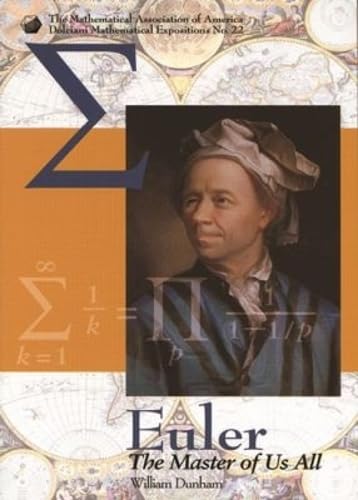
desertcart.com: Euler: The Master of Us All (Dolciani Mathematical Expositions): 9780883853283: William Dunham: Books Review: A superb book about Master Euler! - How can one tell the story of a giant like Leonard Euler? ''The greatest resource of him is his collected works, the 'Opera Omnia'. Their publication begun in 1911, has consumed the remainder of the twentieth century. Only six dozen volumes have appeared until 1999, but his output has not yet run dry.'' ''Euler contributed to long-established branches of mathematics like number theory, analysis, algebra and geometry. He also ventured into the largely unexplored territory of analytic number theory, graph theory, and differential geometry. In addition, he was his century's foremost applied mathematician, as his work in mechanics, optics, and acoustics amply demonstrates.'' Let's ask the question again: How can one write a book about Euler, which will attract the interest of even non-mathematicians and at the same time will clearly show the greatness of him and rise the readers' utmost admiration, which he definitely deserves? Well, Mr. Dunham has achieved this in a masterful way. He has searched among Euler's works and selected only three dozen of Euler's original proofs drawn from thirteen different volumes of the 'Opera Omnia' to discuss them with the reader, scattered in eight chapters of his book: Euler and-Number Theory, Logarithms, Infinite Series, Analytical Number Theory, Complex Variables, Algebra, Geometry, Combinatorics. The book starts with a small but very informative biography of Euler and ends with an Appendix about volume names and subjects of 'Opera Omnia'. Mr. Dunham proves again that he is a master in expository writing of mathematics in historical context. His style is very casual, friendly, clear, with awareness of what the reader will need more and when in order to grasp the subject better. As can be seen from the selected chapters, he has chosen subjects which will appeal most to the interest of a wide group of potential readers. At the beginning of each chapter, he gives a brief history of that subject and then he allows Euler to enter the scene and tells his contribution, and he ends the chapter with an epilogue where he discusses and concludes all that chapter. This makes the reader to clearly understand the place of each mathematical development in time and who have contributed to it. I could not leave the book once I started and it took a few days only to finish it. I am a retired electronics engineer spending my time in studying the development of scientific thoughts in historical context and preparing seminar lectures for some distinguished high school students in physics and mathematics. The content of this book fit so well into my study. The information I met here is not available in any curriculum, which are mostly so dull. The way Mr. Dunham explains it is so inspirational in all ways. On top of everything he has a special sense of humor, which makes you smile from time to time. I loved the paragraph where he makes an analogy for 'inspiration' while he discusses the proof of 'Euler Line' . He asks 'How did Euler know to construct that special triangle in his proof of Heron's formula?' He continues, 'Ultimately, the answer to this question lies in the mysterious realm of the human imagination. One might just as well ask of Shakespeare why he put the balcony scene in 'Romeo Juliet'. This is so wonderful. I wish I could be one of his students but in my age now:) I highly recommend this superb book to everyone who has a moderate college level of mathematics and is interested in the development of science and math in historical context. Especially the parents in this category might find it very useful to help and inspire their children in loving math, if they need it. Review: Dunham at his best, this is book is a must have - Dunham is the master of writing historical math texts. His passion clearly comes through in the writing. I am a perpetual student, and I find the historical texts helpful in many ways. Probably the biggest contribution is that they put math in a historical context, and it really does help understand the theorems. Textbooks do provide some context, but never really link how various problems and solutions led to other major discoveries. The format of the book is perfect. Dunham chose theorems which were his personal favorite. ( consider the challenge of choosing from Euler's body of work ). Part of it is biographical, well a small part. But it is all biographical, since the theorems themselves define Euler and his remarkable contribution to math. Duhnam does a great job of telling Euler's story with his theorems. Each chapter is structed where it explains the context of Eulers work by first providing a historical record of the problem. And the solutions at the time, or lack of. Then Eulers efforts and theorem are documented, and of course a discussion of future devleopments by others. This is not exactly a popular math book, because to enjoy the text you should really be a math person since Dunham's treatment does work through the math.
| Best Sellers Rank | #1,721,845 in Books ( See Top 100 in Books ) #657 in Mathematics History #2,074 in Scientist Biographies #6,227 in History (Books) |
| Customer Reviews | 4.5 4.5 out of 5 stars (74) |
| Dimensions | 6.25 x 0.5 x 9.25 inches |
| ISBN-10 | 0883853280 |
| ISBN-13 | 978-0883853283 |
| Item Weight | 10.4 ounces |
| Language | English |
| Print length | 208 pages |
| Publication date | March 4, 1999 |
| Publisher | American Mathematical Society |
S**L
A superb book about Master Euler!
How can one tell the story of a giant like Leonard Euler? ''The greatest resource of him is his collected works, the 'Opera Omnia'. Their publication begun in 1911, has consumed the remainder of the twentieth century. Only six dozen volumes have appeared until 1999, but his output has not yet run dry.'' ''Euler contributed to long-established branches of mathematics like number theory, analysis, algebra and geometry. He also ventured into the largely unexplored territory of analytic number theory, graph theory, and differential geometry. In addition, he was his century's foremost applied mathematician, as his work in mechanics, optics, and acoustics amply demonstrates.'' Let's ask the question again: How can one write a book about Euler, which will attract the interest of even non-mathematicians and at the same time will clearly show the greatness of him and rise the readers' utmost admiration, which he definitely deserves? Well, Mr. Dunham has achieved this in a masterful way. He has searched among Euler's works and selected only three dozen of Euler's original proofs drawn from thirteen different volumes of the 'Opera Omnia' to discuss them with the reader, scattered in eight chapters of his book: Euler and-Number Theory, Logarithms, Infinite Series, Analytical Number Theory, Complex Variables, Algebra, Geometry, Combinatorics. The book starts with a small but very informative biography of Euler and ends with an Appendix about volume names and subjects of 'Opera Omnia'. Mr. Dunham proves again that he is a master in expository writing of mathematics in historical context. His style is very casual, friendly, clear, with awareness of what the reader will need more and when in order to grasp the subject better. As can be seen from the selected chapters, he has chosen subjects which will appeal most to the interest of a wide group of potential readers. At the beginning of each chapter, he gives a brief history of that subject and then he allows Euler to enter the scene and tells his contribution, and he ends the chapter with an epilogue where he discusses and concludes all that chapter. This makes the reader to clearly understand the place of each mathematical development in time and who have contributed to it. I could not leave the book once I started and it took a few days only to finish it. I am a retired electronics engineer spending my time in studying the development of scientific thoughts in historical context and preparing seminar lectures for some distinguished high school students in physics and mathematics. The content of this book fit so well into my study. The information I met here is not available in any curriculum, which are mostly so dull. The way Mr. Dunham explains it is so inspirational in all ways. On top of everything he has a special sense of humor, which makes you smile from time to time. I loved the paragraph where he makes an analogy for 'inspiration' while he discusses the proof of 'Euler Line' . He asks 'How did Euler know to construct that special triangle in his proof of Heron's formula?' He continues, 'Ultimately, the answer to this question lies in the mysterious realm of the human imagination. One might just as well ask of Shakespeare why he put the balcony scene in 'Romeo Juliet'. This is so wonderful. I wish I could be one of his students but in my age now:) I highly recommend this superb book to everyone who has a moderate college level of mathematics and is interested in the development of science and math in historical context. Especially the parents in this category might find it very useful to help and inspire their children in loving math, if they need it.
M**C
Dunham at his best, this is book is a must have
Dunham is the master of writing historical math texts. His passion clearly comes through in the writing. I am a perpetual student, and I find the historical texts helpful in many ways. Probably the biggest contribution is that they put math in a historical context, and it really does help understand the theorems. Textbooks do provide some context, but never really link how various problems and solutions led to other major discoveries. The format of the book is perfect. Dunham chose theorems which were his personal favorite. ( consider the challenge of choosing from Euler's body of work ). Part of it is biographical, well a small part. But it is all biographical, since the theorems themselves define Euler and his remarkable contribution to math. Duhnam does a great job of telling Euler's story with his theorems. Each chapter is structed where it explains the context of Eulers work by first providing a historical record of the problem. And the solutions at the time, or lack of. Then Eulers efforts and theorem are documented, and of course a discussion of future devleopments by others. This is not exactly a popular math book, because to enjoy the text you should really be a math person since Dunham's treatment does work through the math.
D**1
Bought new but got used.
Bought this book as new but received in “used” condition. Smaller than I expected and too expensive. Looks like I got ripped off.
C**V
Another example of Dunham's brilliant work
William Dunham has become one of my favourites "mathematics expository" writers. In his book "The Calculus Gallery" he explained the history of Calculus, sampling from the masterworks of the best mathematicians that have contributed to this subject. In "Euler, The Master of Us All", he dedicates his masterful writing to one of the most prolific, exciting and greatest mathematician of all times: Leonhard Euler. With Dunham's beautiful clarity and engaging prose, you can follow with amazement Euler's strokes of genius in several fields of Mathematics: Number Theory, logarithms, infinite series, analytic number theory, complex variables, algebra, geometry/topology and combinatorics. I can't hightlight one section more than the others. All of them are simply superb. This book is one of the best books on mathematics I've ever read. (By the way, another one of my very favourites, is John Derbyshire's "Prime Obsession") As Laplace said, "Read Euler, read Euler. He is the master of us all". He was right, and Dunham's book proves it. And just a last word: The Dolciani Mathematical Editions are one of the most fine editions I've found. The quality of printing and the presentation of the book are superb.
T**N
This is a fairly slim book for the cost, but the content justifies this. Unlike some of Dunham's other books, this is really intended for an undergraduate rather than a school or A-level student, though I would recommend it to someone at college who is expecting to do a maths degree. Euler's works are not readily available and this book is one rare chance to see some fully worked proofs of Euler's. Luckily for me my university has Euler's "Opera Omnia" in its library, but even for us privaleged Euler fans, the great tomes are in all sorts of languages, (Latin, German, French &c). Take this opportunity and experience some well selected theorems with proofs belonging to Euler presented by Dunham in English and with informal commentary. I have worked through one or two of the proofs in "Euler, The Master Of Us All" in detail, ensuring that I followed every step, and the rewards are massive. I was so enthusiastic about one of the proofs that I tried to learn it off by heart, (and I think I succeeded short term, but I suspect I would need to revise it now). I am a pure mathematics enthusiast, (though I won't go into my philosophical uncertainties about today's frontiers), and this is what might be called elegant pure maths before all the big fish were caught, (Euler was himself a master fisherman, and could probably fish with a rod in both hands and undoubtedly knew every kind of knot).
D**I
You will need a very strong background in mathematics in order to appreciate the book fully. The math is often sophisticated and the author does not always completly explain the outcomes. Despite this, the book is very well written and the sidebars about the various mathematicians, principally Euler, are fascinating. One really is left with an awe and amazement and an appreciation of Euler's genius.
A**R
Awesome for beginners only. Paper quality is too good and have very nice print.
A**R
This is a masterpiece for any person who enjoys math and has a college level in calculus and integrals.
D**R
As a recent reader I feel the need to confirm what many others have said. This is an exhilarating, path - breaking introduction to mathematics as a craft. Euler's genius is vividly demonstrated with a variety of examples showing his astonishing ability to think inductively, see patterns and relationships in simple numerical examples and then draw on his tool box to convince himself that his guesses were right. His use of power series is spectacular and in a different plane from the mechanistic way I was taught maths - admittedly 60 years ago! I could not put this book down and spent two happy days refreshing my mathematical skills. A perfect lock down treat for an A level student with a good grounding in algebra, logarithms, trigonometry, power series and geometry, who wants a real insight into how mathematics was invented by a genius P
Trustpilot
Hace 4 días
Hace 2 semanas